 Shop My Favorite Non-Toxic Gifts Of 2026!
SKL is reader supported. When you buy through links on our site, we may earn affiliate commission. Learn more here.
Walk down any cleaning aisle, and you’ll find shelf after shelf of “green,” “eco-friendly,” and “free & clear” labels, all competing for your attention, none of them particularly easy to decode.
The frustration is legitimate. Laundry detergent should be simple. It isn’t.
Most mainstream formulas, even those marketed as gentle or natural, contain ingredients worth scrutinizing: phthalates hidden under the umbrella term “fragrance,” optical brighteners that coat fabric with synthetic chemicals designed to trick the eye, and 1,4-dioxane.
This probable carcinogen shows up as a manufacturing byproduct and doesn’t have to be disclosed on any label.
SKL Top Picks, At A Glance…
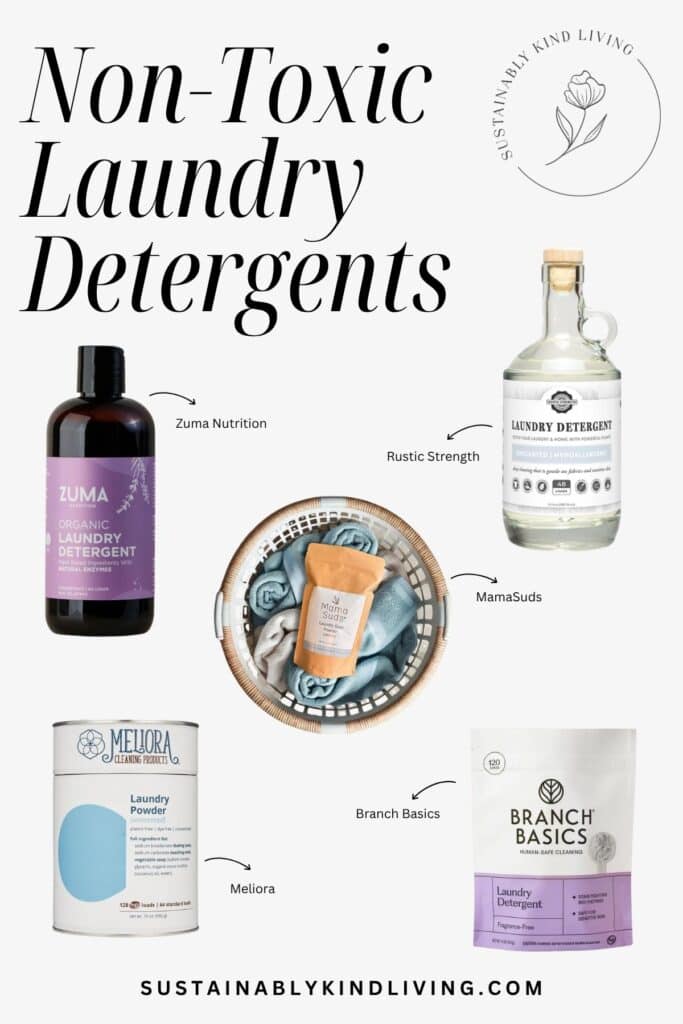
- My Top Pick For Non-Toxic Laundry Detergent: MamaSuds
- Best Plastic-Free Laundry Detergent Powder: Meliora
- Best Ultra-Concentrated Non-Toxic Laundry Detergent: Branch Basics
- Best Refillable Liquid Laundry Detergent: Rustic Strength
- Best Botanical Laundry Detergent: Zuma Nutrition
The “eco-friendly” label doesn’t close the loophole. Many of those formulas still rely on synthetic surfactants or preservatives that don’t hold up to much scrutiny.
The bigger issue is residue. Detergent doesn’t fully rinse out. What stays behind sits against your skin through sheets, towels, and clothing, all day and through the night.
For children, whose skin absorbs more readily than adults, that constant low-level contact is worth taking seriously.
It’s the same reason that what goes into a kid’s mattress or a pair of organic cotton pajamas matters as much as what goes in the wash.
Over the past year, I tested more than 30 detergents across every format: powders, liquids, sheets, and pods. The criteria weren’t complicated.
Does the ingredient list pass inspection? Does it actually clean? I ran them through cloth diapers, school uniforms, and linen, because anything that can’t handle real use isn’t worth recommending.
Best Non-Toxic Laundry Detergents: At a Glance Comparison
(Mobile Users) Scroll to see full comparison →
| Brand | Why it Stands Out | Best For | Price & Value | Format |
|---|---|---|---|---|
| MamaSuds | One of the purest castile soap formulas I tested, with fully transparent ingredients | Babies, cloth diapers & sensitive skin | $12-25 (Up To 128 Loads) | Liquid + Powder |
| Meliora | MADE SAFE® certified powder with refillable steel canisters and compostable refills | Plastic-free homes & low-tox living | $20.99 (128 HE Loads | 64 Standard Loads) | Powder |
| Branch Basics | Ultra-Concentrated Fragrance-Free Formula With Exceptional Ingredient Transparency | Families Wanting A Simple Low-Tox Laundry Routine | $39 (120 Loads) | Powder |
| Rustic Strength | Small-batch refill model with ultra-simple fragrance-free ingredients | Families want affordable refillable detergent | $35-$238 (12-1280 Loads) | Liquid |
| Zuma Nutrition | Organic botanical blend made with soap nuts, coconut oil, and herbal extracts | Readers wanting the most natural ingredient profile | $35.95 (64 Loads) | Liquid |
Why Choosing a Truly Non-Toxic Laundry Detergent Matters
Laundry feels like a non-issue. Soap, water, clothes. What’s there to worry about?
Quite a bit, it turns out. Most mainstream detergents leave residue on fabric that doesn’t wash out between cycles.
That residue sits against skin continuously, gets inhaled as clothing and bedding off-gas, and eventually ends up in waterways, where many of these compounds don’t break down cleanly.
The cumulative picture matters more than any single exposure. Skin absorption, indoor air quality, aquatic ecosystems: detergent touches all three, every time you run a load.
Which is why it’s also one of the more straightforward swaps to make. The alternatives exist, they work, and the rest of this guide covers exactly what to look for in them.
The Toxic Chemicals Hiding In Popular Laundry Detergents
Tide, Gain, Persil, and plenty of brands with “eco” in their name share a common problem: the ingredient list doesn’t tell the full story.
What’s marketed as detergent is often a mix of petroleum byproducts, endocrine disruptors, and manufacturing contaminants that never have to appear on the label.
Here’s what’s worth knowing about the most common offenders.
Synthetic Fragrance & Phthalates
“Fresh linen” scent typically means a blend of undisclosed chemicals, many of them phthalates. These are hormone disruptors with links to allergies, asthma, and reproductive harm.
The word “fragrance” on a label is a legal catch-all that can cover hundreds of individual compounds.
The same issue runs through non-toxic perfumes and air fresheners, where fragrance functions more as a mask than an ingredient.
1,4-Dioxane
A probable carcinogen that doesn’t appear on ingredient labels because it’s a manufacturing byproduct rather than an intentional additive.
New York banned it at trace levels for this reason. It’s one of the most consistent red flags in sudsy formulas, as covered in the non-toxic cleaning products guide.
Optical Brighteners
These don’t remove dirt. They coat fabric with UV-reflective chemicals that make whites look cleaner than they are.
They also don’t rinse out; they just accumulate with repeated washing, and for people with sensitive skin or eczema, that buildup is a real irritant.
Phosphates
Effective at softening water and lifting grime, which is why they’re still used.
The downstream problem is literal: phosphates in waterways fuel algal blooms that deplete oxygen and kill aquatic life.
The same issue applies to non-toxic dishwasher tablets, where phosphate content varies widely by brand.
Quats (Quaternary Ammonium Compounds)
The “antibacterial” claim is real, but the tradeoffs are significant.
Quats are a known asthma trigger, they contribute to antibiotic resistance, and they persist on fabric after the wash cycle ends.
They also turn up in products where you wouldn’t expect them, including some non-toxic floor cleaners marketed as gentle.
SLS and SLES
Sodium lauryl sulfate and its ethoxylated cousin SLES produce the lather most people associate with cleaning power.
They also strip skin’s natural oils and, in the case of SLES, frequently carry 1,4-dioxane contamination from manufacturing.
The same problem applies to non-toxic shampoos, where SLS is one of the first ingredients to look past.
Chlorine Bleach
A cheap and effective whitener that’s also corrosive, a lung irritant, and capable of producing toxic fumes when it contacts other common cleaning chemicals.
For whitening without the downsides, the DIY non-toxic cleaning guide covers practical alternatives, including oxygen-based bleach, washing soda, and vinegar.
Petroleum Distillates
Common in stain removers and heavy-duty formulas. Short-term exposure causes headaches and dizziness; longer-term exposure has been associated with neurological effects.
The same reasoning behind avoiding petroleum-based finishes in non-toxic furniture applies here.
For a broader look at where these chemicals show up across the home, the beginner’s guide to non-toxic living is a good place to start.
The Best Non-Toxic Laundry Detergent Brands In 2026
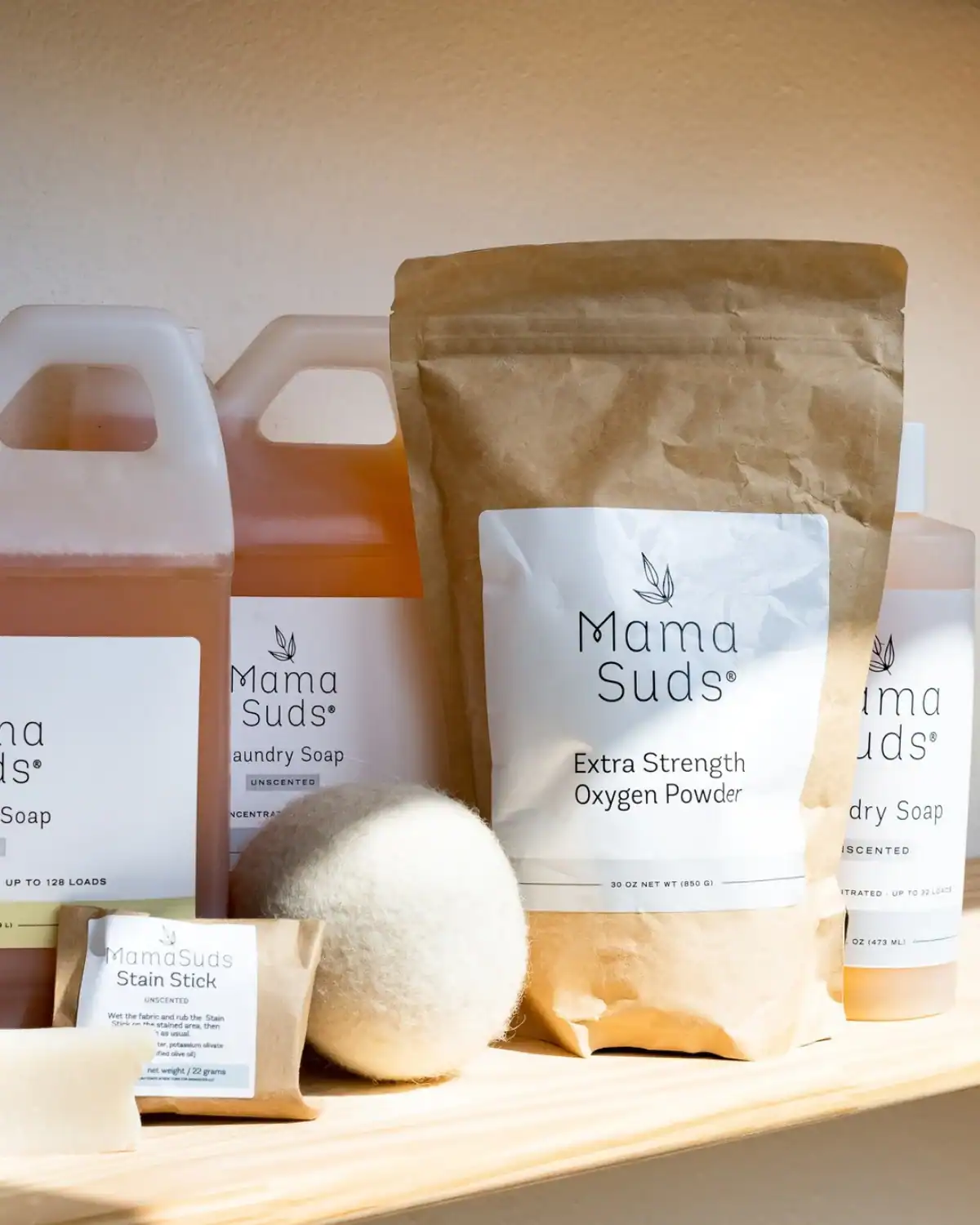
1. MamaSuds — Best Overall Non-Toxic Laundry Detergent For Sensitive Skin & Cloth Diapers
My Rating: ⭐️⭐️⭐️⭐️⭐️ (5.0 — as pure as it gets, trusted for babies & cloth diapers)
Use the discount code SKL15 to save 15%!
I first tested MamaSuds years ago when I was desperate for something safe enough for cloth diapers, and it delivered. No mystery “fragrance,” no unnecessary fillers.
In my own laundry, it’s handled sweat, food stains, and even messy toddler blowouts with ease.
I’ve used it on everything from our softest sheets to delicate dresses, and it’s never caused fading or irritation.
For really tough stains (like set-in oil or grass), I’ll add their extra strength oxygen powder!
What I love most is the peace of mind: when I scoop MamaSuds into my washer, I know exactly what’s going on my kids’ skin. That’s worth everything.
Price & Loads
$12-25 (Laundry Soap) | $25 (Laundry Powder) | Up To 128 Loads
ingredients (Liquid)
Water | Olive Oil Soap | Washing Soda | Borax | Essential Oils (Unscented Option Available)
Ingredients (Powder)
Washing Soda | Sodium Percarbonate | Olive Oil Soap | Essential Oil (Unscented Option Available)
location/shipping
United States | Ships Internationally
What I Love
- Truly transparent ingredient list with no mystery fragrance blends
- Safe for sensitive skin, baby clothes + cloth diapers
- Septic-safe, biodegradable + HE machine friendly
- Extremely concentrated, so one jug lasts a long time
- Available in unscented, lemon, or lavender options
- Small-batch formula made with simple mineral + olive oil-based ingredients
What I Don’t Love
- May need an oxygen booster for heavy stains or workout clothes
- Soap-based formulas can struggle in very hard water without adjustments
- Not the strongest option for deep grease/oil stains on its own
- Contains borax, which some low-tox households prefer to avoid
2. Meliora — Best Plastic-Free Laundry Detergent With MADE SAFE® Certification
My Rating: ⭐️⭐️⭐️⭐️⭐️ (4.9 — MADE SAFE® certified + plastic-free, slightly less strong on set-in stains)
Use the discount code SKL10 to save 10%!
Meliora is one of those brands that makes me feel good before I even pour it into the washer.
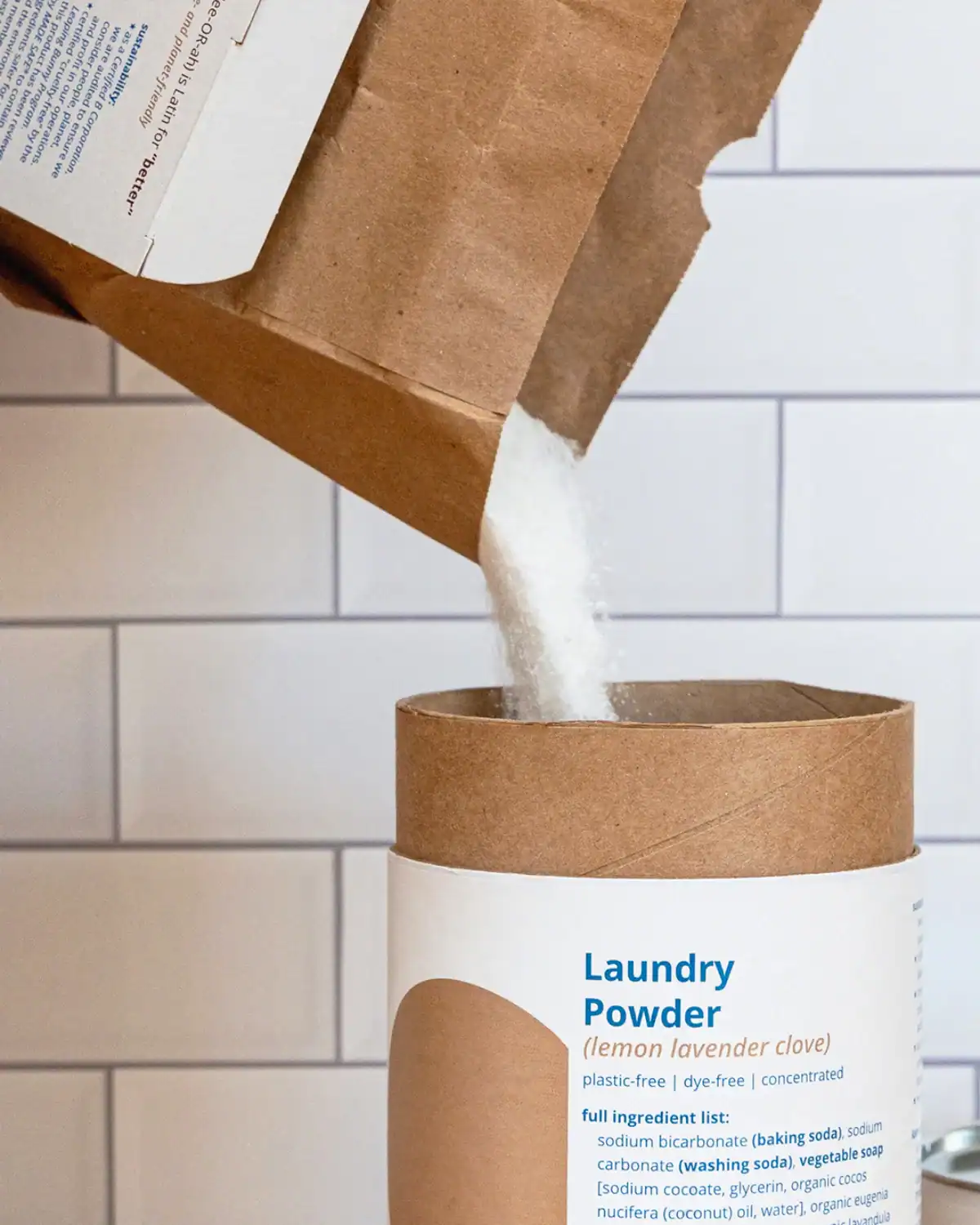
It’s MADE SAFE® certified, Leaping Bunny certified, and comes in a refillable steel canister with compostable refills.
I tested Meliora on my husband’s workout gear, my kids’ school clothes, and even a pile of kitchen towels that usually hang onto food smells. Everything came out clean, soft, and scent-free (in a good way).
It dissolves best in warm or hot water, but when I gave it an extra shake, it worked fine in cold cycles too.
Reviewers love it for the same reasons: purity, consistency, and the bonus of zero plastic waste.
Some mention they wish it were stronger on deeply set stains, but honestly, no powder without enzymes is a miracle worker.
Price & Loads
$20.99 | 128 HE (64 Standard) Loads
ingredients
Baking Soda | Washing Soda | Coconut Oil Soap | Essential Oils (Unscented Option Available)
Location/Shipping
United States
What I love
- MADE SAFE® certified ingredients
- Plastic-free canister + refill system
- Fully transparent ingredient disclosure
- Fragrance-free options available
- Ultra-concentrated, so a little goes a long way
- Essential oil-scented options without synthetic fragrance
- Made in the USA with reusable packaging
What I don’t love
- Powder may not dissolve well in very cold water
- Can require pre-dissolving for cold wash cycles
- Not the strongest option for extremely dirty/work clothes
- Powder detergents can take a little trial and error with HE machines
3. Branch Basics — Best Ultra-Concentrated Non-Toxic Laundry Detergent For Fragrance-Free Cleaning
My Rating: ⭐️⭐️⭐️⭐️⭐️ (4.9 — exceptional transparency, ultra-concentrated, and one of the cleanest mainstream formulas available)
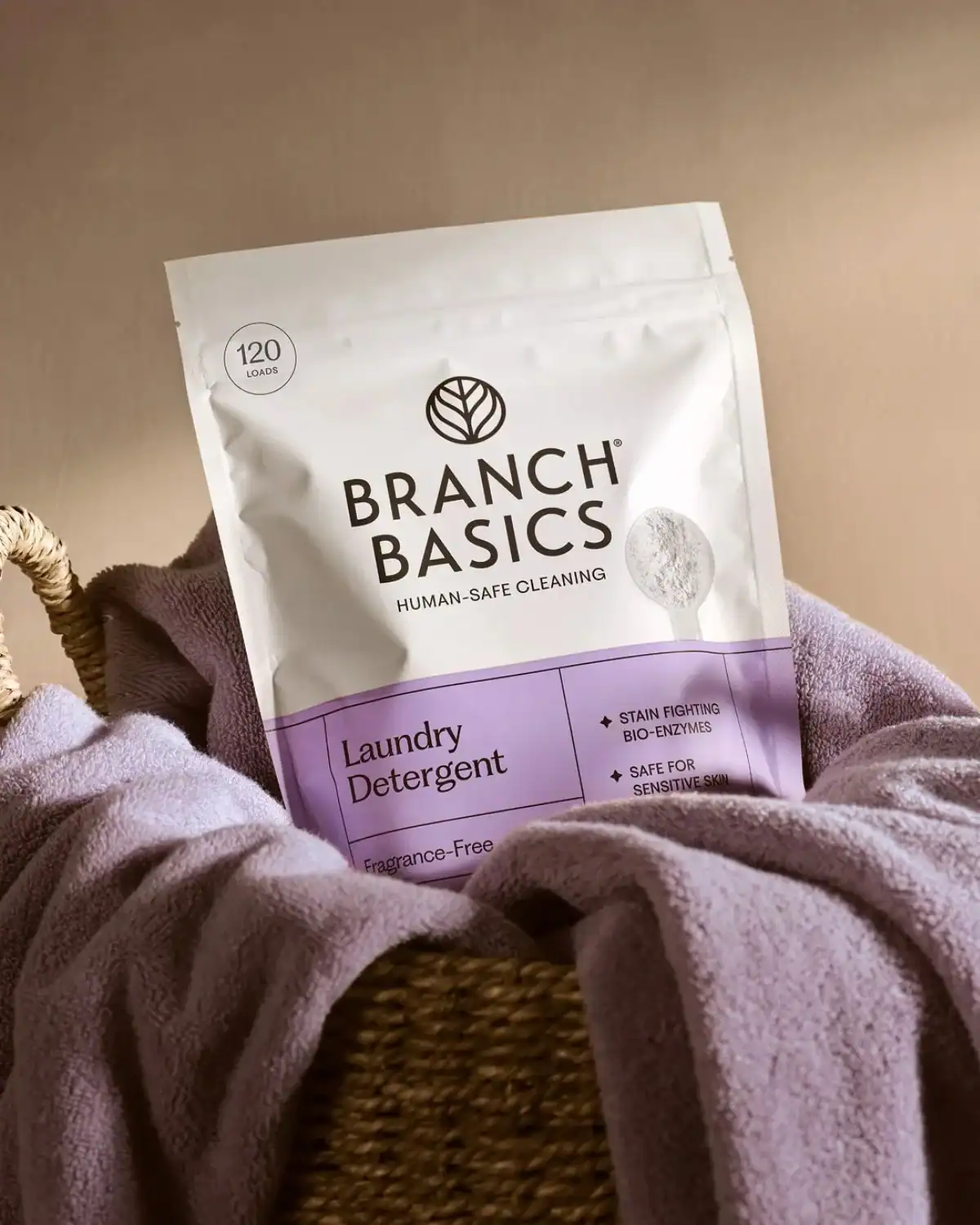
Use the discount code SKL to save 15%!
Branch Basics is one of the brands I consistently recommend to families wanting a simpler, lower-toxic laundry routine without synthetic fragrance or unnecessary fillers.
What immediately stood out to me was how transparent the formula is compared to most “natural” detergents on the market.
It skips many of the ingredients I actively avoid in conventional detergents, including optical brighteners, phosphates, dyes, bleach, ammonia, sulfates, ethoxylates, and 1,4-dioxane.
I tested it on sweaty workout clothes, towels, sheets, and muddy kids’ uniforms, and it handled everyday laundry surprisingly well for such a minimal formula.
The powder dissolves easily, works in both HE and standard machines, and the concentrated formula lasts much longer than you’d expect.
Price & Loads
$39 (120 Loads)
ingredients
Sodium Carbonate | Sodium Percarbonate | Sodium Gluconate | Sodium Lauryl Sulfoacetate | Sodium Metasilicate | TAED | Decyl Glucoside | Poly Sodium Salt | Protease | Amylase
Location/Shipping
United States | Ships To Canada
What I love
- Fragrance-free and designed for sensitive skin
- No 1,4-dioxane, phosphates, optical brighteners, dyes, bleach, or ammonia
- Highly concentrated formula with excellent value per load
- Works in standard + HE washing machines
- Strong cleaning performance without synthetic fragrance
- Septic-safe and biodegradable formula
What I don’t love
- Contains enzymes, which some highly sensitive households prefer to avoid
- Packaging is not plastic-free
- Powder format may require experimentation in very cold water
- More expensive upfront than conventional detergent brands
4. Rustic Strength — Best Refillable Liquid Laundry Detergent For Everyday Family Use
My Rating: ⭐️⭐️⭐️⭐️⭐️ (4.9 — refill model + simple formula, but fewer scent options)

Use this link to get 20% off!
I got a bulk refill pouch of the Rustic Strength unscented laundry soap and poured it into a simple glass jar. Suddenly, my laundry room looked cleaner, and my conscience did too.
The formula itself is refreshingly simple: just coconut-based surfactants, water, and a touch of natural salt. No dyes, no fragrances, no enzymes that can irritate sensitive skin.
I’ve washed everything in it, sweaty workout gear, my twins’ school uniforms, and even our delicate linen sheets, and it came out fresh without that chemical detergent smell.
What stood out most was how little I had to use. One small scoop powered through a full load, and the refill bag lasted me months.
Readers love the transparency and the fact that every product is made in small batches in Missouri, not mass-produced overseas.
Rustic Strength isn’t as widely known as some big eco-brands, but I’d argue that’s part of its charm. You can feel the care in every bag, and the refill model really does cut down on plastic waste.
Price & Loads
$35 (12-24 Loads) | $42 (128-256 Loads) | $238 (640-1280 Loads)
ingredients
Water | Plant-Based Surfactants | Coconut-Derived Cleansers | Mineral-Based Water Softeners | Vegetable Glycerin | Plant-Based Degreasers | Preservatives
Location/Shipping
United States | Ships Internationally Upon Request
What I love
- Extremely transparent, low-tox ingredient standards
- Unscented and safe for sensitive skin + babies
- Concentrated formula lasts a long time
- Works well on odors and everyday stains
- Biodegradable, septic-safe + HE compatible
- Small-batch made in the USA
What I don’t love
- More expensive than conventional detergents
- Heavy-duty stains may need a booster product
- Glass packaging can feel less practical for some households
- Limited scent variety if you enjoy stronger fragrance options
5. Zuma Nutrition — Best Botanical Laundry Detergent With Organic Ingredients
My Rating: ⭐️⭐️⭐️⭐️⭐️ (5.0 — botanical + organic, concentrated but pricier upfront)
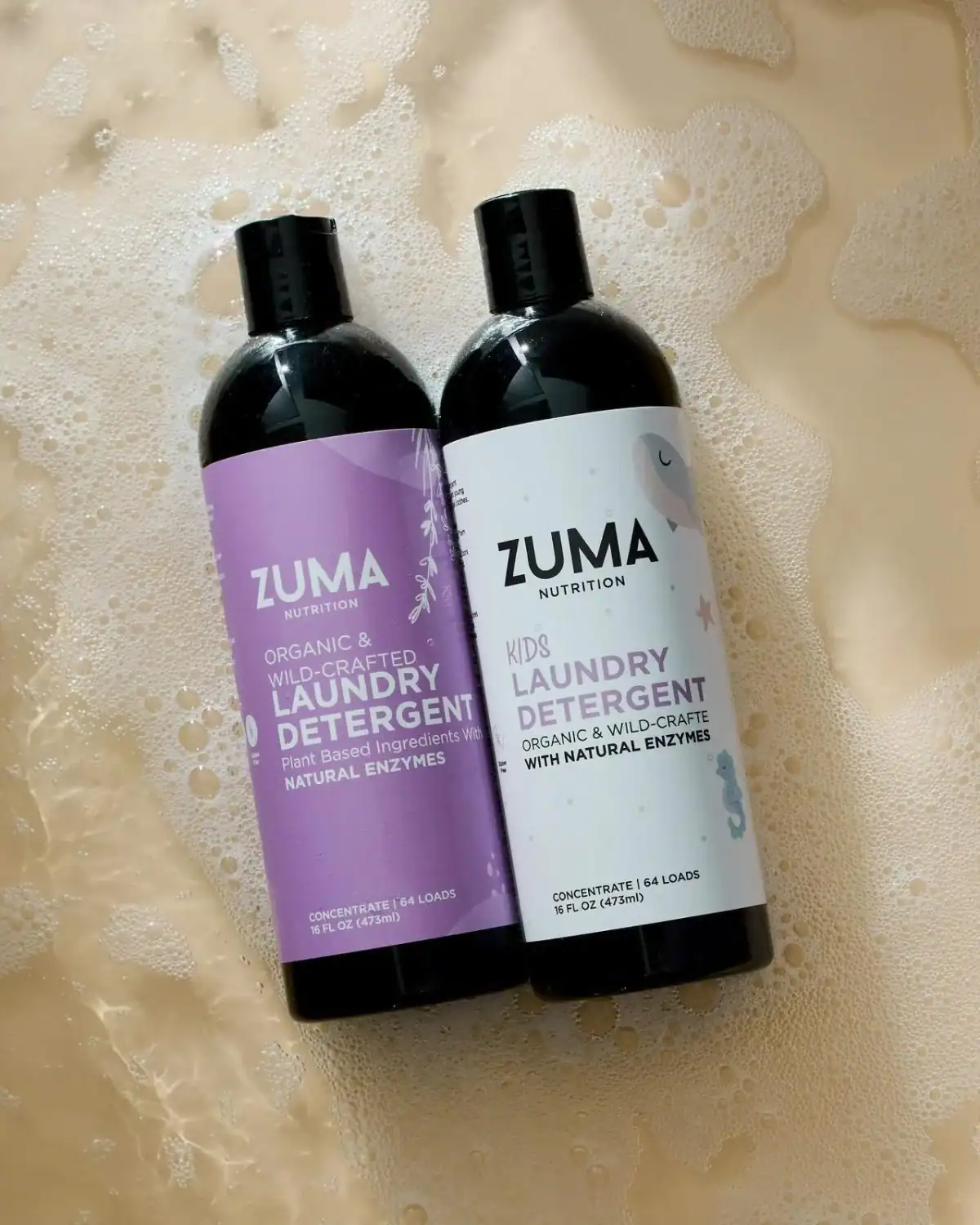
Use the discount code SKL to save 15%!
Zuma Nutrition isn’t your average laundry soap; it’s more like a wellness product that just happens to clean clothes.
I first tried it after learning that their formula includes soap nuts, coconut oil, and herbal extracts, ingredients I already trusted for my skin.
What surprised me was how well it worked: my toddler’s food-stained shirts came out fresh and soft without the “crunch” you sometimes get from natural powders.
I found myself constantly reaching for this bottle of detergent, especially for sheets and pajamas that stay closest to our skin.
Reviews echo my experience: families with sensitive skin rave about the lack of irritation, while eco-conscious shoppers love the glass packaging and short, organic ingredient list.
A few notes: it’s pricier than grocery-store detergents, but the formula is concentrated; a little goes a long way.
Price & Loads
$35.95 (64 Loads)
ingredients
Artesian Spring Water | Soap Nuts | Herbal Extracts | Coconut Charcoal | Zeolite Clay | Essential Oils
Location/Shipping
United States | Select International Shipping
What I love
- Truly organic and wild-crafted ingredients
- Soap nut–based formula with no harsh chemicals
- Gentle enough for sensitive skin + baby clothes
- Leaves fabrics soft without synthetic fragrance
- Biodegradable and eco-friendly formula
- Lab-tested with transparent ingredient sourcing
What I don’t love
- Much pricier than most non-toxic detergents
- Strong “wellness” marketing may feel over-the-top for some shoppers
- Limited independent certifications compared to competitors
- Essential oil scent may not work for highly sensitive households
Are Laundry Sheets, Pods, Liquids, or Powders Really Non-Toxic?
Format matters as much as brand. Here’s how they stack up:
Powder is typically the most straightforward. A simple formula needs nothing more than soap, washing soda, and baking soda, which means no preservatives, no stabilizers, and fewer places for problematic ingredients to hide.
Liquid is convenient and can be done well, but water-based formulas require preservatives to stay stable on the shelf. That’s not automatically a problem, but it narrows the field. Look for third-party certification like EWG VERIFIED™ or EcoCert, and treat synthetic fragrance as a dealbreaker regardless of what else the label says.
Pods are where it gets complicated. Most use a polyvinyl alcohol film that dissolves in the wash, which sounds clean until you follow where it goes. PVA is a plastic, and research increasingly suggests it doesn’t biodegrade as fully as manufacturers claim, contributing to microplastic load in wastewater.
Sheets have the same problem. The minimal-waste format is genuinely appealing, but most eco laundry sheets rely on PVA (polyvinyl alcohol), a plastic-based film that remains controversial from both an environmental and formulation standpoint. After testing dozens of detergents, I still generally prefer powders and highly transparent concentrates over sheet formats altogether.
If you’re optimizing for the cleanest possible formula, powder is the safest starting point. Certified liquids are a reasonable second. With pods and sheets, the burden of proof is on the brand.
How I Evaluated These Detergents
This wasn’t a weekend project. I spent the better part of a year working through more than 30 detergents before narrowing to five, and the criteria were consistent throughout.
Ingredient Transparency
Every formula had to come with a complete, publicly available ingredient list. Synthetic fragrance, optical brighteners, and petroleum-based surfactants were automatic disqualifiers.
Certifications like MADE SAFE® and EcoCert were useful signals, but not sufficient on their own. A certification without a readable ingredient list isn’t accountability.
Format & Formulation
I tested liquids, powders, sheets, and pods. Sheets and pods failed at a higher rate than expected, most often due to undisclosed PVA film or poor dissolution in cold water.
The same scrutiny I applied to ingredients in the non-toxic cookware and safe tea kettles guides applied here.
Cleaning Performance
A clean ingredient list means nothing if the detergent doesn’t clean. Every formula was tested repeatedly over months on cloth diapers, toddler clothes, gym kit, and organic cotton bedding.
One good wash isn’t enough. I needed to know how performance held up across seasons, water types, and washing temperatures.
Brand Responsiveness
I contacted each brand directly with specific questions: 1,4-dioxane testing protocols, fragrance sourcing, and PVA content in sheets. Several didn’t respond or gave non-answers. Those didn’t make the list.
The brands that did make it provided clear answers, shared data without being prompted, and didn’t treat ingredient questions as inconvenient.
Long-Term Track Record
My own testing was cross-referenced against verified long-term reviews on Amazon, brand sites, and sustainability forums to check whether performance and formula integrity held up over time.
A detergent that quietly reformulates or accumulates consistent complaints about skin reactions doesn’t belong on this list, regardless of how it performed in my kitchen.
The five brands that made the cut are covered above.
⚠️ Iffy Brands (Look Eco, But Don’t Fully Pass the Test)
Some detergents look “green” on the surface but don’t quite meet non-toxic standards once you dig into the ingredients.
Rebel Green
USDA Organic on paper, but ingredient lists still include preservatives that can irritate sensitive skin.
If fragrance is a dealbreaker for you, you may want to check out our guide to the fragrance loophole, where we call out the same hidden fragrance issues.
Puracy
Popular and marketed as “clean,” but it relies on synthetic surfactants and preservatives. It does the job, but isn’t fully non-toxic.
When I tested it against purer formulas like Meliora, the difference was clear.
It reminded me of what we saw in our non-toxic dish soap guide: plenty of brands market “plant-based” but sneak in harsher ingredients.
Dropps / Earth Breeze (Sheets & Pods)
These win points for convenience and zero-waste packaging, but they use PVA film (polyvinyl alcohol).
Research is still mixed on whether PVA truly breaks down safely in waterways, which is why I generally prefer powders and highly transparent concentrates instead.
We saw the same “eco on the outside, questionable on the inside” problem in our guide to the most toxic household items hiding in your home.
Toxic Laundry Detergent Brands To Avoid
These are the classic big-name detergents: Tide, Gain, Persil, Arm & Hammer, and they’re still some of the worst offenders for toxic chemicals.
Tide, Gain, Persil, Arm & Hammer
Fragrance, optical brighteners, and even carcinogenic 1,4-dioxane are all common here. Even the “Free & Gentle” versions don’t pass.
Seventh Generation & Mrs. Meyer’s
People are often surprised that these made my “avoid” list. Both lean heavily on undisclosed fragrance blends and harsher surfactants.
They’re better than Tide, but still not what I’d call non-toxic. For truly clean alternatives, start with our non-toxic cleaning products guide.
Hello Bello
Marketed as baby-friendly, but includes conventional surfactants and fragrance that can trigger irritation.
Parents deserve better, which is why I created a full guide to non-toxic school supplies for safer daily swaps.
Ecos, Cleancult, GO by Greenshield
These are some of the worst greenwashers. While marketed as sustainable, the formulas are basically conventional detergents with better branding.
It’s the same marketing trick we broke down in our article on greenwashing examples.
Smart Non-Toxic Laundry Hacks (That Actually Work)
Switching to a safe detergent is step one, but a few simple tricks can make it work even harder (without adding toxins back into the mix).
These are my go-to laundry hacks after testing 30+ non-toxic detergents.
1. Boost Tough Loads With Baking Soda
If your detergent struggles with smelly gym clothes or pet blankets, sprinkle ½ cup of baking soda directly in the drum.
It softens water, deodorizes, and gives your soap a natural boost. I use this trick weekly on my kids’ soccer uniforms.
2. Vinegar For Softer Towels
Skip fabric softener (it’s full of quats + fragrance). Instead, pour ½ cup of distilled white vinegar into the fabric softener compartment.
It keeps towels fluffy and helps rinse away detergent residue. Vinegar is one of those staples I also keep on hand for DIY non-toxic cleaning recipes.
3. Strip Dingy Towels Naturally
For musty towels, try “laundry stripping.” Fill your tub with hot water, add ¼ cup washing soda + ¼ cup borax + ½ cup baking soda, and soak towels for 4–6 hours before rinsing. The gunk that comes out is both gross and satisfying.
4. Wash Machine = Clean Clothes
Even the best detergent can’t save you from a moldy washer. Once a month, run a hot cycle with 2 cups of vinegar, then wipe down the rubber gasket with baking soda paste. It’s one of the easiest non-toxic cleaning habits I’ve kept up with.
5. Skip The Dryer Sheets
Conventional dryer sheets coat fabrics with synthetic fragrance and petroleum-based “softeners.” Instead, toss in wool dryer balls. They cut static, shorten dry time, and you can use the same set for hundreds of loads.
6. Pre-Treat Stains The Safe Way
Grass, oil, and berry stains don’t always budge on the first wash. My hack: dab with castile soap or a paste of baking soda + water before tossing in the washer. For set-in grease, I’ve had good luck with non-toxic dish soap.
Frequently Asked Questions About Non-Toxic Laundry Detergents
The safest laundry detergents use simple, transparent ingredients like castile soap, baking soda, and washing soda.
Brands like MamaSuds and Meliora avoid synthetic fragrances, optical brighteners, and harsh surfactants, making them safe for sensitive skin and babies.
Most laundry sheets use PVA (polyvinyl alcohol), which may not fully break down in water.
While some brands are better than others, powders and highly transparent concentrates are generally the safer option for low-tox households.
Pods often use PVA film and concentrated surfactants that aren’t fully non-toxic. Liquids can hide preservatives and synthetic fragrance. Powders and castile-based liquids are usually the cleanest choices.
Yes, but you may need simple boosters like vinegar, baking soda, or oxygen brighteners for set-in grease or grass stains. Non-toxic detergents clean daily laundry effectively while avoiding harsh chemicals.
Conventional detergents leave chemical residue on clothes that touches skin 24/7 and washes into waterways. Non-toxic, eco-friendly detergents protect your health and reduce pollution.
Not always. Many “free & clear” detergents still use optical brighteners, SLS, or undisclosed preservatives. Always check ingredient transparency and certifications like MADE SAFE® or EcoCert.
Yes. Even natural-sounding fragrances can contain allergens or phthalates. Fragrance-free formulas are best for sensitive skin, babies, or anyone with eczema.
Yes, as long as the detergent is free from fragrance, optical brighteners, and harsh surfactants. Brands like MamaSuds and Zuma Nutrition are gentle enough for baby clothes and cloth diapers.
Most non-toxic powders and liquids are biodegradable and septic-safe, since they avoid phosphates, bleach, and chlorine. Always avoid synthetic antibacterial detergents, which can disrupt septic systems.
Still Deciding?
- MamaSuds is the best choice for sensitive skin, babies, and cloth diapers.
- Meliora stands out for plastic-free packaging and MADE SAFE® certification.
- Branch Basics is ideal for families wanting a fragrance-free, ultra-concentrated detergent with excellent ingredient transparency.
- Rustic Strength is a great refillable liquid option with simple ingredients and strong everyday performance.
- Zuma Nutrition is perfect for readers looking for a more botanical, organic approach to laundry care.
Non-Toxic Laundry Detergent = Safer Clothes, Healthier Homes
Laundry is routine enough that it’s easy to overlook how much contact it actually involves. Sheets, towels, and the clothes your kids wear all day. Once you understand what’s in most detergents, that calculus shifts.
The swap doesn’t have to be complicated. Check your current formula against what you’ve read here, pick something that meets the standard, and run a load. That’s it.
The brands in this guide have been tested, questioned, and vetted over time. Any one of them is a meaningful upgrade over what’s on most supermarket shelves. What matters is making the change, not making the perfect one.
Continue Your Non-Toxic Laundry Journey
Once I started paying closer attention to what was actually hiding in conventional laundry products, I realized how many unnecessary fragrances, dyes, and chemical additives were ending up on the fabrics we wear every single day.
If you’re trying to create a lower-toxic home laundry routine overall, these guides may help next:
- DIY Non-Toxic Laundry Detergents: Simple homemade detergent recipes with lower-toxic ingredients and less fragrance exposure.
- DIY Non-Toxic Cleaning Recipes: Easy homemade cleaners using ingredients like vinegar, baking soda, and castile soap.
- Non-Toxic Dryer Sheets: Safer dryer sheet alternatives without synthetic fragrance or harsh chemical coatings.
- Natural Baby Laundry Detergents: Gentler detergents designed for baby clothes, sensitive skin, and cloth diapers.
- Non-Toxic Laundry Odor Removers: Lower-toxic odor removers for towels, workout clothes, pet smells, and stubborn laundry odors.
- Non-Toxic Cleaning Products: Safer cleaning brands made without harsh fumes, synthetic fragrance, or unnecessary toxic ingredients.
Because honestly, once you start researching safer laundry products, you begin realizing just how much daily chemical exposure can come from the things we wash, wear, and sleep on every day.
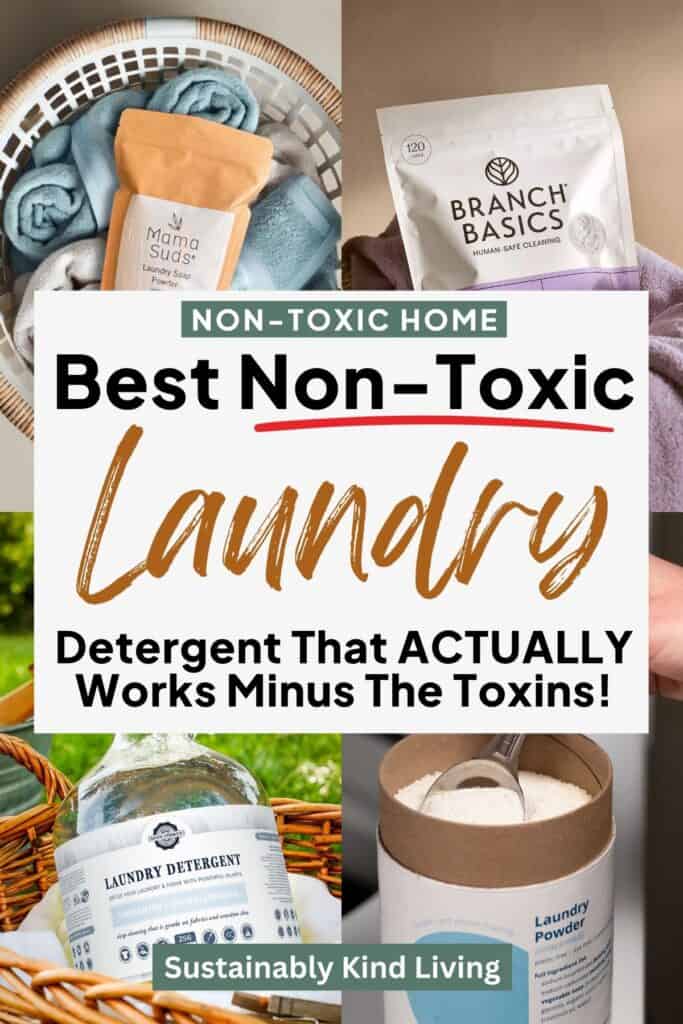
📌 Save This Guide For Later
Tried all the “clean” laundry detergents and still not sure which ones are actually worth buying?
This guide breaks down the best non-toxic laundry detergents, what ingredients to avoid, and which brands are safest for sensitive skin, babies, and everyday laundry.
Save this guide for your next restock!
Sources & Further Reading
If you’ve been trying to find a truly non-toxic laundry detergent, I highly recommend reading beyond the marketing claims on the bottle.
A lot of the research that shaped this guide came from digging into ingredient disclosure laws, environmental studies, and certification standards, not just brand websites.
Here are the sources and organizations I found most helpful while researching and testing these detergents:
Ingredient Safety & Chemical Exposure
- Environmental Protection Agency (EPA) — Explains safer cleaning ingredients, surfactants, and ingredient disclosure standards used in household cleaners.
- National Institute of Environmental Health Sciences (NIEHS) — Research and educational resources on endocrine-disrupting chemicals like phthalates, commonly hidden under “fragrance.”
- Centers for Disease Control and Prevention (CDC) — Overview of phthalate exposure risks, health concerns, and where these chemicals are commonly found.
- New York State Department of Environmental Conservation — Background on 1,4-dioxane contamination in detergents and why some states have started regulating it.
Certifications & Standards
- MADE SAFE® Certification — Details one of the strictest certification standards for non-toxic household and personal care products.
- EWG Verified® — Explains ingredient disclosure requirements and restricted substances in certified products.
- EcoCert — Certification standards focused on biodegradable and naturally derived cleaning ingredients.
- Leaping Bunny Certification — Cruelty-free certification program verifying brands do not test on animals.
Environmental & Waste Research
- National Geographic (Microplastics Explained) — Helpful overview of how plastics and synthetic materials impact waterways and ecosystems.
- Ocean Conservancy (Plastic Pollution & Wastewater) — Educational resource on household waste, wastewater pollution, and environmental contamination.
I also cross-referenced long-term customer reviews, sustainability forums, and certification databases while narrowing this list down to the five detergents that consistently passed my ingredient, transparency, and real-life performance tests.

Steal My Non-Toxic Cleaning Checklist!
Believe us, it’s the BEST…. and it’s free. Does it really get any better than that?! Sign up for our newsletter and get this free checklist to clean your home without any harmful chemicals!


Hi! Have you ever checked out Dirty Labs?
Hi Kelly!
Thanks so much for your comment. Yes, we’ve definitely looked into Dirty Labs — they’re doing some exciting things, especially with their bioenzymatic cleaning technology and their commitment to biodegradable, plant-based ingredients.
That said, we didn’t include them in our Safest Non-Toxic Laundry Detergents of 2025 list, and we like to be fully transparent about why. While they avoid many of the big offenders (like phosphates, optical brighteners, and formaldehyde), there are still a few things we’re cautious about — including the use of certain synthetic preservatives in past formulas, some limited fragrance transparency, and proprietary blends we can’t fully evaluate.
We also prioritize long-term performance and ingredient consistency, and since Dirty Labs is still relatively new, we’re giving it more time before making a full recommendation. That said, we’re definitely keeping them on our radar and love seeing brands push for innovation in this space.
Appreciate you being here and asking such a great question! Have you been using Dirty Labs? What have you thought about them thus far if so?
Thanks so much for being a part of this community 🙂
Danielle
Your article is so well done. So clear to understand. You have researched and answered so many questions…and your tips are so doable!. You’ve given us empowerment tools! May God continue to Bless you! Take good care and THANK YOU!! 🙂
Have you tried Bio Kleen Free and Clear laundry HE liquid?
And I do already use baking powder, hydrogen peroxide, and distilled white vinegar. Changed everything about my laundry!!
Take good care
Teresa
You are so kind, Teresa, thank you! I really do put so much time and effort into these guides and it means the world that you would take the time out of your day to leave such a nice message. Made my day.
We have tested Biokleen! It didn’t make our five picks because it contains C12-16 pareth-7, an ethoxylated surfactant. Ethoxylated ingredients can carry trace 1,4-dioxane, a probable carcinogen that forms as a manufacturing byproduct and never has to be listed on the label. That’s a hard no for our list.
And I love that you’ve already got your own routine going with baking soda, hydrogen peroxide, and distilled white vinegar! That’s such a great low-tox base. Thank you again, Teresa!