 Shop My Favorite Non-Toxic Gifts Of 2026!
SKL is reader supported. When you buy through links on our site, we may earn affiliate commission. Learn more here.
Finding the best non-toxic air fryer took far more digging than I expected.
I wanted something that could crisp potatoes, roast vegetables, and help get dinner on the table for our family of five. But I also wanted to know what the basket, trays, and cooking interior were actually made from.
That turned out to be the harder part.

A stainless steel exterior told me very little about the surfaces inside. Some brands advertised a ceramic coating without clearly explaining the materials underneath it. Others gave me plenty of cooking features but very little information about what would touch our food.
As the founder of Sustainably Kind Living and a mom of three, those are the details I look into before recommending an appliance.
Over the past several years, I’ve tested more than 20 air fryers in my own kitchen, reviewed manufacturer chemical disclosures, and contacted brands when their material descriptions left questions unanswered.
Five made this updated list.
If You’re In A Rush (my quick picks)
- The One I Use The Most: Wonder Oven Pro
- Best Glass Air Fryer: Fritaire
- Best Non-Toxic Basket-Style Air Fryer: Typhur
- Best Compact Non-Toxic Air Fryer Oven: Wonder Oven (Original)
- Best Traditional Toaster Oven Option: GE Digital Air Fryer
I’ve used these air fryers for foods we actually eat, including potatoes, vegetables, salmon, wings, and rotisserie chicken. Alongside the materials research, I paid attention to how evenly they cooked, how much food they could comfortably handle, and how easy they were to clean.
The Wonder Oven Pro is the one I reach for most often. My husband prefers Fritaire for rotisserie chicken, and the Typhur Dome 2 stood out for its wide basket and even browning.
They each have tradeoffs, including coated accessories, different capacities, and very different designs. Below, I’ll explain what earned each one its place and what I’d consider before buying it for your kitchen.
Best Non-Toxic Air Fryers: At A Glance Comparison
Mobile Users: Scroll to see full comparison →
| Air Fryer | Best For | Food Contact material | Cooking Capacity | Price |
|---|---|---|---|---|
| Our Place Wonder Oven Pro | Families replacing both a toaster oven and air fryer | Stainless steel interior, stainless steel basket & rack, PFAS-Free ceramic-coated bake pan | 28 L | $325 |
| Fritaire | Shoppers who prefer cooking in a glass bowl instead of a metal basket | Borosilicate glass bowl, stainless steel accessories | 5 qt | $199 |
| Typhur Dome 2 | Families wanting a wide basket for single-layer cooking | PFAS-free ceramic-coated aluminum basket and crisp plate | Fits a 12-inch pizza, 32 wings | $299 |
| Our Place Wonder Oven | Smaller households with limited counter space | Stainless steel interior, chromed steel basket & rack, PFAS-Free ceramic-coated bake pan | 12 L | $185 |
| GE Digital Air Fry 8-in-1 | Shoppers who prefer a traditional toaster oven with air frying | Stainless steel oven, steel air fry basket & rack, aluminum bake pan | Fits a 12-inch pizza, 6 slices of toast | $249 |
What I Look for in a Non-Toxic Air Fryer
After testing more than 20 air fryers, I’ve learned to look beyond the words “non-toxic” on the box.
My first question is simple: What touches the food?
Then I check the cooking interior, included accessories, and any coatings. A stainless steel exterior doesn’t tell me what the basket or bake pan is made from, and a glass cooking bowl doesn’t tell me what’s on the rack inside it.
For this guide, I prioritized three things:
- Clearly disclosed materials. I want separate information about the basket, rack, bake pan, and cooking cavity.
- Cooking surfaces made without PTFE. My preference is uncoated stainless steel or glass, although I also considered ceramic coatings that manufacturers identify as made without PFAS.
- Performance in my own kitchen. The materials matter, but so do evenly cooked food, useful capacity, and cleanup after dinner.
Those priorities explain why the five picks aren’t identical.
Fritaire offers glass-bowl cooking. Typhur uses a ceramic-coated basket. The Our Place ovens combine stainless steel interiors with metal accessories and a ceramic-coated bake pan.
PFAS-free doesn’t mean uncoated, and a stainless steel interior doesn’t mean every accessory is stainless steel. I explain those differences in each review so you can choose based on what matters most to you.
My hands-on testing tells me how an appliance cooks and fits into everyday life. Manufacturer specifications and chemical disclosures tell me about its materials. I use both when deciding what earns a recommendation.
With all of that in mind, I narrowed more than 20 air fryers down to the five I actually trust enough to recommend.
Each one earned its spot based on its food-contact materials, how transparent the brand was when I asked direct questions, and how it actually performed in my own kitchen, not just what’s printed on the box.
These are the only air fryers I’d feel confident using to cook for my own family.
Safe vs. Not
Materials I Avoid
- PTFE/Teflon coatings: I leave these off my recommended list.
- Undisclosed nonstick coatings: “Nonstick” alone doesn’t tell me what the surface contains.
- “PFOA-free” claims alone: I also want confirmation about PTFE and other PFAS.
- Poorly disclosed food-contact parts: I want to know what each basket, rack, and tray is made from.
- Damaged coatings: Peeling, flaking, or heavily scratched cooking surfaces need attention.
Materials I Look For
- Uncoated stainless steel: My preferred option for food-contact baskets, racks, and baking pans.
- Heat-resistant glass: A cooking bowl designed for the appliance’s operating temperatures.
- Clearly disclosed PFAS-free ceramic coatings: An option when you prefer nonstick convenience.
- Transparent accessory materials: Separate specifications for the basket, rack, and bake pan.
- Compatible uncoated replacements: An alternative if you prefer to swap an included coated pan.
I’ll explain these materials and the limits of “non-toxic” claims in more detail after the reviews.
The Best Non-Toxic Air Fryers I Tested in 2026
These five models performed best against my standards for food-contact materials, transparency, and everyday cooking performance.
1. Wonder Oven Pro | Best Stainless Steel Air Fryer Oven
Best For: Families who want one countertop appliance that can replace both a toaster oven and an air fryer.

Use the discount code SKL10 to save 10%!
The Wonder Oven Pro is the air fryer I use most in my own kitchen. Whether I’m roasting vegetables, crisping potatoes, reheating leftovers, or baking salmon, it’s one of the appliances I reach for almost every day.
What sets it apart is its stainless steel interior, a refreshing change from the PTFE- and Teflon-coated interiors found in so many air fryers.
The included air fryer basket and wire rack are also stainless steel, while the bake pan uses a PFAS-free ceramic coating that can easily be swapped for stainless steel if you prefer to avoid coated cookware altogether.
The 28-liter capacity is perfect for our family of five without feeling oversized. It’s easy to clean, handles just about everything I cook, and is the air fryer I recommend most often to friends, family, and SKL readers.
Price
$325
Food Contact materials
Stainless steel interior, Stainless steel air fryer basket, Stainless steel wire rack
PFAS-free ceramic-coated bake pan
location/shipping
United States, ships to Canada, the United Kingdom & Australia
WHAT TO KNOW BEFORE BUYING
- The included bake pan has a PFAS-free ceramic coating. If you prefer uncoated cookware, swap it for a compatible oven-safe stainless steel pan that fits on the wire rack.
- If you’re deciding between the Original and Pro, my full Our Place Wonder Oven review covers my hands-on experience, materials, cooking performance, and the differences that mattered most in our kitchen.
Why we love it
- Air fry, bake, roast, broil, toast, dehydrate, proof dough, and reheat all in one appliance.
- Perfect size for everyday family meals.
- Stainless steel cooking interior.
- Keeps food crisp without drying it out.
- Easy to clean after busy weeknights.
- One of the most transparent brands we’ve researched.
Our Favorite Wonder Oven Pro Picks:


✔️ Looking beyond your air fryer? My guides to non-toxic cookware and non-toxic bakeware break down the materials, coatings, and everyday performance of the pots, pans, and baking essentials I’ve tested.
2. Fritaire | Best Glass Non-Toxic Air Fryer
Best For: Anyone who prefers glass cooking surfaces instead of metal or non-stick baskets.

Use discount code SKL15 to save 15%!
The Fritaire has become my husband’s favorite air fryer because of the rotisserie function.
He used to love bringing home Costco rotisserie chickens, but once we started learning more about the plastic packaging they sit in while they’re still piping hot, that tradition came to an end.
This gave him a way to recreate that same juicy chicken with crispy skin at home using ingredients we choose ourselves.
It’s also surprisingly versatile. Beyond rotisserie chicken, he uses it for wings, roasted potatoes, vegetables, kabobs, and even dehydrated fruit.
The borosilicate glass bowl is one of my favorite features because you can actually watch everything cook instead of constantly opening a basket to check on it.
It sounds like a small thing until you use it, but it makes a bigger difference than you’d expect.
Price
$199
Food contact materials
Borosilicate glass cooking bowl, Stainless steel air rack, Stainless steel rotisserie basket, Chrome-plated steel rotisserie skewer
location/shipping
United States
WHAT TO KNOW BEFORE BUYING
- I go much deeper into how this one performs in my Fritaire air fryer review, including the glass bowl, rotisserie function, cleanup, and the tradeoffs I noticed after using it at home.
Why we love it
- Borosilicate glass bowl lets you watch food cook from every angle.
- Rotisserie function makes juicy whole chickens with crispy skin.
- Air fry, bake, roast, dehydrate, rotisserie & reheat.
- Includes a rotisserie basket, skewer, tumbler & air rack.
- Easy-to-clean removable glass bowl.
- Excellent material transparency.
Our Favorites from Fritaire:


3. Typhur | Best Non-Toxic Basket-Style Air Fryer
Best For: Anyone who wants the speed and convenience of a traditional basket-style air fryer without a PTFE-coated basket.

If you prefer a traditional basket-style air fryer, the Typhur Dome 2 is the one I’d recommend.
It’s noticeably larger than most basket air fryers, giving you enough cooking space for family-sized meals without stacking food on top of itself.
The wide basket lets food spread out into a single layer, which creates better airflow and noticeably crispier results.
One of the biggest surprises during testing was how evenly it cooked.
Wings, vegetables, salmon, and potatoes all browned beautifully without constantly stopping to shake the basket. It also preheats quickly, runs quietly, and consistently delivers excellent results.
The basket uses a PFAS-free ceramic coating over aluminum rather than stainless steel, which is why it doesn’t rank above the Wonder Oven Pro. But if basket-style performance is your priority, it’s one of the best air fryers I’ve tested.
Price
$299
food contact materials
PFAS-free ceramic-coated aluminum basket, PFAS-free ceramic-coated crisp plate
location/shipping
United States, ships to Canada
WHAT TO KNOW BEFORE BUYING
- The wide basket is excellent for spreading food into a single layer, but it uses a PFAS-free ceramic coating.
- Want the full testing breakdown? Read my Typhur Dome air fryer review for my hands-on notes on cooking performance, basket size, materials, and what I’d want to know before buying.
Why we love it
- Extra-wide basket cooks food in a single layer.
- Excellent airflow for crisp, even results.
- Air fry, roast, bake, broil, reheat & more.
- Fast preheating and quiet operation.
- PFAS-free ceramic-coated basket.
- Simple, intuitive digital controls.
✔️ What touches your food before it reaches the air fryer matters, too. Explore my guides to non-toxic cutting boards and non-toxic cooking utensils for help choosing the tools you use to chop, stir, and serve.
4. Wonder Oven Original | Best Compact Air Fryer Oven
Best For: Smaller kitchens that still want the convenience of a countertop oven.

Use the discount code SKL10 to save 10%!
The Wonder Oven Original was the first Our Place air fryer we brought into our home, and it introduced us to just how much better a stainless steel cooking cavity could be than the PTFE- and Teflon-coated interiors found in so many air fryers.
It handled everything from toast and roasted vegetables to crispy potatoes in a compact, easy-to-use design.
As our family grew, we eventually moved to the Wonder Oven Pro for the larger capacity and upgraded stainless steel basket and wire rack.
If you’re deciding between the two, I’d choose the Pro whenever your budget allows.
That said, if you have a smaller kitchen, cook for one or two people, or simply want a more affordable option, the Original is still a solid choice.
Just keep in mind that it includes chromed steel accessories, whereas the Pro upgrades those food-contact pieces to stainless steel.
Price
$185
Food Contact materials
Stainless steel interior, Chromed steel air fryer basket, Chromed steel wire rack, PFAS-free ceramic-coated bake pan
location/shipping
United States, ships to Canada, the United Kingdom & Australia
WHAT TO KNOW BEFORE BUYING
- This is the compact option I’d choose for smaller meals and limited counter space. The included bake pan is ceramic-coated, with the option to use a compatible uncoated replacement. For more cooking room, consider the Wonder Oven Pro.
Why we love it
- Compact 12 L design that’s ideal for smaller kitchens and apartments.
- Air fries, bakes, roasts, and toasts without taking up much counter space.
- Stainless steel interior instead of PTFE- or Teflon-coated cooking cavities.
- Easy to clean with removable accessories.
- Transparent material disclosures from a brand we trust.
Wonder Oven Color Options:


⚠️ Acceptable With Accessory Swaps
(Minor Concerns, Easily Addressed)
5. GE Digital Air Fryer | Best Traditional Countertop Air Fryer Oven
Best For: Anyone who wants the familiarity of a traditional countertop oven with built-in air frying.

The GE Digital Air Fry Oven is one of the air fryers I’m asked about most often, which is exactly why I wanted to test it myself.
At first glance, it looks very similar to the Wonder Oven Pro with its front-opening door and countertop oven design.
It also features a stainless steel cooking cavity, which immediately caught my attention since that’s still surprisingly difficult to find.
Where the two begin to differ is in the food-contact accessories. The Wonder Oven Pro upgrades to stainless steel racks and an air fryer basket, while the GE includes an aluminum bake pan. That’s one of the reasons the Pro remains my top recommendation.
That said, if you’ve been considering the GE or simply prefer this style of countertop oven, it’s still one of the better options I’ve found compared to many air fryers with PTFE- and Teflon-coated interiors.
price
$249
food contact materials
Stainless steel cooking cavity, Stainless steel air fry basket, Stainless steel wire rack, aluminum bake pan
locaiton/shipping
United States
How I Tested and Evaluated These Non-Toxic Air Fryers
I judged every air fryer on two separate questions. What is it made from? And how well does it cook? A reassuring materials claim wasn’t enough to earn a spot here. Neither was one perfect batch of potatoes.
I’ve spent more than a decade researching products for a lower-tox home as the founder of Sustainably Kind Living. For this guide, I tested more than 20 air fryers and checked the materials information behind each brand’s marketing.
I Checked the Entire Cooking Setup
I looked at the cooking cavity and every food-contact accessory separately. That includes baskets, crisper plates, wire racks, baking pans, and rotisserie parts.
This matters. An oven can have a stainless steel interior and still ship with a coated aluminum pan. A glass-bowl air fryer can still use other materials in its accessories and heating assembly.
I reviewed product specifications, Proposition 65 notices, and the chemical disclosures some manufacturers publish under California’s cookware disclosure law, AB 1200. When the information was incomplete or contradictory, I contacted the company.
A Prop 65 warning told me where to dig. It didn’t settle anything on its own. A warning means the business believes it may be exposing people to a listed chemical. It is not a measured exposure level.
“PFOA-free” didn’t answer my questions either. Major manufacturers committed to eliminating PFOA under an EPA program that ran through 2015, so the claim tells you very little about a coating made today. PTFE, the classic nonstick coating, is itself a PFAS under the OECD definition. So I asked about PTFE, other fluoropolymers, and broader PFAS, and I asked which coating or metal is on each component.
I also kept uncoated cooking surfaces separate from ceramic nonstick. Most “ceramic” nonstick is a sol-gel coating made largely from silica, sprayed onto a metal base. It performs differently, too. In one lab study, sol-gel coatings released food less easily than PTFE and PFA. Both surface types appear in this guide. You deserve to know which one you’re buying.
I Looked Beyond the First Batch
I cooked what my family actually eats: potatoes, vegetables, salmon, wings, and reheated leftovers. Where a model had rotisserie or dehydrate functions, I used those too.
I assessed:
- Browning and crispness: Did the outside crisp without the inside drying out?
- Cooking evenness: Did the whole batch brown consistently, edge to center?
- Hands-on attention: How often did I need to shake, flip, check, or rearrange?
- Usable capacity: How much food fit with room for air to move. Overfilling a basket interferes with browning and causes uneven cooking, so I judged capacity by what cooked well, not the number on the box.
- Everyday operation: Did the controls, noise, and loading design work in a real kitchen?
- Cleanup: How practical was it to clean the bowl, basket, racks, and trays?
These are observations from my kitchen. I don’t assign numerical scores, and I don’t claim temperature accuracy I haven’t measured.
I Compared the Compromises
There’s no single best air fryer. There’s the best one for how you cook.
The Wonder Oven Pro is the one I reach for most for our family of five. Fritaire is my husband’s pick for rotisserie chicken. Typhur stood out for its wide basket and even browning.
I also asked practical questions. Can a worn accessory be replaced, or does the whole appliance go in the trash? Would a smaller model suit a smaller household? Is a coating a fair trade for someone who wants basket-style convenience?
What My Testing Shows, and What It Doesn’t
My testing shows how these air fryers cook and how they fit into daily life. It does not measure chemical migration, airborne emissions, or long-term health outcomes.
The materials assessment relies on manufacturer documentation, regulatory sources, and published research. When a claim comes from the manufacturer, I say so. When a detail is still unclear, I call it an open question, not proof of safety or harm.
Hands-on use plus materials research. That’s how I picked the five air fryers in this guide.
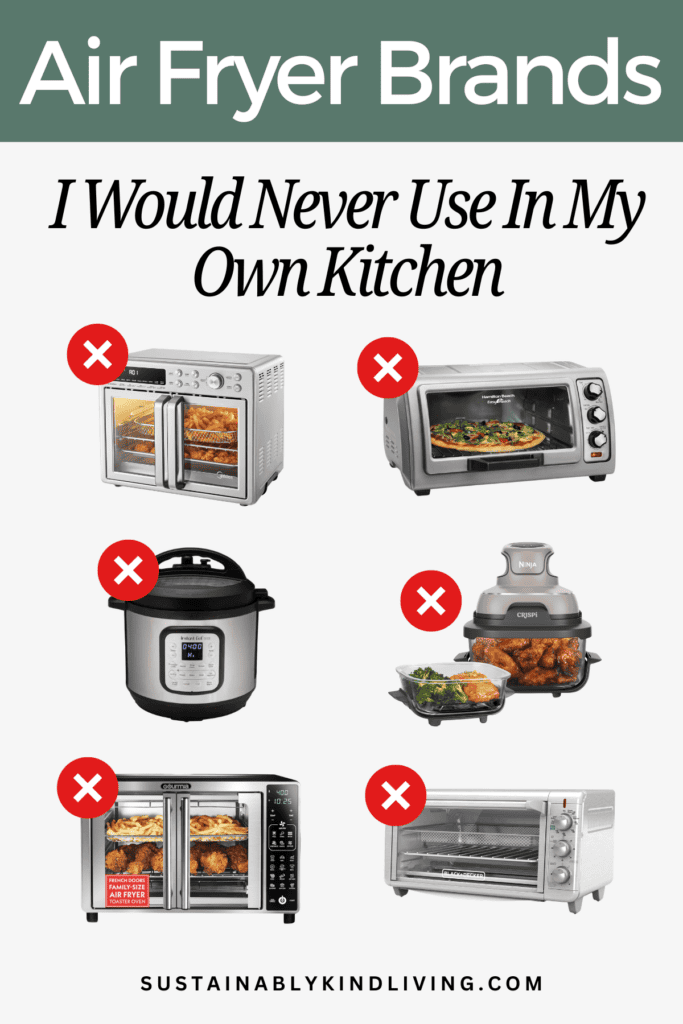
❌ Air Fryers That Did Not Meet My Material Standards
I left the models below off my recommended list because their food-contact materials, heated interior materials, coatings, or available disclosures did not meet the standards I used for this guide.
Hamilton Beach Easy Reach
- Galvanized (zinc-coated) interior
- Chrome-plated steel racks
- Aluminized steel baking pan
- Does not meet stainless steel or glass interior standard
Midea Flexify
- Aluminized steel interior
- Chrome-plated steel racks
- No AB1200 disclosure available
- Heavy aluminum reliance in food-contact zones
Instant Pot Duo Crisp + Air Fryer
- Included air fryer basket contains PTFE
- Default configuration includes nonstick coating
- Durability concerns reported
- Does not meet full stainless food-contact standard
Gourmia Toaster Oven Air Fryer Combo
- Anodized aluminum interior
- Aluminum baking trays included
- No AB1200 disclosure
- Interior does not meet preferred high-heat material criteria
Ninja Crispi
- Nano-ceramic non-stick coating on food-contact surfaces
- Limited transparency on coating composition
- Aluminum components included
- Does not meet full stainless or glass food-contact standard
Black + Decker Extra Wide Convection
- Zinc-coated (galvanized) interior
- Uncoated aluminum baking pan included
- Prop 65 cord warning
- Interior construction does not meet preferred material criteria
Air Fryer Materials Explained: What I Avoid and What I Look For
When I evaluate an air fryer, I look at three areas separately: the surfaces touching food, the materials inside the heated cooking chamber, and the exterior components.
A plastic handle outside the oven is different from a plastic part inside the cooking chamber. An aluminum crumb tray catching drips is different from an aluminum pan holding your dinner.
Those distinctions tell me whether a material means choosing another model, swapping an accessory, or just following the care instructions.
PFAS and PTFE: Why I Choose Alternatives
PFAS are a large class of fluorinated chemicals used for grease, water, and stain resistance. PTFE, the polymer sold under brand names like Teflon, is the PFAS most commonly used in nonstick coatings.
Many PFAS persist in the environment for a long time. Separately, exposure to certain PFAS has been linked to immune effects, developmental and reproductive effects, and increased risk of some cancers. Those findings concern specific chemicals at specific exposure levels. They don’t prove every PFAS-containing product carries the same risk.
For cookware, heat is the issue, and agencies don’t give one number. Germany’s Federal Institute for Risk Assessment, BfR, says PTFE can decompose and release hazardous gases at around 360°C (680°F) and above, mainly when coated cookware is heated empty. It doesn’t expect health effects when cookware is used as intended. Health Canada advises not using nonstick above 260°C (500°F) and not preheating it empty.
That last point matters for air fryers, because many models build in an empty preheat. Neither agency says ordinary cooking releases toxic fumes, and I’m not saying that either.
I prefer an air fryer made without PTFE when a good alternative exists.
“PFOA-free” doesn’t settle it. PFOA is one PFAS, and it was phased out of nonstick production. A product can be PFOA-free and still use PTFE.
Ceramic Nonstick: A Coating Worth Looking Into
A ceramic-coated basket is usually metal with a thin sol-gel coating made largely from silica. It is not solid ceramic cookware.
The word “ceramic” doesn’t tell you the exact formula, whether PFAS are present, or how the coating holds up after wear. I look for an explicit statement on PFAS and PTFE, the underlying metal, and relevant testing where available.
One study is worth knowing. NIST researchers tested two commercially available nanoceramic cookware products with an acetic acid food simulant. Scrubbing pads and steel wool caused no visible change. Titanium dioxide and silicon dioxide nanoparticles showed up only after the harshest treatment: scratching with a tungsten carbide burr.
That supports paying attention to coating damage. It doesn’t show that ceramic air fryer coatings shed particles during ordinary cooking.
So I treat ceramic nonstick as a compromise to explain, not something to reject automatically. If you want basket-style convenience, a clearly disclosed coating made without PFAS can be a practical option. If you want no nonstick layer at all, look at glass or uncoated stainless steel.
Plastics and Phthalates: Location Matters
Phthalates are plasticizers commonly associated with flexible PVC. The FDA notes that certain phthalates have historically been used in food-contact applications, including adhesives, lubricants, and sealants. In 2022, it revoked food-contact authorization for 23 of them.
That doesn’t mean any given air fryer part contains phthalates.
When I find plastic, I want to know which polymer it is, where it sits, whether it touches food, and whether it’s rated for the heat it sees. Health Canada notes that plastic additives such as plasticizers and colourants could transfer into food, most likely at high temperatures, and advises using plastics only as intended.
“BPA-free” answers a question about BPA. It doesn’t identify the plastic or tell you about other additives.
I prefer glass and metal for direct food contact. If an appliance has an internal plastic part, I assess it separately instead of calling the whole appliance plastic-free.
Bare Aluminum: Different From Coated Aluminum
Aluminum is light and conducts heat well, which is why it shows up in baking pans and accessories.
The key question: does food touch bare aluminum, or an intact coating over it?
Health Canada advises against using aluminum cookware for foods high in acid or salt, and against cooking or storing food in it for long periods. It also notes that worn or pitted aluminum transfers metal into food more easily, and that anodized aluminum reduces that transfer.
For my kitchen, uncoated stainless steel is my preferred replacement for a bare aluminum baking pan, especially for anything with tomato, lemon, or other acidic ingredients.
An aluminum base under an intact ceramic coating is a different setup. I name both the coating and the base metal so you know what you’re getting.
My Preferred Air Fryer Materials
Uncoated Stainless Steel
This is my first choice for baskets, racks, and replacement baking pans.
There’s no applied nonstick layer to maintain or replace. Health Canada describes stainless steel as strong, long-lasting, and resistant to rusting and staining. It’s commonly made of iron, chromium, and nickel, and Health Canada advises people with nickel allergies to avoid cookware containing nickel.
I check each accessory individually. “Stainless steel air fryer” can describe the exterior or cooking cavity and say nothing about the basket. And “steel” doesn’t necessarily mean stainless.
The tradeoff: food can stick more than it does on nonstick. I’d rather say that up front than promise an uncoated basket behaves like a coated one.
Heat-Resistant Glass
Glass is another surface I prefer because it provides a cooking bowl without an applied nonstick coating. Being able to watch food brown is also something I appreciate when using Fritaire.
The important qualification is that the glass must be designed for the appliance and its operating conditions. Tempered glass and borosilicate glass are different descriptions, so I use the specification for the exact model rather than treating those terms as interchangeable.
I also check the rack, rotisserie components, and other accessories. A glass bowl tells us about the bowl, not every material in the appliance.
For care, follow the manufacturer’s instructions on handling, cooling, cleaning, and temperature changes. I wouldn’t substitute an ordinary glass container simply because it fits.
Clearly Disclosed Ceramic Coatings Made Without PFAS
I include selected ceramic-coated models because cooking style matters too.
Some readers want the convenience of a removable nonstick basket. In that case, I look for a manufacturer that identifies the coating, states whether it is made without PFAS and PTFE, and explains how to care for it.
Where testing is provided, I check what was tested. A report covering specified PFAS in submitted material samples has a defined scope; it isn’t proof of zero chemical exposure under every condition.
My preference remains uncoated stainless steel or glass, but a disclosed ceramic coating can be an option within this guide. The distinction should be clear before anyone buys.
Compatible Uncoated Replacement Accessories
Sometimes the cooking appliance suits your needs, but an included pan doesn’t match your material preferences.
A compatible uncoated stainless steel baking pan can give you another option without replacing the entire appliance.
Before recommending a swap, I check the dimensions, temperature suitability, rack support, and manufacturer clearance requirements. A replacement needs to allow the door to close and air to circulate properly.
That is how I approach the whole category: identify the actual material, understand where and how it is used, and make a practical choice for the meals you cook.
Air Fryer Marketing Claims I Look Past
After researching this many air fryers, I’ve learned the most reassuring words on the box are rarely the most useful.
These are the claims I check before recommending a model.
“PFOA-Free”
This covers one PFAS. It doesn’t tell you whether the cooking surface uses PTFE or another PFAS.
What I look for instead: An explicit statement about PFAS and PTFE covering the basket, trays, and cooking interior.
“Teflon-Free”
Teflon is a trademark Chemours licenses for its PTFE products. Other manufacturers can’t use the name without a license. So a coating can be “Teflon-free” and still be PTFE.
What I look for instead: The generic material name. PTFE is PTFE, whatever it’s called on the box.
“Stainless Steel”
Sometimes this describes the exterior, not the surfaces touching your food.
What I look for instead: Separate specs for the cooking cavity, basket, rack, and bake pan. “Steel” and “stainless steel” are not the same thing.
“Ceramic”
This doesn’t tell you whether you’re buying solid ceramic or a metal basket with a thin ceramic nonstick coating.
What I look for instead: The coating type, the underlying metal, a PFAS statement, and care instructions.
“BPA-Free”
This doesn’t identify the plastic or tell you where it sits in the appliance.
What I look for instead: The actual material, whether it touches food, and whether it’s rated for the heat it sees.
“Non-Toxic” and “Chemical-Free”
Under the FTC’s marketing guidance, a “non-toxic” claim implies a product is non-toxic for both people and the environment, and brands should have solid scientific evidence for that or qualify the claim. So I want to know what a brand means by it. Which substances does it exclude? Which components does it cover? What’s the evidence?
“Chemical-free” means nothing. Glass, stainless steel, and ceramic are all made of chemicals.
What I look for instead: Specific material disclosures and clearly scoped testing.
The question I keep coming back to is simple. Can this company tell me what its cooking surfaces are made of? That answer is worth more than any badge on the box.
How to Care for Your Air Fryer’s Food-Contact Surfaces
Choosing better materials is only part of the picture. How you clean the basket, handle the accessories, and replace worn parts matters, too.
These are the care practices I recommend for the models in this guide. Follow your specific model’s manual for cleaning instructions and temperature limits.
- Use tools that suit the surface. For coated baskets and trays, choose utensils the manufacturer approves. Avoid scraping stuck food with metal utensils.
- Clean gently after cooking. Let the appliance cool as directed, then use a soft sponge and the recommended cleaning method. Avoid abrasive pads on coated surfaces.
- Check before using the dishwasher. Dishwasher compatibility varies by accessory, even within the same appliance.
- Protect glass from sudden temperature changes. Follow the manufacturer’s cooling instructions before washing a hot glass bowl.
- Inspect the parts that touch your food. Replace peeling or flaking coated accessories, cracked glass, and parts with significant corrosion. Ask the manufacturer about damage you cannot identify.
- Choose replacement accessories that fit properly. A stainless steel tray needs to be compatible with your appliance and leave the required space for airflow. Check the manufacturer’s guidance before swapping parts.
My buying tip: Check whether replacement baskets, trays, or glass bowls are available before choosing an air fryer. Being able to replace one worn accessory can make a favorite appliance much easier to keep using.
All Your Air Fryer Questions Answered!
Normal heating does not automatically mean an air fryer releases toxic fumes. The materials and temperature matter. PTFE coatings can release hazardous gases when severely overheated at around 360°C (680°F). BfR says adverse health effects are not expected from properly used PTFE cookware without overheating. Follow your appliance’s temperature limits and operating instructions.
Air frying is not inherently unhealthy. Consider both the appliance’s cooking surfaces and how you prepare your food.
For example, acrylamide can form in starchy foods during frying, roasting, and baking, regardless of whether you use an air fryer. The FDA recommends cooking potato products to golden yellow rather than dark brown to reduce its formation.
My preferred food-contact surfaces are uncoated stainless steel and heat-resistant glass designed for the appliance.They let you cook without a nonstick coating on those surfaces.
There isn’t one material that makes an entire appliance “the safest.”
Check the basket, tray, racks, and other cooking accessories individually. I also consider clearly identified PFAS-free ceramic coatings when nonstick convenience is a priority.
PTFE, the material associated with Teflon coatings, is not expected to cause adverse health effects when used properly without overheating, according to BfR. Severe overheating is the concern.
I prefer alternatives without PFAS-based cooking coatings, but that preference does not mean ordinary use of every PTFE-coated air fryer is dangerous.
“Ceramic” alone is not enough information to judge a coating. Look for a manufacturer that identifies the coating, explicitly states whether it is PFAS-free, and provides care instructions for that model.
A ceramic-coated metal basket is different from solid ceramic. I consider disclosed PFAS-free ceramic coatings a practical option for easy food release, while glass and uncoated stainless steel are my preferences for avoiding nonstick coatings altogether.
A warning means the business knows or believes the product can expose users to a chemical on California’s Proposition 65 list. It does not automatically mean the product violates safety standards.
Ask the manufacturer which chemical triggers the warning, where it is located, and how exposure could occur. A warning alone does not tell you whether the concern involves a cooking surface, cord, housing, or another component.
It is a claim about the absence of PFAS, but you need to check what the claim covers. Does it apply to the basket coating, all food-contact accessories, or the entire appliance?
If testing supports the claim, check which substances and components were tested and the reporting limits. “Not detected” in specified samples does not establish that every PFAS is absent from every part. PFOA-free is also narrower than PFAS-free.
Yes, if the accessory is designed for that appliance and used according to its instructions. Bare aluminum and coated aluminum are different food-contact surfaces.
Health Canada advises against using bare aluminum cookware for foods high in acid or salt. If you prefer to avoid direct food contact with aluminum, look for a compatible uncoated stainless steel accessory.
No manufacturer can establish zero risk from every component under every condition of use. In this guide, “non-toxic air fryer” describes the options I’ve selected for their disclosed cooking materials, alternatives to traditional PFAS-based coatings, and performance in my kitchen.
My testing helps me assess cooking and everyday usability. It does not replace laboratory testing for chemical migration or emissions.
Start by identifying its cooking surfaces and checking their condition. Follow the temperature limits, keep the required vents clear, and use the recommended cleaning tools.
For peeling coatings, cracked glass, or significant corrosion, contact the manufacturer about replacing the affected accessory. If you want to switch to stainless steel, use a replacement confirmed to be compatible with your exact model.
Uncoated stainless steel is my preference for avoiding nonstick coatings. Nonstick surfaces may offer easier food release, so the better choice depends on your priorities.
Check the accessories separately. A stainless steel cooking cavity can still come with a coated baking pan, and a stainless steel exterior tells you little about the basket.
Look for model-specific information about the basket, crisper plate, baking tray, and other coated accessories.Check the manufacturer’s material specifications, chemical disclosures, and any available test reports.
PTFE is a PFAS, so a disclosed PTFE coating answers that question. A PFOA-free label does not rule out PTFE or other PFAS. If the information is unclear, ask: “Do any food-contact coatings contain intentionally added PFAS, including PTFE?”
Still Deciding?
If you’re choosing between the top options, here’s where I’d start:
- Wonder Oven Pro: Best overall for families who want stainless steel food-contact surfaces and one appliance that can replace both an air fryer and toaster oven.
- Fritaire: Best if your priority is cooking in a borosilicate glass bowl and being able to watch your food as it cooks.
- Typhur Dome 2: Best basket-style option if you care most about a wide cooking surface, fast cooking, and even browning.
- Wonder Oven Original: Best compact air fryer oven for smaller households or kitchens with limited counter space.
- GE Digital Air Fry Oven: Best traditional toaster-oven-style alternative if you prefer that familiar design.
Final Thoughts on the Safest Non-Toxic Air Fryers
An air fryer should make dinner easier. You shouldn’t have to spend hours figuring out what the basket is coated with before you can feel comfortable cooking in it.
That’s why I’ve included both my experience using these models and the material details that are so often missing from product descriptions. You deserve to know what touches your food, how the appliance actually cooks, and what you’re getting for your money.
Choose the option that fits your meals, counter space, and material preferences. For me, an appliance earns its place when it works well enough that I keep reaching for it on busy weeknights.
Is there an air fryer you’d like me to look into? Leave the brand and model in the comments. I’d love to know what you’re considering and which questions you still need answered.
Continue Your Non-Toxic Kitchen Journey
Transforming your kitchen starts with safer tools. These are some of our most popular non‑toxic appliance and cookware guides:
- Non-Toxic Tea Kettles: Plastic-free kettles made from stainless steel, glass, or ceramic for cleaner boiling.
- Non-Toxic Toasters & Toaster Ovens: Cleaner countertop appliances made without harmful coatings so your toast stays chemical-free.
- Non-Toxic Cookware: Healthy pots and pans crafted from stainless steel, cast iron, and enamel to reduce toxin exposure while cooking.
- Non-Toxic Baking Sheets & Bakeware: Heat-safe, toxin-free bakeware made from stainless steel, ceramic, and glass for safer baking and roasting.
- Non-Toxic Rice Cookers: Safer rice cookers with stainless steel or ceramic interiors for toxin-free meal prep.
📌 Save This Guide For Later
Saving this post to your Non-Toxic Kitchen or Healthy Home Pinterest board means you’ll always have the safest air fryer picks just a click away.
Tap the image below (or use the “Pin” button) to save it and help other toxin-conscious cooks find it too!

Sources & Further Reading
At SKL, transparency matters just as much as safer materials. The research behind this guide draws from environmental health agencies, regulatory disclosures, and peer-reviewed studies on PFAS and chemical exposure.
These sources help explain why certain coatings, metals, and materials used in kitchen appliances may raise concerns, and why material transparency is so important when choosing everyday cookware and appliances.
- Environmental Protection Agency: Explains what PFAS are, how people are exposed to them, and the EPA’s current understanding of their potential human health and environmental risks.
- National Institute of Environmental Health Sciences (NIEHS): Provides an overview of PFAS chemicals, common exposure pathways, and current research into their potential health effects.
- European Environment Agency (EEA) :Summarizes why PFAS are considered persistent chemicals, where they are found, and why they are a growing public health concern.
- Journal of Exposure Science & Environmental Epidemiology: Peer-reviewed review examining the primary pathways of human PFAS exposure and summarizing current evidence on potential health effects.
- California Legislative Information (AB-1200): Outlines California’s cookware disclosure law requiring manufacturers to disclose intentionally added chemicals of concern in cookware and food-contact products.
- Office of Environmental Health Hazard Assessment (OEHHA) – Proposition 65: Explains California’s Proposition 65 program and why certain cookware and consumer products may carry warning labels for chemicals linked to cancer or reproductive harm.

Steal My Non-Toxic Cleaning Checklist!
Believe us, it’s the BEST…. and it’s free. Does it really get any better than that?! Sign up for our newsletter and get this free checklist to clean your home without any harmful chemicals!







Thanks so much for your guide to air fryers and that you get to the points immediately! Formatted very well and easy to read format! I’m subscribing! 😊🎄🦃
Thank you!!
I’m thrilled and very appreciative that in 2025, your full taking the time to write and research instead of taking the ai easy way out.
Your work here is noted.
Thank you!!!
Thank you for noticing this – we work SO hard on all of our blog posts. We promise to always be the ones behind the research and writing 🙂
Can you possibly confirm that the baking tray for the Midea Flexify™ French Door Air Fryer Oven is indeed stainless steel? I was looking through the user manual before purchasing and it mentions “non-stick coating of baking tray” under Cleaning & Care.
Hi Kecia, Yes the doors are stainless steel. You can swap out the baking tray for one of our non-toxic options we listed in the article. When we reviewed the Midea, it did not have a non-stick coating tray BUT they may have added this due to the huge demand from consumers (I assume they just do not know the health implications of this!). So, if it comes with the tray, just swap it out.
I am most concerned about the air frying basket. That seeks harder to replace and if it contains non-stick chemicals I am not sure how to replace that.
I understand your concerns here – have you looked into the Fritaire? It’s quite large (I was shocked at how large it was) and cooks everything just perfectly. I highly recommend it!
What about Ninja CRISPi? Any thoughts about it?
Hi Gabriel, thanks for letting us know about this one! I just reached out to the brand and will let you know what we find out. I also placed an order so we can get our hands on it and vet it on our side 🙂
When I called the Midea company they told me the appliance itself had the warning…
Hi Renee! We personally tried and tested the Midea and we noted the Prop 65 warning in the section right under the caption. It does have one but we did not see it relating to any components that come into contact with food: Prop 65 warning- The packaging materials in this box may contain chemicals like Bisphenol S (BPS). The warning is related to the packaging materials only and does not affect the safety of cooking food in the air fryer.
Thank you for the response!
I’ve spent hours researching which air fryer to buy that would be nontoxic and work well, and this was the most helpful article out of all of them. Thank you for your attention to detail!
You are so welcome! If you need any more help, please feel free to ask away – we tried and tested each one on the list and have a folder filled with our folders and notes 🙂
Regarding replacement trays for the Medea unit, what size are you recommending?
The Wildone 12 x 10 stainless steel pan is the best fit I could come across on Amazon. Although it’s not wide enough to slide into the grooves, it rests securely on the wire rack. Hope this helps!
Are any of the Ninja or other brands of the basket type air fryers safe? Like the Ninja AD300CO or the DZ201.
Can you use a silicone basket liner to help?
One website says they use PFAs another says they are PFA free.
I don’t want to buy from someone that uses them in manufacturing but also want something easy to clean.
Hello,
I am considering purchasing a Cafe air fryer, I am very concerned about the toxic materials in our cooking appliances. I personally called the company and was told that the wire rack has steel and nickel plating and dehydrate function also uses the same materials. You don’t mention in your description of the materials used – nickel, I am concerned about that, what are your thoughts on this material? Is it toxic?
Thank you so much for reaching out and for doing your own research—it’s incredibly important (and unfortunately not very common) to dig into the materials used in our everyday kitchen appliances.
You’re right to have questions about nickel. While nickel is a naturally occurring metal and often used in stainless steel, it can cause health concerns for certain individuals, especially those with a nickel allergy or sensitivity. For most people, the levels of nickel used in food-contact surfaces—especially when alloyed in stainless steel—aren’t likely to pose a significant risk. However, prolonged contact with acidic foods or high heat can increase the potential for leaching small amounts of nickel into food, particularly if the plating wears down over time.
Because Cafe confirmed their wire racks are nickel-plated, it’s something to be aware of—especially if you’re nickel-sensitive or planning to use the dehydrate function often (which involves long, low-heat cooking). That said, nickel is not classified as a known toxin like PFAS or BPA, but it can still be a concern in the context of bioaccumulation or chronic exposure for some people.
We always recommend erring on the side of caution, especially when transparency is lacking. If this makes you uncomfortable, you may want to consider safer alternatives with fully stainless steel or uncoated food-contact surfaces—like the Fritaire or a model that offers non-plated, lab-disclosed components.
Let me know if you’d like help narrowing down options that are nickel-free or better for metal sensitivities. I’d be happy to help!
I misspoke in my previous comment. I meant to say that per fritaire the rotisserie SKEWER is chromed steel.
Thank you so much for the clarification—this is incredibly helpful!
I’ll make sure to update the Fritaire listing to reflect that the rotisserie skewer is made of chromed steel, not stainless. Accuracy matters so much in this space, especially for readers who are trying to reduce their exposure to questionable metals or coatings in their kitchen.
Your attention to detail and follow-up truly helps improve the quality of our recommendations. Thank you again for taking the time to share this correction—I’ve noted it and will revise accordingly!
Thanks for the insightful reviews! I tried using your code on Our Place, however it said it wasn’t valid 🙁
Hi there,
Thank you so much for letting me know about this — I truly appreciate it.
Because of your comment, we reached out to the brand right away to let them know the code isn’t working. I’m so grateful you took the time to flag it — it really helps us keep everything accurate and up to date for our readers.
I’m sorry for the frustration, especially if you were ready to check out. As soon as we hear back from them, we’ll make sure everything is updated on our end.
Thank you again for being here and for your support — it means more than you know.
Hi,
I just bought the normal wonder oven and the material of the baskets and such is chromed steel. When I go to the pro version it says “steel” instead of chromed steel. But it doesn’t say stainless steel. How odd. I’m not 100% sure now what materials are used since steel could mean either. But I wanted to let everyone know the normal wonder ovens should not be expected to be stainless steel.
Also these are not dishwasher safe, the trays and sheet etc. I found that surprising too.
Additionally, someone else emailed and was told the ceramic is nano. Whatever that means. If that means anything to someone they can email and ask. Don’t assume it’s not. Just trying to help everyone understand their options better.
Best,
Rachael
Hi Rachael — this is such a thoughtful breakdown, thank you for sharing all of this 🤍
You’re absolutely right on a few key points, especially around the wording. Terms like “steel” vs. “stainless steel” and “chromed steel” can mean very different things — and we always encourage people to question that level of detail.
For anyone reading:
• Chromed steel = a plated surface, not solid stainless
• “Steel” doesn’t automatically mean food-grade stainless
• “Nano ceramic” typically refers to a coating, not fully ceramic material
That said, this is exactly why the Wonder Oven is categorized the way it is in the guide. It’s not being presented as perfect — it’s included because it significantly reduces risk compared to conventional air fryers (especially those using PFAS-based non-stick coatings).
The stainless steel interior and overall material profile still make it a better option in a category where truly non-toxic appliances are very limited — but like most appliances, it’s not 100% free of all coatings or material trade-offs.
And you’re also spot on about care — when something isn’t dishwasher safe, it’s often a sign that coatings or plated materials are involved and need more gentle handling over time.
Really appreciate you adding this context — this kind of discussion is exactly what helps people make more informed, realistic choices 🤍
What about the Cuisinart TOA-60 or the Breville Smart Oven with tray swaps?
Also, is the Media safe or not?
Great questions — this is where things can get a little nuanced 🤍
Cuisinart TOA-60 / Breville Smart Oven (with tray swaps):
These can be a better option if you’re mindful. The interiors are typically stainless steel, which is great — but many of the included trays and baskets come with non-stick coatings. Swapping those out for uncoated stainless steel or glass is definitely the way to go.
That said, even with swaps, you still have to consider internal components, so they’re not 100% “non-toxic” — just a safer alternative.
Midea air fryers:
Most Midea models rely on non-stick coated baskets and trays. Even if labeled PFAS-free, they still use coated surfaces that can degrade over time with heat and use. Because of that, they don’t meet our criteria for long-term non-toxic cooking.
Bottom line:
If you’re going the air fryer route, stainless steel interiors + swapping out coated accessories is the best middle ground. Otherwise, sticking with oven cooking using stainless steel, cast iron, or ceramic cookware is still the safest option overall.
Hope that helps 🤍
Thank you for your wonderful breakdown and beautiful insight on clean options!
I’m curious about the Ninja Air Fryer Toaster Oven SP151. How does this oven stack up? I’m new to clean living and still learning the ins and outs. Your feedback is wildly appreciated!
Hi! Thank you so much for asking about the SP151, this pushed me to dig way deeper than I expected to.
I went all the way into SharkNinja’s official AB1200 chemical disclosure list to get you a real answer instead of a guess. Good news: the SP151 falls under their SP15X series, and that disclosure lists things like manganese, titanium dioxide, nickel, and carbon black, the kind of trace elements you’d expect from stainless steel and internal electronics.
There’s no PTFE (Teflon) or PFAS disclosed anywhere in that entry. For comparison, SharkNinja does explicitly flag PTFE on their air fryers, waffle makers, and pressure cookers when it’s actually present, so they’re not being quiet about it when it exists. The Prop 65 warning on the box is almost certainly tied to one of those trace elements (titanium dioxide and nickel are both Prop 65-listed), not a hidden non-stick coating.
So this is looking like a genuinely solid, transparent pick. I’m going to reach out to SharkNinja directly to get final written confirmation before I officially add it to the guide, since I only recommend what I’ve personally tested and verified. But this is a big step up from where I started when you first asked, so thank you for the great question.
I’ll update this thread once I hear back from them and get one in my own kitchen to test!
To the author:
theconsciousinsider.com is the 2nd search result for this topic. The #1 recommended airfryer on that site is ceramic-coated. They give info on safe materials and list that material as most unreliable. Thought it was funny.
Thank you for caring.
Haha thank you for this. Yes I’m not sure what’s happening with search results lately but it seems the more greenwashed the better according to most. I will say, GoDuckGo shows us a lot – as does Ecosia if you want to make the swap to a better search engine 🙂
Your discount code for the wonder oven pro is not working. Do you have an updated code?
Hi Sara, we just had them update it. It is working now, sorry for the delay!