 Shop My Favorite Non-Toxic Gifts Of 2026!
SKL is reader supported. When you buy through links on our site, we may earn affiliate commission. Learn more here.
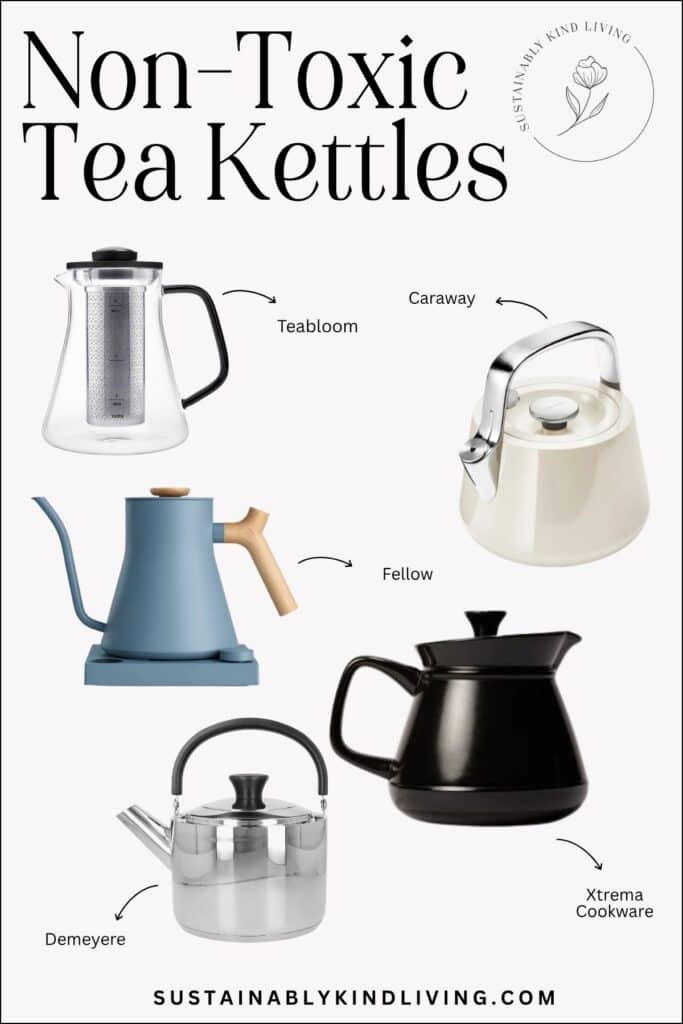
Finding non-toxic tea kettles worth recommending has become a seven-year project for us at SKL. I’ve tested 21 kettles hands-on, and these are the five I recommend today.
Each year, I reevaluate the brands and order new kettles to check whether the materials, construction, or performance have changed.
A kettle I loved several years ago still has to earn my recommendation today. I also stay in contact with manufacturers and revisit the guide whenever a reader asks us to test another option.
Some kettles have remained favorites through years of use. Others have disappointed me with declining quality, chipped paint, or frustrating pouring.
In this update, I’m sharing the ones I recommend, the compromises you should know about, and why several previously featured options no longer make the cut.
The Best Non-Toxic Tea Kettles I Tested, at a Glance
- Best Stovetop Tea Kettle: Caraway
- Best Affordable Non-Toxic Tea Kettle: Teabloom Virtuoso
- Best Electric Gooseneck Kettle: Fellow Stagg EKG
- Best Large-Capacity Stainless Steel Tea Kettle: Demeyere Resto
- Best 100% Ceramic Tea Kettle: Xtrema
This updated shortlist covers electric and stovetop tea kettles, affordable options, and temperature-controlled models for tea and pour-over coffee.
I’ll walk you through their materials, share what I liked and disliked, and help you choose one that fits your kitchen.
Compare The 5 SKL-Approved Tea Kettles
(Mobile Users) Scroll to see full comparison →
| Brand | Best For | Water Contact Materials | Capacity | Price |
|---|---|---|---|---|
| Caraway Whistling Tea Kettle | Premium stovetop | Stainless steel interior | 64 fl oz / 1.89 L | $195 |
| Teabloom Virtuoso | Glass stovetop, excluding induction | Borosilicate glass, 304 stainless steel and food-grade silicone | 34 fl oz / 1.00 L | $49.95 |
| Fellow Stagg EKG Pro | Electric gooseneck for pour-over | 304 stainless steel; silicone probe seal and lid gasket | 30 fl oz / 0.90 L | $199.95 |
| Demeyere Resto (The new model) | Uncoated stainless steel stovetop | 18/10 stainless steel interior | 152 fl oz / 4.50 L | $79.99 |
| Xtrema Retro | 100% ceramic Stovetop Option | 100% Ceramic | 80 fl oz / 2.37 L | $180 |
Safe vs. Not
Tea Kettle Materials: What I Avoid & What I Look For
Before we get into the reviews, here’s the short version of what matters to me when choosing a non-toxic tea kettle.
Materials & Claims I’m Cautious About
- Plastic Touching Hot Water Or Steam: Filters, lid undersides, spout covers, and whistle components deserve just as much attention as the kettle’s interior. I prioritize glass and stainless steel wherever possible.
- Plastic Carrying Handles: Handle durability matters when you’re lifting and pouring boiling water. I prefer metal or other clearly documented alternatives, and disclose exceptions.
- Enamel Coatings: Enamel-coated kettles don’t meet my criteria for this guide. I prefer uncoated water-contact surfaces or clearly documented ceramic options.
- Undisclosed Coatings & Components: A stainless steel exterior doesn’t tell me what’s inside the lid, filter, or whistle. I want brands to identify those materials too.
- “BPA-Free” & Vague “Non-Toxic” Claims: Neither replaces a complete material disclosure. I look for specific information and relevant testing behind the marketing.
Materials & Features I Prioritize
- Uncoated Stainless Steel: For the water chamber, lid underside, spout, and filter, with the stainless steel grade identified wherever possible.
- Borosilicate Glass: An uncoated option that makes the water chamber easy to inspect. Stovetop compatibility and proper handling still matter.
- Ceramic With Relevant Testing: I look for clear information about the ceramic, any glaze or coating, and product-specific lead and cadmium testing.
- Clearly Disclosed Silicone Seals: I identify silicone separately from plastic and explain where it contacts water, steam, or condensation.
- Secure Lids & Reliable Pouring: A kettle should feel stable, pour predictably, and be straightforward to fill and clean. Materials alone don’t earn my recommendation.
- Durability & Available Replacement Parts: I consider how the kettle holds up beyond the first few boils and whether a broken lid or whistle can be replaced.
Scroll past the reviews for the full materials breakdown, including stainless steel, silicone, ceramic testing, and more.
The Best Non-Toxic Tea Kettles, Fully Reviewed
These are the kettles I recommend after years of testing and reevaluating my choices. Each one was used in my kitchen for everyday tea, not just a few test boils. I’ve noted exactly what touches your water, including silicone and any plastic, so you know what you’re buying.
1. Caraway | Best Non-Toxic Stovetop Tea Kettle
Best For: Anyone who wants a durable whistling kettle with an uncoated stainless steel interior that works on gas, electric, and induction.
Use discount code SKL to save 10%!
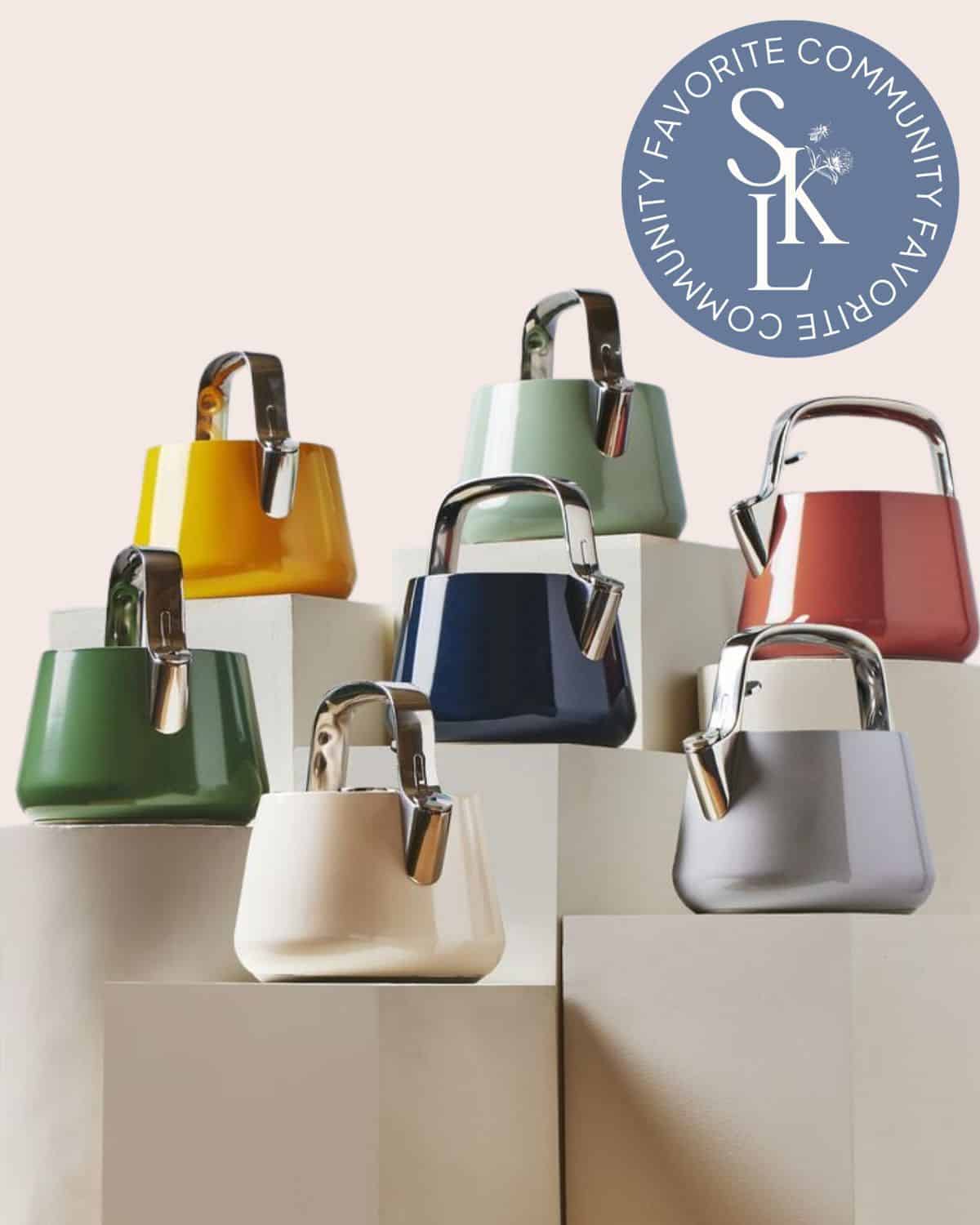
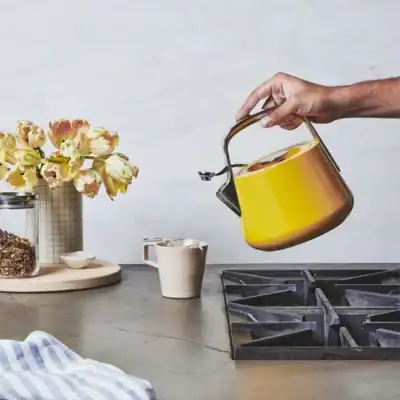
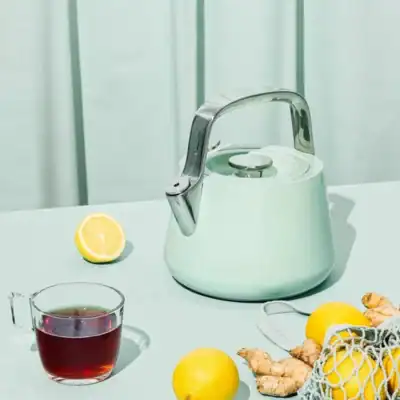
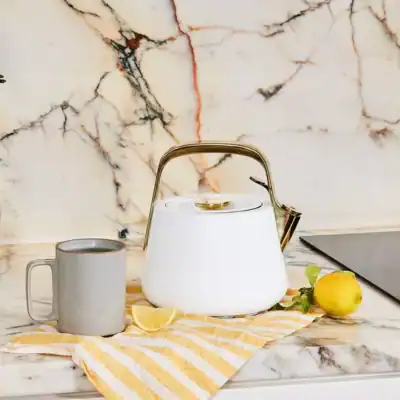
After four years of testing, Caraway is still my favorite stovetop tea kettle. The exterior hasn’t chipped once, it pours smoothly, and I haven’t had a single issue with it. For me, it’s a 10/10.
The water-contact interior is uncoated stainless steel, while the PFAS-free ceramic coating sits on the outside.
How you heat it matters. Caraway recommends low to medium heat because the kettle holds heat efficiently, and I’ve followed that advice.
On medium heat, mine boils water reliably, and the handle has stayed comfortable enough that I haven’t needed a pot holder. Metal handles can still get hot, so check yours carefully.
The lid takes a little force to remove, which may bother some people. I actually appreciate the snug fit. I’d much rather have a secure lid than one rattling around on the stove.
It’s an expensive kettle, but this is the kind of long-term performance I want when I spend more.
Price
$195
Materials
Interior: Uncoated Stainless Steel. Exterior: Ceramic-Coated Stainless Steel. Carrying Handle & Lid: Stainless Steel
Location/shipping
United States, International Shipping Options
why it made my list
- Uncoated stainless steel interior.
- Stainless steel carrying handle and lid.
- Compatible with gas, electric, and induction.
- Four years of firsthand testing with no exterior chipping.
my testing experience
- No exterior chipping in four years.
- Consistent boiling and a smooth pour.
- Comfortable handle during my use on medium heat.
- Tight lid that feels secure, though it takes some effort to remove.
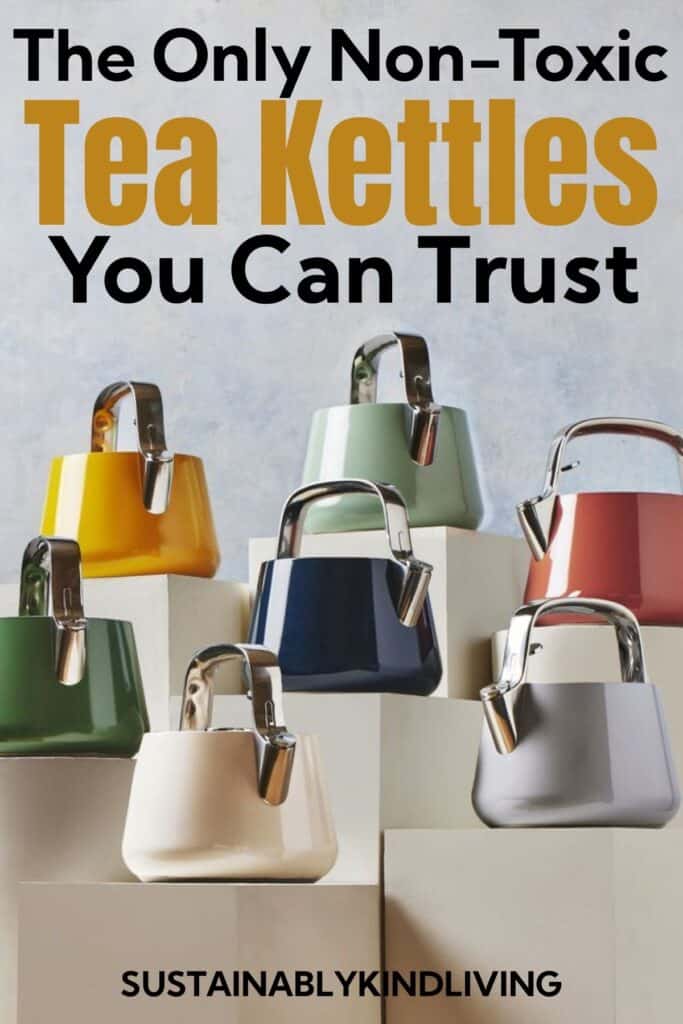
More Color Options From Caraway:
👉Pro Tip: Don’t undo your plastic-free kettle with a plastic tea bag. One plastic tea bag released about 11.6 billion microplastic particles into hot water in a McGill University study. Loose leaf or plastic-free bags are the move. These are the safest organic tea brands we’ve vetted for pesticides, heavy metals and packaging.
2. Teabloom Virtuoso | Best Affordable Non-Toxic Tea Kettle
Best For: Tea drinkers who want to heat water to suit their tea and steep loose leaves in the same glass vessel.
Use discount code SKL10 to save 10%!
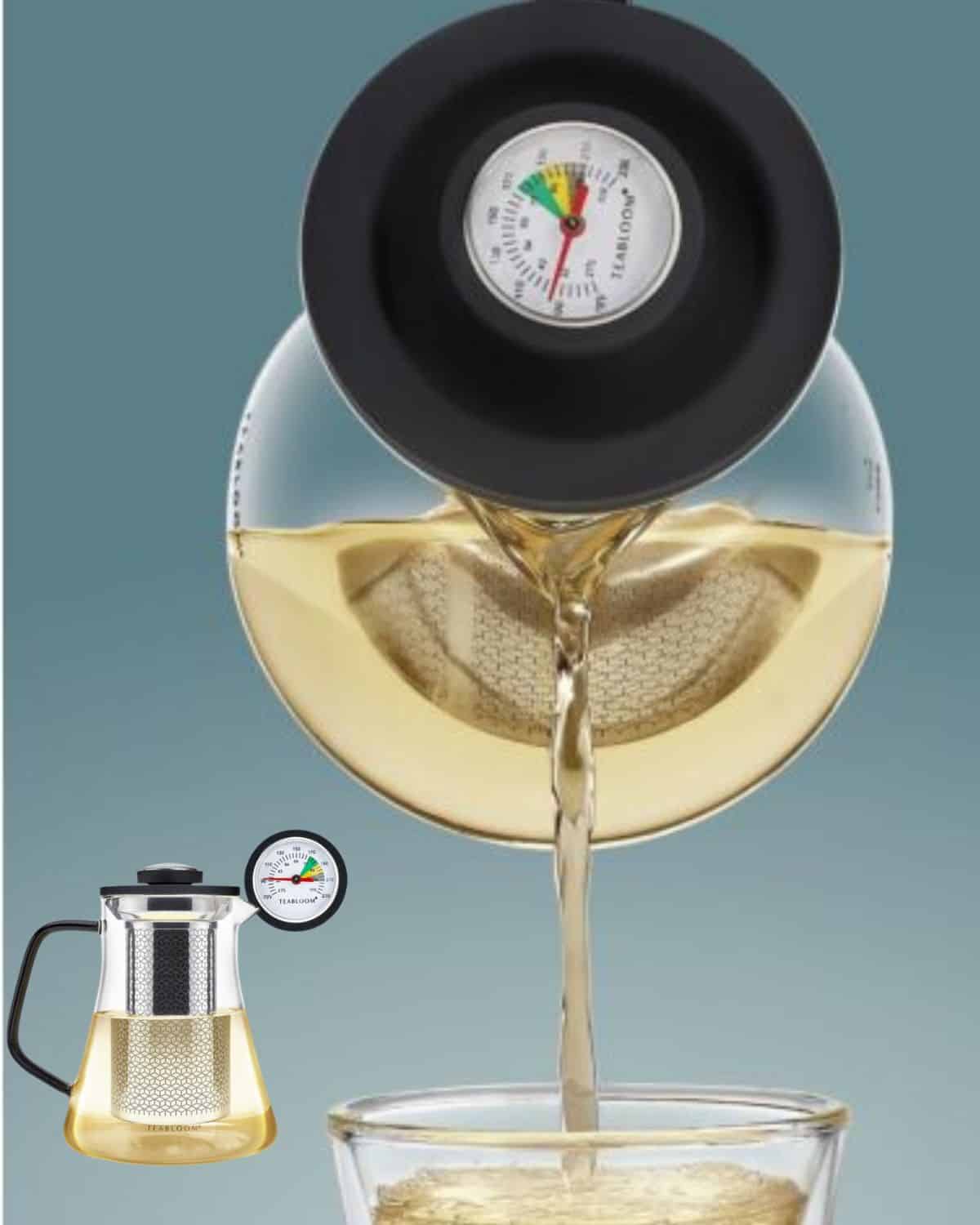
The Teabloom Virtuoso felt much sturdier than I expected when I ordered it. But the feature that makes it a favorite is the built-in thermometer.
Different teas need different brewing temperatures, and the easy-to-follow indicators help me heat the water for whatever I’m making. Every time I’ve made tea with it, the result has been just right. For a serious tea drinker, that temperature guidance makes a difference.
It doubles as a kettle and teapot: heat your water, add loose leaves to the removable infuser, and steep directly in the same vessel. The long infuser reaches toward the bottom, making it useful for smaller servings as well as a full pot.
The body is borosilicate glass, with 304 stainless steel and food-grade silicone components. It isn’t silicone-free, and the metal thermometer assembly should never go in the microwave.
My only complaint is that some loose tea leaves occasionally escape the infuser. It hasn’t been a big enough issue to spoil the experience for me.
Price
$49.95
Materials
Body: Borosilicate Glass. Lid Assembly: 304 Stainless Steel & Silicone.
Location/shipping
United States
why it made my list
- Heats water and steeps tea in one vessel.
- Built-in thermometer provides guidance for different tea types.
- Long, removable infuser accommodates smaller batches.
- Glass body makes the brewing process easy to see.
my testing experience
- Much sturdier than I expected.
- Temperature indicators are easy to follow.
- Consistently made tea I loved across different brews.
- Downside: Some loose leaves occasionally escape the infuser
- It isn’t compatible with induction stovetops, so check your stove before ordering.
3. Fellow Stagg EKG Pro | Best Electric Gooseneck Tea Kettle
Best For: Anyone who wants adjustable water temperature and a controlled pour for tea and pour-over coffee.
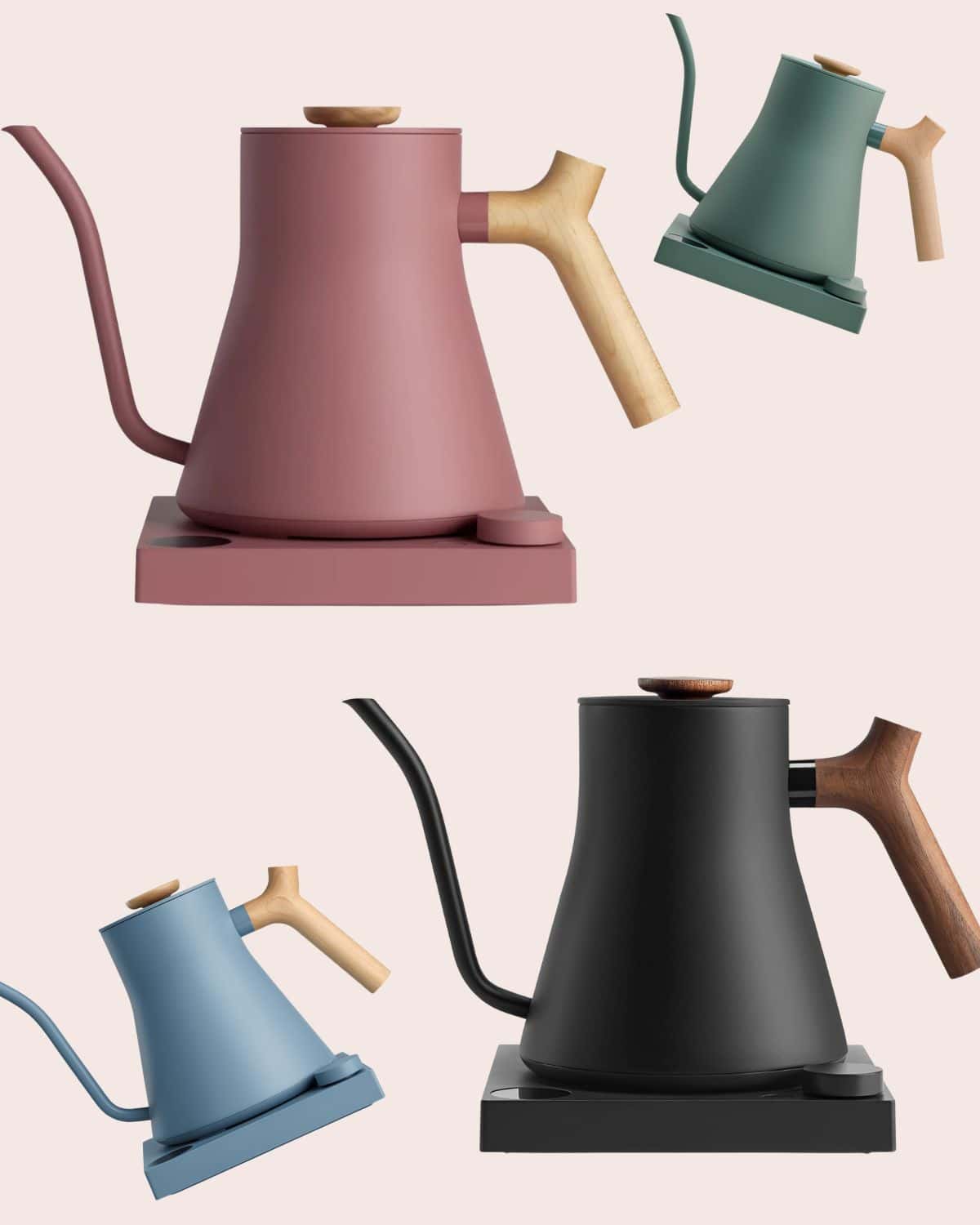
Fellow was the best electric kettle I tested overall, and it held up better than every other electric option I tried.
The temperature control is the reason I reach for it. Different teas call for different temperatures, and this lets me hit the exact one instead of bringing everything to a full boil.
Its narrow gooseneck spout is designed for a slow, controlled pour, which also makes it useful if you brew pour-over coffee.
The water chamber and lid underside are stainless steel. Silicone sits around the temperature probe and on the lid gasket. None of the plastic touches your water.
The electric base is plastic, but it never touches your water. I tested the walnut handle version, which uses wood for the handle and lid pull. Oil the wood occasionally so it doesn’t dry out and crack.
At 30 fl oz / 0.90 L, it’s considerably smaller than Caraway or Demeyere. This is a kettle for precision and smaller batches, not for filling a large pot quickly.
Price
$199.95
Materials
Water Chamber & Lid Underside: Stainless Steel. Temperature-Probe Seal: Silicone. Handle & Upper Lid: Walnut Wood. Other Components: Plastic in the electric base and lid assembly.
location/shipping
United States, International Shipping Options
why it made my list
- Best electric kettle I tested overall.
- No plastic in the water path.
- Exact temperature control for different teas.
- Walnut handle and lid pull instead of plastic.
my testing experience
- Held up better than every other electric kettle I tested.
- Precise, easy temperature control.
- Practical tradeoff: smaller capacity and a deliberately slow pour.
- Material tradeoff: Plastic remains in the powered base and lid assembly.
👉 Pro Tip: Boiling doesn’t remove PFAS. Look for a water filter whose exact model is certified for PFOA and PFOS reduction under NSF/ANSI 53 or 58. My guide to the best PFAS water filters explains what to check before buying.
4. Demeyere Resto | Best Large-Capacity Stainless Steel Tea Kettle
Best For: Anyone who wants a large stovetop kettle for several servings, with compatibility across gas, electric, and induction.
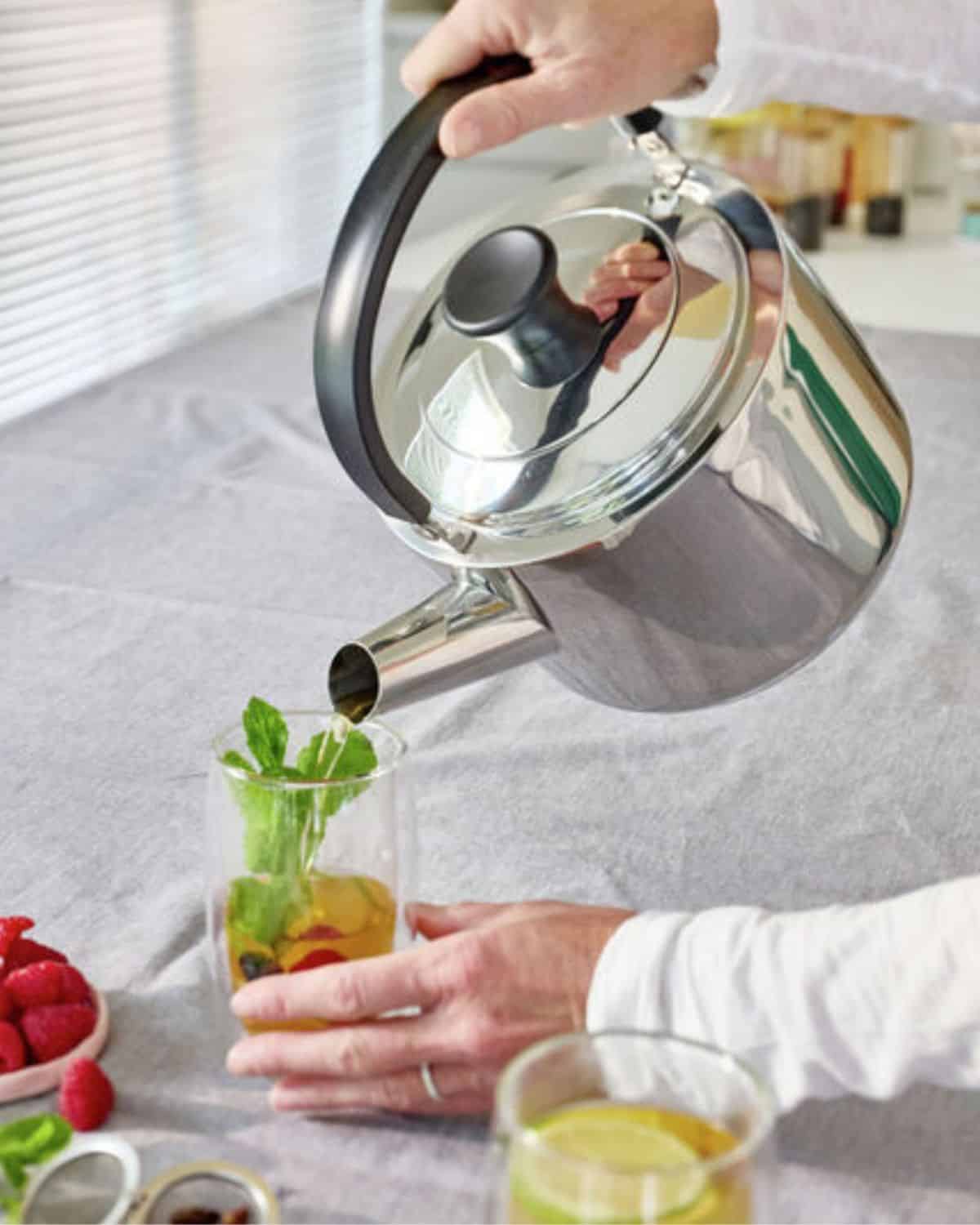
The redesigned Demeyere Resto (model 1034385) is a great kettle to use. It heats water quickly, feels comfortable to handle, and delivers a clean, smooth pour.
Its 152 fl oz / 4.50 L capacity is useful when you’re making tea for several people or heating water for other kitchen tasks. If you usually make just one cup, you may prefer something smaller.
The body is 18/10 stainless steel, with an aluminum core enclosed within the three-layer base for heat distribution. Your water touches stainless steel, while the aluminum stays within the base.
It works on gas, electric, and induction stovetops. The collapsible handle helps with storage, and dishwasher-safe construction makes cleanup straightforward.
Price
$79.99
Materials
Body: 18/10 Stainless Steel. Base: Encapsulated Aluminum-Core Sandwich Construction.
location/shipping
United States, International Shipping Options
why it made my list
- Largest capacity among my main picks.
- Stainless steel water-contact body.
- Compatible with gas, electric, and induction.
- Collapsible handle and dishwasher-safe construction.
my testing experience
- Quick, efficient heating.
- Comfortable grip when handling.
- Clean, smooth pouring.
- Worth considering: More capacity than you’ll need for a single cup.
Prefer 100% Ceramic? Xtrema Is Another Favorite, When Available
Xtrema’s tea kettle is a 100% ceramic alternative to the glass and stainless steel options above, and it’s one I tested and loved. There’s no metal, plastic or nonstick coating in the water path. The interior is glazed ceramic, and Xtrema provides third-party leach testing for lead and cadmium.

Unfortunately, it’s frequently unavailable. That’s why I removed it from the readily available shopping options: I want readers to be able to buy the kettles I recommend. If you prefer ceramic and aren’t in a hurry, it’s still worth checking for a restock.
Other Tea Kettles I Tested and Why They Didn’t Make My Top Picks
Over seven years, we’ve tested far more kettles than earned a recommendation. Some were ruled out because of plastic in the water or steam pathway. Others disappointed me once they became part of my daily routine.
I consider the whole kettle. Fellow earned its place as my favorite electric option despite its exterior plastic components. Other models chipped, leaked or became frustrating to handle. Good materials matter, but so does a kettle that holds up and works reliably every morning.
Quickone
Quickone used to be one of my recommendations. It isn’t anymore.
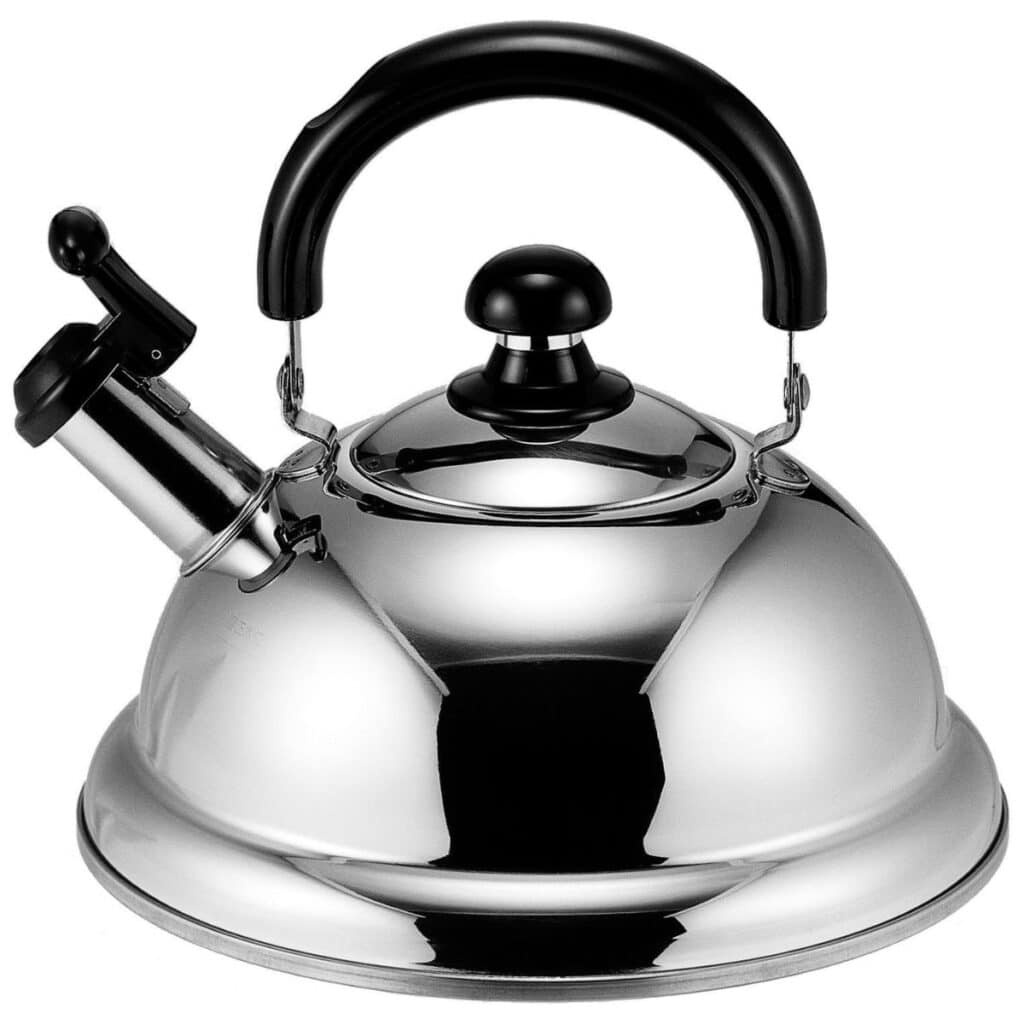
Over time, the kettle started shaking all over the stovetop. Then the lid stopped seating securely. Either problem alone would make me nervous. Together, with a full kettle of boiling water, it was enough for me to pull it from the list.
This is why we keep buying new units and reevaluating my recommendations. A former favorite still has to meet my standards today.
COSORI Double-Wall
COSORI got a lot right. The water pathway is plastic-free, and at its price, that’s not easy to find.
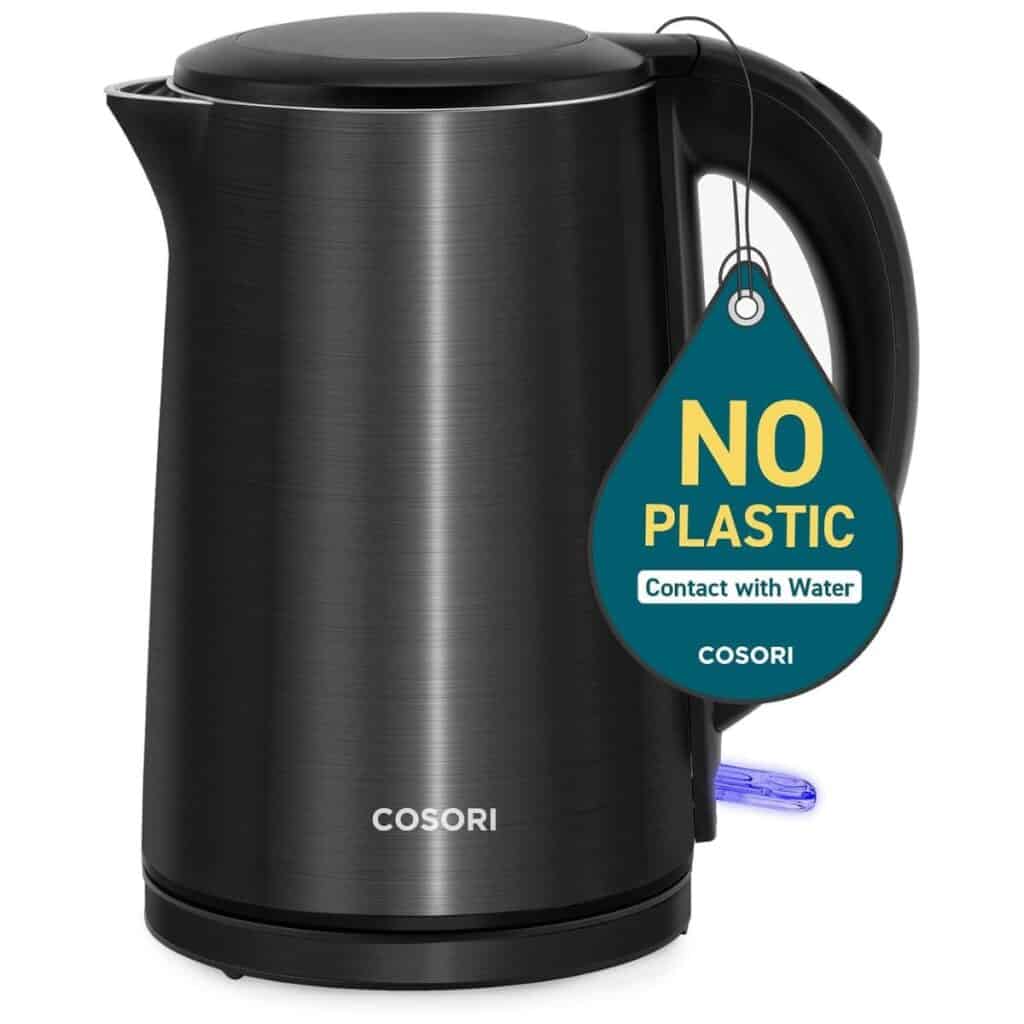
The problem was durability. As my long-term testing continued, the kettle gradually deteriorated. It didn’t give me enough confidence to keep recommending it for daily use.
Good materials got it on my radar. They weren’t enough to keep it there.
SAKI Luna Pro
SAKI’s temperature control and stainless steel water pathway made it a strong contender.
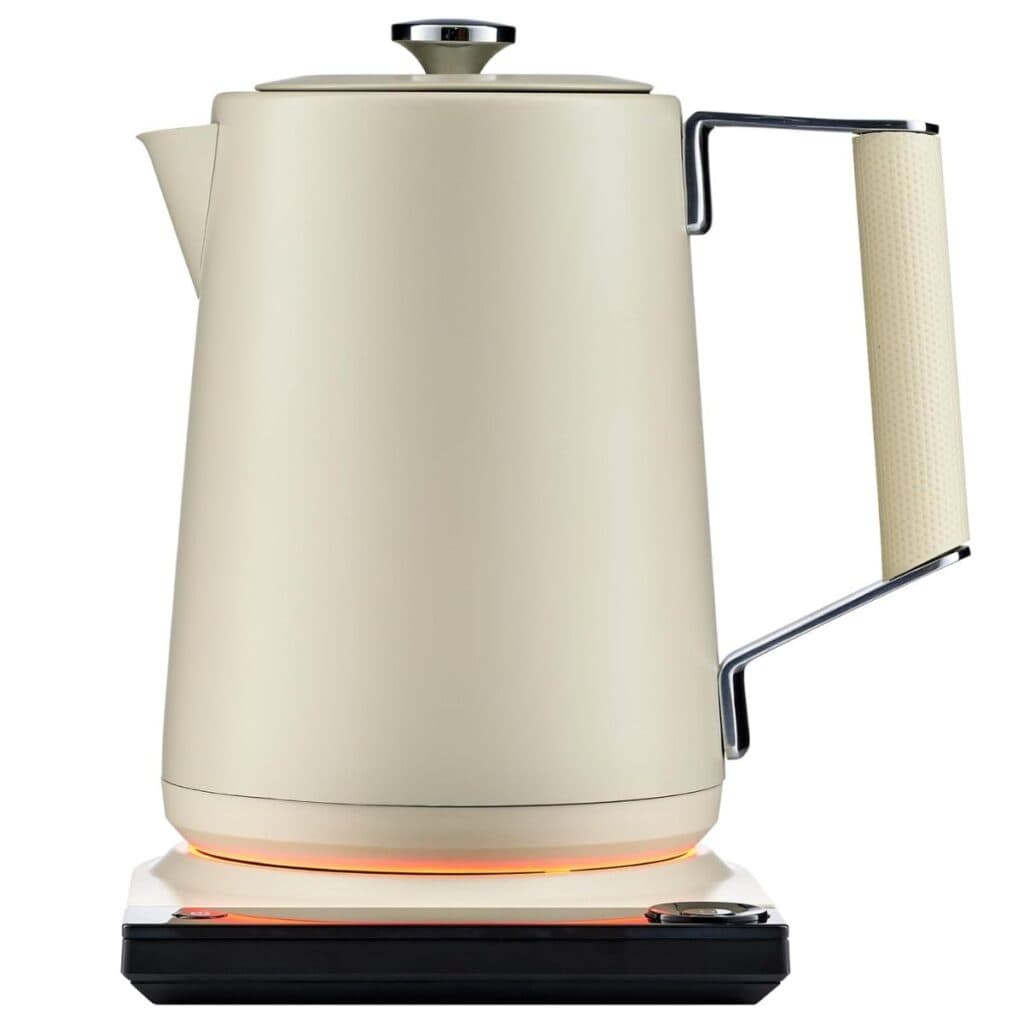
But the exterior paint chipped during my testing, and overall it didn’t feel as well made as the kettles I recommend. At this price, I expect a kettle to look and feel solid for years.
If you’re ready to spend in this range, I think you’re better served putting that money toward a more durable premium option.
Made In
I wanted to love this one by Made In. The built-in thermometer is genuinely useful, and the stainless steel construction is solid.
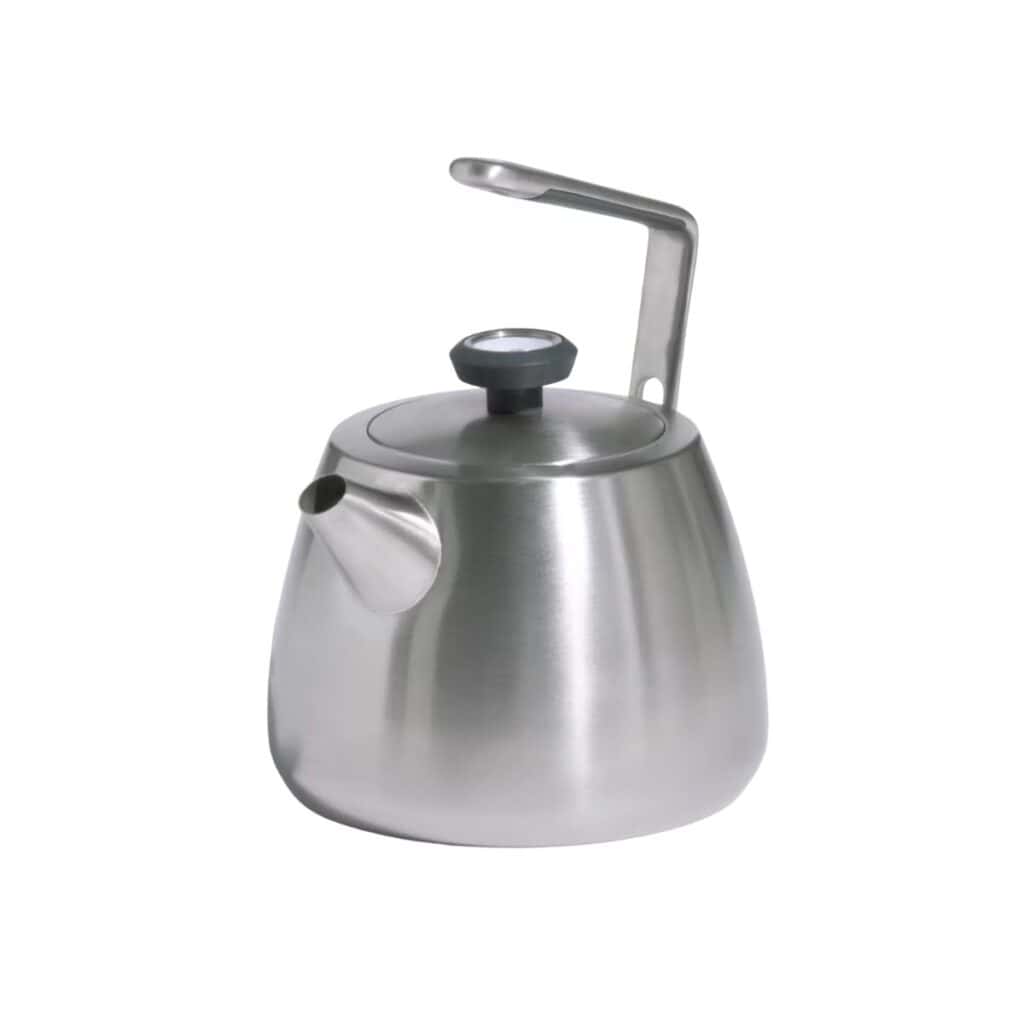
But the pour was horrible. Water came out in a slow, frustrating trickle, and getting a full cup took far longer than it should. For pour-over coffee, a controlled flow can be a feature. For everyday tea, it’s a chore.
Then there’s the whistle. It’s so loud it’s startling. In a house with kids, that’s not a small thing.
At this price, the basics need to be excellent. Pouring and whistling are the basics.
ASCOT K2
ASCOT markets the K2 as plastic-free. Its filter includes stainless steel and plastic.
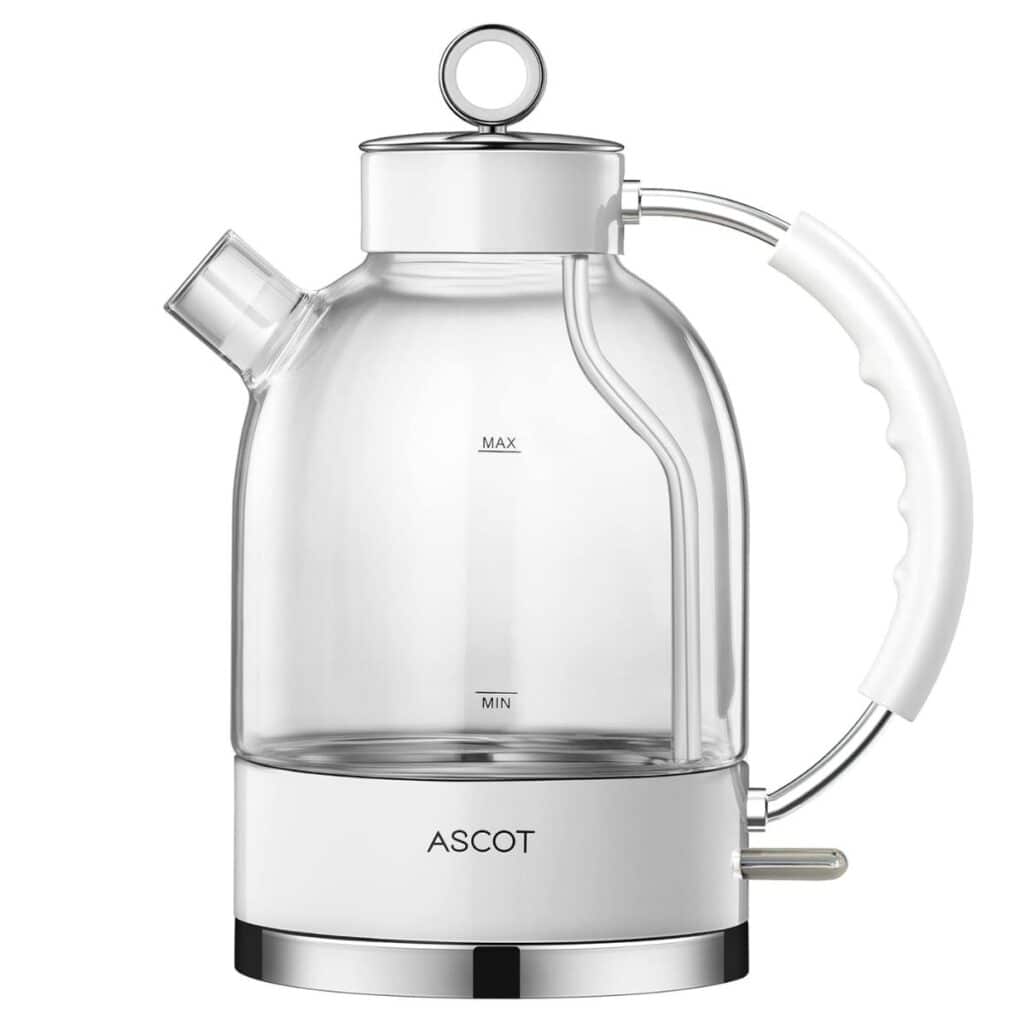
That’s the exact detail I look for, because the filter is where plastic tends to hide on kettles that look clean from the outside. It’s part of the path your water takes on the way out.
The problem is that the plastic-free headline doesn’t match the spec sheet. Most shoppers read the headline, not the parts list.
Those plastic filter components kept it from meeting my water-contact materials criteria.
Earlier Demeyere Kettles
Demeyere makes excellent stainless steel. That was never the issue.
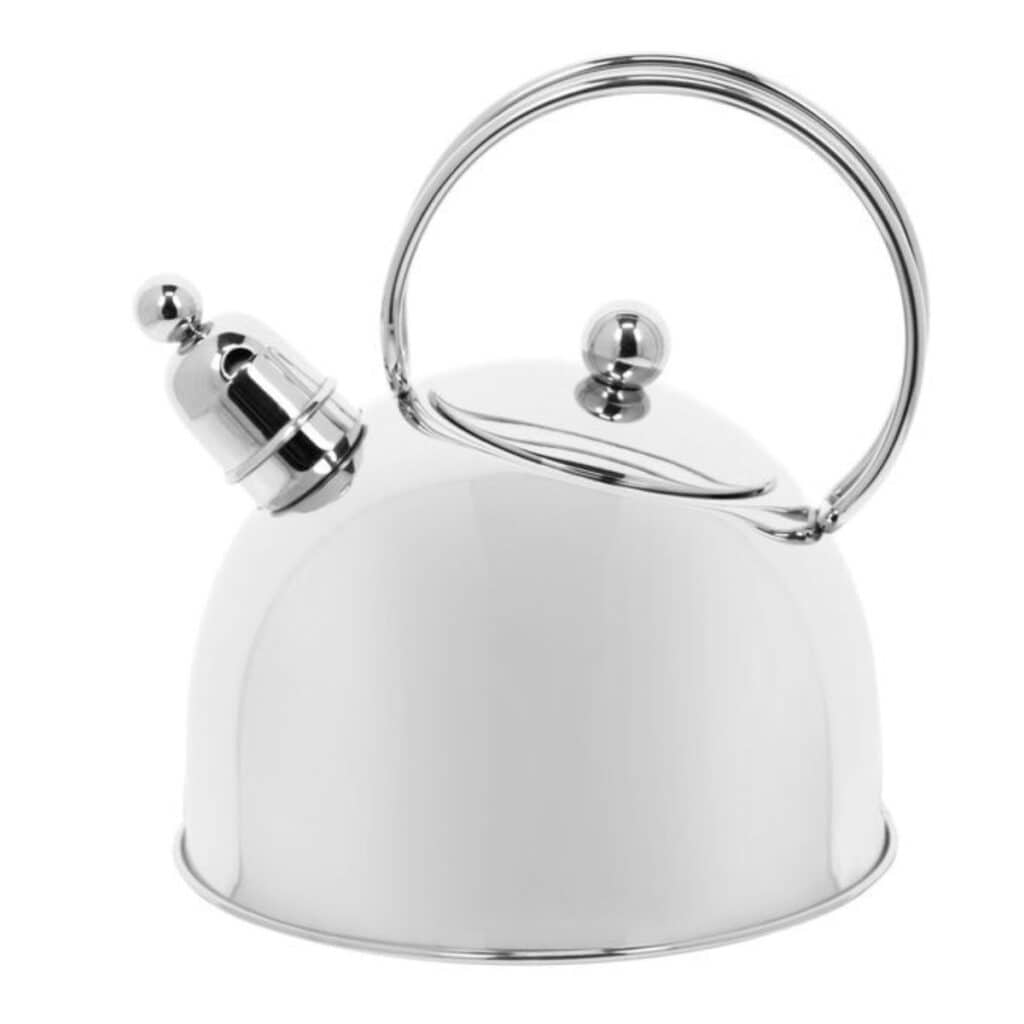
The earlier models I tested didn’t win me over on handling. The lid, the grip and the pour all felt like more work than they should have. A kettle can have great materials and still be frustrating to use every morning.
The redesigned Resto fixed those problems, which is why it’s one of my top picks. If you’re shopping Demeyere, check for model 1034385. That’s the version I tested and recommend.
Cuisinart PerfecTemp CPK-17P1
I understand why people like this kettle by Cuisinart. Six temperature presets and a keep-warm function are genuinely handy, especially if you drink different kinds of tea.
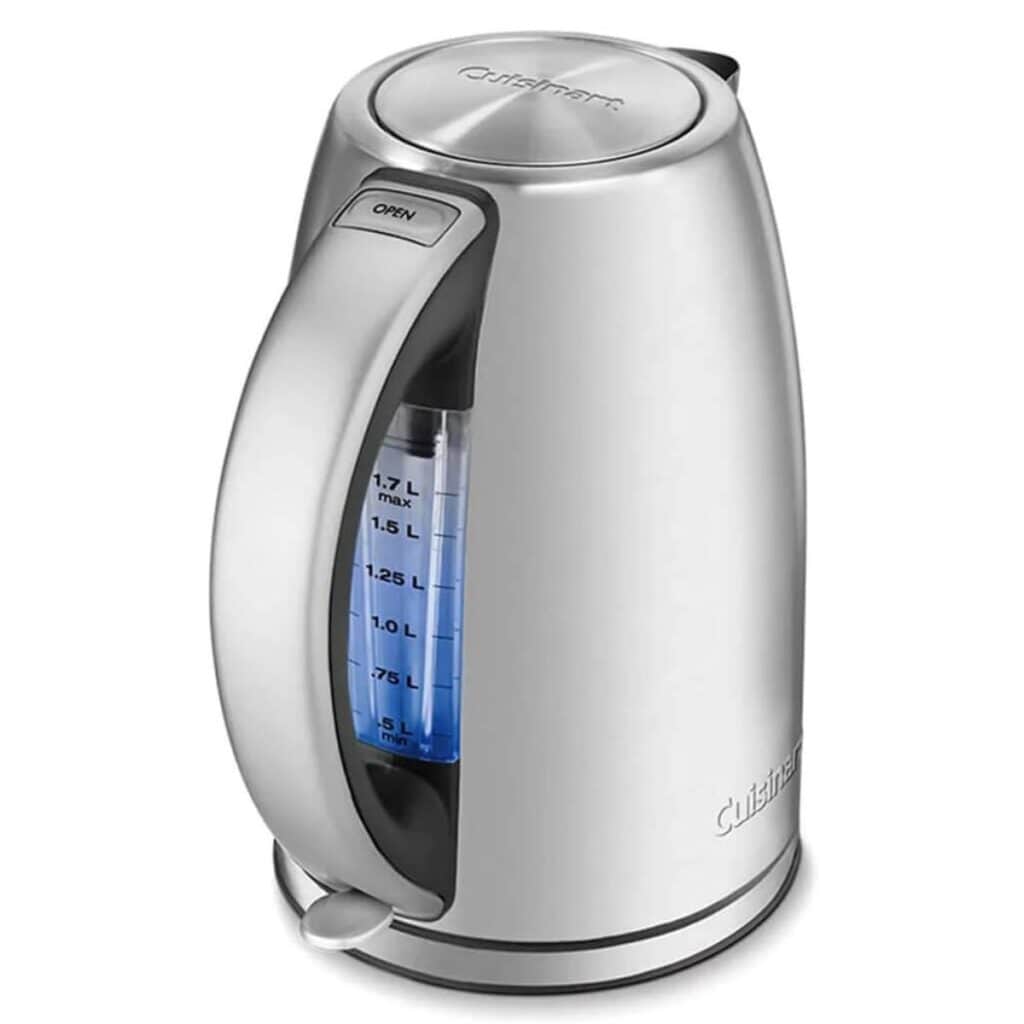
But the stainless steel exterior isn’t the whole story. The lid and filter assembly include plastic, and both are part of the water and steam pathway.
Those are the parts most shoppers never think to check. They’re also the parts I pay the most attention to. A stainless body with plastic in the filter and lid isn’t a plastic-free kettle, no matter how good the presets are.
EUROSTAR Plastic Electric Kettles
EUROSTAR electric kettles are inexpensive and I understand the appeal. But I couldn’t verify a plastic-free water and steam pathway on EUROSTAR’s plastic models, and that kept them off my list.
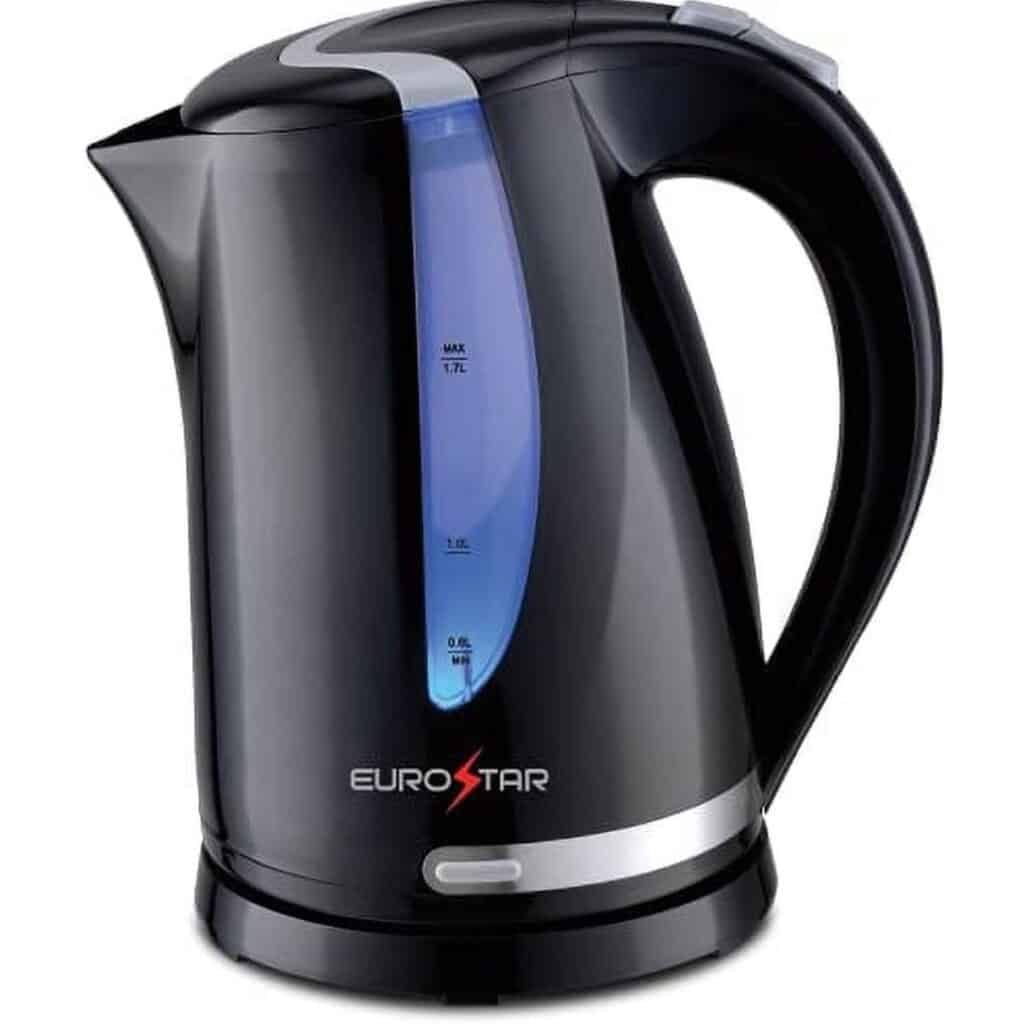
A BPA-free label (which does not mean BPS-free) doesn’t change that. It only tells you which chemical isn’t there, not what the plastic actually is.
MegaChef MGKTL1743
The low price of the MegaChef is tempting, but it’s a plastic-bodied kettle, and I couldn’t verify a plastic-free water and steam pathway or get a complete breakdown of the internal components. That kept it off my list.
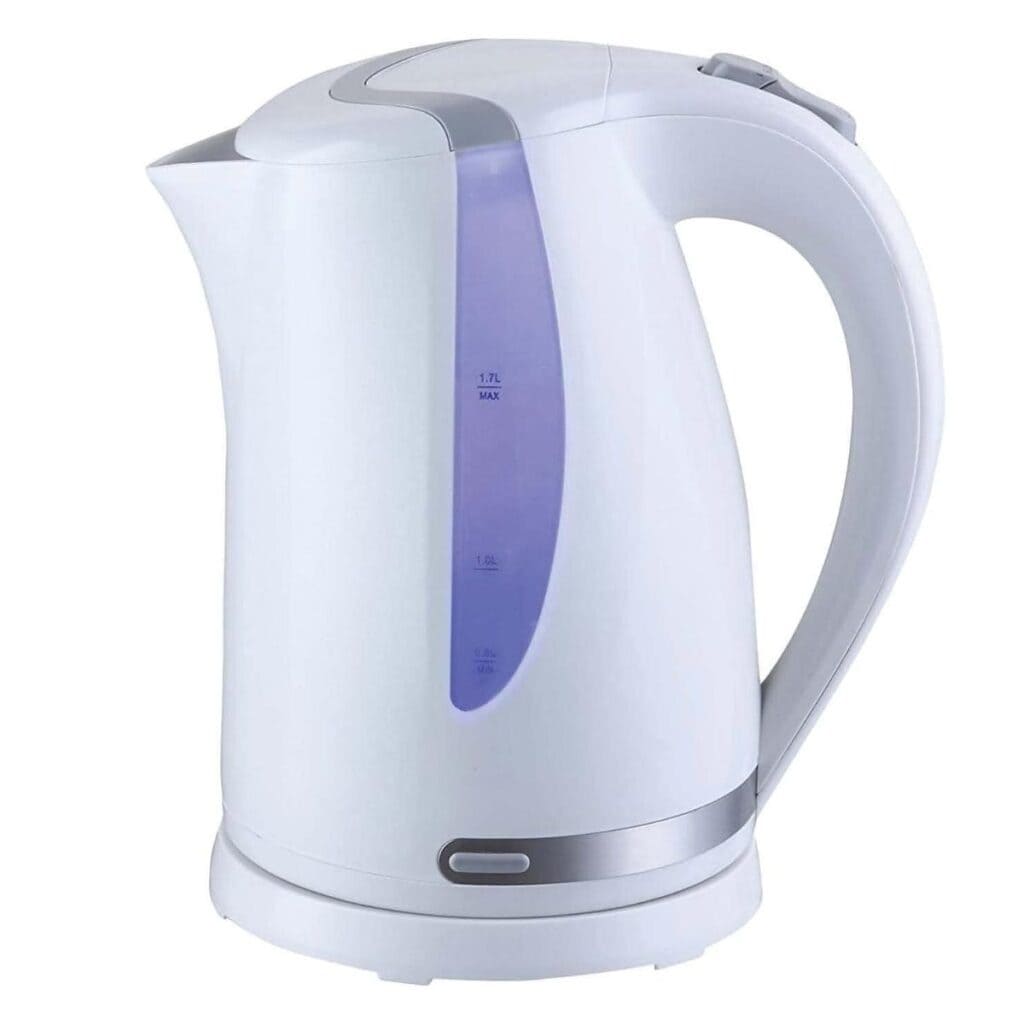
Boiling water fast is useful. It’s just not the bar for a non-toxic guide.
Mainstays Plastic Electric Kettle
Mainstays is one of the most affordable kettles out there, and I don’t take that lightly. Affordability matters to me too.
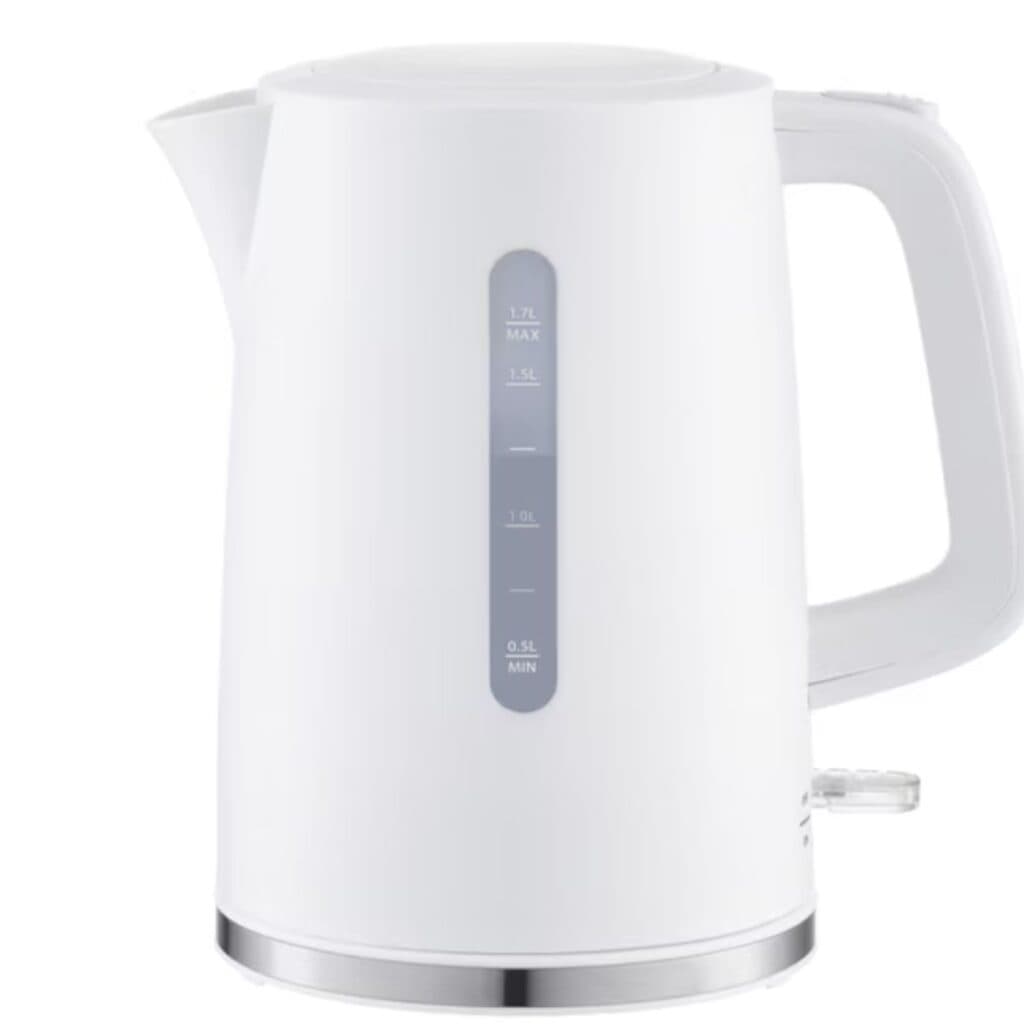
But it has a plastic water chamber, and that’s a hard no for this guide.
I also don’t want anyone to read “BPA-free” on the box and assume it meets my standards. It doesn’t. If budget is your priority, the Teabloom Virtuoso is the affordable kettle I actually recommend.
Peach Street Speed-Boil PE1300
At first glance, Peach Street looks like a great budget glass kettle. You can see the water, and the body is glass.
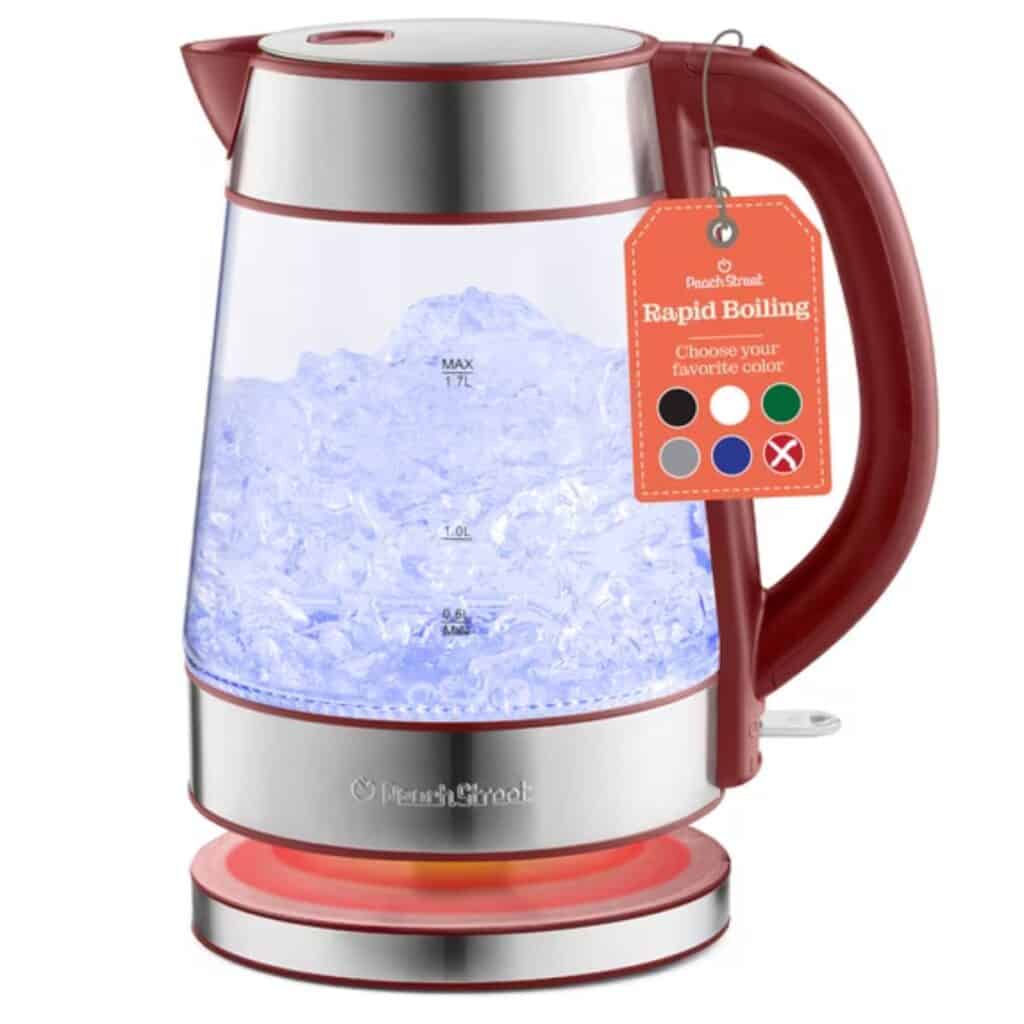
Look closer and the spout and parts of the lid are plastic. Steam hits the lid, and every pour runs through the spout.
This is one of the most common traps in this category. A glass kettle isn’t automatically a plastic-free kettle. You have to check every part the water touches on the way in and the way out.
Le Creuset Enamel-on-Steel Kettles
I love the way these look. Le Creuset’s colors are hard to beat on a stovetop (thankfully we got Caraway!).
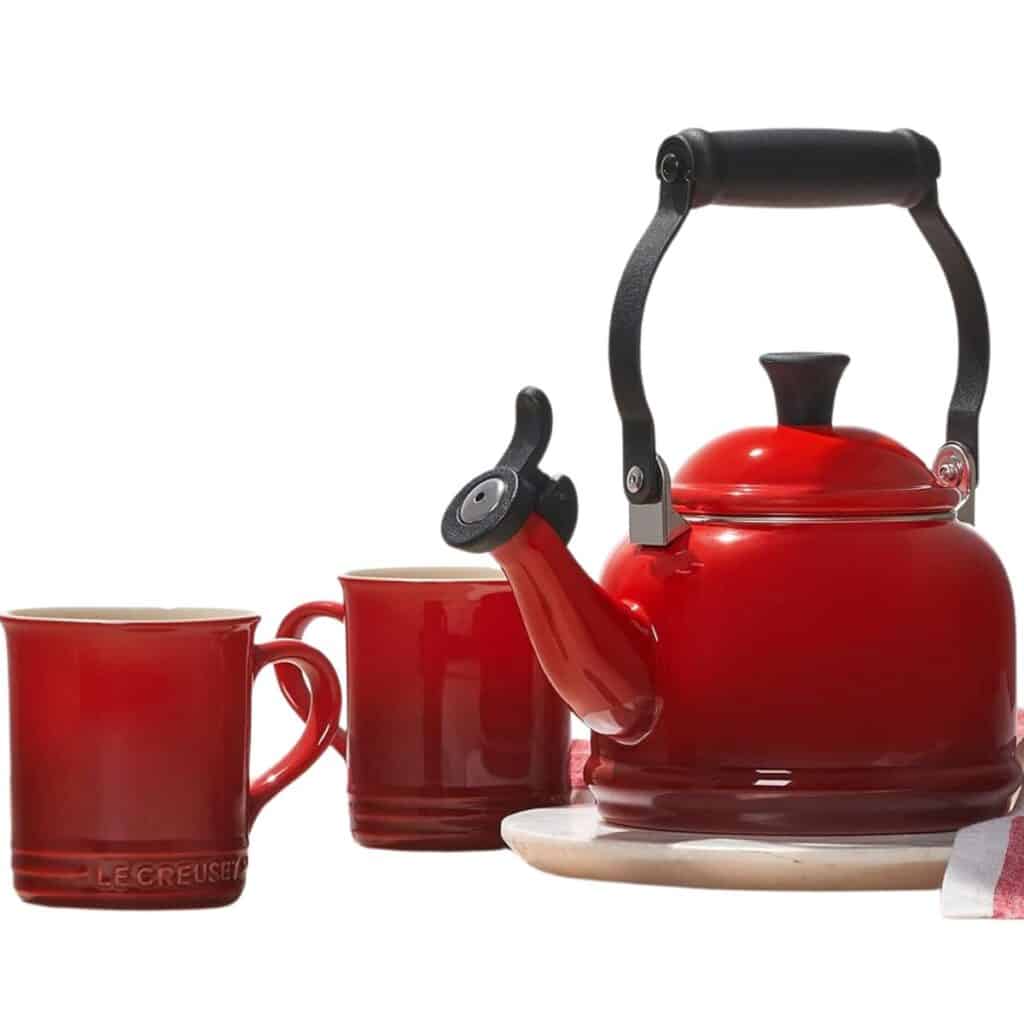
In my testing, chipping was the deciding issue. Le Creuset’s enamel-on-steel kettles began chipping two years in. A coating adds a layer I have to verify and a surface that can wear through.
Mr. Coffee Flintshire
The Flintshire whistle didn’t sound during my testing, which meant I couldn’t rely on its ready alert. Rust later developed inside, and those two problems were enough for me to rule it out.
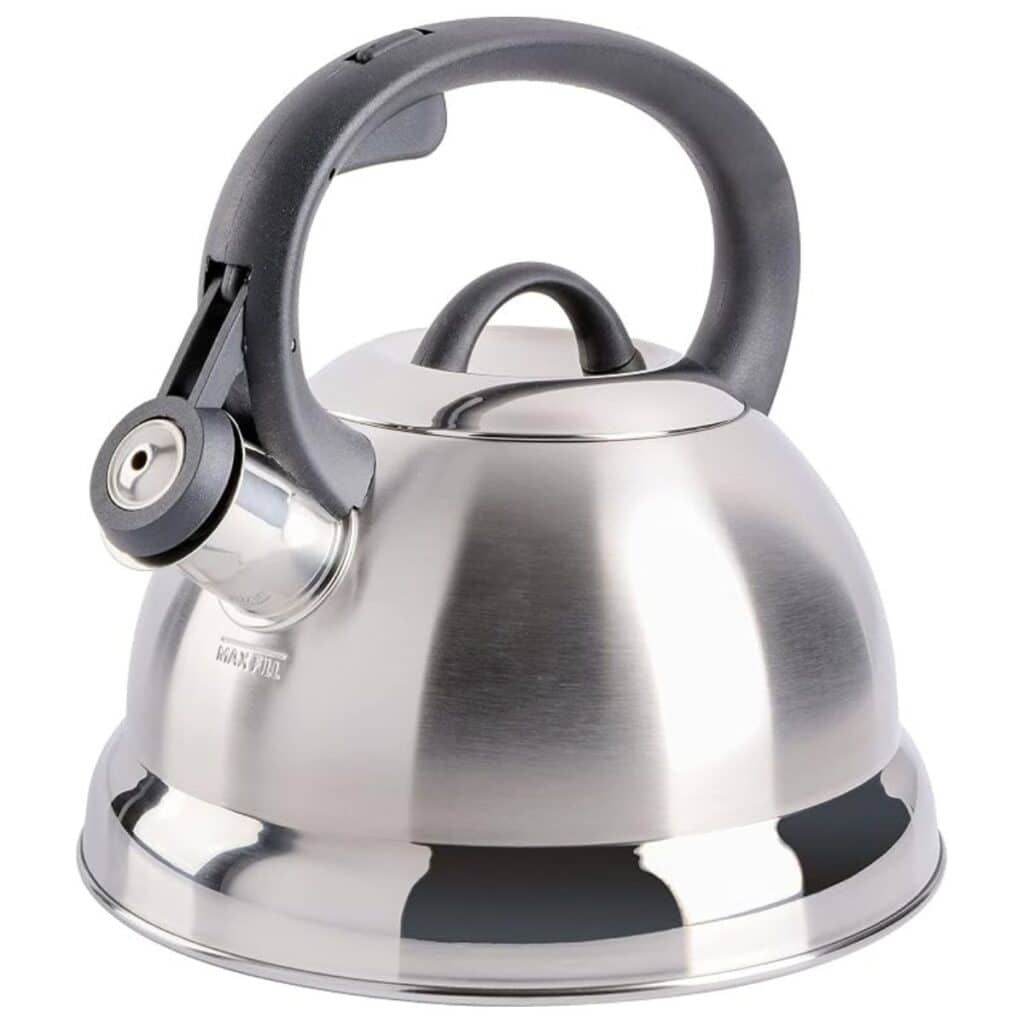
I expected a budget kettle to be basic. I didn’t expect it to fail at the basics.
Amazon Basics Stovetop Kettle
On paper, the Amazon Kettle looks like a smart budget buy. Stainless steel body, stainless lid, whistling spout, low price.
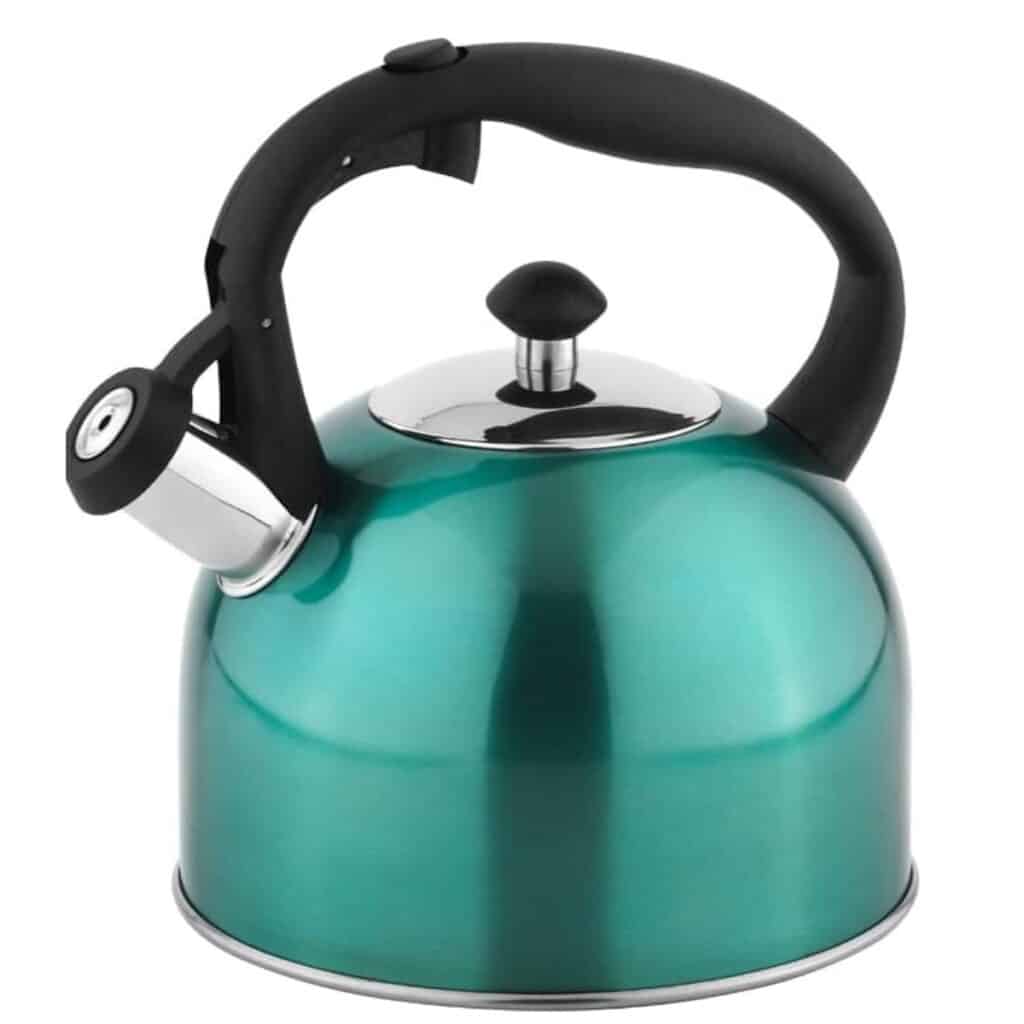
In my kitchen, it struggled with almost everything a stovetop kettle needs to do.
The whistle didn’t work, so I couldn’t rely on it to tell me the water was ready. The handle got hot. Steam leaked out around the lid, right where your hand goes to lift it. Then the handle started coming loose near the spout.
Any one of those would be a problem. All four together made it a kettle I wasn’t comfortable using, and price doesn’t make up for that.
Amazon Basics Electric Kettle With Glass Carafe (1.1 Quart)
The glass carafe makes the Amazon Basics Electric Kettle look like an easy budget pick. You can see the water, the measurement lines are clear, and it’s inexpensive.
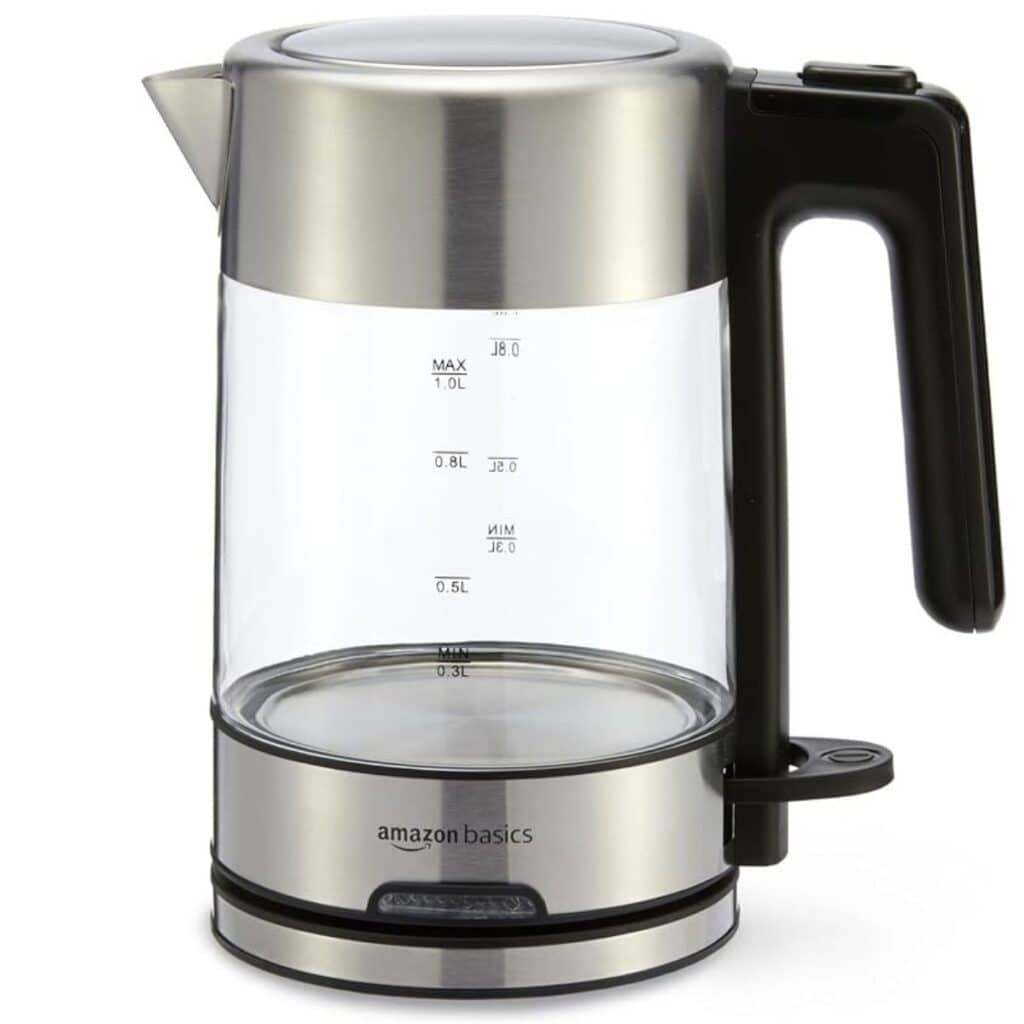
It didn’t last. First, the lid stopped closing properly. Then water began leaking from underneath the kettle. When the switch and automatic shutoff became unreliable, I stopped using it.
A glass body is a good start. But a kettle you use every day has to hold up for more than a few months. This one didn’t.
Viking 2.6-Quart Whistling Kettle
Viking has a lot going for it. Stainless steel construction, induction compatibility and a solid, well-made feel.
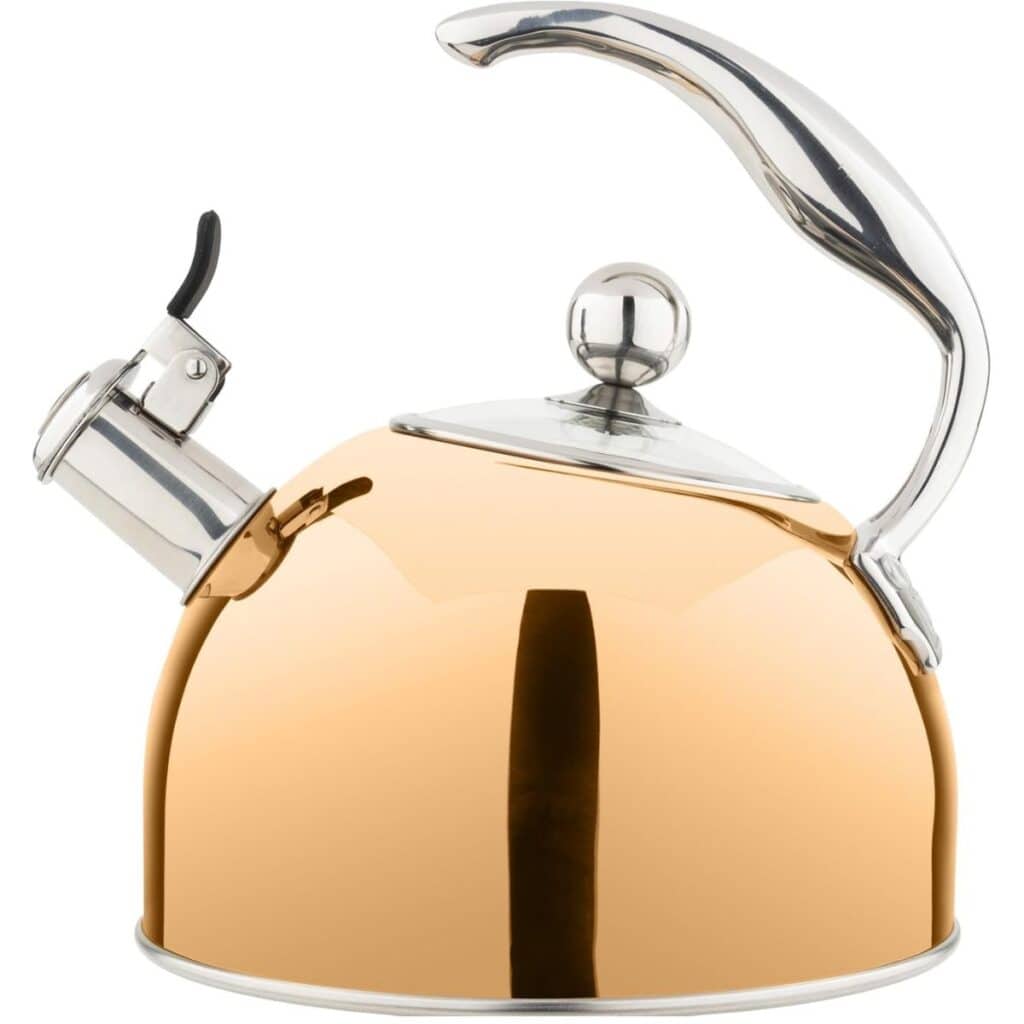
The handling is what kept it off my list. The handle got hot. The lid was awkward to remove. And filling around the fixed handle was a hassle every single time.
None of those sound huge on their own. Together, they made it a kettle I didn’t reach for. Viking itself recommends a pot holder until you know how the kettle behaves on your stove, especially on gas.
I want a kettle that’s easy to live with every morning. Viking is well built, but the kettles on my list are simply easier to use.
Toxic Materials In Tea Kettles: What I Avoid And Why
A good-looking kettle can still leave you guessing about what’s inside. The body is easy to see. The filter, lid underside, whistle and coatings usually take more digging.
I focus on what touches boiling water and steam, how those materials handle heat, and how clearly the brand explains its construction. My preference is to minimize plastic and unnecessary coatings along that path. That’s a buying standard, not proof that every kettle containing plastic is harmful.
Plastic In The Water And Steam Path
This is the big one. Plastic can hide in the filter, lid underside, spout cover and whistle, even on kettles with a stainless or glass body. Cuisinart’s PerfecTemp and ASCOT’s K2 both have stainless or glass bodies with plastic in the lid or filter.
Heat is the concern. In a 2025 University of Queensland study of polypropylene kettles, the first boil in a new kettle released almost 12 million nanoplastic particles per milliliter. Release dropped with repeated boiling, and hard tap water reduced it further.
The bigger picture is still unsettled. The FDA says current evidence doesn’t show that the microplastic and nanoplastic levels detected in foods pose a health risk. The UQ researchers also say long-term health effects need more study.
So here’s my position. Reducing plastic contact with boiling water is a reasonable preference with real data behind it. It’s not proof that every plastic kettle is harmful, and I won’t claim a plastic-free kettle eliminates microplastic exposure.
If you have a plastic kettle now: the UQ researchers found that boiling and discarding water several times reduced particle release more than rinsing.
BPA And The Limits Of “BPA-Free”
BPA is used in polycarbonate plastics and epoxy resins. NIEHS identifies it as a chemical that can affect hormone activity.
“BPA-free” answers one question. It doesn’t name the plastic, disclose additives, or show that nothing migrates at boiling temperatures. And replacements aren’t automatically better. A systematic review in Environmental Health Perspectives found BPS and BPF, two common BPA substitutes, are as hormonally active as BPA.
That doesn’t mean every BPA-free kettle contains BPS or BPF. The material has to be identified before anyone makes that claim. It does mean the label isn’t enough.
Enamel Coatings
Enamel is a glass coating fused to metal. Its safety depends on what’s in the glaze and colorants, and on the coating staying intact.
When Thailand’s Department of Science Service tested 94 enamelware samples, more than half of the decorated pieces exceeded the national cadmium limit. Undecorated pieces had no detectable lead or cadmium. That’s a market survey of enamelware in general, not a test of any kettle in this guide.
My reason for excluding enamel is simpler. I prefer an uncoated water-contact surface. A coating adds a layer I have to verify and a surface that can chip. That applies to the enamel kettles we tested, including Le Creuset’s enamel-on-steel models, not to every product those brands make.
Uncoated Aluminum Touching Water
Aluminum can transfer from uncoated food-contact products. Germany’s BfR found aluminum moving from uncoated trays into acidic foods, and advises keeping acidic and salty foods out of uncoated aluminum. Plain water is a different condition, and I haven’t found kettle-specific data.
Design matters here. Aluminum sealed inside a stainless steel base, like the Demeyere Resto’s encapsulated core, never touches your water. An uncoated aluminum interior does. I want that distinction documented before judging a kettle.
Unidentified Coatings
If a kettle has a coating, I want to know what it is and where it is.
PFAS have been authorized for some food-contact uses, including certain nonstick coatings. An exterior coating is a different situation from an interior one. Caraway’s ceramic coating is on the outside. Its water-contact interior is uncoated stainless steel.
Before trusting a coated kettle, I check:
- Does the coating touch water or steam?
- What is it made of?
- Does a “PFAS-free” claim cover that specific component?
- What happens if it chips?
Plastic Carrying Handles
A handle outside the water pathway is a different consideration from a plastic filter or lid underside exposed to hot water and steam. I check its construction, stability and comfort when lifting a full kettle.
Mr. Coffee and Amazon Basics didn’t lose their recommendations simply because they had plastic handles. The Flintshire’s whistle failed during my testing, and rust later developed inside. The Amazon Basics stovetop kettle had an unreliable whistle, escaping steam and a handle that became loose.
For Fellow, I tested the walnut handle version. Other versions use plastic handle components, so check the finish you’re ordering. I disclose those differences and judge handling alongside the kettle’s overall performance.
What I prioritize: disclosed materials throughout the water and steam path, relevant testing, easy cleaning, and replacement parts. Those details tell me much more than a stainless steel shell or a “non-toxic” badge.
Safest Materials To Look For In A Non-Toxic Tea Kettle
When I evaluate a tea kettle, I follow the water and the steam.
What holds the water? What heats it? What does steam hit on the way out? A filter, a lid underside, a whistle and a seal can all sit in that path, and none of them show up in a product photo.
My preference is a clearly disclosed water and steam pathway built from glass, uncoated stainless steel, or ceramic with relevant testing, with any silicone identified separately.
Borosilicate Glass
Borosilicate is my favorite material when I want to see exactly what’s happening inside the kettle. Glass manufacturer SCHOTT describes its borosilicate glass as having very low thermal expansion and high chemical durability. Low thermal expansion is what helps it handle repeated heating and cooling.
There’s a practical upside too. You can see limescale, residue and any damage without guessing.
But heat-resistant isn’t unbreakable. I follow the manufacturer’s stovetop, temperature and cleaning instructions. A glass body also isn’t the whole kettle. Glass kettles often have stainless steel lids, silicone seals, or plastic parts in the lid and spout.
What I want to see: The type of glass, every non-glass component and where it sits, and clear care instructions.
Uncoated Stainless Steel
Stainless steel is the backbone of most of my picks. It’s durable, easy to clean, and works on every stovetop when the base is built for induction.
Brands often list grades like 304, 18/8 or 18/10. Those describe the alloy. They aren’t a certification of the finished kettle.
I also don’t call stainless steel “zero-leaching.” Stainless steel contains nickel and chromium, and metal transfer can happen. In an Oregon State University study, tomato sauce cooked in stainless steel picked up nickel and chromium.
Leaching depended on the grade, cooking time and how new the steel was, and dropped with repeated use.
Acidic sauce simmered for hours is a very different condition from boiling water, so I don’t apply those numbers to kettles.
Kettle-specific data exists, and it’s mixed. In a Danish study, 10 of 26 electric kettles released more than 50 µg/L of nickel into water. Lead and chromium release was not significant. That study is from 2000, and the failing kettles were redesigned or withdrawn.
A later BfR study of 11 electric kettles found only low metal release, which decreased over consecutive days.
If you have a nickel allergy or a medically advised low-nickel diet, ask the brand about the interior steel grade and follow your clinician’s guidance. I won’t call a stainless kettle nickel-free without specific evidence.
What I want to see: The disclosed grade, which parts touch water and steam, and finished-product testing rather than broad promises.
Ceramic With Relevant Testing
A fully ceramic kettle can mean no metal and no plastic in the water path. But “ceramic” is a broad word. What matters is the finished glaze.
The FDA has documented that some ceramic foodware leaches significant amounts of lead from food-contact surfaces, and sets lead-leaching limits for ceramicware. The CDC notes that lead can leach when a glaze is improperly fired or breaks down with wear, and that chips and cracks increase leaching.
Testing conditions matter too.
The EU’s Joint Research Centre has pointed out that standard lead and cadmium migration tests for ceramics run at room temperature, which doesn’t reflect cooking. A pass at room temperature tells you less about a product that gets heated every day.
Neither a white glaze nor a handmade look proves anything.
What I want to see: Food-contact suitability, model-specific lead and cadmium migration results, and the test method and conditions used.
Clearly Disclosed Silicone Seals
Silicone shows up in kettle seals, lid gaskets and around temperature probes. The Teabloom and Fellow kettles in this guide both use it.
I list silicone separately from plastic. It’s a synthetic polymer with a different chemical structure. Calling it “natural” or “made from sand” doesn’t establish the safety of a finished seal.
Silicone can contain cyclic siloxanes (D4, D5, D6). In one migration study, siloxanes moved into ethanol-based food simulants but were not detected in milk after six hours at 40°C. I haven’t found strong data on silicone seals in boiling water specifically.
Regulators do set standards. In the US, rubber articles for repeated food contact, including silicone, must meet the FDA’s extraction limits. Germany’s BfR Recommendation XV sets conditions for food-contact silicones, including permitted starting materials and limits on volatile compounds in the finished rubber.
For a kettle, I want to know:
- Does the silicone touch boiling water, steam, or only condensation?
- Is it a small ring or a larger component?
- Can it be removed, cleaned and replaced?
- What backs up a “food-grade” or “LFGB” claim? The phrase alone isn’t a lab report.
What I want to see: Where the silicone sits, food-contact documentation, and replacement parts.
The Entire Water And Steam Path Matters
The most useful disclosure breaks the kettle into parts.
| Component | What I Check |
|---|---|
| Water chamber | Glass, stainless steel, ceramic, or a coating? |
| Base & heating element | Does water touch the element plate, and what is it made of? Is any aluminum fully sealed? |
| Lid underside | Does steam hit plastic, metal or silicone? |
| Spout filter | Stainless mesh, plastic mesh, or none? |
| Spout & whistle | Metal, or plastic parts in the steam path? |
| Seals & gaskets | Silicone, rubber, or undisclosed? |
| Handle & exterior | Material, heat, and whether coatings can chip |
A plastic handle outside the water path is a different compromise from a plastic filter sitting in boiling water. These details let me explain the actual tradeoffs instead of handing out a verdict based on one material name.
What Makes A Materials Claim Worth Trusting?
I give the most weight to information that answers a specific question:
- A component breakdown: Which material is used where?
- An identifiable test report: Which product or part was tested?
- Relevant conditions: Was it tested hot, repeatedly, and for long enough?
- Clear results: Which substances, and what detection limits?
- Care and parts: How do you descale it, and can you replace a lid, seal or whistle?
A report on a brand’s cookware says nothing about its kettle. A test on the body doesn’t cover the filter.
My standard is simple. I want to know what touches the water, see the evidence behind important claims, and be able to maintain the kettle for years. That’s a much better reason to recommend a kettle than “non-toxic” on the box.
Greenwashing In The Tea Kettle Aisle: Claims I Don’t Take At Face Value
Kettle marketing is good at telling you what a kettle isn’t. It’s much worse at telling you what it is.
“Non-Toxic” On The Box
There’s no certification behind “non-toxic.” The FTC’s Green Guides say brands making the claim should have competent and reliable scientific evidence for it, or qualify it clearly.
So I ask the brand: non-toxic based on what testing, of which parts? Brands that know their materials answer specifically. Brands that reply “all my products are safe” have told me what I need to know.
“Plastic-Free” That Stops At The Body
A kettle gets marketed as plastic-free because the body is glass or steel. Then the filter, lid underside or handle turns out to be plastic.
ASCOT markets plastic-free and discloses a plastic filter. The disclosure is there if you dig. The headline just doesn’t match it.
Product Names That Do The Selling
“Stainless Steel Electric Kettle” is a product name, not a construction disclosure. Brands also reuse names across models. KRUPS sells kettles with stainless bodies and kettles with plastic construction. Demeyere’s earlier kettles and the redesigned Resto share a name but not my recommendation.
That’s why I list model numbers. Check yours before ordering.
“Lead-Free” Ceramic
The FDA issued guidance after imported pottery labeled “lead free” turned out to contain extractable lead. One cause: potters switching to lead-free glazes but firing in old kilns that still held lead residue.
That guidance targeted traditional pottery, not kettles. The lesson still applies. A lead-free glaze and a lead-free finished product are different claims.
“Eco-Friendly” And “Sustainable”
The FTC warns against broad environmental benefit claims like “eco-friendly” because they’re nearly impossible to substantiate.
For a kettle, the most sustainable feature is boring. It lasts. So I skip the eco language and look at durability and replacement parts instead.
My rule: if a claim can’t name the part it applies to, it doesn’t count.
How I Vetted These Non-Toxic Tea Kettles
Over seven years, I’ve tested 21 tea kettles in my own kitchen. My evaluation combines materials research with everyday use: making tea, filling and pouring, cleaning, and watching how each kettle holds up over time.
I Purchase the Kettles
I buy the kettles I test so I receive the same retail product, packaging and instructions you would. Each one has to earn its recommendation through its construction and performance.
I Investigate the Materials
I review the listing, manual and available component information, checking the interior, lid underside, filter, spout, whistle and seals. When a material isn’t disclosed, I contact the manufacturer directly.
Some kettles are ruled out at this stage. Others move into daily use once I have enough information about their water and steam pathway.
I Test Them in Everyday Use
The kettles that meet my materials criteria go into rotation for real tea making in a busy household with three kids. I follow the manufacturer’s heat settings and operating instructions throughout testing.
For stovetop models, I assess boiling speed and whistle performance. For electric models, I evaluate the controls, temperature settings and automatic shutoff. I pay attention to whether those features remain dependable with continued use.
I Check Handling and Pouring
A kettle needs to feel manageable when it’s full of hot water. I check:
- How securely the lid fits and how easily it comes off.
- How the handle feels when the kettle is full and hot.
- Whether water pours smoothly without dribbling.
- How easy the opening is to fill.
- Whether steam escapes near my hand.
I also explain handling limitations. A metal handle that stays comfortable on my stove may behave differently on yours.
I Evaluate Cleaning and Durability
I clean and descale each kettle according to its instructions, checking how easily I can reach the interior and remove buildup.
With continued use, I look for changes in the finish, lid fit, handle stability and overall performance. A good first impression matters less to me than a kettle that remains reliable.
I Reevaluate My Recommendations
Each year, I revisit the brands and purchase new units to check for changes in materials, construction or performance. I identify the model I recommend because different versions from the same brand can deliver different experiences.
Reader requests help shape this process, too. Six of the 21 kettles I’ve tested came directly from community suggestions.
My recommendations change when the kettles do.
Frequently Asked Questions About Non-Toxic Tea Kettles
Caraway is my favorite stovetop tea kettle after four years of use with no exterior chipping, reliable boiling and a smooth pour.
For heating water and steeping loose-leaf tea in one vessel, I love the Teabloom Virtuoso.
Fellow is my electric pick for temperature control, with its plastic and silicone components disclosed in the review above.
I prioritize uncoated stainless steel, borosilicate glass and ceramic with relevant testing documentation. Check the lid underside, filter, spout and whistle components, too. A glass body or stainless steel exterior doesn’t tell you everything about the surfaces that touch water and steam.
An uncoated, food-contact stainless steel interior is one of my preferred options for boiling water. But “stainless steel kettle” doesn’t describe every component. I still check for plastic filters, lid undersides, water-level windows and undisclosed coatings before recommending a model.
First, distinguish a plastic-free water pathway from a completely plastic-free appliance.
Fellow is my preferred electric option in this guide, but it is not entirely plastic-free. Its interior and lid underside are stainless steel, with silicone around the temperature probe and at the lid gasket.
The electric base is plastic. The version I tested has a walnut handle and lid pull. If you want to avoid plastic throughout the kettle itself, consider one of my recommended stovetop options instead.
I like glass for visibility and stainless steel for resistance to accidental knocks. Glass needs more careful handling, and only models specifically approved for stovetop use should go on a burner. For either material, I check the complete construction rather than choosing by appearance alone.
No. BPA-free addresses one chemical; it does not mean the kettle contains no plastic or verify every component. I look for specific material disclosures, including the lid, filter and spout, rather than relying on that claim.
The Caraway and redesigned Demeyere Resto featured above work on induction. The Teabloom Virtuoso does not. Fellow’s electric kettle uses its own powered base and should never be placed on a stovetop. Check the exact model before ordering, especially when a brand sells several different kettles.
Only if it is designed for brewing as well as heating water. The Teabloom Virtuoso has a removable infuser for steeping directly in the vessel, which is one reason I enjoy using it. Fellow’s electric kettles are designed for water only, so steep your tea separately after heating.
They may be mineral deposits rather than rust. Heated water can leave buildup that changes the appearance of the interior. Follow your kettle’s descaling instructions before assuming the metal is corroding.
If spots persist, the surface is pitted or material is flaking, contact the manufacturer rather than dismissing it as ordinary scale.
Follow the instructions for your exact model. Use gentle cleaning tools and a manufacturer-approved descaling method for mineral buildup. Avoid steel wool and abrasive pads that can damage the surface.
Dishwasher compatibility varies: an electric kettle and its base should not be submerged or put in the dishwasher unless the manufacturer explicitly permits it.
Still Deciding? Here’s What I’d Choose
- For an everyday stovetop kettle: Caraway. Four years of use, no exterior chipping, and a consistently smooth pour. It’s still my favorite.
- For loose-leaf tea: Teabloom Virtuoso. I love heating and steeping in one vessel, with a thermometer that helps me get the temperature right for each tea.
- For electric temperature control: Fellow Stagg EKG.
- For a larger stovetop kettle: The redesigned Demeyere Resto. A great option when you regularly heat more water, with induction compatibility.
- For a ceramic option: Xtrema, when available. It’s worth checking back if ceramic is your preference.
A Kettle Should Earn Its Place in Your Kitchen
After years of updating this guide, I’ve become more selective about what earns a recommendation. A kettle needs to be easy to live with: something you can comfortably fill, heat, pour and clean every day.
That’s why I’m happy to keep this list short. I want you to find a kettle you’ll enjoy using for years, and I’ll keep revisiting these recommendations with that same expectation.
Is there a kettle you’d like me to test next? Leave the exact brand and model in the comments. Six of the kettles we’ve tested came directly from community requests, and your suggestions continue to shape this guide.
More Non-Toxic Favorites for Your Daily Brew
I’ve spent years testing what goes into our daily cups, from the tea and coffee to the equipment we use. These guides will help you take the next step:
- Non-Toxic Coffee Makers: My tested picks, with a closer look at the materials touching your brew.
- Non-Toxic & Organic Coffee Brands: The coffees we recommend after testing for taste and reviewing sourcing and testing disclosures.
- Non-Toxic & Organic Tea Brands: A guide to choosing your next tea, including ingredients and tea bag materials.
- Water Filters for Reducing PFAS: What to look for in filtration, including certifications and contaminant reduction claims.
📌 Save This Guide For Later
Save this guide on Pinterest for later! Keep my tested non-toxic tea kettle picks handy for your next kitchen upgrade, or send it to a fellow tea lover.
Sources & Further Reading
If you want to dig into the research behind this guide, these are the sources I relied on. I’ve grouped them by topic so you can go straight to what you care about most.
Plastic & Microplastics
- University of Queensland: Plastic Particles From Kettles: The 2025 study measuring nano- and microplastic release from new polypropylene kettles, and how repeated boiling and hard water changed it.
- McGill University Study in Environmental Science & Technology: The research on plastic tea bags releasing billions of microplastic particles into hot water.
- FDA: Microplastics and Nanoplastics in Foods: The FDA’s current position on microplastics in food, including where it says the evidence stands.
BPA & “BPA-Free” Alternatives
- NIEHS: Bisphenol A: What BPA is, where it’s used, and why it’s studied as a hormone-disrupting chemical.
- Environmental Health Perspectives: BPS and BPF Systematic Review: The review comparing the hormonal activity of common BPA replacements to BPA itself.
Silicone
- Siloxane Migration From Silicone Products (PubMed): Migration testing of cyclic siloxanes from silicone into milk, formula and food simulants.
- 21 CFR 177.2600 (eCFR): The FDA regulation covering rubber articles, including silicone, intended for repeated food contact.
- BfR Recommendations on Food Contact Materials: Germany’s database of food-contact recommendations, including Recommendation XV on silicones.
Stainless Steel & Metal Release
- Oregon State University: Stainless Steel Leaches Nickel and Chromium: How steel grade, cooking time and repeated use affected nickel and chromium transfer into tomato sauce.
- DTU: Nickel Release From Electric Kettles: The Danish study that tested 26 electric kettles for nickel, chromium and lead release.
- BfR: Metal Release From Coffee Machines and Electric Kettles: Germany’s follow-up testing of electric kettles for metal release.
Ceramic, Glaze & Enamel
- FDA CPG 545.450: Lead in Ceramicware: The FDA’s compliance guidance and lead-leaching limits for ceramic foodware.
- FDA: “Lead Free” Labeling Guidance: Why the FDA warned against “lead free” labels on pottery that still released lead.
- FDA: Questions and Answers on Lead-Glazed Traditional Pottery: How lead ends up in pottery made with lead-free glazes.
- CDC: Lead Poisoning From Ceramic Dinnerware: A case report explaining how worn glazes, chips and cracks increase lead leaching.
- EU Joint Research Centre: Migration Testing of Ceramic and Enameled Bakeware: Why room-temperature migration tests may not reflect real cooking conditions.
- Thailand Department of Science Service: Heavy Metals From Enamel Ware: Market testing of decorated and undecorated enamelware for lead and cadmium.
Aluminum, Coatings & PFAS
- BfR: Aluminium Transfer From Uncoated Trays to Food: Germany’s research on aluminum moving into acidic foods from uncoated containers.
- FDA: Authorized Uses of PFAS in Food Contact Applications: Where PFAS have been permitted in food-contact materials, including some nonstick coatings.
Glass
- SCHOTT: Borosilicate Glass: Technical overview of borosilicate’s thermal and chemical properties from one of its original manufacturers.
Marketing Claims
- FTC Green Guides: Non-Toxic Claims (16 CFR 260.10): What the FTC expects from brands that call a product “non-toxic.”
- FTC Green Guides: General Environmental Benefit Claims (16 CFR 260.4): Why vague claims like “eco-friendly” are hard to substantiate.
I also reviewed manufacturer specifications, user manuals and parts diagrams for every kettle in this guide, and contacted brands directly when their materials weren’t clear. Research in this are

Steal My Non-Toxic Cleaning Checklist!
Believe us, it’s the BEST…. and it’s free. Does it really get any better than that?! Sign up for our newsletter and get this free checklist to clean your home without any harmful chemicals!







A huge thanks to Danielle, this information is valuable to me. I’ve gone threw 2 well made, what I believed to be safe, brands I know from my 68 yrs. life. I am fed-up after a mere 18 months of 2 failures. I take this extremely serious.
I now am armed with great information to try once more.
Thank you so much for this — it truly means a lot 🤍
And I hear you… that kind of repeated disappointment is exactly what led me down this path in the first place. So many “well-made” and trusted brands just aren’t built the same anymore, especially when it comes to the materials used inside.
The fact that you’re taking this seriously and doing the research now is everything — that’s how we start making better, longer-lasting choices for our health and our homes.
About the Ascot – what about that silicone filter at the end of the spout?
I’m not comfortable with that, even if it is not plastic.
That’s a fair concern. Silicone is different from plastic, but I completely understand wanting to avoid it around boiling water altogether. If that’s your preference, I’d skip the Ascot and look at the Demeyere stainless steel kettle instead. It’s made from high-quality 18/10 stainless steel with no coating, so it’s a much simpler option material-wise. We also include the Quickone if you want a more affordable stainless steel choice. We’ll make the silicone component on the Ascot clearer in our next update too. Thanks for bringing it up!