 Shop My Favorite Non-Toxic Gifts Of 2026!
SKL is reader supported. When you buy through links on our site, we may earn affiliate commission. Learn more here.
Finding the best non-toxic coffee maker means looking past the glass carafe and the “BPA-free” sticker. What matters is everything your water and coffee touch on the way to your cup: the reservoir, the heater, the tubing, the showerhead, the basket, and the filter.
Coffee is serious business in our house. I’m a mom of three and a full-time blogger, so coffee gets me through school mornings, deadlines, and everything in between.
My husband was born and raised in Italy, and we split our year between Italy and the US. We usually have three coffee makers on the counter at once, because some mornings call for a moka pot and some call for a full pot of drip.
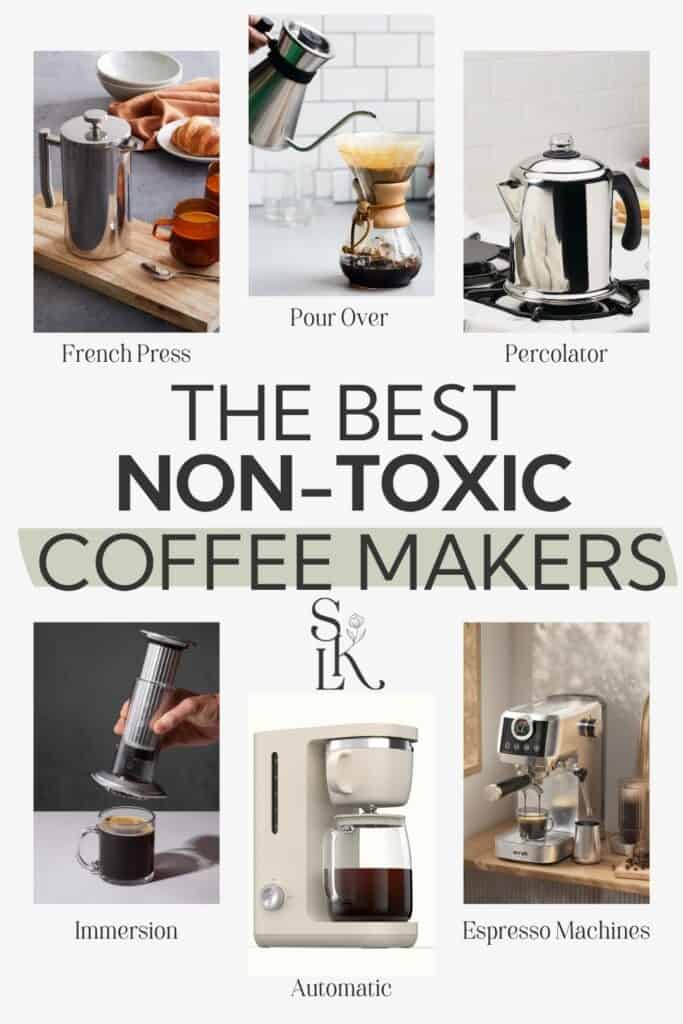
Over the last seven years, I’ve tested more than 30 coffee makers for this guide. My newest addition is Caraway’s 10-Cup Coffee Maker, which spent two months in my kitchen before earning its spot.
Every pick below was chosen for its materials first. I prioritize borosilicate glass, uncoated stainless steel, and food-contact ceramic, and I flag silicone wherever it shows up. Then it had to make coffee worth getting out of bed for, and fit into real family life.
My Top Non-Toxic Coffee Maker Picks (At a Glance)
- Best Automatic Coffee Maker: Caraway 10-Cup Coffee Maker
- Best Programmable Non-Toxic Coffee Maker: Simply Good Coffee THE BREWER
- Best Glass Pour-Over: Chemex Six Cup Classic
- Best Stainless Steel French Press: Frieling Double-Walled French Press
- Best Stainless Steel Moka Pot: Bialetti New Venus 6-Cup
- Best Cold Brew Maker: Ovalware Airtight Cold Brew Maker, 1.0L
Whether you want a pot ready when you wake up, a single perfect pour-over, or espresso-style coffee from the stovetop, there’s a non-toxic option here for your routine and budget.
Each review breaks down exactly what your coffee touches, why it made my list, and how it held up in our kitchen, including the tradeoffs.
Safe vs. Not
Coffee Maker Materials: What I Avoid & What I Look For
Before we get into the reviews, here’s the short version of what matters to me when choosing a non-toxic coffee maker.
Materials & Claims I’m Cautious About
- Plastic Touching Hot Water Or Coffee: Brew baskets, showerheads, and internal tubing deserve just as much attention as the carafe. I prioritize glass and stainless steel alternatives wherever possible.
- Plastic Water Reservoirs: Even when the water starts cold, it is still sitting in plastic. My top automatic picks use glass reservoirs; machines with plastic tanks belong in the low-tox category.
- Undisclosed Coatings & Internal Components: A beautiful stainless steel exterior does not tell me what is inside. I want brands to identify the materials throughout the water and coffee pathway.
- “BPA-Free” As The Whole Selling Point: It addresses one chemical, but does not mean plastic-free or tell us everything about the material.
- Vague “Non-Toxic” Marketing: I look for specific material disclosures and relevant testing that explain what a brand’s claim actually means.
Materials & Features I Prioritize
- Borosilicate Glass: For reservoirs, carafes, and pour-over brewers, glass makes the brewing setup straightforward and easy to inspect.
- Uncoated Food-Contact Stainless Steel: A practical choice for filters, brew baskets, showerheads, and water pathways.
- Food-Contact Ceramic With Clear Glaze Information: For ceramic drippers, I look for information about lead and cadmium testing rather than assuming every glaze is the same.
- Clearly Disclosed Silicone Seals: Several picks use silicone for seals or connections. I identify it separately so you can choose according to your own material preferences.
- Accessible Parts & Easy Cleaning: A brewer should be practical to maintain. Removable filters, accessible reservoirs, and available replacement parts matter beyond the first few cups.
Scroll past the reviews for the full materials breakdown, including BPA-free claims, silicone, aluminum, ceramic glazes, and the compromises in our low-tox alternatives.
The Best Non-Toxic Coffee Makers, Reviewed
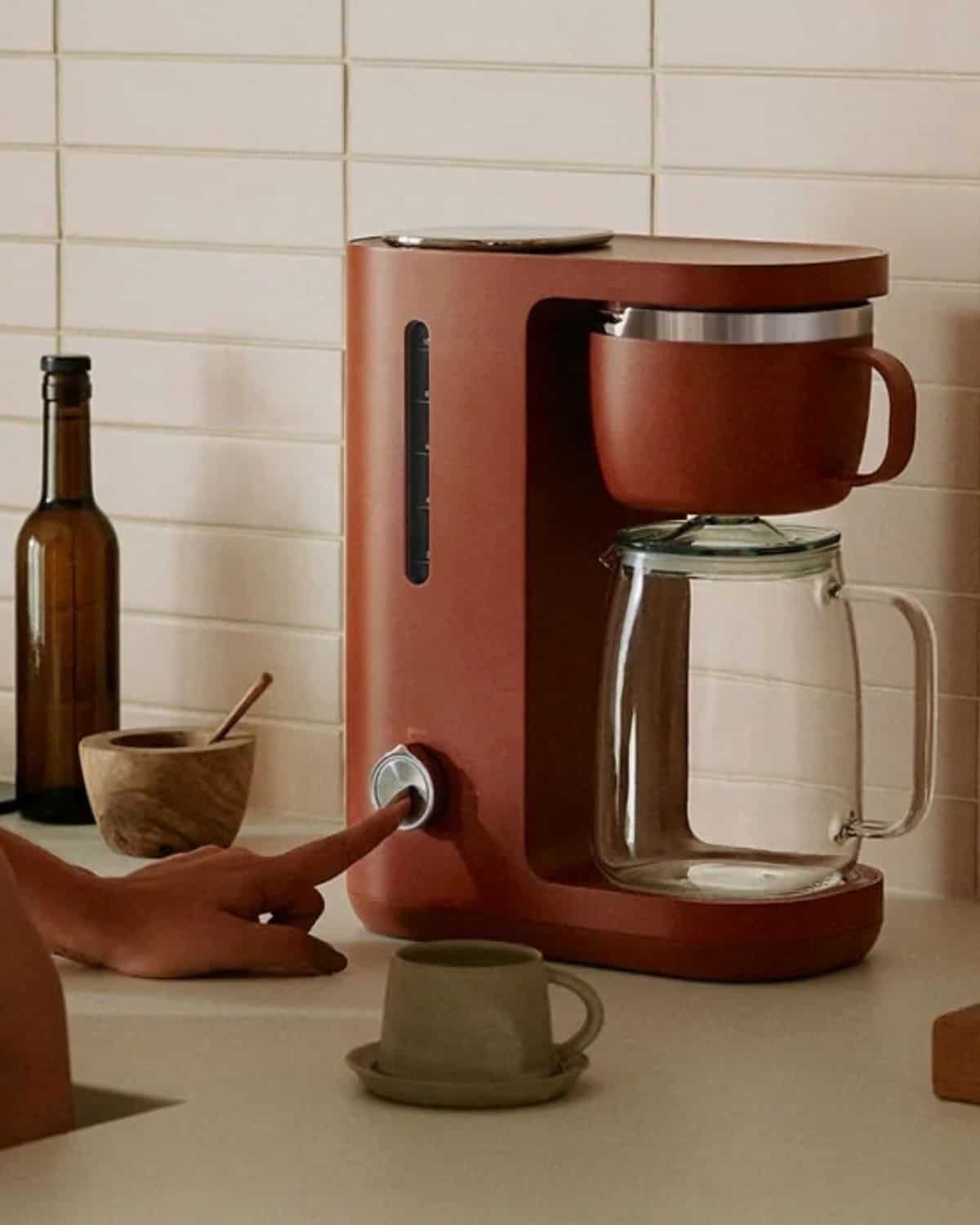
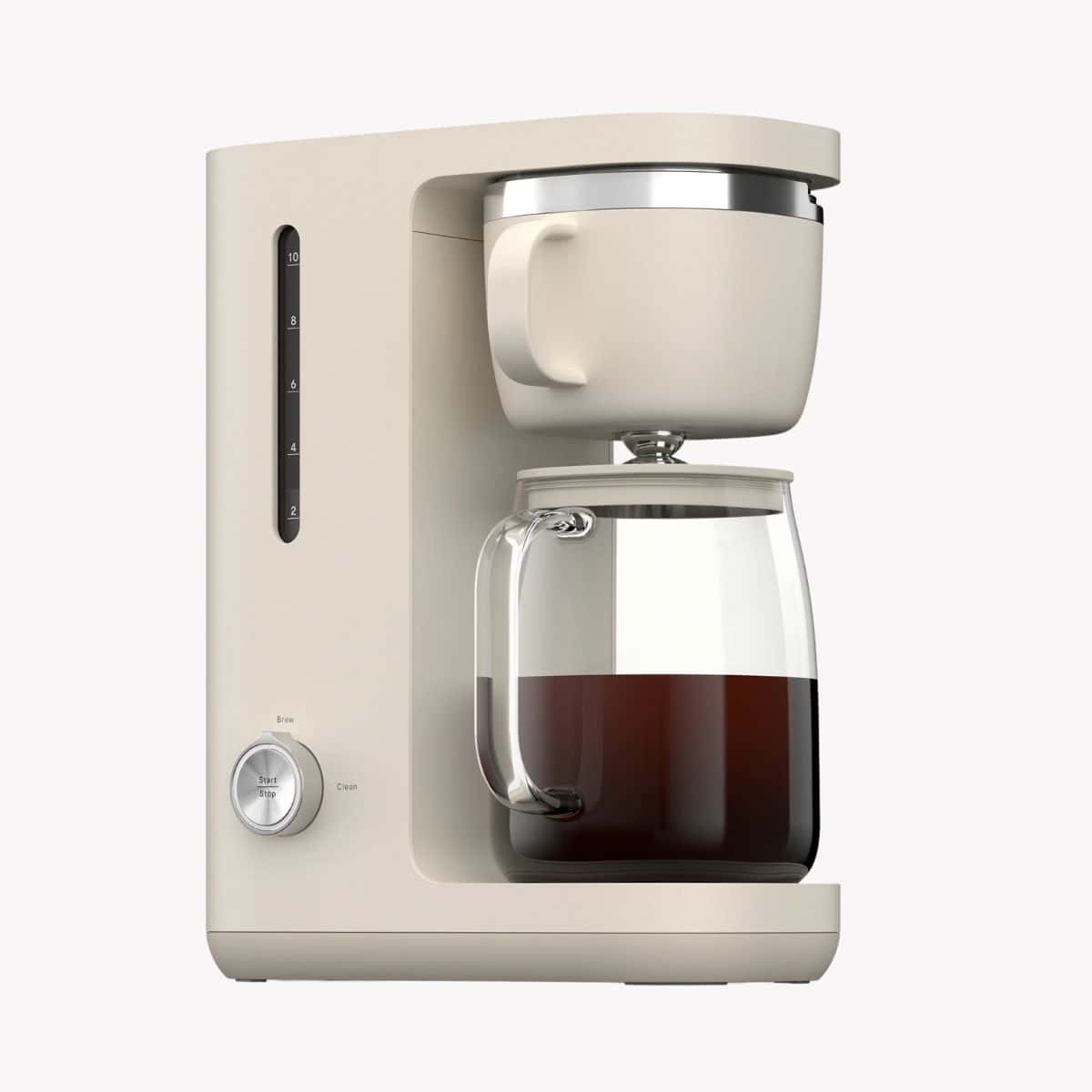
1. Caraway 10-Cup | Best Non-Toxic Automatic Coffee Maker
Best For: Anyone who wants automatic drip coffee with a glass reservoir and a plastic-free brewing pathway.
Use discount code SKL to save 10%!
Most “non-toxic” coffee makers stop at the glass carafe. Your water still sits in a plastic tank, runs through plastic tubing, and drips through a plastic basket.
Caraway’s 10-Cup is one of the few automatic drip machines with a plastic-free brewing pathway from start to finish.
It uses a glass water reservoir and stainless steel for the water path, showerhead, brew basket, and reusable filter, ending in a glass carafe.
It’s also made without PFAS, lead, and cadmium, verified by a third-party lab. That’s the level of disclosure I look for: every surface your water touches, named.
Then there’s the warming plate. As a mom of three running a blog from home, my coffee goes cold constantly. The Caraway holds it for 90 minutes, and mine was still the perfect temperature at the end.
For busy parents, that’s a game changer. After testing more than 30 coffee makers over seven years, this is my top non-toxic automatic pick.
Price
$495
Materials
Reservoir & Carafe: Glass | Water Path, Showerhead, Brew Basket & Reusable Filter: Stainless Steel, According To Caraway
Location/shipping
United States, International Shipping Options
why it made my list
- Glass water tank. Most “glass” drip machines stop at the carafe.
- Internal tubing is glass and steel too, not just the parts you can see.
- Brews 2 to 10 cups. Full pot takes 4 to 8 minutes.
- Third-party tested for PFAS, lead, and cadmium.
my testing experience
- Smooth, balanced coffee. Closer to pour-over than typical drip.
- One dial. No screen, nothing to program.
- Coffee was still the perfect temperature at the 90-minute shutoff.
- Removable parts go in the dishwasher.
- Downside: no timer. If you want coffee waiting for you, see #2.
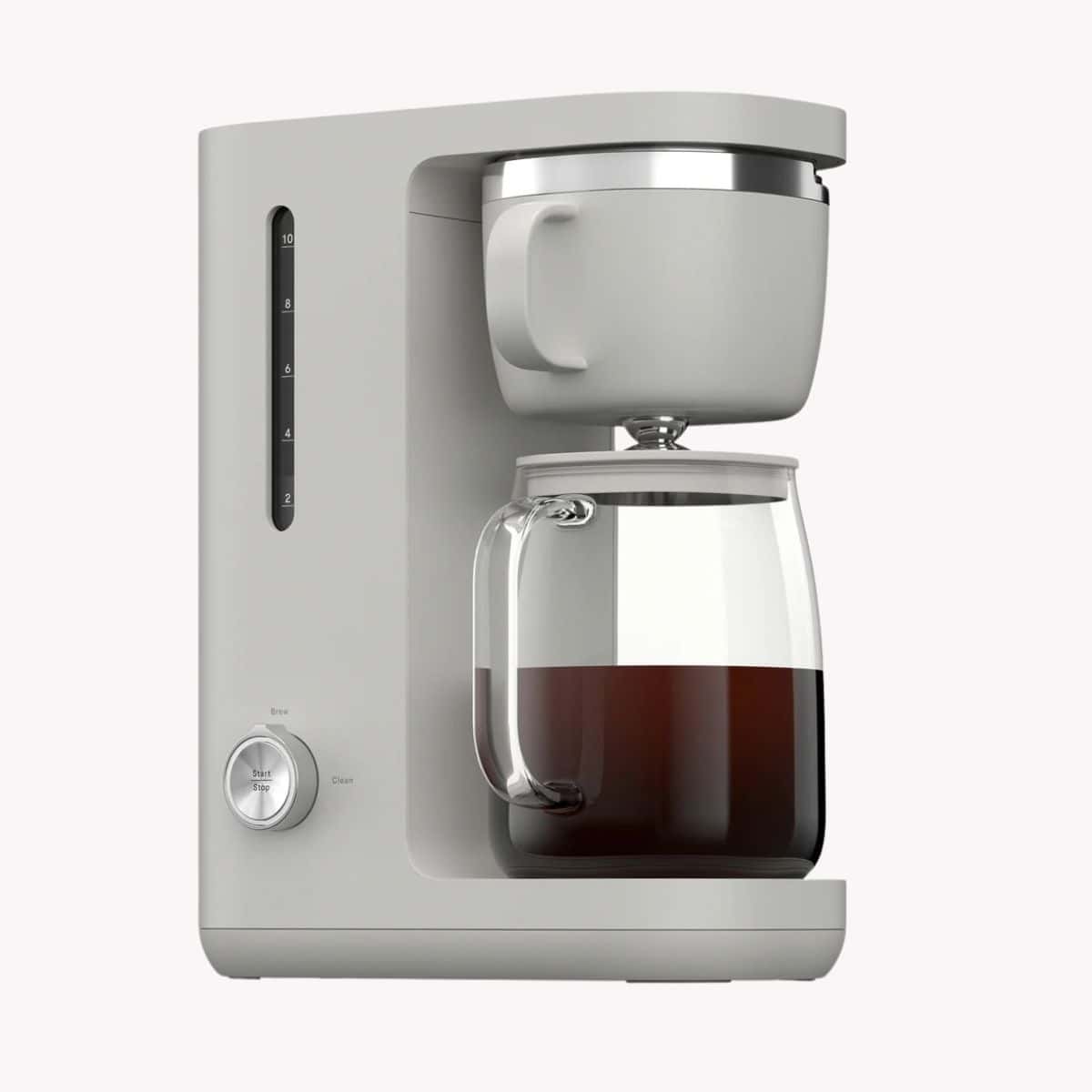
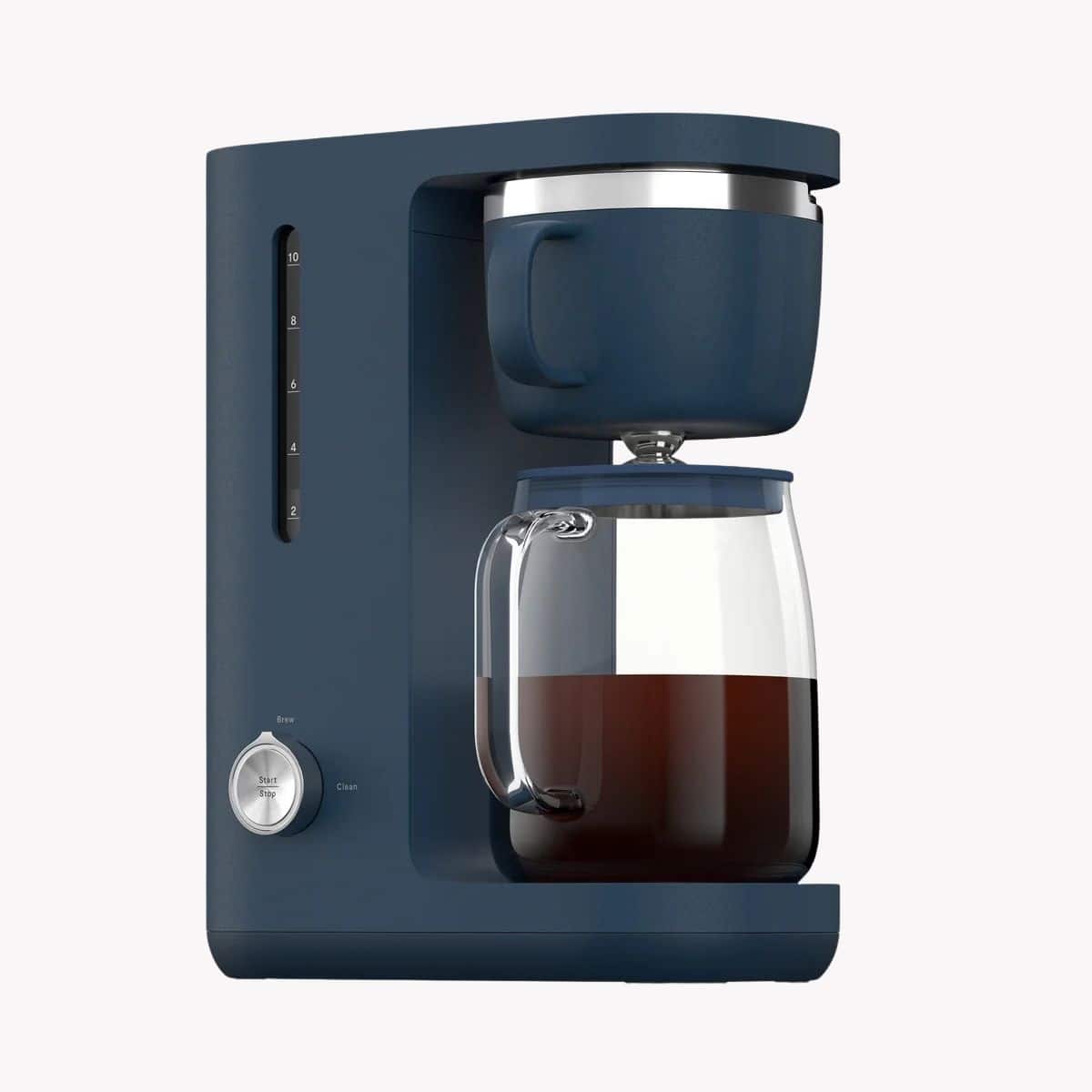
More Color Options From Caraway:
✔️ Found Your Coffee Maker? Let’s Talk Beans: What goes into your brewer matters, too. My guide to the best non-toxic coffee brands covers organic options, mold and mycotoxin testing, and what to look for beyond the marketing claims.
2. Simply Good Coffee THE BREWER | Best Programmable Non-Toxic Coffee Maker
Best For: Anyone who wants to schedule their morning coffee without a plastic water reservoir or plastic brew basket.
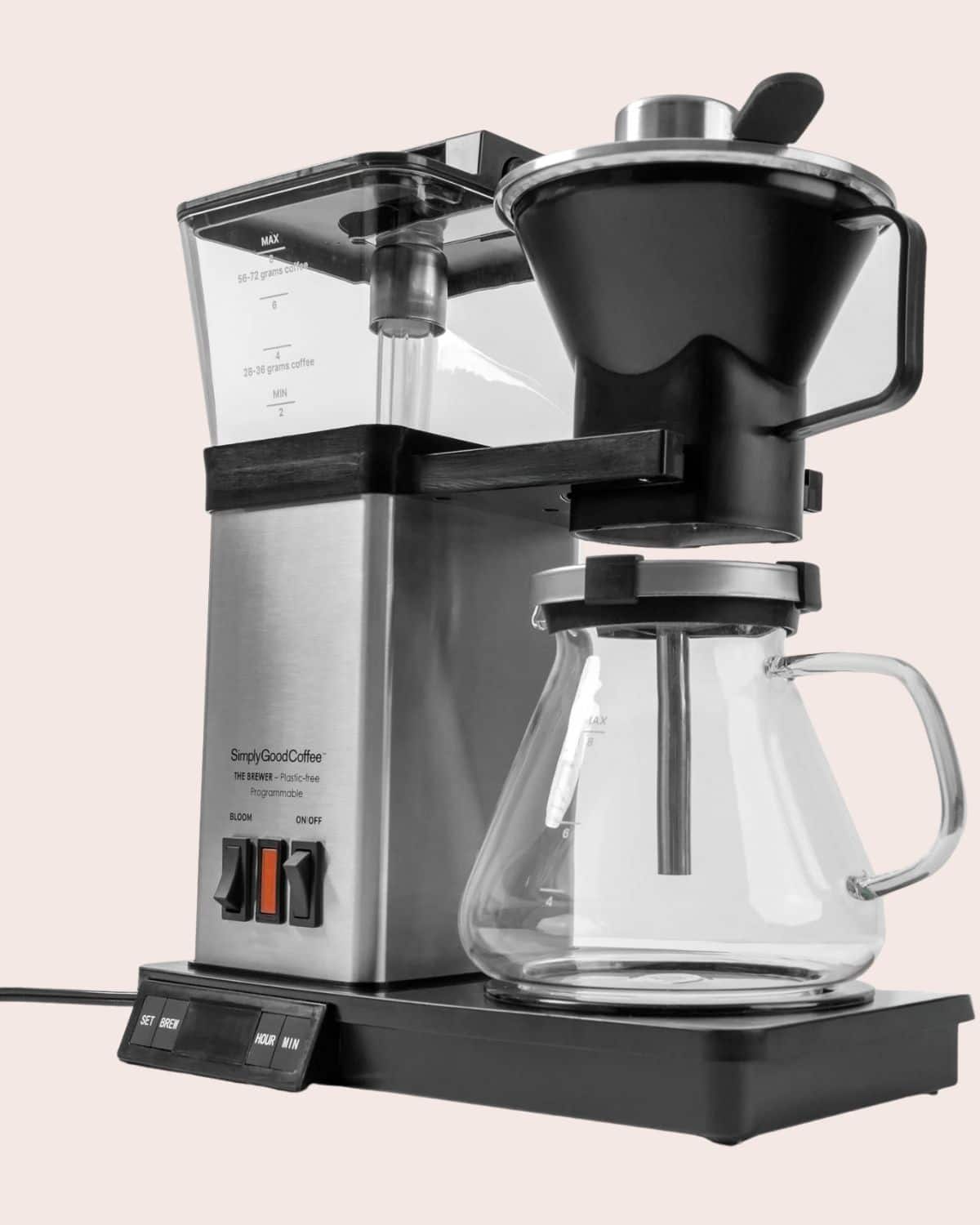
This is my pick for a non-toxic programmable coffee maker. Plastic-free drip machines are rare. Plastic-free drip machines with a timer are rarer.
It has a borosilicate glass reservoir and carafe, stainless steel heating and brewing components, and silicone seals and connections.
No plastic or aluminum touches the water or coffee. Silicone does, which is why I list it separately in my materials breakdown.
And then the best part. There is nothing like waking up to coffee already brewing without having to do it yourself.
Set the 24-hour timer the night before, and on school mornings, a full pot is waiting. The only catch is remembering to prep it after the kids are in bed.
Price
$479.99 (currently on sale for $379.99)
Materials
Reservoir & Carafe: Borosilicate Glass | Heater & Brewing Components: Stainless Steel | Seals & Connections: Silicone
location/shipping
United States, International Shipping Options
why it made my list
- The only pick here with a timer and a glass tank.
- No plastic or aluminum touches the water. Silicone does, in seals and tubing.
- Takes standard #4 cone filters. Easy to find anywhere.
- Bloom setting you can switch on or off.
my testing experience
- Smooth and rich. No bitterness.
- Having coffee ready when I came downstairs felt like a small luxury.
- The catch: it only works if you prep it the night before. I didn’t always remember.
3. Chemex Six Cup Classic | Best Plastic-Free Glass Pour-Over Coffee Maker
Best For: Anyone who wants a straightforward glass brewing setup and enjoys making coffee by hand.
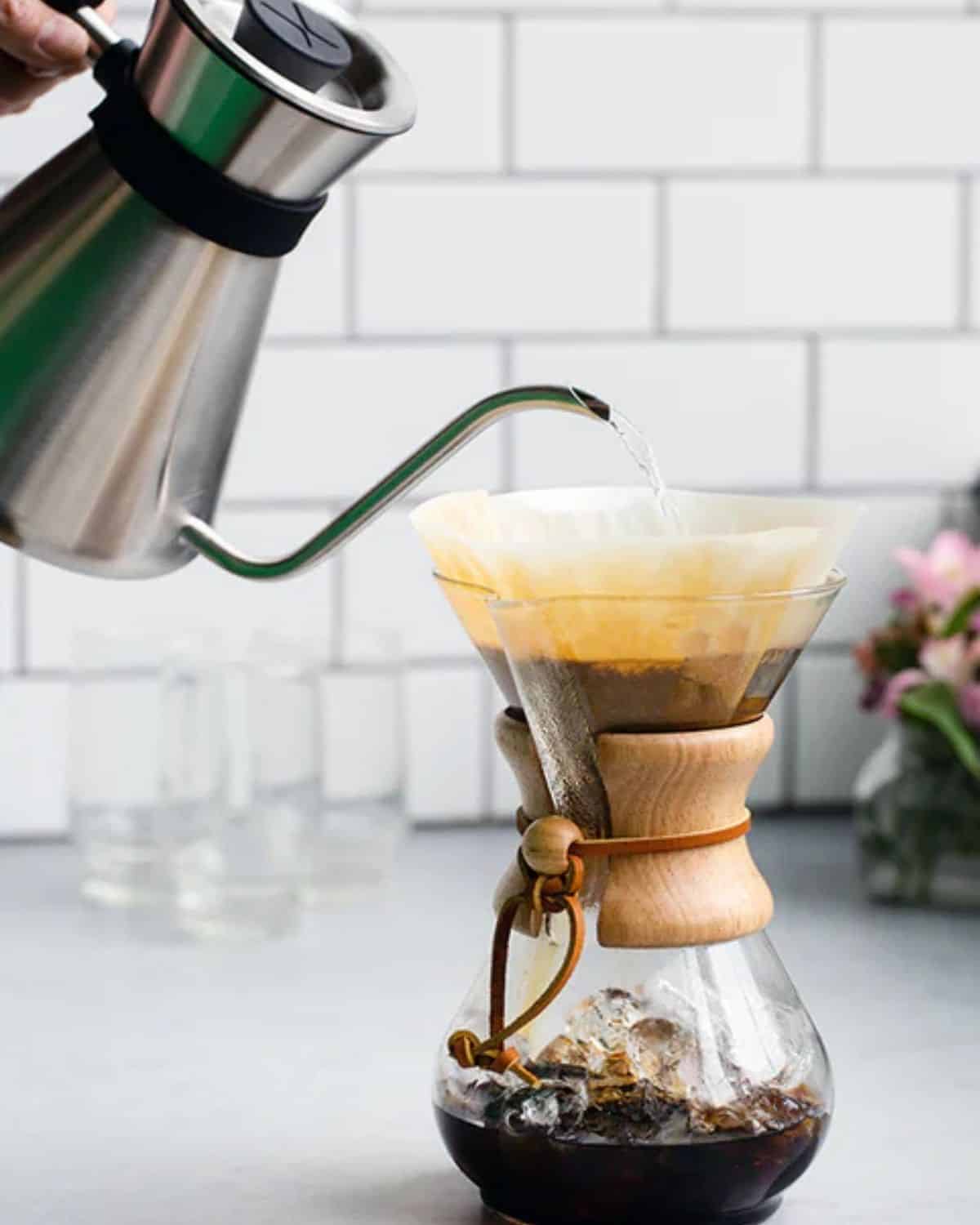
If you want the simplest plastic-free coffee maker in this guide, it’s the Chemex.
Borosilicate glass brewer, wooden collar, leather tie. No reservoir, no tubing, no heating element, no hidden basket.
That simplicity is the point. Every surface your coffee touches is glass or paper, and you can see all of it. Chemex’s bonded paper filters are thicker than standard filters, which hold back oils and fine sediment for a lighter, cleaner cup.
We usually run three coffee makers in our kitchen, because some mornings call for something different.
The Chemex is the one that never leaves the counter. You heat the water separately and pour by hand, so it’s best for mornings when you have a few minutes to enjoy the process.
Price
$47
Materials
Brewer: Borosilicate Glass | Exterior Collar: Wood & Leather | Filtration: CHEMEX Bonded Paper Filters
location/shipping
United States, International Shipping Options
why it made my list
- One piece of glass. Nothing hidden to investigate.
- 30 oz brewer. It makes a real pot, which the V60 doesn’t.
- Bonded filters are 20-30% heavier than standard paper. Lighter, cleaner cup.
- Glass made in Germany.
my testing experience
- Clean and bright. You taste the beans, not just “coffee.”
- Rinse the filter with hot water first, or you’ll taste paper.
- No matter which machine I’m testing, my Chemex stays in the kitchen as backup.
- Downside: cools fast. No insulation, no warming plate.
✔️ Your kettle is part of the brewing process, too. If you’re choosing a plastic-free manual brewer, check what your water touches while it heats. Explore my non-toxic tea kettle guide next.
4. Frieling Double-Walled French Press | Best Stainless Steel French Press
Best For: Anyone who prefers fuller-bodied coffee and wants an insulated French press without a glass carafe.
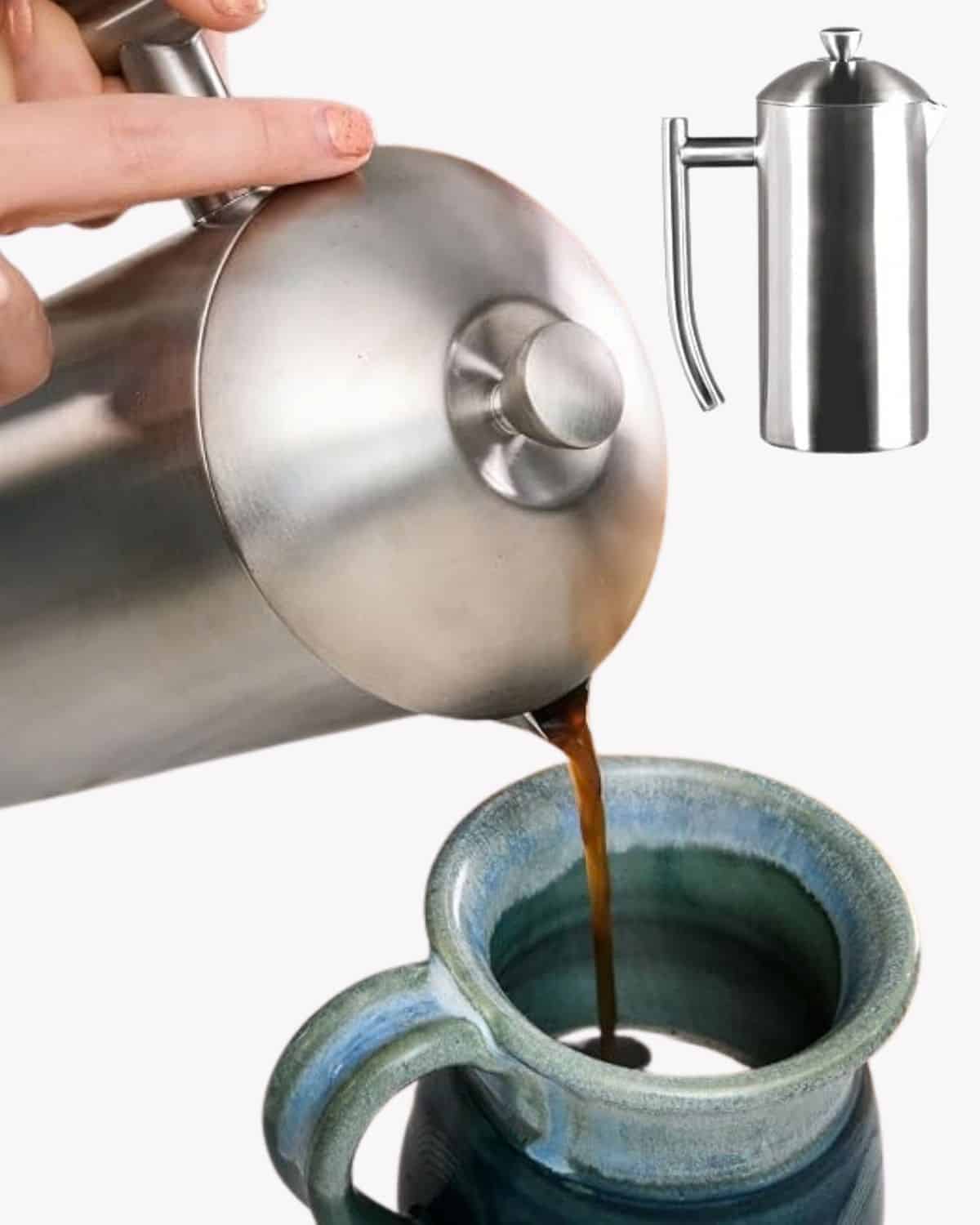
Most stainless steel French presses still hide plastic inside, usually in the plunger assembly or filter frame. The Frieling doesn’t.
Body, lid, and filter are all 18/10 stainless steel, and there’s no rubber gasket on the plunger. It seals metal against metal.
The double-wall construction holds heat far longer than glass, and replacement screens are available, so a worn filter doesn’t mean replacing the whole press.
Metal filtration also keeps the coffee oils, so you get the full, rich body French press is known for.
We’re a clumsy household with three kids. Glass French presses have not survived us. This one has, and it’s my pick for the best stainless steel French press.
Price
$139
Materials
Body, Lid & Filter Assembly: 18/10 Stainless Steel
location/shipping
United States, International Shipping Options
why it made my list
- No glass to break. Body, lid, and filter are all 18/10 steel.
- No rubber gasket on the plunger. Metal against metal.
- Double-wall body and lid. Frieling claims four times the heat retention of glass.
my testing experience
- Full-bodied and rich, the way French press should be.
- We’re clumsy. Nothing here to break.
- Coffee stayed hot long after pressing.
- 36 oz is about three mugs, not six.
- Downside: you can’t see inside to check how much is left.
✔️ Prefer glass? Teabloom’s double-walled glass French press is my plastic-free pick if you’d rather see your coffee brew.
5. Hario V60 Ceramic Dripper 02 | Best Affordable Non-Toxic Pour-Over
Best For: Anyone who wants an affordable ceramic coffee dripper for a single mug or a small batch.
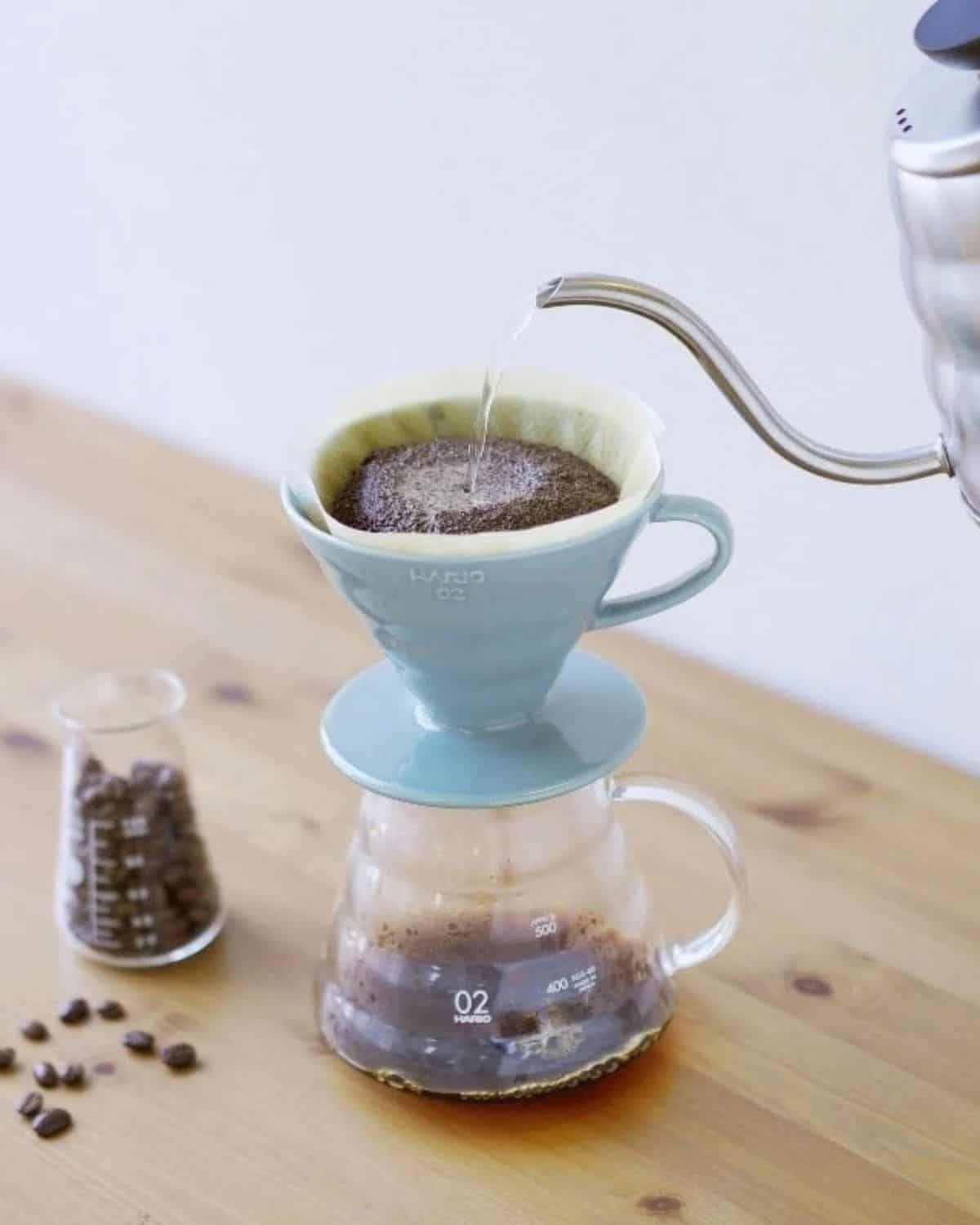
For an affordable non-toxic pour-over, the Hario V60 in ceramic is hard to beat. The white model, VDC-02W, is porcelain, made in Arita, Japan. Add a size 02 paper filter, grounds, and hot water. There’s nothing else in the brew path.
Material matters here, because the V60 also comes in plastic. Buy the ceramic version specifically.
With ceramic, I also look for glaze information, since some ceramic foodware can release lead from food-contact surfaces. More on that in my materials section below.
This is my one-perfect-cup brewer. It sits right on your mug, and the cone shape and single large opening let you control the brew with your pour. It takes a few tries to find your rhythm. A gooseneck kettle helps.
Price
Full Set + Filters $53.50 | Just The Coffee Dripper $26
Materials
Dripper: Porcelain | Filtration: Size 02 Paper Filters
location/shipping
United States, International Shipping Options
why it made my list
- Porcelain, made in Arita, Japan.
- Most affordable pick in the guide.
- Brews 1 to 4 cups, straight into a mug or a server.
- One big opening lets your pour control the brew.
my testing experience
- Bright and clear, with a slightly fuller body than Chemex.
- About 3 minutes per brew.
- Easy to clean, and dishwasher-safe on the top rack.
- Preheat it with hot water first. Ceramic pulls heat from the brew.
- Downside: technique matters. A gooseneck kettle helps.
6. AeroPress Steel | Best Stainless Steel Single-Serve Coffee Maker
Best For: Anyone who wants a compact manual brewer for one serving without a plastic brewing chamber.
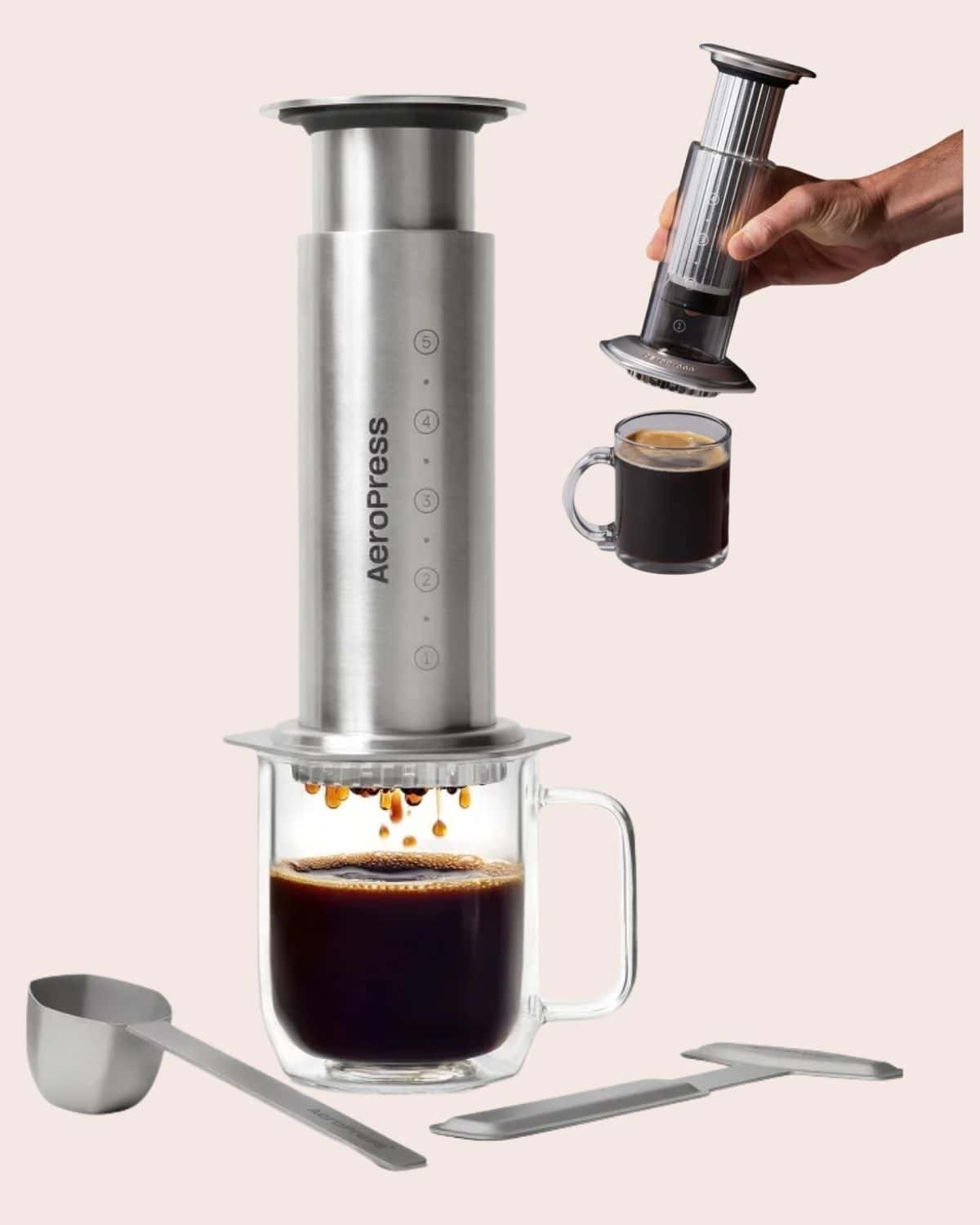
The AeroPress has been a coffee favorite for years, but the original is plastic. The AeroPress Steel fixes that.
The chamber, plunger, filter cap, scoop, and stirrer are 304 stainless steel. The only exception is the plunger seal, which is LFGB-grade silicone.
The chamber is vacuum-insulated, holds 12 oz, and goes in the dishwasher. This recommendation covers the Steel version only. Not the Original, Clear, or Go.
It’s easily one of my favorite ways to make coffee. With freshly ground light roast from our local roaster, it made an incredibly flavorful cup.
Steep about four minutes, press, and you’re done. It makes concentrated coffee for one or two, but it isn’t an espresso machine.
Price
$49.95
Materials
Chamber, Plunger & Filter Cap: 304 Stainless Steel | Plunger Seal: LFGB-Grade Silicone | Filtration: Paper Or Compatible Stainless Steel Filter
location/shipping
United States, International Shipping Options
why it made my list
- Every part except the seal is 304 steel, including the scoop and stirrer.
- Vacuum-insulated chamber stays cool to hold.
- 12 oz chamber, 20% bigger than the plastic models.
- Dishwasher-safe.
my testing experience
- Freshly ground light roast from my local roaster made an incredibly flavorful cup.
- Same smooth AeroPress coffee, minus the plastic chamber.
- Add grounds and hot water, steep four minutes, press.
- Cleanup: pop the puck out, rinse.
- Downside: heavier than the original, and one or two cups per round.
7. Bialetti New Venus 6-Cup | Best Stainless Steel Moka Pot
Best For: Rich, concentrated stovetop coffee without aluminum.
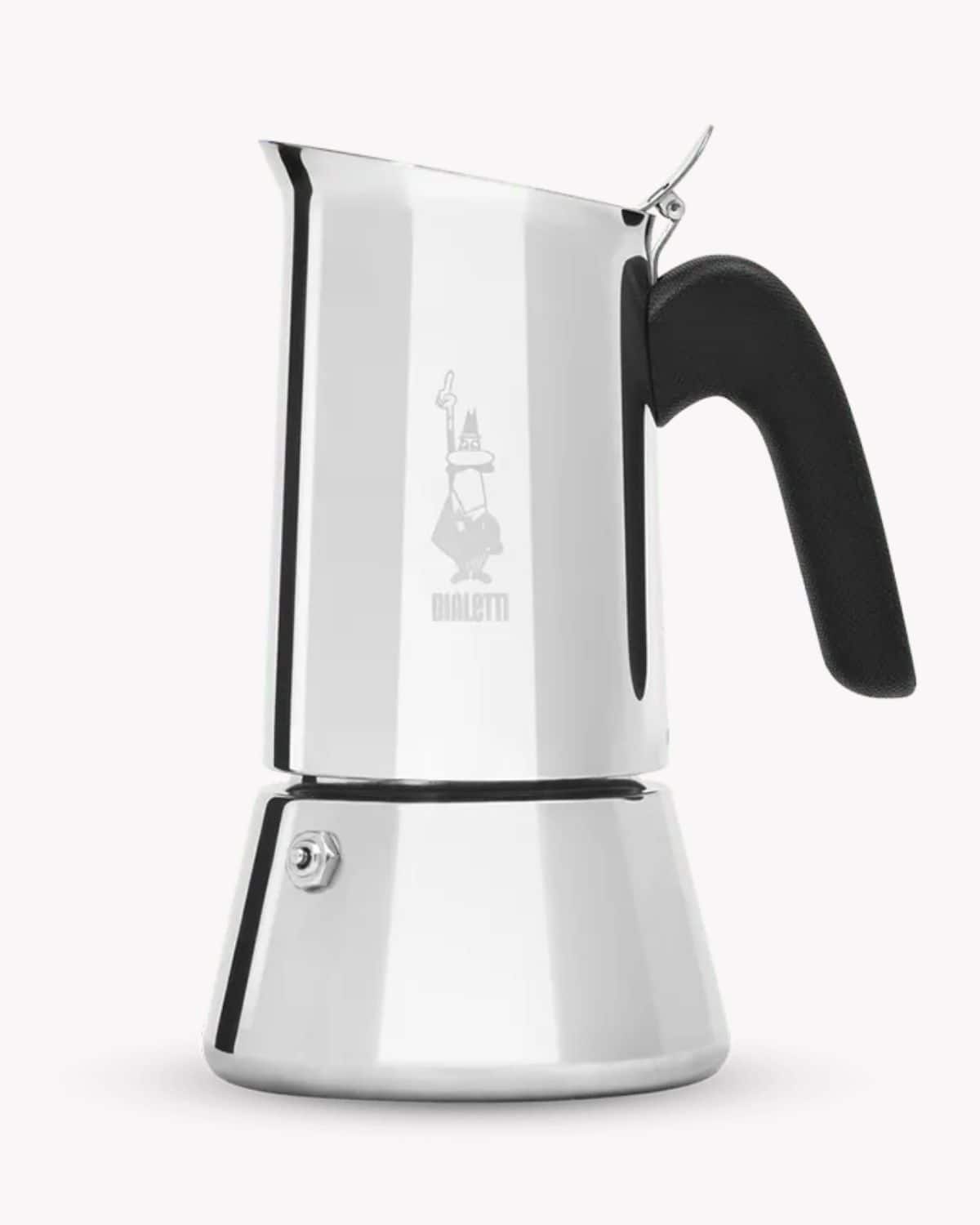
Most moka pots are aluminum, including Bialetti’s iconic Moka Express. The New Venus is the stainless steel alternative, with an 18/10 stainless steel body and a stainless steel coffee funnel.
My husband was born and raised in Italy, and we split our year between Italy and the US. The moka pot is a fixture in Italian kitchens, so this one had to earn its place in ours.
It makes rich, concentrated, espresso-style coffee you can drink straight, with milk, or topped up with hot water.
It works on gas, electric, and induction. The 6-cup size makes about 235 ml total, so six small moka servings, not six mugs.
CARE TIP: Dry each part thoroughly after washing and store the pot disassembled. Stainless steel is corrosion-resistant, but it isn’t rust-proof.
Price
$45
Materials
Body: 18/10 Stainless Steel | Coffee Funnel: Stainless Steel
location/shipping
United States, International Shipping Options
why it made my list
- 18/10 stainless steel body.
- Works on gas, electric, and induction.
- Replacement funnels and gaskets available.
- Espresso-style coffee without a countertop machine.
my testing experience
- Robust, espresso-style coffee.
- Quick rinse after use.
- If it tastes bitter, lower the heat and pull it as soon as it gurgles.
- No fill line. Fill to just below the safety valve.
- 6 cups means espresso cups. About 235 ml total.
8. Ovalware Airtight Cold Brew Maker | Best Glass Cold Brew Coffee Maker
Best For: Anyone who wants to prepare cold brew ahead of time and store it in the same glass container.
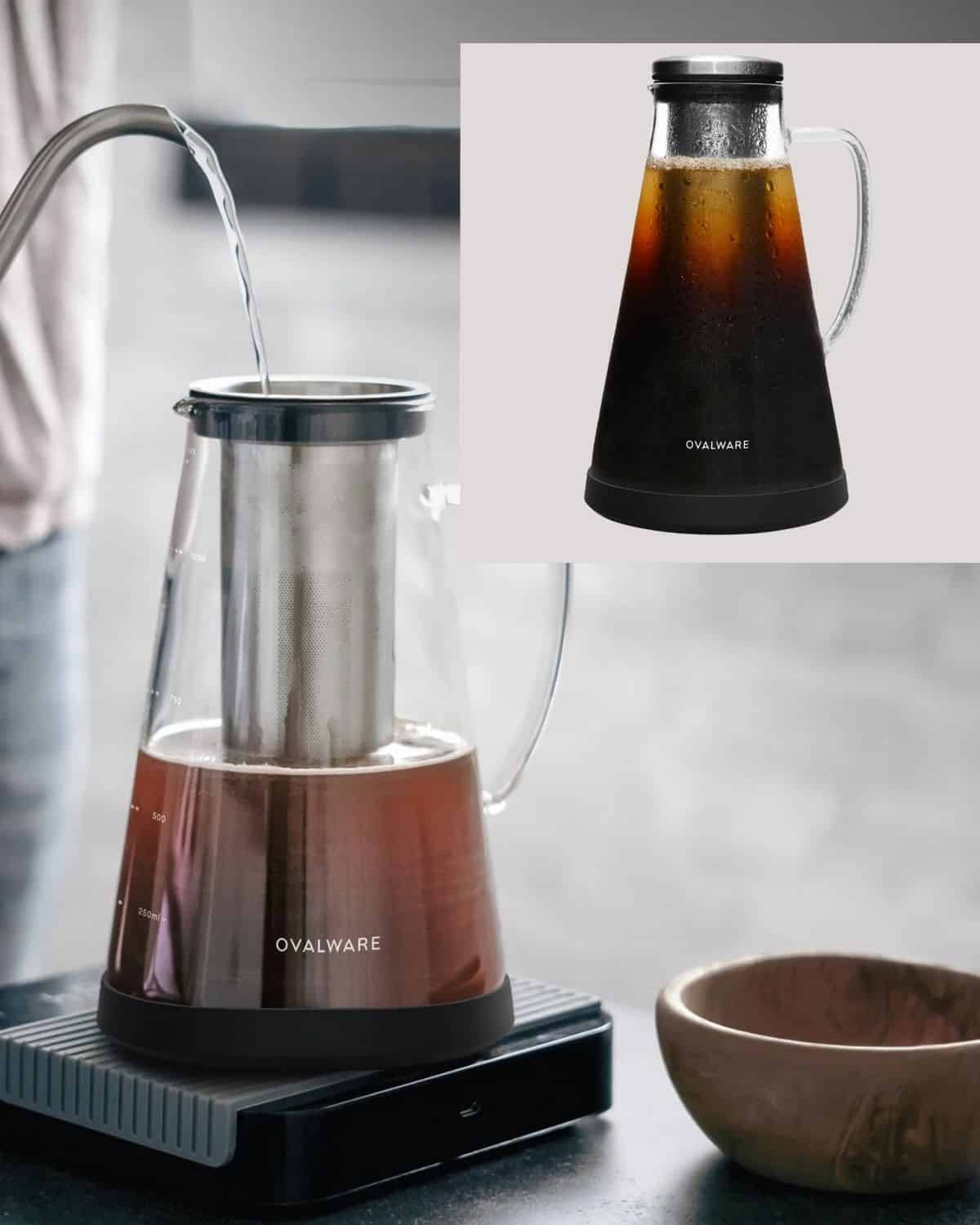
Most cold brew pitchers are plastic. The Ovalware is a borosilicate glass carafe with an 18/8 stainless steel filter and stainless steel cap. The only other material is a silicone seal.
The seal is removable for cleaning, and the filter is welded, not soldered. Those details matter for something you’ll fill, empty, and wash over and over.
Iced coffee season runs long in our house. One overnight batch gives us several glasses of smooth, rich cold brew, stored in the same container it brewed in. It makes excellent cold brew tea too, so it earns its fridge space year-round.
Price
$32+
Materials
Carafe: Borosilicate Glass | Filter & Cap: 18/8 Stainless Steel | Airtight Seal: Silicone
location/shipping
United States, International Shipping Options
why it made my list
- Glass pitcher with a steel filter and cap.
- Brews and stores in the same container.
- Sized to fit a fridge shelf.
- Works for tea too.
my testing experience
- Smooth, rich, and much less bitter than hot coffee.
- Steeped overnight. One batch made several glasses of iced coffee.
- Made excellent cold brew tea too.
- Washed well in the dishwasher.
- Downside: the fine filter takes more effort to clean than tossing a paper filter.
✔️ Keep the glass habit going. Explore my non-toxic food storage picks for storing leftovers and other everyday essentials.
9. COLETTI Bozeman Induction Percolator | Best Stainless Steel Percolator
Best For: Anyone who wants a stainless steel stovetop coffee maker without plastic or aluminum brewing components.
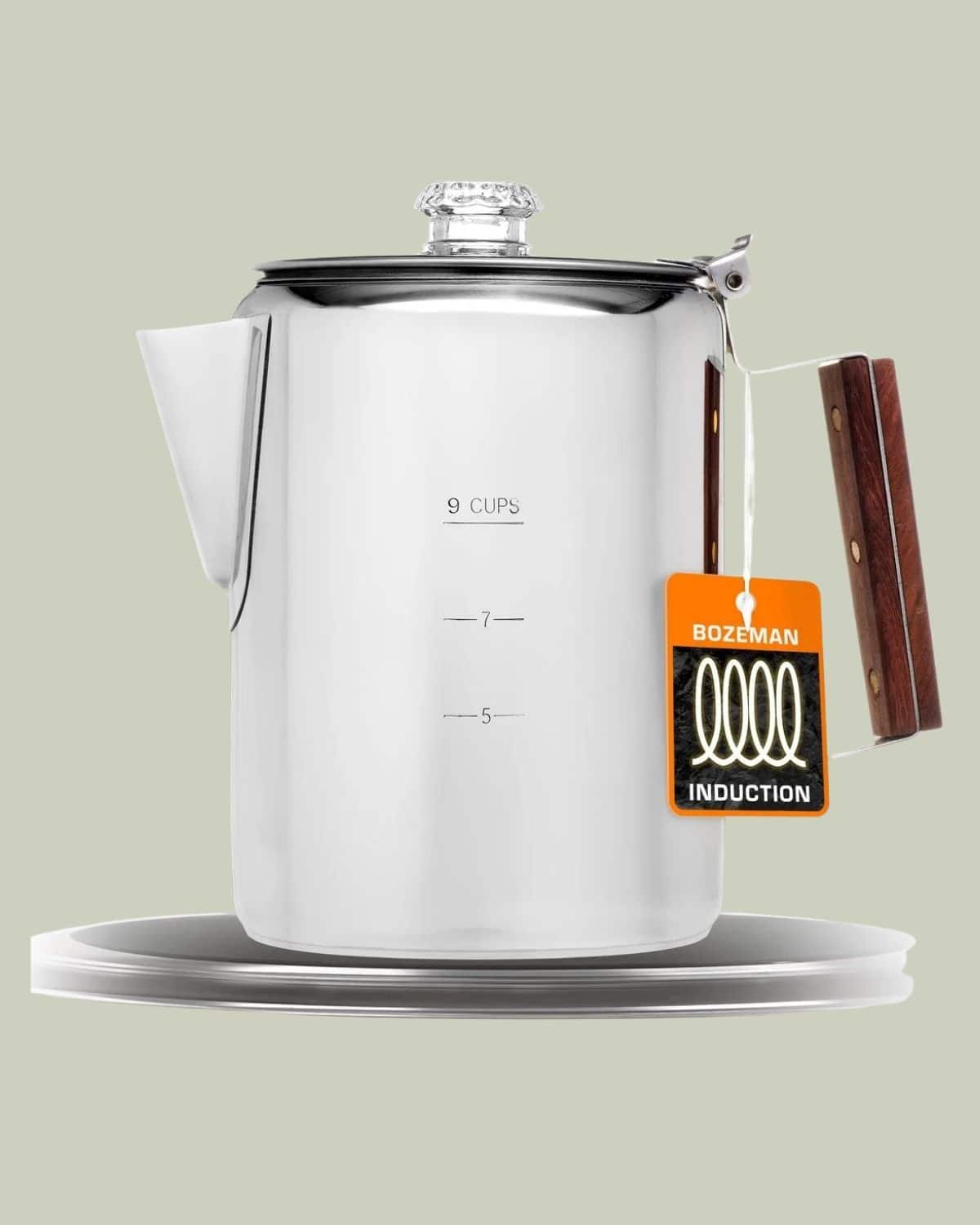
Many stovetop percolators are aluminum or hide plastic in the basket or stem. The COLETTI Bozeman is stainless steel through the pot, basket, and brewing tube, with a glass knob and a wooden handle. No aluminum, no plastic.
Buy the Induction version if you cook on induction. The standard Bozeman won’t work on it.
It heats quickly and makes strong, bold coffee that comes out hotter than drip. Percolators need a little attention, since the water cycles through the grounds again and again. Pull it too late and it turns bitter.
It comes in a 6-cup, 9-cup and 12-cup.
Price
$34+
Materials
Brewing Components: 18/8 Stainless Steel | Knob: Glass | Handle: Wood
location/shipping
United States, International Shipping Options
why it made my list
- Steel, glass, and wood. No aluminum or plastic.
- Works on induction, gas, and electric.
- Dishwasher-safe.
- Also works on a campfire.
my testing experience
- Strong, bold, and hotter than drip.
- Heated quickly. About 5 minutes of perking once it starts.
- Leave it longer and it turns bitter. COLETTI says the same.
10. Ascaso Steel DUO PID | Best Low-Tox Espresso Machine
Best For: Anyone who wants powered espresso brewing and a steam wand for cappuccinos and lattes, and accepts a plastic water reservoir.
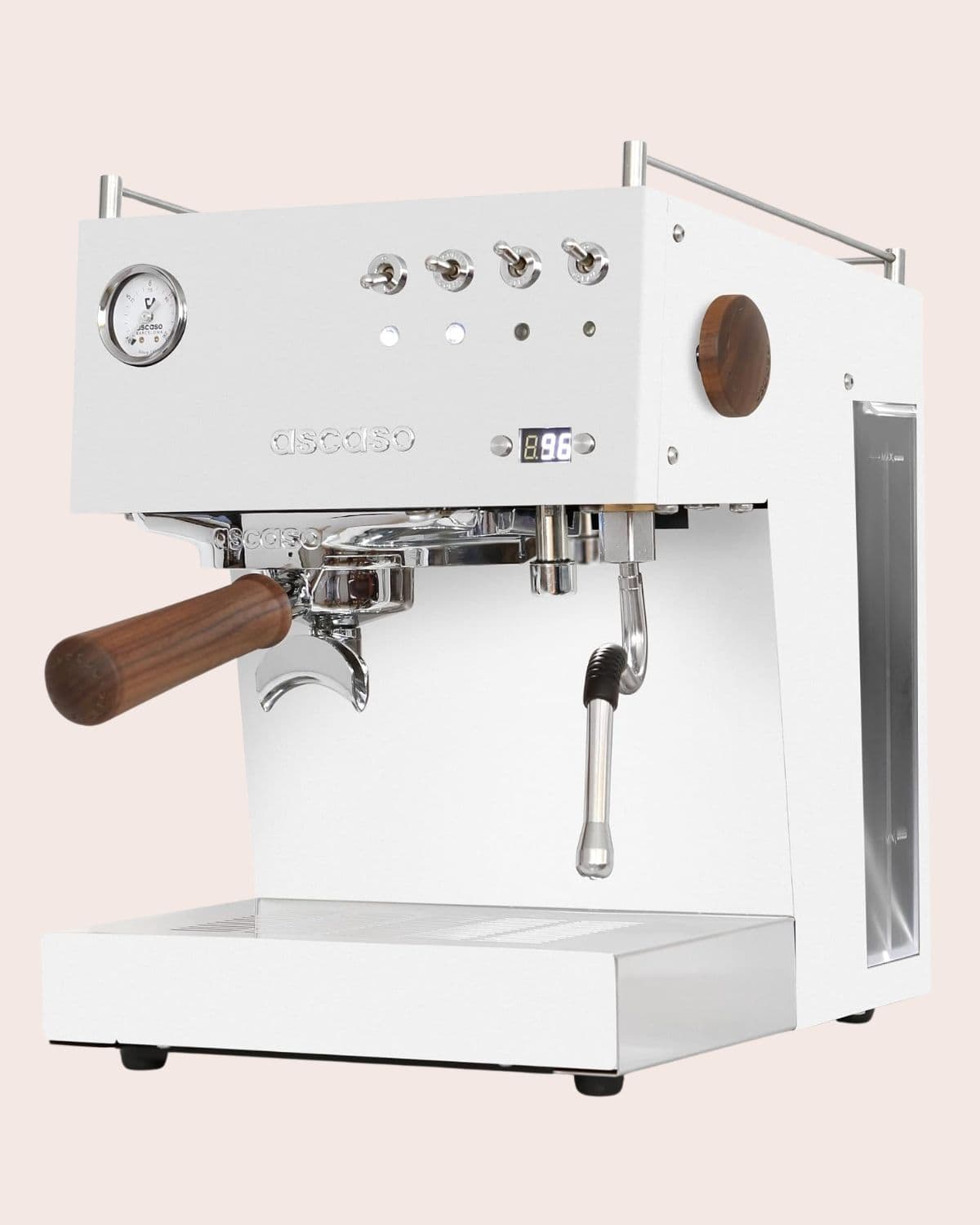
Plastic-free espresso machines barely exist. Most use aluminum boilers or thermoblocks where water touches aluminum directly, plus plastic reservoirs and tubing.
The Ascaso is my low-tox pick because of its heating pathway. Water travels through a stainless steel tube inside the aluminum thermoblock, so the aluminum transfers heat while the water touches steel.
It isn’t plastic-free. There’s a plastic water reservoir and silicone tubing, which is why I call it low-tox rather than non-toxic.
With my husband’s Italian roots and my own coffee habit, café-style drinks at home are non-negotiable. Two thermoblocks let you pull a shot and steam milk at the same time, which makes two lattes before the morning chaos actually doable.
Price
$2,095
Materials
Heating Pathway: Stainless Steel Tube Within An Aluminum Thermoblock | Reservoir: Plastic | Additional Components: Silicone Tubing, Seals & Fittings
location/shipping
United States, International Shipping Options
why it made my list
- Water heats inside a stainless steel tube, per Ascaso.
- Two thermoblocks. Pull a shot and steam milk at the same time.
- PID temperature, preinfusion, and programmable shot volume.
- Built in Barcelona.
my testing experience
- Excellent espresso. The controls made dialing in each shot easy.
- Ready in minutes, not the half hour a boiler machine needs.
- Loved brewing and steaming at the same time.
- Easy to refill, and gorgeous on the counter.
- Downside: steaming is gentler than a café machine. Fine for lattes at home.
❓ Wondering about Breville? The Breville Barista Express is one of the most popular home espresso machines for good reason. It has a built-in grinder, it’s easy to learn on, and it costs a fraction of the price of the Ascaso. For a lot of families, that’s a big deal.
It doesn’t make my non-toxic list because of its plastic water tank and stainless steel-lined aluminum heating element, with less detail about the internal water path.
If budget and an all-in-one setup come first, it’s a great machine. If materials come first, the Ascaso is worth the investment.
Safest Materials To Look For In A Non-Toxic Coffee Maker
When I evaluate a coffee maker, I follow the water.
Where does it sit before brewing? What heats it? Which tubes, seals, filters, and surfaces does it touch before reaching my cup?
That approach is more useful than judging a machine by its exterior. A stainless steel appliance can contain a plastic reservoir and plastic brew basket. A glass carafe tells you about the finished coffee’s container, but nothing about the journey getting there.
My preference is a clearly disclosed brewing pathway built primarily from glass, uncoated food-contact stainless steel, or suitable ceramic, with any silicone components identified separately.
Borosilicate Glass
Borosilicate glass is one of my favorite materials for coffee brewing because it combines good chemical resistance with resistance to temperature changes.
Glass manufacturer SCHOTT explains that borosilicate glass has low thermal expansion, which helps it withstand thermal shock, and high chemical durability. Those properties make it a practical material for products repeatedly exposed to hot water.
For coffee makers, I look for it in:
- Water reservoirs.
- Carafes and cold brew pitchers.
- Pour-over brewers.
- Internal water lines, where the manufacturer specifically identifies them.
There is also a practical benefit: a transparent reservoir or carafe lets you see residue and reach accessible surfaces during cleaning.
But heat-resistant does not mean unbreakable. I still follow the manufacturer’s temperature and cleaning instructions rather than assume every glass brewer can handle a stovetop, sudden temperature changes, or dishwasher use.
I also distinguish plain glass from decorations or coatings on a food-contact surface. “Made from glass” should not end the inquiry if the inside is painted, coated, or otherwise treated.
What I want to see: The type of glass, its location in the brewer, and clear care instructions.
Uncoated Food-Contact Stainless Steel
Stainless steel is especially useful when I want durable brewing components without relying on glass for every part.
I prioritize it for:
- Brew baskets and reusable filters.
- Showerheads.
- Water-heating tubes.
- French press bodies, plungers, and lids.
- Thermal carafe interiors.
Several recommendations identify grades such as 304, 18/8, or 18/10. These are alloy descriptions, rather than independent certifications of a finished coffee maker. A grade tells us something about the material; it does not establish how every component was manufactured or tested.
I also avoid describing stainless steel as “zero-leaching.” Germany’s Federal Institute for Risk Assessment, BfR, evaluates the release of metals from food-contact utensils because metal transfer can occur. The material, food or liquid, temperature, and contact conditions all matter. Its findings about other utensils should not be treated as measurements of the coffee makers in this guide.
That distinction matters when reading marketing. “Stainless steel” is a useful disclosure, but it is not proof that a machine releases no substances under every possible condition.
The same applies to nickel. Stainless steel can contain nickel, and research from Oregon State University found nickel and chromium leaching into tomato sauce cooked in stainless steel, varying by grade, cooking time, and how new the steel was.
So I would not call a stainless steel brewer nickel-free without specific supporting evidence. Readers with medically advised dietary nickel restrictions should choose according to their clinician’s guidance.
What I want to see: The disclosed grade where available, the exact water-contact components, and relevant finished-component testing rather than broad promises.
Food-Contact Ceramic & Porcelain
Ceramic and porcelain drippers can offer a simple brewing setup with no internal tubing or reservoir. But I look beyond the word “ceramic” to the finished surface that touches the water and coffee.
The important questions are:
- Is the product intended for food and beverage use?
- What does the manufacturer disclose about the glaze?
- Is there relevant lead and cadmium migration testing?
- Does the evidence apply to the actual model and finish?
The FDA has documented that some ceramic foodware can release significant amounts of lead from food-contact surfaces. It also maintains separate guidance addressing cadmium contamination in ceramicware. This supports checking the finished product rather than assuming all ceramic is equivalent.
Migration testing is particularly useful here. It evaluates what transfers into a test liquid under specified conditions. That answers a different question from a test measuring how much of an element exists somewhere in the product.
FDA ceramicware guidance references methods for extracting lead and cadmium from glazed surfaces. When a brand shares results, I want to know the test method, the product tested, and the conditions used.
Neither a white glaze nor an earthy, handmade appearance proves safety. I would also avoid using a decorative ceramic piece as a coffee dripper unless it is explicitly suitable for that purpose.
What I want to see: Food-contact suitability and model-specific information about the finished glaze, with migration results when available.
Clearly Disclosed Silicone Seals & Connections
Silicone appears in several brewers in this guide, including plunger seals, airtight lids, and connections between components.
I identify it separately because a glass-and-steel brewer with a silicone seal is different from a brewer containing only glass and metal.
Silicone is a synthetic polymer material. It has a different chemical structure from conventional plastics such as polypropylene, but calling it “natural” or “made from sand” does not establish the safety of a finished seal or tube.
BfR’s Recommendation XV sets conditions for silicones intended for food contact, including which starting materials and production aids may be used and a limit on volatile organic compounds in finished silicone rubber. That is a more meaningful basis for evaluation than treating all silicone as identical.
For a coffee maker, I want to know:
- Whether the silicone touches cold water, hot water, or finished coffee.
- Whether it is a small seal or a longer section of tubing.
- Whether it is suitable for the intended temperature and repeated use.
- Whether it can be removed, cleaned, and replaced.
- What documentation supports claims such as “food-grade” or “LFGB-tested.”
I do not assume that “medical-grade” means a finished component has been tested for coffee brewing. Likewise, an LFGB claim needs supporting details; the phrase alone is not a laboratory report.
What I want to see: A disclosed purpose, suitable food-contact documentation, and clear maintenance instructions.
The Entire Brewing Pathway Matters
The most useful material disclosure identifies each stage separately.
| Component | What I Check |
|---|---|
| Reservoir | What stores the water, and can I access it for cleaning? |
| Heater | What surface actually touches the water inside the heating system? |
| Tubing & Connections | Are they glass, metal, silicone, plastic, or a combination? |
| Showerhead & Brew Basket | What touches the heated water and wet grounds? |
| Filter | Is it paper, stainless steel, plastic mesh, or another material? |
| Carafe & Lid | What touches brewed coffee during storage and pouring? |
An aluminum heating block containing a stainless steel water tube is different from a heater in which water directly contacts aluminum. A plastic handle outside the brewing area is different from a plastic filter basket holding wet grounds.
These details let me explain the actual compromises instead of assigning a safety verdict based on one material name.
What Makes A Materials Claim Worth Trusting?
I give the most weight to information that answers a specific question:
- A component breakdown: Which material is used where?
- An identifiable test report: Which product or component was tested?
- Relevant conditions: Do the temperature, contact time, and repeated-use conditions reflect the intended application?
- Clear results: Which substances were assessed, and what were the detection or reporting limits?
- Care instructions: How should the product be cleaned, descaled, and maintained?
A report about a brand’s cookware does not automatically establish anything about its coffee maker. A test on one component does not cover every seal, tube, and fitting.
My standard is straightforward: I want to understand the materials, see the basis for important claims, and be able to maintain the brewer properly. That gives me a much stronger reason to recommend it than “non-toxic” printed on the packaging.
Toxic Materials In Coffee Makers: What I Avoid And Why
A beautiful coffee maker can still leave you guessing about what’s inside. The glass carafe is easy to see. The tubing, fittings, heating chamber, and coatings usually take a little more digging.
When choosing a non-toxic coffee maker, I focus on what touches the water and coffee, how those materials handle heat, and how clearly the brand explains its construction. My preference is to minimize plastic and unnecessary coatings along that path. That’s a buying standard, rather than proof that every machine containing plastic is harmful.
Here are the components I look at most closely.
Plastic In The Hot-Water And Coffee Path
Plastic can appear in the reservoir, showerhead, filter basket, internal tubing, and carafe lid. A stainless steel exterior tells you very little about these parts.
The questions that matter are which plastic is used, where it sits, and what conditions it was designed and tested for.
The FDA evaluates food-contact substances using migration and toxicology information relevant to their intended use.
Temperature, contact time, and the food or drink involved help determine appropriate testing conditions. A general “food-safe” claim doesn’t answer every question about repeated contact with hot water.
For this guide, I prioritize reducing plastic contact in the heated brewing path. A cool-water reservoir and a plastic showerhead carrying near-boiling water have different exposure conditions, so I evaluate them separately.
What I want the manufacturer to disclose:
- The material used in the reservoir, showerhead, basket, and internal tubing.
- Whether hot water or brewed coffee touches each component.
- Whether testing covers the component’s actual operating temperature and repeated use.
- How to clean, inspect, and replace parts that wear out.
If your goal is a coffee maker without plastic water contact, a plastic reservoir still fails that preference, even when the brand describes it as BPA-free.
BPA And The Limits Of “BPA-Free”
BPA is associated with certain polycarbonate plastics and epoxy resins. NIEHS identifies it as a chemical that can interfere with hormone activity. That does not mean every plastic coffee maker contains BPA. The material needs to be identified before making that claim.
“BPA-free” is useful information, but it answers one question. It doesn’t identify the plastic, disclose every additive, or demonstrate that nothing can migrate during brewing.
The National Toxicology Program has also evaluated BPA alternatives and identified concerns and substantial evidence gaps across the chemicals reviewed. Replacing BPA therefore doesn’t automatically establish that an alternative is safer in every application. Equally, we shouldn’t assume every BPA-free coffee maker contains BPS or BPF.
My buying rule: I look for the actual material and relevant testing behind the label. When that information is missing, a simpler glass or stainless steel brewing setup is easier to assess.
Microplastics: A Concern That Needs Careful Claims
Microplastics deserve attention, but claims about them can run far ahead of the evidence.
The FDA says there is currently not sufficient scientific evidence to show that microplastics and nanoplastics from plastic food packaging migrate into foods and beverages. It also says available evidence does not demonstrate that the levels detected in food pose a human health risk. Research remains limited by differences in sampling, measurement, and testing methods. Those statements don’t establish the performance of any particular coffee maker.
I prefer to reduce unnecessary plastic contact where practical. However, I won’t claim that a specific brewer releases a certain number of particles, or that a plastic-free model eliminates microplastic exposure, without relevant testing.
For shoppers, the useful distinction is between a preference to reduce plastic contact and a measured finding about a particular product.
PFAS And Unidentified Nonstick Coatings
If a coffee maker advertises a nonstick surface, I want to know its composition and location.
PFAS have been used in food-contact applications, including certain nonstick coatings and sealing gaskets. The FDA explains that the way a substance is incorporated into a product affects its potential to migrate. The presence of a fluoropolymer coating alone therefore doesn’t establish how much exposure occurs during use.
Location matters, too. A coating on an exterior warming plate beneath a glass carafe has a different relationship to your coffee than a coating inside a brewing chamber.
Before choosing a coated brewer, I check:
- Does the coating touch water or coffee?
- What is its exact composition?
- Does a “PFAS-free” claim cover that component or the entire machine?
- What does the manufacturer recommend if the surface chips or wears?
For my own shortlist, I favor uncoated food-contact surfaces where possible. An unidentified “premium nonstick” finish doesn’t give me enough information.
Uncoated Aluminum In Direct Contact With Water Or Coffee
Aluminum requires a closer look at the design.
The German Federal Institute for Risk Assessment, or BfR, explains that aluminum can transfer from uncoated food-contact products into food, with acidic and salty conditions increasing transfer. That guidance supports paying attention to direct contact; it doesn’t establish the amount released by a particular coffee machine.
An aluminum heating block also isn’t automatically an aluminum water path. Water may travel through a separate tube inside the block. I want that distinction documented before judging the machine.
I prefer clearly identified glass or stainless steel surfaces for direct brewing contact. I also avoid repeating the claim that aluminum coffee makers cause Alzheimer’s disease. The Alzheimer’s Association says studies have failed to confirm aluminum as a cause.
Lead In Internal Fittings And Ceramic Glazes
A metal component can look sturdy while revealing very little about its alloy. Espresso machines deserve particular attention because their water paths may include multiple fittings and valves.
In a small 2013 investigation of eight household coffee machines, BfR found elevated lead release from portafilter machines, with one of the three tested releasing large amounts, particularly after descaling. This historical finding cannot be applied to every espresso machine or used to accuse a current model. It does show why component composition, migration testing, and descaling instructions matter.
For ceramic brewers, the concern is the finished glaze. FDA guidance addresses lead contamination in ceramic foodware, so “ceramic” by itself isn’t enough to establish safety. I look for food-contact testing relevant to the finished product.
What I prioritize: disclosed materials throughout the brewing path, appropriate testing, accessible cleaning, and clear maintenance instructions. Those details tell me much more than a stainless steel shell or a reassuring “non-toxic” badge.
Popular Coffee Makers That Didn’t Make My Non-Toxic Shortlist
When comparing familiar coffee machines with my picks, I look beyond the glass carafe and stainless steel finish. The reservoir, filter basket, and internal water pathway matter, too.
These exclusions reflect my materials standards. A disclosed chemical or plastic component doesn’t, by itself, establish how much transfers into brewed coffee.
1. BLACK+DECKER 12-Cup Programmable Coffee Maker, CM1160B-1
Why it didn’t make my list: Its model-linked chemical disclosure lists BPA and styrene.
BLACK+DECKER links a California AB 1200 disclosure specifically named for the CM1160B-1. That document identifies BPA and styrene, but doesn’t specify the components containing them or provide migration results for brewed coffee.
For me, that disclosure is a reason to choose another brewer. A glass carafe doesn’t answer the remaining questions about the machine’s materials.
2. Mr. Coffee PerfectBrew Hot And Cold Brew System, 8-Cup
Why it didn’t make my list: The manufacturer confirms plastic in brewing and serving components.
In a public response on Target’s product page, Mr. Coffee’s Consumer Team identifies the brew/filter basket, carafe lid, and water-filter assemblies as plastic.
Those details tell me more than the stainless steel finish. I prefer automatic brewers with a glass reservoir and clearly disclosed stainless steel brewing components.
3. Hamilton Beach FlexBrew Trio, 49902
Why it didn’t make my list: Its compatible nylon filter and conventional plastic-pod brewing options don’t meet my preferences.
Hamilton Beach’s official parts list identifies a compatible “Permanent Filter, Nylon” for the 49902. That places a synthetic plastic directly in the filtration setup when this accessory is used.
The machine also accepts K-Cup-style pods. Conventional Keurig K-Cups use polypropylene plastic, adding a disposable plastic container to the brewing process.
Paper filters or loose grounds change that configuration, but they don’t establish that the reservoir and internal water pathway are plastic-free.
4. Cuisinart SoHo 5-Cup Coffee Maker, DCC-5 Series
Why it didn’t make my list: Cuisinart identifies a nylon brewing filter for these models.
Cuisinart calls replacement part DCC-5NF a “Nylon Filter Basket” and lists compatibility with the DCC-5BK, DCC-5TR, and DCC-5TRNAS variants.
I prefer stainless steel reusable filtration or paper filters in a brewer with clearly disclosed coffee-contact materials.
5. Ninja DualBrew Hot & Iced Coffee Maker, CFP101
Why it didn’t make my list: Its conventional plastic-pod configuration and incomplete internal-material disclosures don’t meet my buying standard.
Ninja identifies the CFP101 as a grounds-and-pods brewer and lists plastic among its construction materials. That broad description doesn’t identify every surface that contacts hot water or coffee.
Using conventional polypropylene K-Cups introduces a plastic pod into the brewing setup. Choosing grounds avoids that pod, but doesn’t establish a plastic-free internal water pathway.
6. Keurig K-Elite With Conventional Disposable K-Cups
Why it didn’t make my list: Conventional K-Cups use a polypropylene brewing container.
Keurig identifies its conventional K-Cup pods as #5 polypropylene. The K-Elite punctures the pod and brews through it, so the plastic cup remains part of the preparation system.
For daily single servings, I prefer AeroPress Steel, which lets me brew without a disposable plastic pod.
Keurig’s environmental claims also deserve scrutiny. In 2024, the SEC found its statements about pod-recycling tests were incomplete and inaccurate because they omitted negative feedback from recycling companies. That finding concerns recycling claims, rather than chemical migration into coffee.
This assessment applies to the K-Elite used with conventional disposable K-Cups. Reusable filters and other brewing systems require separate evaluation.
What This Means When You’re Shopping
You don’t have to evaluate an entire brand at once. Check the exact model and the way you plan to use it.
For these machines, my reasons for choosing differently include a model-linked chemical disclosure, identified plastic brewing components, or a conventional plastic-pod setup. Those are concrete details you can compare with the glass, ceramic, and stainless steel brewing options in my shortlist.
How I Tested And Selected These Non-Toxic Coffee Makers
This shortlist draws on seven years of hands-on testing with more than 30 coffee makers, alongside research into the materials used throughout each brewing system. Caraway, the newest addition, spent two months in my kitchen before earning its place.
I evaluated each brewer for:
- Coffee flavor: The finished cup’s flavor, body, and how much I enjoyed drinking it.
- Everyday use: Preparation, controls, pouring, and how comfortably it fit into my morning routine.
- Cleaning and maintenance: Access to reservoirs, filters, and seals, plus the work required after brewing.
- Practical design: Capacity, handling, breakable components, and availability of replacement parts.
- Material transparency: Documentation identifying the surfaces that contact water and coffee, from the reservoir through the heating and filtration systems.
My recommendations combine firsthand performance with documented material details. I distinguish manufacturer claims from independent research and use scientific and regulatory sources to explain material concerns. Where a component remains undisclosed, I identify that gap.
How To Spot Greenwashing In Coffee Maker Claims
When shopping for a non-toxic coffee maker, I look for claims tied to specific components. Here are the distinctions that help me decide whether a brand has answered my questions.
- “Stainless steel” should identify the brewing parts. A steel exterior tells you little about the reservoir, heater, tubing, or filter basket. Look for a component-by-component breakdown.
- “Plastic-free” needs a defined scope. Does it cover the complete water and coffee pathway or only the carafe? Check whether silicone seals and connections are disclosed separately.
- “BPA-free” doesn’t identify the replacement material. I want the plastic type, where it is used, and documentation supporting its intended food-contact conditions.
- “PFOA-free” doesn’t mean “PFAS-free.” If a food-contact coating is present, ask what it is made from and which components the claim covers.
- “Safety tested” should name the product and test. Useful documentation identifies the model or component, substances assessed, testing conditions, and results.
My most useful question for a manufacturer: “Can you identify every material that contacts water or coffee, from the reservoir through brewing and pouring?”
A clear answer makes comparison easier. For more examples, explore my guide to spotting greenwashing.
How To Clean And Maintain Your Coffee Maker
Choosing the materials is only part of the job. Coffee oils, wet grounds, and mineral deposits still need attention, whether your brewer is glass, ceramic, or stainless steel.
- Empty used grounds after brewing. Once the brewer has cooled enough to handle, clean the basket or filter rather than leaving wet grounds sitting until tomorrow.
- Wash the removable parts as directed. Dishwasher instructions vary by model. The ceramic Hario and Bialetti Venus, for example, have different care requirements.
- Give filters and seals some attention. Follow the instructions for taking apart French press filters and removing washable seals. These small areas are easy to overlook.
- Let everything dry before reassembling. For a moka pot, dry both chambers and store them apart between uses.
- Descale automatic machines according to their manuals. Use the recommended product, dilution, and rinse cycle. Don’t assume a vinegar recipe is suitable for every heating system.
- Check parts as you clean. Replace worn seals or damaged filters, and contact the manufacturer about persistent corrosion, pitting, leaks, or damage to a safety valve.
Cleaning removes coffee residue; descaling removes mineral buildup. Your automatic machine may need both, even when the reservoir looks clean.
Most Common Questions On Non-Toxic Coffee Makers
Caraway is my favorite automatic option from this guide. After two months of testing, I loved the coffee flavor, simple controls, and easy pouring and cleaning. Its manufacturer-disclosed brewing system uses a glass reservoir and stainless steel brewing components.
If scheduling your coffee matters more, Simply Good Coffee’s Plastic-Free Programmable THE BREWER is my pick. For a simple manual setup, Chemex remains the backup I always keep in my kitchen.
A glass carafe doesn’t establish a plastic-free brewing system. Water and coffee may still contact plastic in the reservoir, showerhead, filter basket, internal connections, or carafe lid.
For example, Mr. Coffee’s Consumer Team confirms plastic brewing components in its PerfectBrew system despite its glass carafe and stainless steel finish. Check the entire water-to-cup pathway before buying.
BPA-free addresses BPA, rather than every material or substance in the brewer. It doesn’t establish that the machine is plastic-free or explain how its components were tested for repeated hot-water contact.
I look for identified materials and testing relevant to the conditions in which they’re used. The FDA’s food-contact assessment approach considers migration, exposure, and intended use.
Yes. Caraway and Simply Good Coffee’s Plastic-Free Programmable THE BREWER are the glass-reservoir options in this guide.
Check the exact product name before ordering. Simply Good Coffee’s materials claims apply to its specified plastic-free model, and a brand may sell other machines with different construction.
Choose AeroPress Steel. AeroPress identifies its construction as 304 stainless steel with a silicone plunger seal.
The Original uses polypropylene, while the Clear uses Tritan for its chamber and plunger. These versions have different materials, so “AeroPress” alone isn’t a precise recommendation for someone avoiding a plastic brewing chamber.
For my household, stainless steel is the more practical choice because we’re a little clumsy. I loved getting the full-bodied French press coffee I wanted without worrying about breaking a glass vessel.
Glass can also suit your preferences. Whichever you choose, check the lid, filter, and other coffee-contact parts rather than judging the brewer by its main vessel alone.
A paper filter doesn’t replace the surrounding brewing components. It sits inside the basket while liquid passes through it. It also doesn’t change the reservoir, showerhead, tubing, or brew-through lid.
Use paper filters if you prefer that brewing style, but assess the machine’s contact materials separately.
I haven’t verified a completely plastic-free powered espresso machine for this shortlist.
Ascaso Steel DUO PID is an option with disclosed compromises: a plastic reservoir, silicone components, and a stainless steel water tube within an aluminum thermoblock. It suits readers who want powered espresso and milk steaming while accepting those materials.
Here, “low-tox” describes that editorial category. It isn’t a laboratory finding that the machine produces less chemical exposure than another model.
No. A manual brewer can be a simpler, more affordable starting point. Hario’s ceramic V60 is my budget pick, while Chemex offers a glass pour-over setup.
Remember to include your kettle and serving vessel in the decision. A carefully chosen dripper only covers one part of the preparation.
Still deciding? Here’s What I’d Choose
- For easy everyday coffee: Caraway. I loved the taste, simple controls, and easy pouring and cleanup.
- For coffee ready when you wake up: Simply Good Coffee.
- For a simple manual brewer: Chemex. It’s the backup I always keep in my kitchen.
- For full-bodied coffee without breakable glass: Frieling’s stainless steel French press.
- For a smaller budget: The ceramic Hario V60.
- For one cup at a time: AeroPress Steel.
- For rich, concentrated moka coffee: Bialetti New Venus 6-Cup. Simple brewing and easy rinse-and-dry cleanup.
- For cold brew: Ovalware. Brew ahead and store it in the same glass pitcher.
- For stovetop percolator coffee: COLETTI Bozeman Induction.
- For espresso and steamed milk: Ascaso, if you’re comfortable with its plastic reservoir and other material tradeoffs.
My Final Thoughts On Non-Toxic Coffee Makers
A little background on our coffee obsession: our family splits life between Italy and Chicago, and my husband was born and raised in Italy. So yes, coffee gets taken very seriously around here. We don’t just love it. We LIVE for it.
This guide had to satisfy both my materials standards and our enthusiasm for a really good cup. Because once the research is done, I want to enjoy my coffee, preferably while it’s still hot and before one of the kids needs something.
The beans deserve attention, too. I put just as much thought into the coffee we buy as the brewer we use. My organic and fair-trade coffee guide walks through what I look for, including sourcing transparency and contaminant testing.
Now tell me: what’s on your counter, and would you buy it again? I’d love to hear your coffee loyalties, your biggest buying regrets, and the little brewer you refuse to part with
A Few More Guides for Your Coffee & Tea Routine
Once you’ve found your brewer, let’s find something lovely to put in it. These guides will help with the beans, the tea, and the kettle you reach for every day:
- Organic & Fair-Trade Coffee Brands: Find your next favorite coffee, with a closer look at sourcing and contaminant testing.
- Non-Toxic Tea Kettles: Explore options for heating water for your pour-over, French press, or favorite tea.
- Organic Tea Brands: For an afternoon cup, a cozy evening ritual, or the tea lover sharing your kitchen.
📌 Save This Guide For Later
Still deciding? Save this guide to your Non-Toxic Kitchen or Coffee & Tea Pinterest board so you can find my tested coffee maker picks when you’re ready to shop.
Sources & Further Reading
Materials Science & Safety Research
- SCHOTT. SUPREMAX® and BOROFLOAT® Borosilicate Glass: Product Properties. https://www.schott.com/en-ie/products/borofloat/product-variants
- Kamerud, K.L., Hobbie, K.A., and Anderson, K.A. (2013). Stainless Steel Leaches Nickel and Chromium into Foods During Cooking. Journal of Agricultural and Food Chemistry. Oregon State University. https://fses.oregonstate.edu/publications/stainless-steel-leaches-nickel-and-chromium-foods-during-cooking
- German Federal Institute for Risk Assessment (BfR). Some Portafilter Espresso Machines Release Too Much Lead.FAQ. https://www.bfr.bund.de/en/service/frequently-asked-questions/topic/some-portafilter-espresso-machines-release-too-much-lead/
- German Federal Institute for Risk Assessment (BfR). BfR Research: Proof of the Transfer of Aluminium from Menu Trays to Food. https://www.bfr.bund.de/en/press-release/bfr-research-proof-of-the-transfer-of-aluminium-from-menu-trays-to-food/
- German Federal Institute for Risk Assessment (BfR). Recommendation XV: Silicones. BfR Recommendations on Food Contact Materials, as of August 1, 2024.
- National Toxicology Program (2017). NTP Research Report on Biological Activity of Bisphenol A (BPA) Structural Analogues and Functional Alternatives. Research Report 4. https://ntp.niehs.nih.gov/go/rr04abs
- National Institute of Environmental Health Sciences (NIEHS). Bisphenol A (BPA).https://www.niehs.nih.gov/health/topics/agents/sya-bpa/index.cfm
U.S. Regulatory Guidance
- U.S. Food and Drug Administration. Questions and Answers on Lead-Glazed Traditional Pottery.https://www.fda.gov/food/environmental-contaminants-food/questions-and-answers-lead-glazed-traditional-pottery
- U.S. Food and Drug Administration. Guidance for Industry: Safety of Imported Traditional Pottery Intended for Use with Food and the Use of the Term “Lead Free” in the Labeling of Pottery. https://www.fda.gov/regulatory-information/search-fda-guidance-documents/guidance-industry-safety-imported-traditional-pottery-intended-use-food-and-use-term-lead-free
- U.S. Food and Drug Administration. Microplastics and Nanoplastics in Foods.https://www.fda.gov/food/environmental-contaminants-food/microplastics-and-nanoplastics-foods
- U.S. Food and Drug Administration. Authorized Uses of PFAS in Food Contact Applications.https://www.fda.gov/food/process-contaminants-food/authorized-uses-pfas-food-contact-applications
- U.S. Securities and Exchange Commission (2024). SEC Charges Keurig with Making Inaccurate Statements Regarding Recyclability of K-Cup Beverage Pods. https://www.sec.gov/newsroom/press-releases/2024-122
Health Context
- Alzheimer’s Association. Myths About Alzheimer’s. https://www.alz.org/alzheimers-dementia/what-is-alzheimers/myths

Steal My Non-Toxic Cleaning Checklist!
Believe us, it’s the BEST…. and it’s free. Does it really get any better than that?! Sign up for our newsletter and get this free checklist to clean your home without any harmful chemicals!








Is there a safe coffee maker that used Nespresso virtua pods?
Hi Larry, we have yet to find a non-toxic coffee maker for the Nespresso virtual pods. But we are still searching!
I recently purchased a Cuisinart 14 cup coffee maker model DCC3200NAS.
Several websites claim this model is PFA free but nowhere on the box or instruction booklet is this stated.
I would appreciate any information you have on this product.
Thanks in advance.
Thanks so much for reaching out!
You’re right to be cautious—it’s frustrating when product listings mention PFAS-free materials but the official packaging or manuals don’t confirm it. As of now, Cuisinart has not made any public claims on their website or in official documentation that the DCC-3200NAS model is free from PFAS (including PTFE or PFOA).
While some third-party sites might list it as PFAS-free, that information is often based on assumptions about materials rather than confirmed manufacturer disclosures. The internal components—like the water reservoir, tubing, or non-stick hot plate—could potentially contain coatings or materials with PFAS unless otherwise specified by the brand.
If you’re aiming for a truly non-toxic coffee maker, we recommend looking for brands that clearly state:
No PTFE, PFOA, or other PFAS
Uncoated stainless steel heating elements and carafe
BPA-free plastic components
whatever happened to the old fashioned Percolaters? Are they not safe?
Great question! Old-fashioned percolators can absolutely be a good option, especially when they’re made from stainless steel and don’t have nonstick coatings or plastic parts in contact with hot coffee. We focused this guide on the coffee makers and machines we personally tested, so percolators weren’t included in this round. But you’re absolutely right to bring them up, and we’ll be adding them to our upcoming update of the guide. Thank you for the suggestion!
Great article. For the percolator, what filters do you suggest using? This is the way my grandmother used to make coffee and I’ve never had. Better cup of coffee than hers but I’m concerned about toxic filters.