 Shop My Favorite Non-Toxic Gifts Of 2026!
SKL is reader supported. When you buy through links on our site, we may earn affiliate commission. Learn more here.
I’ve always dreamed of having a thriving little indoor garden — pots of basil spilling over, tender lettuces ready for the picking, maybe even a few cheerful cherry tomatoes by the window.
But after so many failed container gardens, I was curious if the Gardyn Studio could finally change that.
When I first began this Gardyn Studio review, I wanted to know one thing: could a smart hydroponic system really make growing food indoors as easy as it sounds?
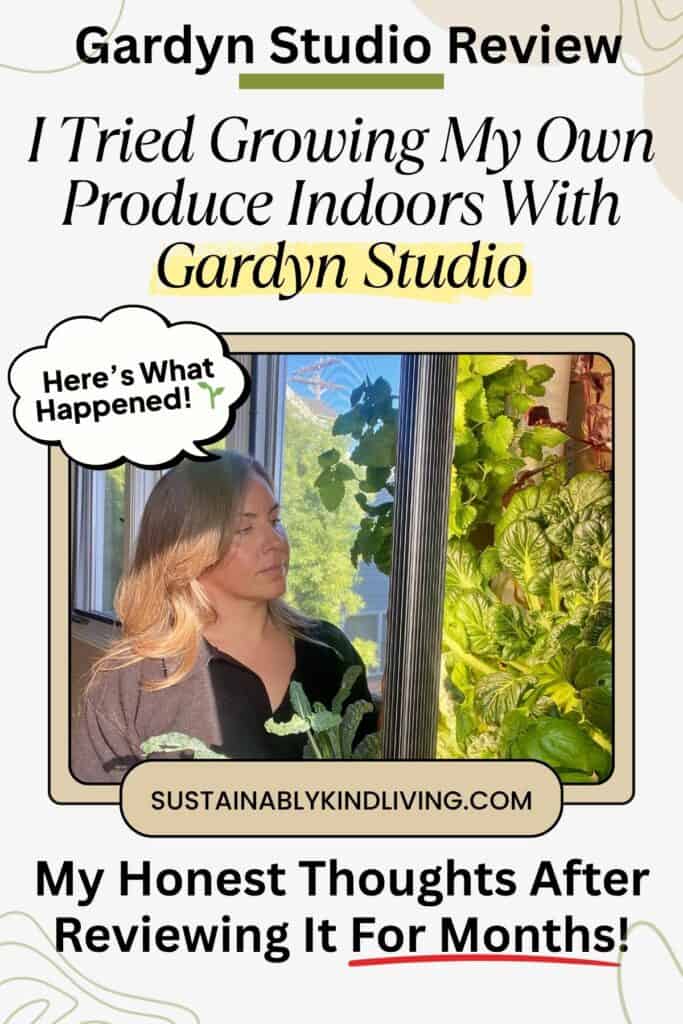
My reality up to that point? Crispy leaves, wilted stems, and more than a few “easy” gardening kits that ended in disappointment.
The sunny spots in my home were never quite right, and every attempt eventually withered away. Sound familiar? So when the Gardyn Studio arrived on my doorstep, I’ll admit — my hopes were sky-high.
A compact, all-in-one hydroponic garden that promised to grow fresh herbs and greens with almost no effort? It sounded like the perfect marriage of technology and sustainability.
In this review, I’ll share my honest experience setting it up, growing with it, and what it’s really like to harvest your own food indoors — no green thumb required.
Quick Pros & Cons, at a glance…
Pros
✅ Compact: Takes up only 1.4 square feet, and the pump is quieter than a small garden fountain.
✅ Safe Materials: Built with BPA-free, food-safe materials with no PFAS or phthalates.
✅ Simple Setup: Takes about 30 minutes with the video tutorial.
✅ Consistent Yield: Delivers regular harvests of greens and herbs once plants are established.
✅ Wide Plant Catalog: 100+ edible varieties with pet-safe options available.
✅ Good ROI For Herb Lovers: Quickly pays for itself by replacing expensive, store-bought herbs.
Cons
❌ Very bright Grow Light: Plan placement away from bedrooms and windows.
❌ Smart App Membership Value Varies: $39/month didn’t pencil out for me, but it may if you travel often.
❌ Lighting/Watering Schedule: Can revert to default settings if not constantly connected to the Wi-Fi.
❌ Overflow Risk: During refills, if you don’t check tank levels closely.
❌ Not “Set It & Forget It”: Expect ~20 minutes maintenance weekly, plus a monthly deep clean.
So First Off: Quick Specs
- Footprint: ~1.4 sq ft
- Capacity: Up to 16 plants at once
- Features: Smart app controls, built-in camera, AI growing guidance from “Kelby” with additional subscription
- Lighting: LED bar
- Average Growing Timeline: Sprouts day 3; first harvest ~8 weeks
- Trial & Warranty: 60-day trial and 2-year warranty; non-sprouting pods replaced
📦 What’s In The Box
The Gardyn Studio arrives with everything you need to get growing, including the main growing units, LED light bar, 16 yCubes (pre-seeded grow pods), plant nutrients, and a detailed setup guide. The video tutorial is essential—don’t skip it!
Price
The Gardyn Studio retails at $499. The included smartphone app acts as your 24/7 gardening assistant that automates water and lighting and tracks your plant’s progress.
For an additional $39/month subscription, you can access Gardyn’s AI assistant, Kelby, who will remind you to add plant food, clean the water tank, and even take care of your plants while you are away from home.
Quick Verdict
The Gardyn Studio is genuinely easy to set up and produces consistent herbs and greens with about 20 minutes of weekly care. Just don’t count on the Gardyn Studio to completely erase your weekly trips to the grocery store for produce.
How Does The Gardyn System Work?
The Gardyn Studio is a closed, recirculating hydroponic garden.
Water and nutrients are held in the reservoir base, while the pump circulates the nutrient solution through the vertical columns to water your plants, and gravity returns it to the tank.
The seedlings come in pre-planted “yCubes” (rockwool blocks) that snap into the designated planting ports on the grow units. A front-mounted LED light bar provides the “sun,” so you are not dependent on strong sunlight.
The smart app controls a consistent lighting and watering schedule, so your plants get just what they need, when they need it, without any guesswork.
What You Can Grow
The Gardyn Studio allows you to grow up to 16 plants at a time (or fewer). If you are looking for more volume, the Gardyn Home supports up to 30 plants at one time.
My Gardyn Studio system came with 16 pre-seeded pods from their “Chef Faves” collection, including lettuce, kale, bok choy, basil, thyme, and more.
But you don’t have to order from their pre-selected kits; you can choose from over 100 individual options that include herbs, vegetables, and flowers.
I loved that the instructions told you exactly where to place each pod based on the amount of sunlight they required. Be sure to pay attention to this important step because it can be the difference between success and withering plants.
Why Gardyn’s Non-Toxic Materials Really Matter
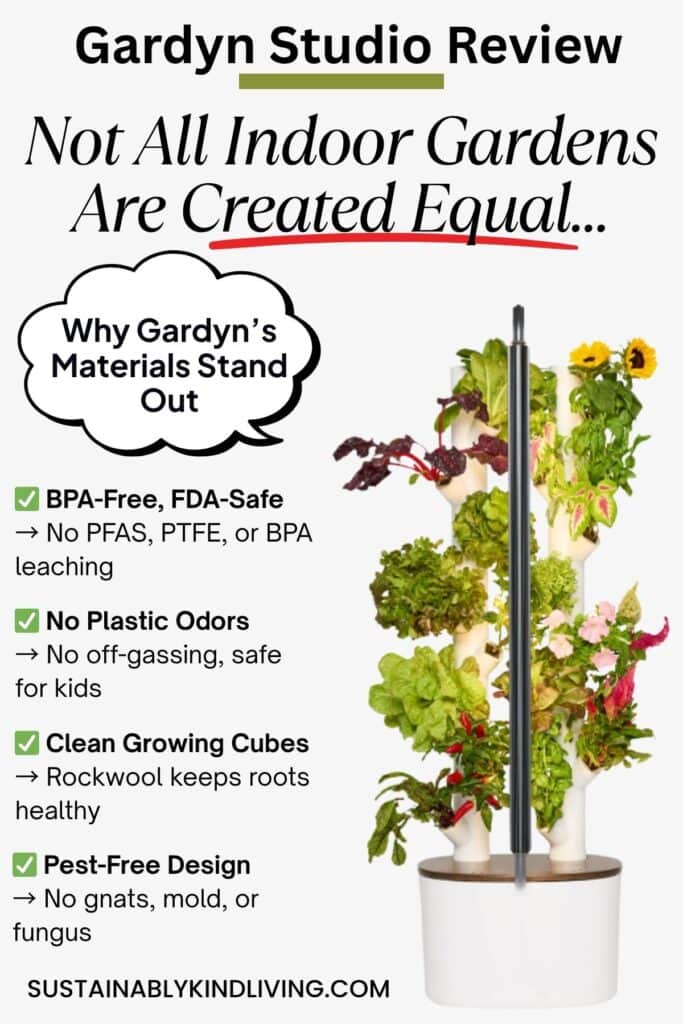
What your food touches becomes part of what you consume. In a recirculating indoor garden, that means every surface, every drop of water, and every material should be safe for repeated contact with your edible plants.
BPA-Free, FDA-Compliant Watering System
In a hydroponic garden, water runs through the same reservoir, pump, tubing, and plant cups many times a day.
If those parts are not food-contact grade, you can get off-odors, off-tastes, and, most worrisome, toxic chemicals like PFAS, phthalates, or BPA in your food.
Gardyn’s “wet zone” uses food-contact safe, BPA-free, FDA-compliant ABS (Acrylonitrile Butadiene Styrene), selected specifically for constant contact with water and roots. There are no PFAS or PTFE in Gardyn’s watering system.
I was pleasantly surprised when unboxing the Gardyn that I didn’t smell any plastic odors, which is great news for anyone with young kids or chemical sensitivities.
Clean, Inert Growing Medium
Gardyn’s pre-seeded yCubes use rockwool, a clean, inert mineral fiber that holds both moisture and air evenly around roots.
Because it isn’t soil, rockwool helps keep the system tidy and reduces common indoor pests like whiteflies, fungus gnats, and gray mold. A big win for indoor gardeners!
The Water You Use Matters
I highly recommend using reverse-osmosis filtered water with added minerals for the best results. Tap water can often contain bacteria, heavy metals, and other toxic contaminants that can hinder the growth of your plants and make their way into your food.
Setup & First Impressions
Easy Assembly In 30 Minutes or Less
From opening the box to turning on the grow light, the complete setup from start to finish took about 30 minutes.
It comes with a printed guide, but I would recommend going straight to the setup video available on YouTube. It will make your life so much easier.
The video clearly shows how all of the parts fit together, especially when it comes to assembling the light bar.
Connecting to The Wi-Fi
The last step was to connect the Gardyn app, which is slightly cumbersome because you need to connect it to your home’s Wi-Fi system. It can be a little finicky depending on how far your phone is from the unit.
One point of frustration I had with my Gardyn Studio is that when we turned off our Wi-Fi each night, it threw off the pre-programmed lighting and watering schedules.
If I forgot to unplug the unit entirely, the grow light would turn on in the middle of the night—and it was bright enough to wake the neighbors.
My First Impressions
Having struggled for years to get my own garden going, I was pleasantly surprised by how quick and easy the Gardyn was to set up, and how little maintenance it required to get healthy sprouts in a matter of days.
The first couple of months, I relied heavily on the direction from Kelby in the smart app (paid feature), which made a big difference in getting my plants off to a healthy, strong start. Tips on when and how to trim the sprouts and roots were invaluable.
Once the plants were established, it was easy to create my own calendar reminders for routine maintenance, and I found that I no longer needed the monthly subscription to keep my plants growing.
However, if you travel often, you’ll get a lot of value out of the automated systems offered by the paid-for options in the app.
Helpful Tips
Keep a small pitcher nearby for mixing fertilizer and topping off the tank when needed. Fill slowly to avoid overflows.
Use the app to keep an eye on the tank water levels. It is difficult to see into the tank when assembled, and it can be easy to overfill
My Real Results
After growing with the Gardyn Studio for three months, I found that it provided reliable fresh herbs and a steady weekly salad or two once established.
If you have grand aspirations to replace your produce hauls from the grocery store with harvests from your Gardyn, don’t get your hopes up too high.
While it produces a lot for its size, you’ll probably get 1 or 2 large salads’ worth on a good week. For me, the real value is in the herbs.
I love to cook with fresh herbs, but keeping them for longer than a few days is nearly impossible, and I have never had any luck trying to grow my own.
Store-bought fresh herbs cost anywhere from $3 to $5 per package. They wilt within days. It comes with a lot of plastic waste, and if you’re someone who cooks regularly, that’s a lot of money you’re spending each month.
With the Gardyn, I had fresh basil, thyme, and lemon balm whenever I needed them. No more throwing away half-dead basil or making do with over-dried thyme.
That alone justified the system for me. Moving forward, I’ll plan to convert all of my seed pods to different herb varieties.
💸 $25 off the Gardyn Studio with code FRESH25
My Growing Timeline & What You Can Expect
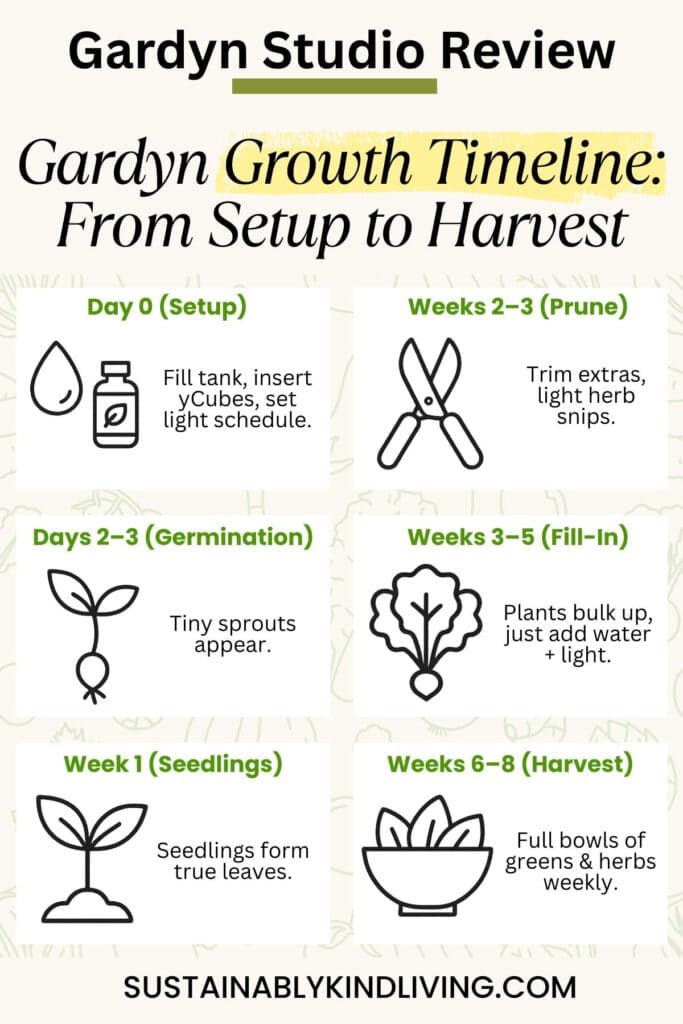
📱 Day 0 (Setup): Fill the tank, insert yCubes, and confirm the light schedule in the app.
🌱 Days 2–3 (Germination): Tiny sprouts begin to poke through the rockwool.
🌿 End of Week 1 (Seedlings): Most pods have visible seedlings. You will see true leaves start to form on fast growers like lettuce and basil.
✂️ Weeks 2–3 (Thinning & First Prune): Trim extras so each site has the strongest one to three stems, depending on the plant. This concentrates growth and prevents crowding. You can start with very light snips of herbs for garnish.
🥬 Weeks 3–5 (Fill-In): Plants bulk up. Lettuce heads and kale rosettes take shape. Keep the light schedule steady (12–14 hours a day worked well for me) and top off the water tank weekly.
🥗 Weeks 6–8 (First Real Harvest): Expect your first full bowls of greens and handfuls of herbs. My timeline was about two months for consistent harvests. I was able to harvest enough for a large salad that would feed 2-3 people each week.
Is the AI Plant Assistant “Kelby” Worth It?
Gardyn’s AI assistant “Kelby” is supposed to be the brain of the system. It monitors your plants through the built-in camera, tracks water usage and light cycles, and sends you customized care tasks through the app.
In theory, Kelby tells you when to refill the tank, refresh the water completely, check the roots, prune overgrowth, and harvest. It also creates time-lapse videos of your plants growing and offers a “vacation mode” that slows growth when you’re away.
With your subscription, you also get 10 credits per month for new seed pods, and discounted pricing on plant food and accessories. If you plan on replacing your plants often, this could help to offset costs.
My take? Kelby was helpful, but not essential.
The most helpful reminders were tank refills, monthly refreshes, and root checks. These are easy to forget if you’re busy, and missing them can cause problems. So having a nudge was useful.
But after a month or two, I felt comfortable creating my own calendar reminders on my phone for the same tasks, and they worked just as well.
Refill every 7 days. Deep clean once a month. Check roots when the app used to tell me to. You still get the automated lighting, watering, and camera updates without paying for the Kelby subscription.
Best Performers & Worst Performers (Seeds To Plant)
Best Performers
These plants thrived in my west-facing office corner during a hot summer:
- Basil – The absolute star. Grew fast, stayed lush, and produced more than I could use.
- Thyme – Steady and reliable. Perfect for roasting vegetables.
- Perpetual spinach – Lived up to its name. I could harvest outer leaves weekly without killing the plant, but it didn’t add up to more than 4-5 harvestable leaves a week.
- Kale – Tender, never bitter. Way better than store-bought baby kale.
- Celery – Surprisingly easy. Great for adding to my green smoothies and soups.
- Kohlrabi – A fun experiment that actually worked.
- Lemon balm – Grew like crazy. Made an excellent addition to iced tea.
- Sunflowers – These were just for fun, and they bloomed beautifully.
Underperformers:
- Bull’s blood – Struggled from the start. I think this suffered from overwatering + root rot. It ended up being fine, but it hasn’t grown as lush as the other plants.
- Onions – Extremely slow. I’m guessing they didn’t love the summer heat.
Looking back, I think starting cool-season crops in July was my mistake. The Gardyn was sitting in a warm office during peak summer.
These plants probably would have done better in fall or winter; regardless of whether you’ll really use all nine pieces, you will. But these two will likely get the most use.
Does The Gardyn Studio Fit in a Small Home?
Footprint
The Gardyn Studio is compact. It takes up about 1.4 square feet of floor space, which is roughly the size of a small end table. I placed mine in a corner of my office, and it fit without feeling cramped.
It actually was a really nice touch to have so much greenery in my office! If you’re in a tiny apartment or studio, it’s doable. But you need to plan for the light.
Light Intensity
The lights are very bright. Bright enough that my dad joked airplanes might mistake it for a landing strip. During the day, this isn’t an issue. The light feels like natural sunlight and creates a pleasant glow in the room.
At night? It’s a different story. If you keep this unit in or near your bedroom, the lights will wake you up. My office shares a wall with our neighbors, and they mentioned noticing the light through their bedroom window.
Noise
The pump is impressively quiet. It’s softer than a small fountain and runs continuously without being disruptive. Even in my office, I hardly noticed the pump running most of the time.
If you’re sensitive to white noise, you might notice it in a completely silent room. But it’s not loud enough to interfere with sleep, conversation, or TV watching.
Aesthetics
Without plants, the Gardyn Studio looks like a slightly upgraded version of a DIY hydroponic system. It’s clearly plastic tubing and functional hardware.
But Gardyn did put thought into the design. The matte plastic with its wooden base gives it an elevated look. The light bar is sleek and modern. And once your plants start growing, they quickly cover the not-so-aesthetic plastic tubes.
By week four, my unit looked like the lush indoor garden I had always hoped for. The mix of greens, herbs, and sunflowers created a living wall effect that actually made my office prettier.
Is It Hard To Maintain the Gardyn Studio?
Cleaning a hydroponic system sounds intimidating. But like with all the required tasks, the Gardyn app makes it easy.
- Weekly maintenance took 20 minutes or less on weeks when I didn’t need to do a full tank refresh. I’d check the water level, top it off with filtered water, and make sure the roots weren’t clogging anything. Quick and simple.
- Refills happened about every 7 days in my warm office. Your mileage may vary depending on how many plants you’re growing and how hot your space is.
- Monthly deep cleaning took about 30 minutes. This involved draining the tank completely, wiping down the interior with a sponge and baking soda, and refilling with fresh water and nutrients.
I didn’t use Gardyn’s HydroBoost supplement as the app suggested since I didn’t receive it in my starter kit. I stuck with the included plant food, and my plants thrived anyway.
Using filtered water and having a removable shower head made the whole cleaning process quick and painless. Even after three months, there was virtually no biofilm, and a quick swipe of a sponge got it clean.
One Important Caution: When the app tells you to add fertilizer, it wants you to mix it into 2 gallons of water. If your tank is already partially full, this can cause an overflow.
Why Gardyn Studio Is a More Sustainable Choice
- Less plastic packaging waste. Every time you buy store herbs or greens, they come in plastic clamshells or bags. With the Gardyn, I harvest directly into my salad bowl. No packaging. No waste.
- Fewer grocery trips. I’m not driving to the store every week for fresh basil. That reduces my transportation footprint, even if only slightly.
- Harvest only what you need. Herbs from the store often come in quantities larger than you’ll use. Half the package wilts before you finish it. With the Gardyn, I pick exactly what I need for tonight’s dinner. Zero food waste.
- Water efficiency. Hydroponic systems use significantly less water than traditional soil gardening. The Gardyn recirculates the same water for weeks, only requiring top-offs to replace what the plants absorb.
Is the Gardyn Studio a perfect zero-waste solution? No. It requires electricity, plastic components, and occasional replacement parts. But compared to buying packaged greens weekly, it certainly is a meaningful reduction in waste.
Who It’s Best For (& Who Should Skip It)
Best for:
✅ Families who want pesticide-free greens at home. Kids love watching plants grow, and you control exactly what goes into your food.
✅ Apartment dwellers with limited space. The compact footprint fits where traditional container gardens can’t.
✅ Herb lovers tired of buying wilted store basil. This is where the Gardyn truly shines. Fresh herbs on demand, no waste.
✅ Wellness-minded cooks who enjoy the ritual. Checking your plants becomes a pleasant daily habit.
Skip if:
❌ You live in a studio or sleep near the unit. The lights are too bright at night, especially during shorter winter days.
❌ You want zero maintenance or zero ongoing cost. This isn’t a “set and forget” system. It requires weekly attention and eventual pod replacements.
❌ You plan to go full DIY hydro from day one. The Gardyn is designed around its proprietary system. If you want total customization and hacking, other platforms may suit you better.
Final Verdict: Is The Gardyn Studio Worth the $499 Investment?
The Gardyn Studio may not be a complete replacement for your weekly grocery haul, but it delivers something even more meaningful: consistency, convenience, and a deeper connection to your food.
It brought fresh herbs and greens into my daily life with minimal effort, and along the way, reminded me that growing food — even in small, unconventional spaces — can be simple, satisfying, and sustainable.
If you’re craving a bit more green in your home and a little less waste in your routine, the Gardyn Studio is a beautiful place to begin.
💸 $25 off the Gardyn Studio with code FRESH25
💚 More to Love…
If this Gardyn Studio review sparked your interest in creating a healthier, greener home, you’ll love these other SKL guides:
- 🌱 Indoor Garden Systems — Smart, compact setups to grow fresh greens year-round.
- ♻️ Electric Kitchen Composters — Turn food scraps into nutrient-rich soil in days.
- 🌿 Natural Homemade Fertilizers — DIY recipes to nourish your plants without chemicals.
- 🏡 Sustainable Home Decor & Home Goods — Eco-friendly upgrades to make every room greener.
- ✨ Guide To Non-Toxic Living For Beginners — Simple swaps to start your clean-living journey
- 💻 How To Create A Non-Toxic & Eco-Friendly Workspace — Healthier desks, offices, and creative spaces.
📌 Save This Gardyn Studio Review
Pin this honest review + more non-toxic gardening ideas! From indoor growing systems to sustainable home upgrades, this guide is packed with eco-friendly inspiration for greener living.


Steal My Non-Toxic Cleaning Checklist!
Believe us, it’s the BEST…. and it’s free. Does it really get any better than that?! Sign up for our newsletter and get this free checklist to clean your home without any harmful chemicals!