 Shop My Favorite Non-Toxic Gifts Of 2026!
SKL is reader supported. When you buy through links on our site, we may earn affiliate commission. Learn more here.
If you’re looking for the best countertop reverse osmosis system, you’re likely trying to balance serious contaminant removal with zero plumbing changes — especially if you rent.
Countertop reverse osmosis systems are one of the few plug-and-play filtration options capable of meaningfully reducing PFAS, lead, fluoride, microplastics, and other dissolved contaminants.
But here’s what most guides gloss over: not every unit labeled “RO” is actually certified for the contaminants people are worried about.
When we began evaluating countertop systems for our own home, installing an under-sink unit wasn’t realistic.
So I approached this the same way I approach every filtration guide on this site — by reviewing NSF certification databases, verifying model-specific listings under NSF/ANSI Standard 58, comparing membrane specifications, and cross-checking documented PFAS reduction claims.
Popularity didn’t matter.
Marketing language didn’t matter.
Certification did.
That’s why this guide is strict.
Every system included below:
- Uses true reverse osmosis membrane filtration
- Carries NSF/ANSI Standard 58 certification or clearly documented PFAS reduction capability
- Provides transparent, model-specific performance data
If it didn’t meet those standards, it didn’t make this list.
Those standards matter because PFAS — often called “forever chemicals” — are now detected in thousands of U.S. water systems and do not break down easily in the body or the environment.
I break down exactly what PFAS are, how they enter drinking water, and why certification matters in our full guide to PFAS and how to reduce exposure.
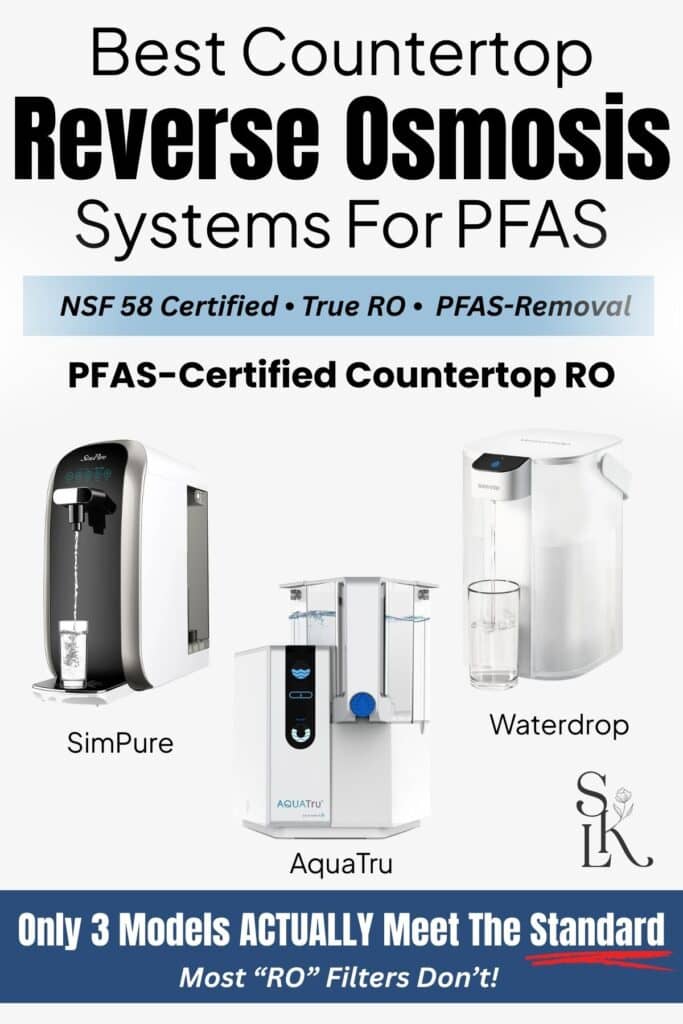
Below, we’ll walk through the three countertop reverse osmosis systems that actually meet the standard.
My Top 3 Countertop Reverse Osmosis Systems (At a Glance)
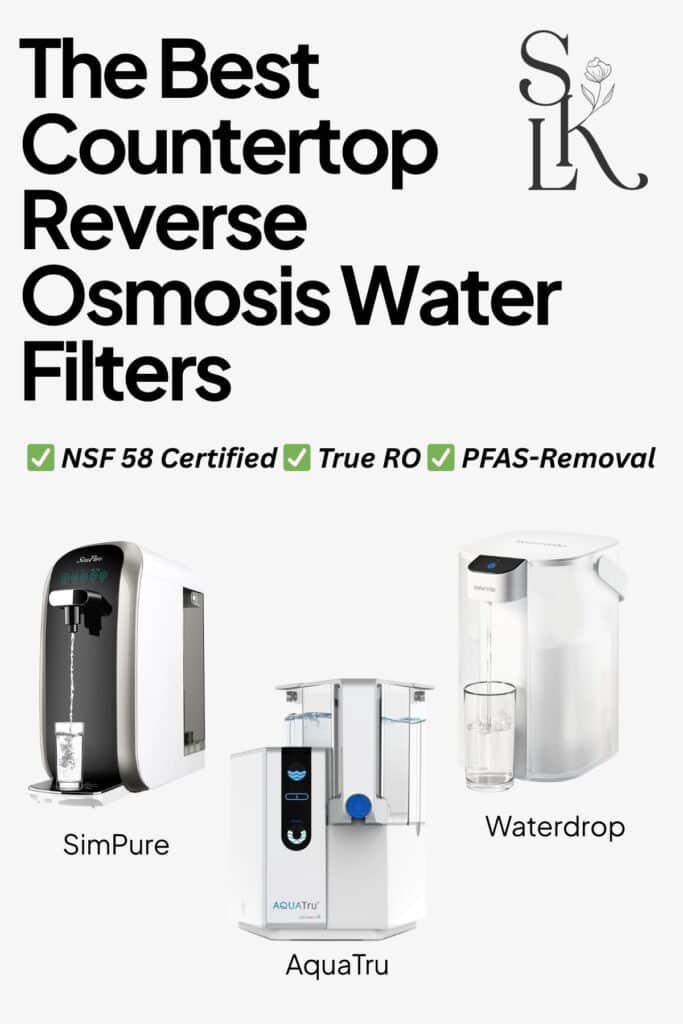
- Best Overall (What We Use): AquaTru Countertop RO
- Best Budget Certified Option: SimPure Y7P-BW
- Best Modern High-Capacity Option: Waterdrop Countertop RO (NSF 58 Models Only)
If you’re here for the short answer, those are the only three countertop reverse osmosis systems that currently meet our strict PFAS standards.
There are dozens of countertop “RO-style” filters on the market. Very few carry NSF/ANSI Standard 58 certification for full-system reverse osmosis performance.
Fewer still explicitly document PFOA and PFOS reduction. This list is intentionally short.
Below, I break down why each system earned its place — including certification details, membrane specs, replacement schedules, and who each one is best for.
The 3 Best Countertop Reverse Osmosis Systems for PFAS (Fully Reviewed)
1. AquaTru Countertop Reverse Osmosis System
Best Overall Countertop Reverse Osmosis System for PFAS
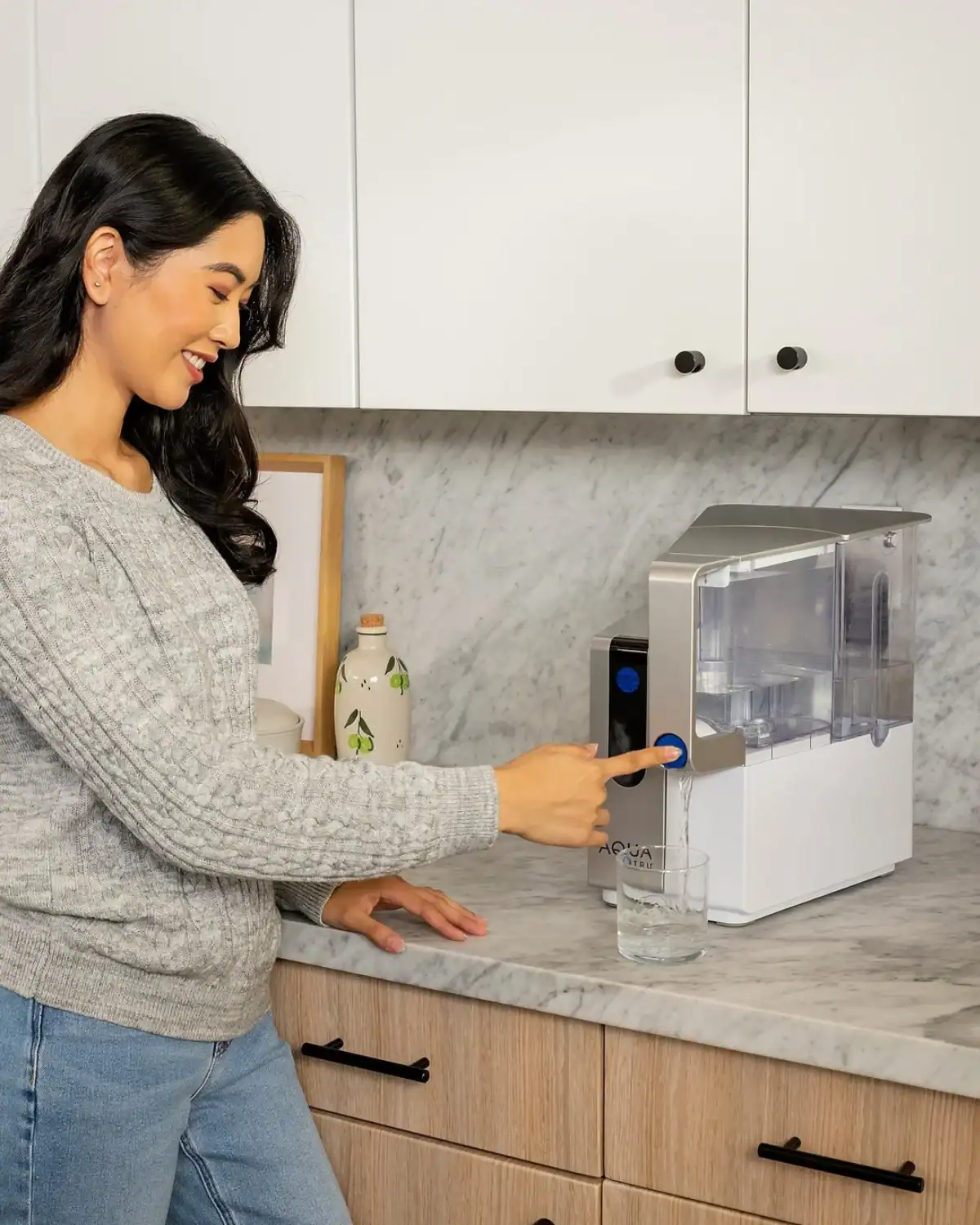
AquaTru is the countertop reverse osmosis system we use in our own kitchen — and I don’t say that lightly.
When we started renting, I knew I wanted reverse osmosis-level filtration, but installing an under-sink unit wasn’t realistic.
After digging into NSF certification databases and verifying which systems were actually certified under NSF/ANSI Standard 58 (not just component tested), AquaTru consistently rose to the top.
This system uses a true 4-stage reverse osmosis process: a sediment pre-filter, activated carbon, RO membrane, and a final polishing carbon filter. The RO membrane is what matters most for PFAS.
Reverse osmosis physically pushes water through a semi-permeable membrane that blocks microscopic contaminants — including PFOA and PFOS — rather than relying solely on adsorption like carbon filters do.
What separates AquaTru from many countertop competitors is full-system NSF/ANSI Standard 58 certification.
That means contaminant reduction claims — including PFAS — are independently verified under standardized testing conditions. It’s not just “tested in a lab.” It’s certified.
For renters, small kitchens, or families who want serious filtration without plumbing changes, this is one of the strongest plug-and-play systems available — especially if you’re not ready for a full under-sink installation.
Price
$349–$499
CERTIFICATION / FILTRATION TYPE
Reverse Osmosis – NSF/ANSI Standard 58 Certified
location/shipping
United States (select international availability varies by retailer)
What We Love
- NSF-certified full-system reverse osmosis (not just component claims)
- Explicit PFOA and PFOS reduction documentation
- No installation required — true countertop plug-and-play
Best For
- Renters who can’t install under-sink systems
- Families prioritizing maximum PFAS reduction
- Households wanting certified reverse osmosis without dealer installation
2. SimPure Y7P-BW Countertop Reverse Osmosis System
Best Budget Certified Countertop RO for PFAS
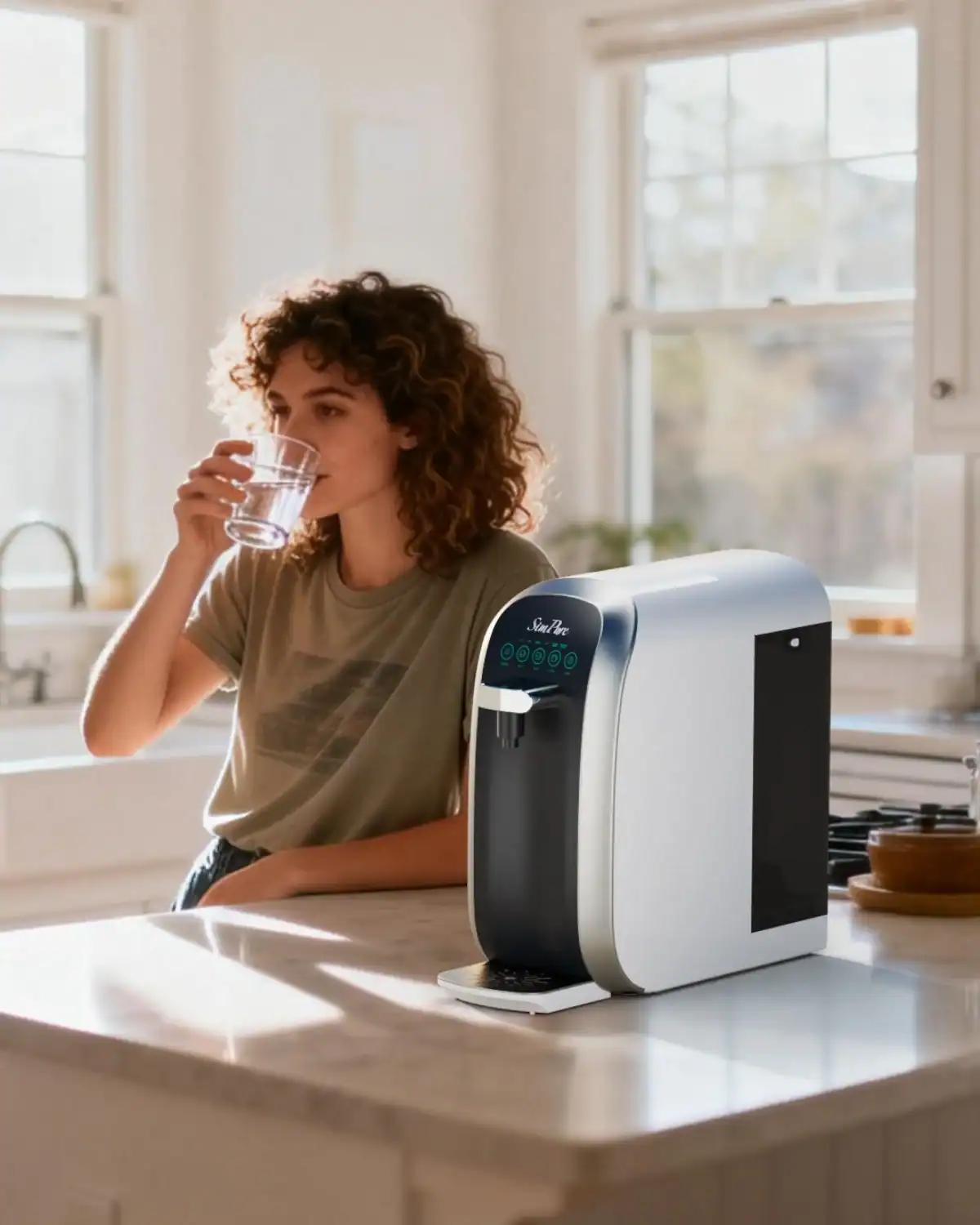
If you want certified reverse osmosis performance at a lower price point, the SimPure Y7P-BW is one of the few countertop systems that legitimately qualify.
Unlike many “RO-style” countertop filters that rely on partial testing or component certifications, the Y7P-BW carries NSF/ANSI Standard 58 certification for reverse osmosis performance. That matters.
Certification confirms the membrane meets standardized contaminant reduction benchmarks — including PFAS compounds like PFOA and PFOS.
This is a true plug-and-play system. No installation. No drilling. No permanent plumbing changes.
Water is poured into the top reservoir, filtered through a multi-stage RO process, and dispensed from the unit.
Because it uses reverse osmosis, it also reduces lead, fluoride, arsenic, nitrates, and microplastics — not just chlorine and taste.
It’s not as design-forward as some premium models, and the reservoir is slightly smaller than higher-end units.
But for renters or budget-conscious households who want certified PFAS reduction without sacrificing filtration strength, it’s one of the most defensible options available.
Price
$299–$399
CERTIFICATION / FILTRATION TYPE
Reverse Osmosis – NSF/ANSI Standard 58 Certified
location/shipping
United States (limited international availability varies by retailer)
What We Love
- NSF-certified reverse osmosis at a lower price point
- True plug-and-play countertop design
- Broad contaminant reduction beyond PFAS
Best For
- Budget-conscious renters
- Smaller households
- Buyers who want certified RO without premium pricing
3. Waterdrop Countertop Reverse Osmosis System (NSF 58 Certified Models Only)
Best Modern High-Capacity Countertop RO for PFAS
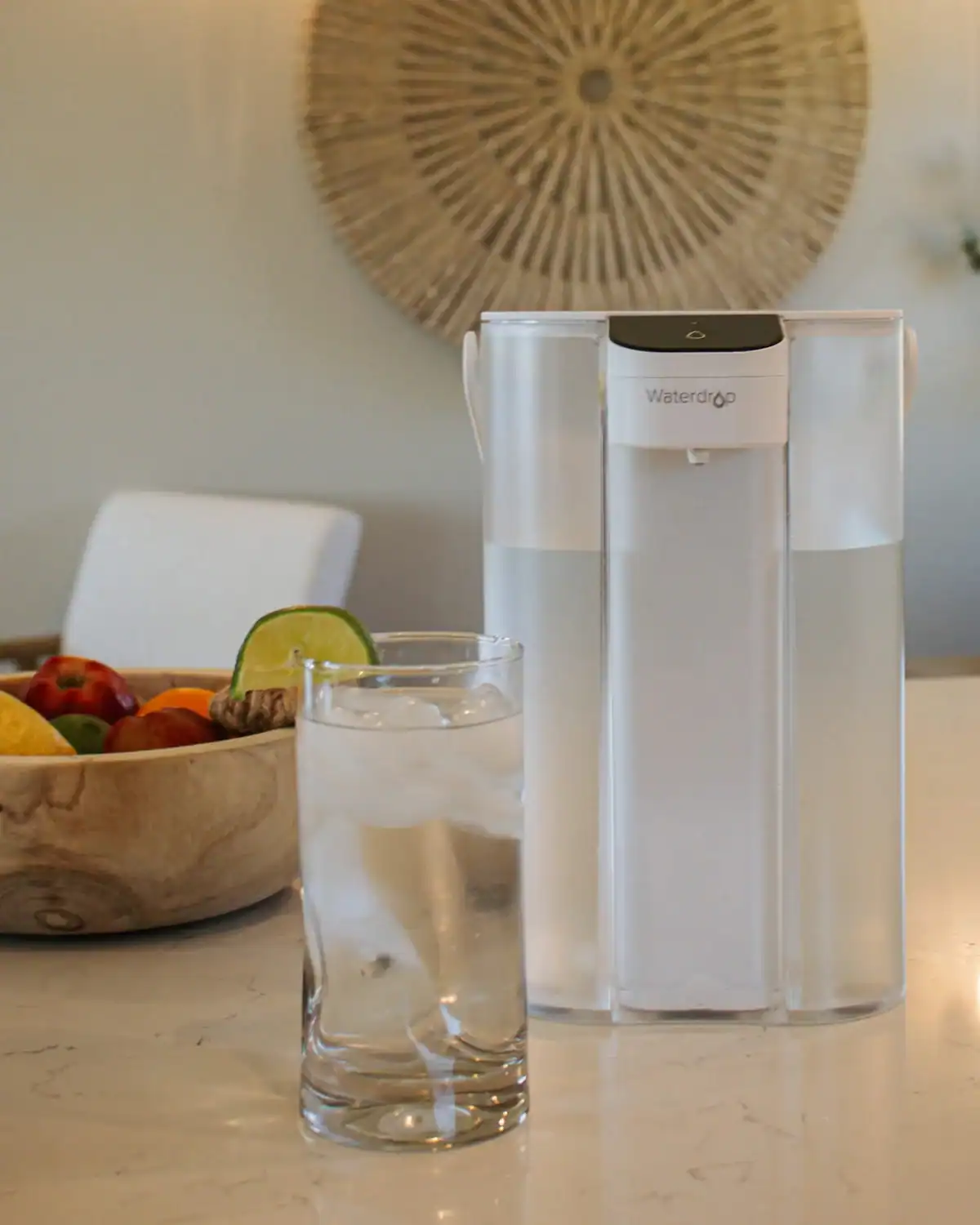
Waterdrop has become one of the most visible brands in the countertop filtration space — but this is where buyers need to slow down.
Not every Waterdrop countertop system is NSF/ANSI Standard 58 certified. Only specific models carry full-system reverse osmosis certification.
When selecting a Waterdrop unit for PFAS reduction, you must verify the exact model number and confirm NSF 58 certification for membrane performance.
The certified models use multi-stage reverse osmosis filtration, including sediment and carbon pre-filtration, followed by an RO membrane designed to reduce PFOA and PFOS at the molecular level.
Like other true RO systems, it also reduces lead, fluoride, arsenic, nitrates, and microplastics.
Where Waterdrop stands out is in capacity and design. Many of their certified countertop models feature larger internal tanks and faster dispense rates than entry-level units.
The build is sleek, compact, and modern — which matters if this system will live visibly on your counter every day.
If you want certified reverse osmosis with a more design-forward feel and higher daily output, Waterdrop is the strongest option — as long as you verify the certification.
Price
$399–$499
CERTIFICATION / FILTRATION TYPE
Reverse Osmosis – NSF/ANSI Standard 58 Certified (Model-Specific)
location/shipping
United States, ships internationally (availability varies by retailer)
What We Love
- NSF-certified RO on select models
- Larger tank capacity and faster dispensing
- Sleek, modern countertop design
Best For
- Households with higher daily water use
- Buyers who want modern aesthetics
- Families wanting certified RO without plumbing
What To Look For in a Countertop Reverse Osmosis System (Decision Checklist)
Not all countertop RO systems are built the same — and when PFAS removal is your priority, small details matter.
Here’s exactly what separates a certified, defensible system from one built mostly for marketing.
1. NSF/ANSI Standard 58 Certification
This is non-negotiable. NSF/ANSI Standard 58 verifies reverse osmosis system performance under standardized testing conditions.
It confirms the system reduces specific contaminants — including PFOA and PFOS — at validated levels.
Do not rely on:
- “RO membrane tested”
- “Independently lab tested”
- “PFAS tested”
Look for full-system NSF 58 certification tied to the exact model number.
If you cannot confirm certification in the NSF database or on official documentation, assume performance is not verified.
2. True Reverse Osmosis (Not Just Carbon
Reverse osmosis works differently from carbon filtration.
Carbon adsorption captures contaminants at the surface level. Reverse osmosis physically forces water through a semi-permeable membrane that blocks dissolved compounds at the molecular level.
That difference is critical for PFAS. If your goal is maximum PFAS reduction in a plug-and-play format, reverse osmosis provides the most comprehensive countertop solution available.
3. Transparent Replacement Schedules
PFAS reduction declines if filters aren’t replaced on time.
Look for brands that clearly outline:
- Pre-filter replacement intervals (often 6–12 months)
- RO membrane lifespan (typically 2 years)
- Annual maintenance cost estimates
If a brand hides replacement timelines or avoids discussing long-term costs, that’s a red flag. Transparency signals confidence.
4. Tank Capacity & Daily Output
Countertop systems vary significantly in output.
Consider:
- How many people are in your household
- Whether you cook frequently
- Whether you fill reusable water bottles daily
Larger internal tanks and faster dispense rates reduce refill frustration — especially in busy households.
5. Clear Contaminant Reduction Charts
A serious filtration brand should provide:
- A contaminant reduction list
- Documentation referencing NSF standards
- Specific mention of PFOA and PFOS
Vague phrases like “removes 99% of contaminants” mean very little without named compounds and a certification context.
When filtration affects your family’s drinking water, clarity should be easy to find.
6. Honest Tradeoff
Reverse osmosis systems:
- Produce some wastewater
- Remove beneficial minerals along with contaminants
- Require periodic filter changes
Brands that openly discuss these tradeoffs tend to be more trustworthy than those that oversell “perfect water” claims.
Filtration is about reduction — not perfection.
Choosing the best countertop reverse osmosis system doesn’t require panic. It requires documentation, certification, and realistic expectations.
Once you focus on verified performance, the options narrow quickly — which is exactly why this list is short.
Why This List Is Intentionally Short
There are dozens of countertop filtration systems. Only three made this list. That’s intentional.
Certification, documented PFAS reduction, and transparent performance matter more than popularity, influencer campaigns, or aesthetic design.
If a system didn’t clearly meet strict reverse osmosis standards, it didn’t make this guide — even if it’s trending online.
Greenwashed Countertop “RO” Systems: What to Watch For
Countertop reverse osmosis has exploded in popularity — and unfortunately, so has marketing confusion.
Not every system labeled “RO” meets strict certification standards. And when you’re trying to reduce PFAS, small wording differences matter.
Here’s where brands often blur the lines.
1. “RO-Style” Filtration Without NSF 58 Certification
Some countertop systems describe themselves as “RO-style,” “RO technology,” or “reverse osmosis inspired.”
That language means nothing without NSF/ANSI Standard 58 certification for full-system performance. Component certification is not the same as full-system certification.
A brand may use an RO membrane that meets certain material standards, but unless the complete system is certified under Standard 58, contaminant reduction claims are not independently verified.
If PFAS reduction matters to you, always confirm:
- NSF/ANSI Standard 58 certification
- Model-specific documentation
- Listing of PFOA and PFOS reduction
If you can’t find it clearly documented, assume it’s not verified.
2. Bluevua & Other “Component Certified” Claims
Brands like Bluevua are frequently marketed as certified RO systems.
Some models reference certification — but buyers need to confirm whether certification applies to the entire system or only to specific internal components.
Component testing does not equal full contaminant reduction certification. That doesn’t automatically mean the system is ineffective.
It means claims require closer review. In a category as technical as PFAS filtration, clarity matters more than aesthetics.
3. Carbon-Only Countertop Filters Marketed as PFAS Solutions
Activated carbon can reduce certain PFAS compounds under the right conditions.
However, countertop carbon filters without NSF 53 certification for PFOA/PFOS should not be assumed to provide meaningful PFAS reduction.
Many countertop filters focus on:
- Taste improvement
- Chlorine reduction
- Basic sediment removal
That is not the same as verified PFAS removal. Reverse osmosis remains the most comprehensive plug-and-play method available for reducing a broad range of PFAS compounds.
4. Marketplace Brands With No Transparent Certification Records
Large online marketplaces are full of sleek countertop “RO” systems with impressive spec sheets — but no accessible NSF listings.
If a brand does not provide:
- Clear certification documentation
- NSF listing links
- Contaminant reduction charts
- Replacement schedules
It becomes difficult to evaluate real-world performance. When filtration claims affect health decisions, documentation should be easy to find — not hidden behind marketing pages.
💭 Frequently Asked Questions About Countertop Reverse Osmosis Systems
The best countertop reverse osmosis system for PFAS is one that carries NSF/ANSI Standard 58 certification and explicitly lists PFOA and PFOS reduction.
Certified systems use a true reverse osmosis membrane to physically block dissolved contaminants at the molecular level. Always verify the exact model number in the NSF database rather than relying on marketing claims.
Certified countertop reverse osmosis systems can remove the vast majority of PFAS, including PFOA and PFOS.
Reverse osmosis forces water through a semi-permeable membrane designed to block microscopic contaminants.
Performance depends on certification, membrane integrity, and proper filter replacement.
Reverse osmosis generally provides more comprehensive PFAS removal than carbon filtration alone.
While certain certified carbon systems can reduce some PFAS compounds, reverse osmosis blocks dissolved contaminants at a finer level and is considered the strongest plug-and-play option for PFAS reduction.
Yes, reverse osmosis systems remove fluoride along with PFAS, lead, arsenic, and many other dissolved contaminants.
Carbon-only countertop filters typically do not remove fluoride unless specifically engineered and certified to do so.
Yes, reverse osmosis systems produce some wastewater during filtration. This is part of the membrane flushing process that helps remove contaminants.
Modern countertop systems are more efficient than older designs, but some water discharge is normal.
Reverse osmosis water is considered safe for long-term consumption.
Because RO removes both contaminants and beneficial minerals, some systems include remineralization stages to improve taste and mineral content.
The safety of RO water is widely supported in residential and commercial use.
Countertop reverse osmosis systems can provide comparable contaminant reduction to under-sink RO systems if they carry NSF/ANSI Standard 58 certification.
The primary differences are tank size, output capacity, and convenience — not filtration strength.
Yes, countertop reverse osmosis systems are ideal for renters because they require no plumbing modifications.
They plug into a standard outlet and use refillable reservoirs rather than permanent installation.
Most countertop reverse osmosis systems require pre-filter replacement every 6 to 12 months and RO membrane replacement approximately every 2 years.
Following manufacturer guidelines is essential to maintain PFAS reduction performance.
No, boiling water does not remove PFAS and may actually concentrate them as water evaporates.
Filtration — particularly certified reverse osmosis — is required to effectively reduce PFAS levels.
You can verify certification by searching the exact model number in the NSF database or reviewing official documentation from the manufacturer.
Certification should clearly reference NSF/ANSI Standard 58 for reverse osmosis performance.
No, not all models from these brands carry full-system NSF/ANSI Standard 58 certification.
Buyers should confirm the specific model number and verify certification rather than assuming brand-wide approval.
Countertop reverse osmosis is worth it for households prioritizing PFAS, lead, fluoride, and dissolved contaminant reduction without permanent plumbing changes.
It offers one of the strongest plug-and-play filtration solutions available.
Continue Your Water Filter Education
If you’re building a cleaner water setup at home, these guides will help you compare filtration types and understand what actually reduces PFAS — not just improves taste.
- What Is PFAS? A Clear Guide to “Forever Chemicals” and How to Reduce Exposure
- The Best Under Sink Water Filters for PFAS (Certified & Fully Reviewed)
- The Best Whole House Water Filters for PFAS, Chlorine & Heavy Metals
- 8 Trusted Brands That Make the Best PFAS Water Filters
- Shower Filters for Chlorine & Skin Health
Whether you’re filtering one faucet or upgrading your entire home, understanding how reverse osmosis, carbon filtration, and whole-house systems differ makes it easier to choose the right solution for your family.
Your Cleanest Water — No Plumbing Required
Choosing the best countertop reverse osmosis system isn’t about chasing trends. It’s about reducing exposure in a way that actually fits your life.
If you rent.
If you don’t want to modify cabinets.
If you’re not ready for a full under-sink or whole-house install.
Countertop reverse osmosis gives you certified, membrane-level filtration without permanent changes to your home. For our family, it was the most realistic next step.
I wanted a verified PFAS reduction. I wanted NSF certification. And I wanted something I could plug in and trust without guessing what “tested” really meant.
Water is daily. It’s cumulative. It’s foundational.
And while no system eliminates every exposure, installing a certified reverse osmosis unit at the point where you drink and cook can meaningfully reduce some of the most persistent contaminants — including PFOA and PFOS.
You don’t need to overhaul your entire home overnight. You just need solid information — and a system backed by real standards. Small upgrades add up.
I’d Love to Hear From You
Are you using a countertop reverse osmosis system right now — or are you still deciding between countertop, under-sink, and whole-house options?
If you rent, what’s been your biggest hesitation about installing filtration?
And if you already use AquaTru, SimPure, or Waterdrop, I’d genuinely love to hear how it’s working for you — especially long-term maintenance and filter replacement experience.
Leave a comment below and share what you’re seeing in your local water report or what helped you finally choose a system.
Your experience may help another family make a more confident decision.
Sources & Scientific References
Because PFAS filtration claims are frequently misrepresented in marketing materials, all certification references in this guide were cross-checked against publicly available regulatory databases, NSF certification listings, and peer-reviewed research on PFAS removal technologies.
The sources below provide additional context on PFAS exposure, treatment standards, and reverse osmosis performance.
Government & Regulatory Agencies
- U.S. Environmental Protection Agency (EPA) – PFAS Overview
https://www.epa.gov/pfas - U.S. Environmental Protection Agency – National Primary Drinking Water Regulation for PFAS
https://www.epa.gov/sdwa/and-polyfluoroalkyl-substances-pfas - U.S. Geological Survey (USGS) – PFAS in U.S. Tap Water (2023)
https://www.usgs.gov/news/national-news-release/tap-water-study-detects-pfas-forever-chemicals-across-us - Agency for Toxic Substances and Disease Registry (ATSDR) – Toxicological Profile for PFAS
https://www.atsdr.cdc.gov/pfas/index.html - Centers for Disease Control and Prevention (CDC) – PFAS & Health Effects
https://www.atsdr.cdc.gov/pfas/about/health-effects.html
Certification & Filtration Standards
- NSF International – NSF/ANSI Standard 58 (Reverse Osmosis Systems)
https://www.nsf.org/knowledge-library/nsf-ansi-58-reverse-osmosis-drinking-water-treatment-systems - NSF International – NSF/ANSI Standard 53 (Health Effects Filtration)
https://www.nsf.org/knowledge-library/nsf-ansi-42-53-and-401-filtration-systems-standards - NSF Certified Drinking Water Treatment Units Database
https://info.nsf.org/Certified/DWTU/ - Water Quality Association (WQA) – PFAS Filtration Guidance
https://www.wqa.org/resources/pfas - U.S. EPA Drinking Water Treatability Database – PFAS Treatment Technologies
https://www.epa.gov/water-research/drinking-water-treatability-database-tdb
Peer-Reviewed Research on PFAS Removal
- Appleman, T.D., et al. (2014). Treatment of poly- and perfluoroalkyl substances in U.S. full-scale water treatment systems. Water Research.
https://doi.org/10.1016/j.watres.2013.12.012 - Rahman, M.F., et al. (2014). Behavior and fate of perfluoroalkyl and polyfluoroalkyl substances in drinking water treatment: A review. Water Research.
https://doi.org/10.1016/j.watres.2014.06.008

Steal My Non-Toxic Cleaning Checklist!
Believe us, it’s the BEST…. and it’s free. Does it really get any better than that?! Sign up for our newsletter and get this free checklist to clean your home without any harmful chemicals!