 Shop My Favorite Non-Toxic Gifts Of 2026!
SKL is reader supported. When you buy through links on our site, we may earn affiliate commission. Learn more here.
Non-toxic rice cookers aren’t as easy to find as you might think.
When I first started looking into safer kitchen appliances, I assumed a rice cooker would be simple. It felt like one of those basic tools that shouldn’t come with hidden concerns.
But once I started digging into materials, coatings, and how these appliances are actually made, I realized that most rice cookers rely on the same types of nonstick surfaces I had already removed from my kitchen when I switched to non-toxic cookware.
That’s when things got frustrating. Many brands use vague terms like “healthy nonstick” or “eco-friendly coating” without clearly explaining what’s touching your food.
And when you’re cooking something as often as rice, that daily exposure starts to matter more than most people realize.
SKL top picks, in a nutshell…
- My Favorite Non-Toxic Rice Cooker Overall: Our Place
- Best Carb-Reducing Rice Cooker: GreenPan
- Best 100% Non-Toxic Rice Cooker: Vitaclay Chef
- Best Stainless Steel Rice Cooker: Buffalo
- Best Budget Non-Toxic Rice Cooker: Elite Gourmet
In our home, rice is a staple. It shows up in everything from quick weeknight meals to slower, cozier dinners, so it’s something we’re making all the time.
As I started updating things like our non-toxic food storage containers, it naturally brought up the same question here too: what is actually touching our food every day?
That’s what made finding a rice cooker that felt both safe and easy to use something I took seriously.
Over time, I tested different options, compared materials, and paid close attention to what brands were actually willing to disclose.
Some stood out for their transparency. Others looked good on the surface but raised more questions the deeper I went.
What I found is that not all “non-toxic” rice cookers are created equal. The cooking surface makes the biggest difference, and understanding that one detail can completely change which option is right for you.
Below are the ones I would personally feel comfortable using in my own kitchen, along with what makes each one different, so you can choose based on what matters most in your home.
Best Non-Toxic Rice Cookers: At a Glance Comparison
Mobile Users: Scroll to see full comparison →
| Brand | Best For | Materials | Price & Sizing |
|---|---|---|---|
| Our Place | Everyday use & modern design | Ceramic Nonstick | $139 | 6-Cup |
| GreenPan | Reducing starch in rice | Thermolon™ Ceramic Nonstick Coating | $250 | 10-Cup |
| VitaClay Chef | 100% non-toxic cooking | Unglazed Natural Clay (Zisha Clay) | $170 | 6-Cup |
| Buffalo | Stainless steel durability | Multi-Ply Stainless Steel | $330 | 5-Cup |
| Elite Gourmet | Budget-friendly option | 304 Stainless Steel (Surgical-Grade) | $30 | 10-Cup |
Why Choosing a Non-Toxic Rice Cooker Matters
Rice cookers operate at sustained heat and come into direct contact with your food, which makes the materials used inside them especially important.
Many conventional models rely on nonstick coatings made with PFAS (per- and polyfluoroalkyl substances) or related compounds like PTFE.
According to the Environmental Protection Agency, PFAS are known as “forever chemicals” because they persist in the body and environment, with links to immune and hormonal health concerns.
When PTFE-based coatings are exposed to very high temperatures, they can release fumes.
Organizations like the Environmental Working Group note that these fumes may cause short-term flu-like symptoms known as polymer fume fever, especially in poorly ventilated spaces.
While rice cookers are designed to regulate temperature, the presence of these materials in everyday cooking appliances is part of why many people choose to look for simpler, more inert alternatives.
The Hidden Problem With Most Rice Cookers
Most rice cookers look the same from the outside, but the biggest difference is the surface that actually touches your food. Many rely on Teflon or other PTFE-based nonstick coatings to prevent rice from sticking.
These coatings are part of the PFAS family, which is where most of the well-known concerns come from. They’re effective and widely used, but they’re not the same as newer PFAS-free alternatives.
To respond to those concerns, many brands have shifted toward what’s often labeled as “ceramic nonstick.” This is where things get confusing.
I’ve seen the same kind of confusion when researching non-toxic bakeware, where “ceramic” can mean very different things depending on how it’s made.

Ceramic nonstick coatings are different from PTFE-based coatings. They are typically made using a sol-gel process that creates a thin, glass-like layer over a metal base, and they do not use PFAS.
That’s an important distinction. At the same time, they are still coatings, which means they can wear down over time with repeated use.
Another challenge is how little detail many brands actually provide. It’s common to see phrases like “non-toxic nonstick” or “proprietary coating” without a clear explanation of what that includes.
Without that level of transparency, it becomes difficult to compare products or understand how they’ll hold up over time.
What this really comes down to is understanding the difference between three types of cooking surfaces: PTFE-based nonstick, PFAS-free coated surfaces, and completely coating-free materials like stainless steel or clay.
Once you understand those categories, it becomes much easier to choose a rice cooker that actually fits your comfort level.
How I Chose The Best Non-Toxic Rice Cookers
Instead of relying on labels like “healthy” or “non-toxic,” I focused on what could actually be verified. The first thing I looked at was the cooking surface.
Every rice cooker on this list falls into one of three categories: PTFE-based nonstick, PFAS-free coated surfaces, or completely coating-free materials like stainless steel or clay.
From there, I prioritized options that either avoided PFAS entirely or clearly disclosed what was being used instead.
Next, I looked at material transparency. If a brand couldn’t clearly explain what their coating or inner pot was made from, it didn’t make the list.
Vague terms like “proprietary nonstick” or “eco coating” were a red flag. I focused on brands that were upfront about their materials and how their products are constructed.
I also considered how these cookers perform in real life. Some of the cleanest materials, like pure clay or stainless steel, come with a slightly different cooking experience.
Others are designed to be more convenient but still aim to reduce exposure compared to traditional nonstick. I wanted to include a mix of options so you can choose what fits your routine, not just what looks best on paper.
Finally, I paid attention to long-term use. Rice cookers are something most people use regularly, sometimes daily. That makes durability and material stability more important than one-time use.
The result is a list that balances material safety, transparency, and everyday usability, so you can choose based on what matters most in your kitchen.
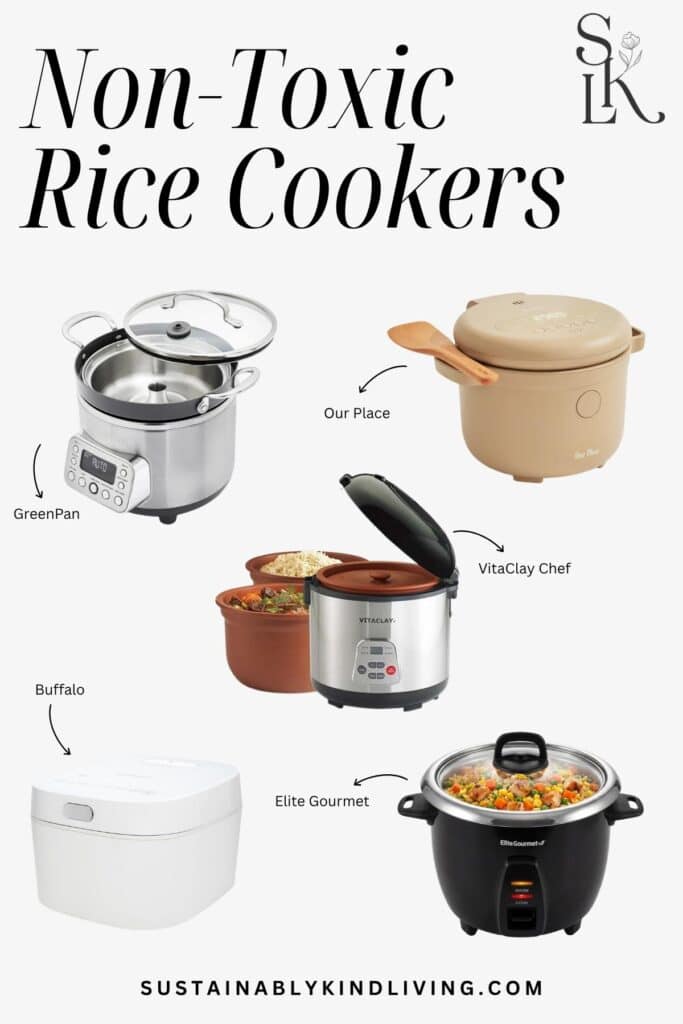
These are the rice cookers that stood out after looking closely at materials, coatings, and how they actually hold up with regular use.
Each one takes a slightly different approach, so the right choice really depends on what matters most in your kitchen.
The Best Non-Toxic Rice Cookers of 2026
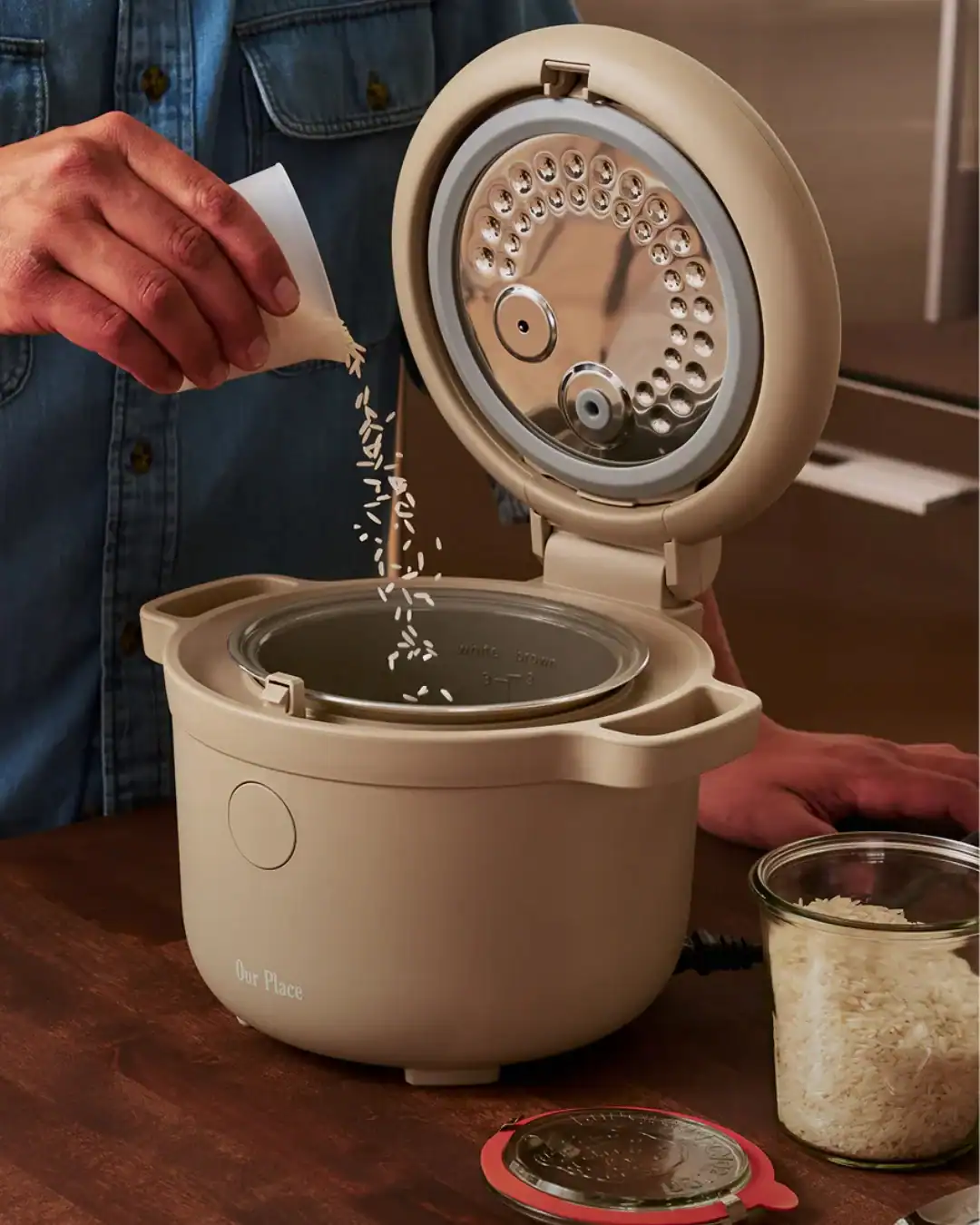
1. Our Place Rice Cooker — My Personal Favorite Non-Toxic Rice Cooker
Best For: Anyone who wants a simple, everyday rice cooker that feels easy to use and looks good on the counter
Use discount code SKL10 to save 10%!
I’ve used this one in my own kitchen, and it’s the rice cooker I keep coming back to.
The design is clean, the size is manageable, and it’s something you actually don’t mind leaving out on the counter.
More importantly, it just works. You can add your rice, press a button, and trust that it’s going to turn out well without constantly checking on it.
The inner pot uses a ceramic-based nonstick coating that is free from PFAS, PTFE, and PFOA, which makes it a meaningful step up from traditional Teflon-based rice cookers.
You still get that easy release and simple cleanup, but without relying on the same materials that raised concerns in the first place.
It’s not a coating-free option like stainless steel or clay, but for everyday use, this is one of the most practical balances I’ve found between ease, design, and safer materials.
Price & Size
$139 | 6-Cup
Food Contact Material
Ceramic Nonstick | PFAS, PTFE & PFOA-Free
Location/shipping
United States | Ships To Canada, The United Kingdom & Australia
What I Like
- I’ve used it myself, and it’s incredibly easy to work into daily routines
- PFAS-free nonstick surface (no traditional Teflon)
- Compact, design-forward, and doesn’t feel like a bulky appliance
- Consistent results with minimal effort
What to Keep in Mind
- Still a coated surface, not fully inert like stainless steel or clay
- Needs gentle care to help the coating last over time
2. GreenPan Elite Carb-Reducing Rice Cooker — Best Carb-Reducing Rice Cooker
Best For: Anyone looking to reduce starch in rice while using a stainless steel cooking surface
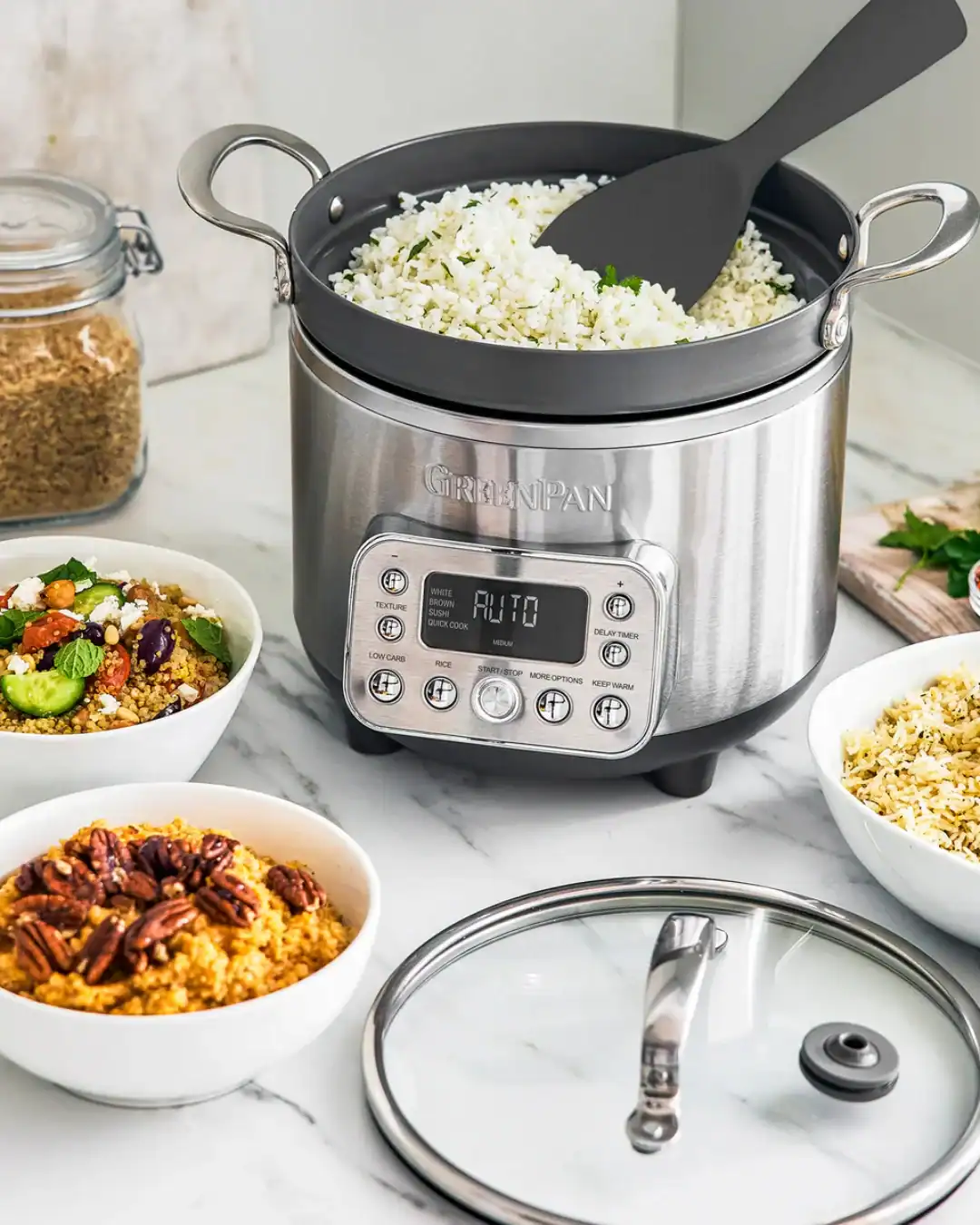
We actually found this one by complete chance while I was working, and it ended up being a huge game-changer for my dad.
As a diabetic, managing carbs is something he has to think about daily, and this gave him a way to still enjoy rice in a way that worked better for him. He absolutely loved it.
Instead of letting the rice absorb all the water, it uses a basket system that allows excess starch to drain away during the cooking process.
The result is a lighter, less sticky texture, which can be helpful if you’re trying to reduce overall starch.
The cooking surface itself is stainless steel, so there’s no nonstick coating involved. That’s a big plus if you’re trying to avoid coated surfaces altogether while still using a modern appliance.
It does take a little getting used to compared to a traditional rice cooker, but once you understand the method, it fills a really specific need in a way most rice cookers don’t.
Price & Size
$249.99 | 10-Cup
Food Contact Material
Thermolon™ Ceramic Nonstick Coating | PFAS-Free
location/shipping
United States | Ships Via Region-Specific Websites Only
What I Like
- Stainless steel cooking surface (no coating)
- Unique carb-reducing function that actually serves a purpose
- Can be helpful for blood sugar-conscious cooking
- Feels like a more intentional upgrade vs standard rice cookers
What to Keep in Mind
- Cooks rice differently than traditional methods
- Slight learning curve at first
- Texture is less sticky than the standard rice cooker results
If You’re Rethinking Your Kitchen Appliances…
If you’re starting to look more closely at what your food is cooking in, it usually doesn’t stop at one appliance. I found myself going down the same path with non-toxic air fryers and non-toxic slow cookers too, since both involve repeated heat and the same questions around materials.
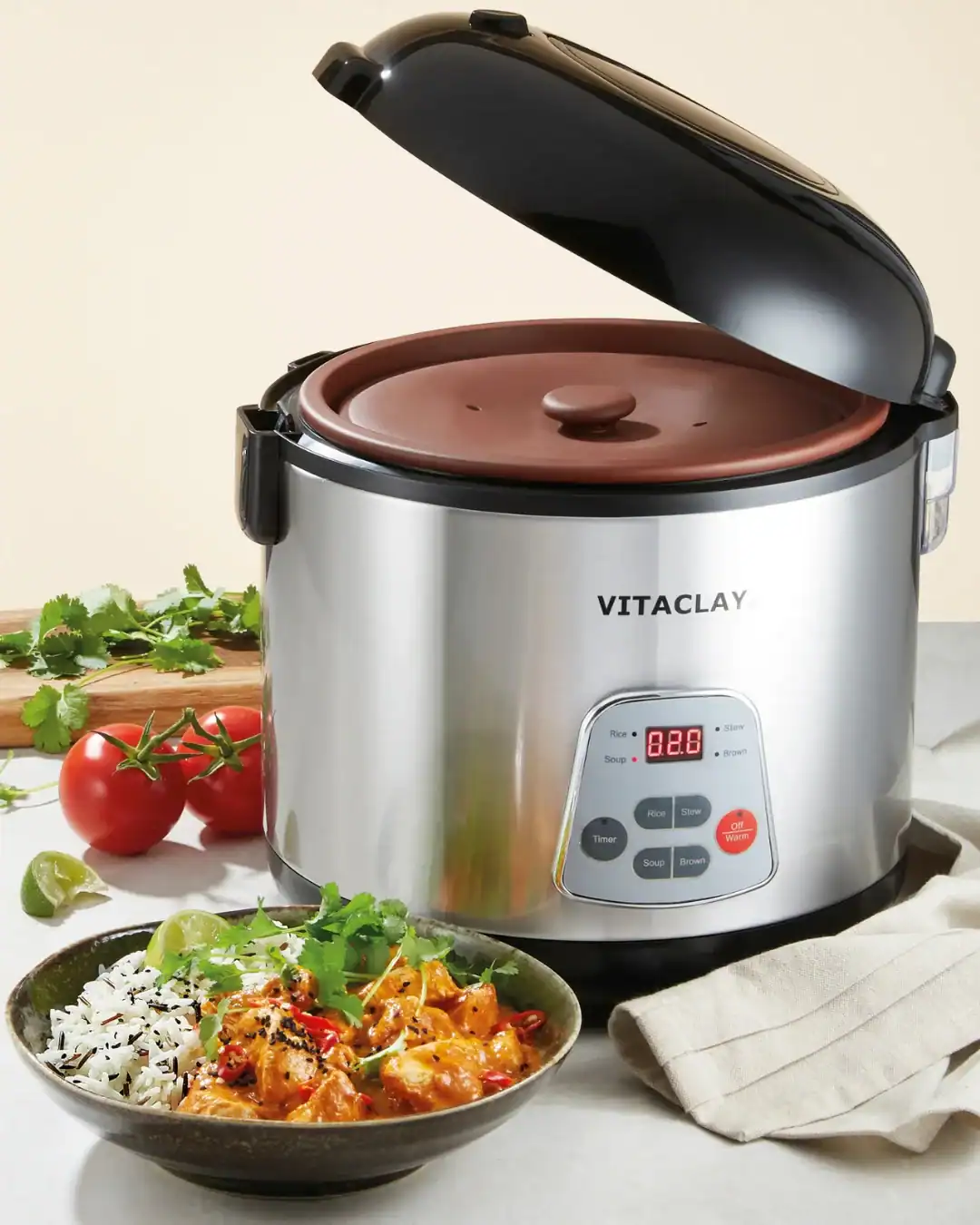
3. VitaClay Chef Rice Cooker — The Most Non-Toxic Rice Cooker
Best For: Anyone who wants the cleanest possible cooking surface with zero coatings or metals
Use discount code SKL10 to save 10%!
VitaClay Chef uses a natural, unglazed Zisha clay pot, which means your food is not coming into contact with metal or any kind of nonstick layer.
There’s no PTFE, no ceramic coating, and no synthetic materials involved in the cooking surface at all.
This is about as close as you can get to traditional, low-tox cooking in a modern appliance.
Clay has been used for centuries because it’s stable, non-reactive, and doesn’t rely on added coatings to function.
It does cook differently. The process is slower and a bit more hands-on, and the pot itself needs to be handled with care.
But if you’re prioritizing material purity above everything else, this is the strongest option on the list by a wide margin.
Price & Size
$170 (6-Cup) | $200 (8-Cup)
Food Contact Material
Unglazed Natural Clay (Zisha Clay) | PFAS, PTFE & PFOA-Free
Location/shipping
United States
What I Like
- Completely coating-free cooking surface
- No metals or synthetic materials touching food
- One of the cleanest cooking methods available
- Great for slow cooking, soups, and traditional recipes
What to Keep in Mind
- Fragile compared to stainless steel
- Longer cooking times
- Requires more care and attention during use
4. Buffalo Smart Cooker — Best Stainless Steel Rice Cooker
Best For: Anyone who wants a durable, coating-free rice cooker with more modern performance
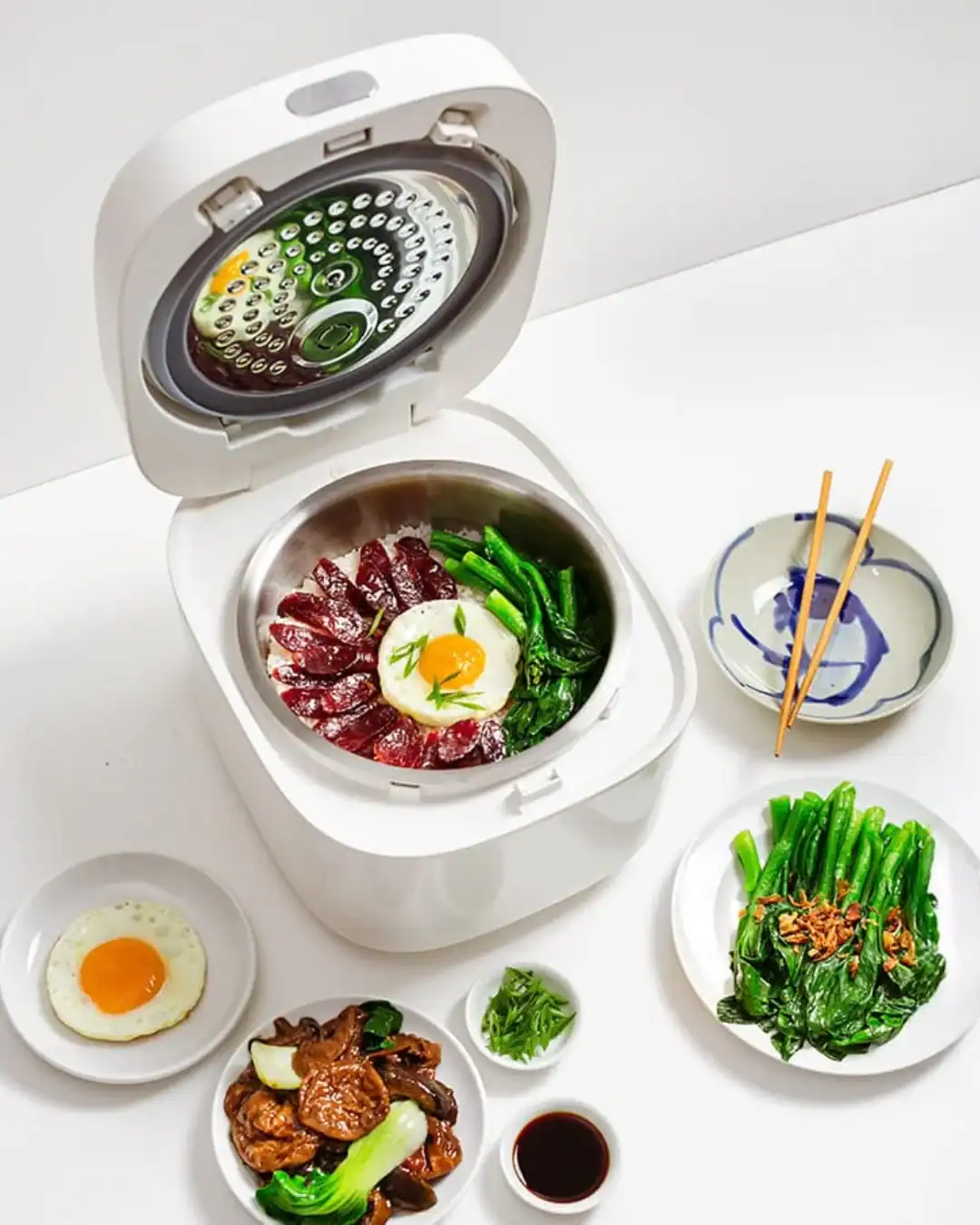
If you like the idea of stainless steel but still want something that feels like a traditional rice cooker, this is a really solid option.
The inner pot is made from multi-layer stainless steel, so there’s no nonstick coating involved.
It’s designed to be durable, non-reactive, and long-lasting, which makes it a good fit if you’re trying to move away from coated surfaces without switching to something like clay.
It also uses induction heating, which helps distribute heat more evenly compared to basic models.
That makes a difference in how consistently the rice cooks, especially if you’re making different types of grains.
It’s a bit heavier and more of an investment, but it feels like a long-term appliance rather than something you’ll need to replace after a few years.
Price & Size
$330 | 5-Cup
Food Contact Material
Multi-Ply Stainless Steel
location/shipping
China | Ships To The United States & Internationally
What I Like
- Stainless steel cooking surface with no coating
- Durable and built to last
- Even cooking with induction heating
- Feels like a long-term upgrade
What to Keep in Mind
- Heavier than most rice cookers
- Higher price point
- Slight learning curve compared to nonstick
5. Elite Gourmet Stainless Steel Rice Cooker — Best Budget Non-Toxic Rice Cooker
Best For: Anyone who wants a simple, coating-free option at a more affordable price
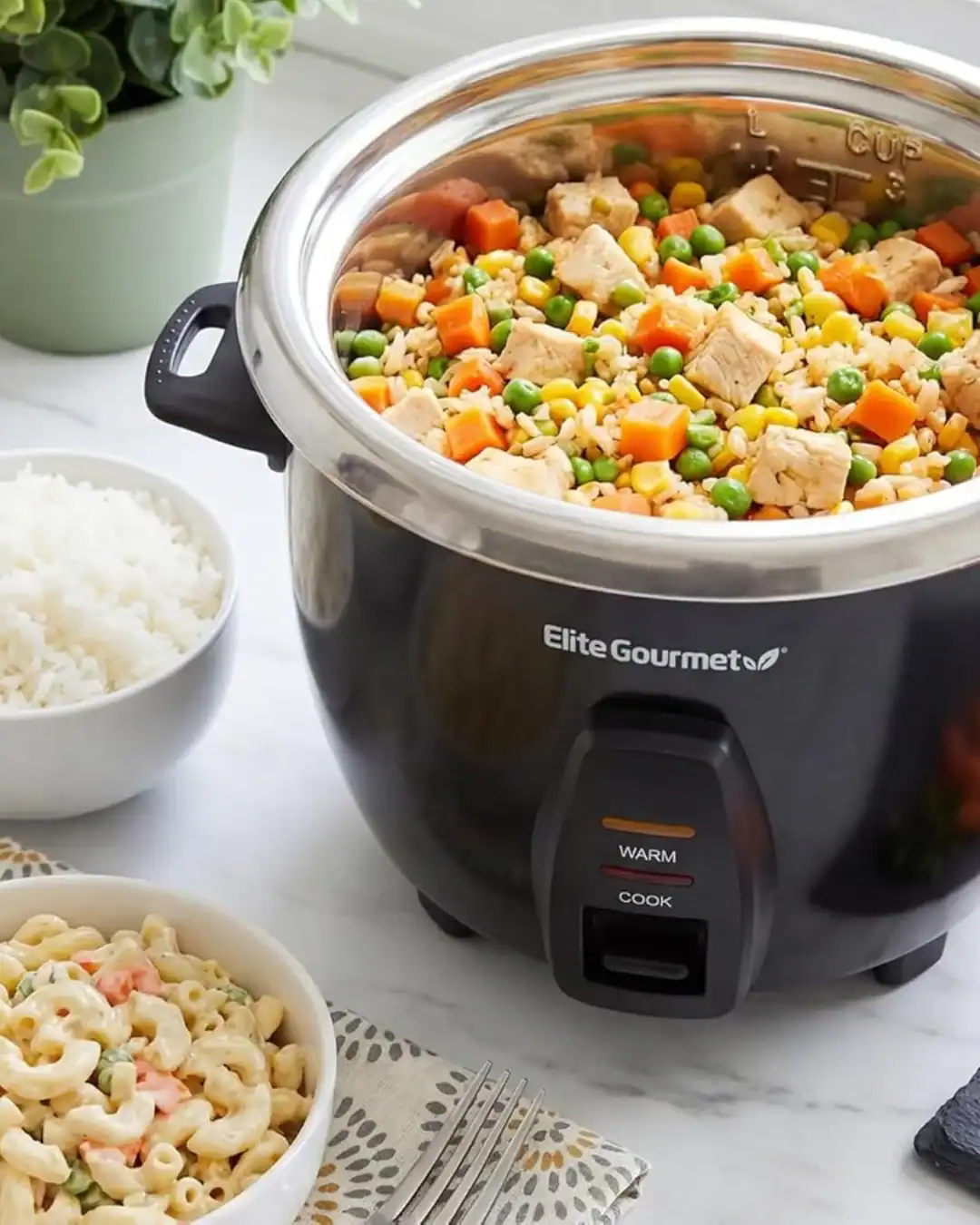
If you’re trying to avoid nonstick coatings without spending a few hundred dollars, this is one of the most accessible options.
The inner pot is made from 304 stainless steel, so there’s no coating involved.
It’s a straightforward design, but that’s part of the appeal. There’s nothing complicated here, and it does exactly what you need it to do.
It doesn’t have the advanced features or precision of higher-end models, but for basic rice cooking, it gets the job done.
It’s a good entry point if you’re just starting to swap out traditional nonstick appliances.
It feels more utilitarian than the others on this list, but for the price, it’s one of the easiest ways to move toward a fully coating-free setup.
Price & Size
$30 | 10-Cup
Food Contact Material
304 Stainless Steel (Surgical-Grade)
location/shipping
China/United States | Ships Internationally
What I Like
- Very budget-friendly
- Stainless steel cooking surface with no coating
- Simple and easy to use
- Good entry-level option
What to Keep in Mind
- Fewer features and presets
- Less precise cooking compared to higher-end models
- More basic overall design
⚠️ Note On Prop 65 Warning:
This rice cooker carries a California Prop 65 warning for potential lead exposure. This does not mean the stainless steel cooking pot contains lead. In most cases, the warning applies to internal electrical components or external parts, not the food-contact surface.
What Is The Safest Material For A Rice Cooker?
When it comes to choosing a non-toxic rice cooker, the most important factor is the cooking surface.
This is what your food is in direct contact with every time you use it. Not all materials perform the same, and understanding the differences can make the decision a lot clearer.
Stainless Steel
Stainless steel is one of the most widely trusted materials for cooking. It doesn’t rely on coatings, which means there’s nothing to wear down over time.
It’s durable, non-reactive, and holds up well with regular use. That’s why it’s commonly used in professional kitchens and high-quality cookware.
The tradeoff is that it’s not naturally nonstick, so there can be a slight learning curve depending on how you cook your rice.
Pure Clay (Ceramic)
Clay is one of the most traditional cooking materials, and it’s still one of the cleanest.
In rice cookers like Vitaclay Chef, the inner pot is made from natural, unglazed clay, which means there are no coatings, metals, or synthetic materials involved.
It’s a very simple, time-tested approach. It does require more care and patience, but if your goal is to minimize exposure as much as possible, this is one of the strongest options available.
Ceramic Nonstick (PFAS-Free)
Ceramic nonstick coatings are often used as an alternative to traditional Teflon.
They are typically made using a sol-gel process and are free from PFAS, PTFE, and PFOA, which is why many people see them as a safer upgrade.
They still provide that easy-release surface, which makes cooking and cleanup much more convenient. That said, they are still coatings.
Over time, they can wear down with repeated use, so they sit somewhere between traditional nonstick and fully coating-free materials.
The Bottom Line
If you want the lowest possible exposure, stainless steel and pure clay are the most stable choices.
If you prefer ease and convenience, PFAS-free ceramic nonstick can still be a meaningful step up from traditional Teflon-based coatings.
It really comes down to what fits your routine and what level of tradeoff you’re comfortable with.
Frequently Asked Questions About Non-Toxic Rice Cookers
The safest rice cooker materials are stainless steel and pure clay because they do not rely on nonstick coatings.
These materials are stable, non-reactive, and do not break down over time, the way coated surfaces can.
If you are looking for the safest non-toxic rice cooker, these are generally the best options to consider.
Ceramic rice cookers that are labeled PFAS-free are considered a safer alternative to traditional nonstick rice cookers.
However, most use a ceramic-based coating rather than solid ceramic, which means they are still a coated surface and can wear down over time.
They are a common middle-ground option for those looking for a non-toxic rice cooker with easier cleanup.
Some rice cookers contain PFAS through PTFE-based nonstick coatings, commonly known as Teflon. Many newer non-toxic rice cookers are marketed as PFAS-free, but it is still important to check the materials used in the inner pot to understand what is actually touching your food.
Stainless steel is generally considered a better option for a non-toxic rice cooker because it does not rely on coatings.
Nonstick rice cookers are easier to use, but stainless steel offers a more stable cooking surface and avoids the concerns associated with coated materials.
PFAS-free rice cookers are typically safer than traditional Teflon-based models, but they are not all the same. Many use ceramic nonstick coatings, which are different from PTFE but still function as a coating.
If you want a completely non-toxic rice cooker, coating-free materials like stainless steel or clay are the most straightforward choice.
White basmati rice and jasmine rice tend to have lower arsenic levels compared to other types of rice. Brown rice can contain higher levels because it retains the outer layer of the grain where arsenic accumulates.
Choosing lower-arsenic varieties can make a difference if you cook rice frequently.
To reduce arsenic in rice, rinse it thoroughly before cooking and consider soaking it for several hours. Cooking rice in excess water and draining the extra liquid can also help lower arsenic levels. These methods can be used alongside a non-toxic rice cooker for safer everyday cooking.
Rice cookers are worth it if you cook rice or grains regularly. A good non-toxic rice cooker can improve consistency, simplify cooking, and reduce the need to monitor the process. It can also be used for other grains and simple meals.
Rice cookers with nonstick coatings may pose a higher risk of chemical exposure if the surface becomes scratched or worn over time.
Choosing a non-toxic rice cooker with stainless steel or clay helps reduce that risk by eliminating coated surfaces.
When shopping for a non-toxic rice cooker, it is best to avoid PTFE or Teflon-based coatings and products that do not clearly disclose their materials.
Look for transparent brands that specify whether the cooking surface is stainless steel, clay, or a PFAS-free coating.
Still Deciding? Start Here
If you’re not sure which direction to go, here’s a simple way to narrow it down based on what actually matters most:
- For Everyday Use & Design: Our Place
- For Reducing Starch In Rice: GreenPan
- For The Most Non-Toxic Option: Vitaclay Chef
- For A Stainless Steel Rice Cooker: Buffalo
- For A Budget-Friendly Option: Elite Gourmet
Final Thoughts on Choosing a Non-Toxic Rice Cooker
Rice is one of those foods most of us make on a regular basis without thinking much about it.
So when you start looking at what’s actually involved- the materials, the heat, and what your food is sitting in while it cooks, it can feel like a lot at first.
But it usually comes down to one simple question: what is my food touching while it cooks?
Once you start there, things get clearer pretty quickly. You don’t need to overcomplicate it or try to find a perfect option.
For some people, that means switching to stainless steel or clay. For others, it’s choosing a PFAS-free rice cooker that still feels easy to use day-to-day. Both approaches are valid.
What matters more is that you’re paying attention and making a choice that feels better than what you had before. Because with something you use this often, even small changes can make a difference over time.
Continue Your Non-Toxic Kitchen Routine
If you’re building a safer, lower-toxic kitchen setup, these guides can help you take the next step:
- Non-Toxic Cookware: This is one of the biggest sources of exposure, especially with daily heat and repeated use.
- Non-Toxic Baking Sheets & Bakeware: A lot of the same coating concerns show up here.
- Non-Toxic Coffee Makers: Another daily-use appliance where materials matter more than most people think.
- Non-Toxic Blenders: Great to check if you’re using plastic around heat or high-speed blending.
- Non-Toxic Food Storage Containers: One of the most overlooked sources of everyday exposure.
- Non-Toxic Cutting Boards: A simple swap that can make a bigger difference than expected.
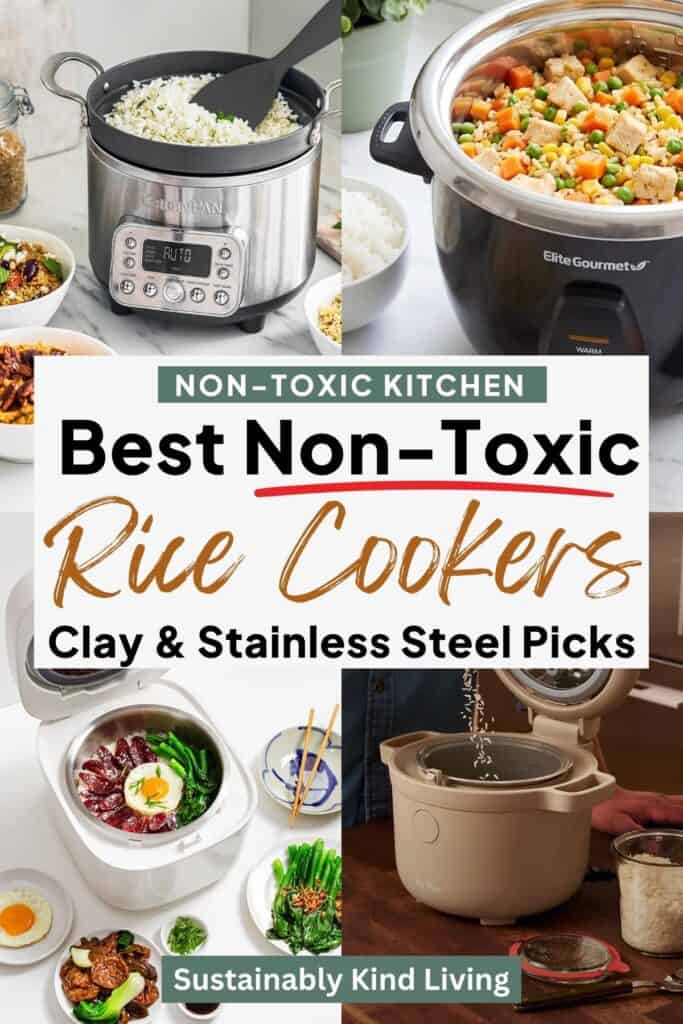
📌 Save This Guide For Later
If you’re upgrading your kitchen, this is one of those guides worth saving.
It breaks down what to avoid, what to look for, and the best non-toxic rice cookers without the greenwashing, so you can come back to it when you’re ready to choose what fits your routine.
Sources & Further Reading
If you want to dig deeper into the materials and research behind non-toxic rice cookers, these are some of the most helpful resources:
- Environmental Protection Agency — PFAS Explained https://www.epa.gov/pfas/pfas-explained
- Environmental Working Group — Guide to Avoiding PFAS in Cookware https://www.ewg.org/consumer-guides/ewgs-guide-avoiding-pfas-chemicals
- Agency for Toxic Substances and Disease Registry — Toxicological Profile for PFAS https://www.atsdr.cdc.gov/toxprofiles/tp200.pdf
- National Institute of Environmental Health Sciences — Perfluoroalkyl and Polyfluoroalkyl Substances (PFAS) https://www.niehs.nih.gov/health/topics/agents/pfc
- U.S. Food and Drug Administration — Authorized Uses of PFAS in Food Contact Applications https://www.fda.gov/food/process-contaminants-food/authorized-uses-pfas-food-contact-applications

Steal My Non-Toxic Cleaning Checklist!
Believe us, it’s the BEST…. and it’s free. Does it really get any better than that?! Sign up for our newsletter and get this free checklist to clean your home without any harmful chemicals!







Hi – I’m reading the description fo #2 – GreenPan Elite Carb-Reducing Rice Cooker — Best Carb-Reducing Rice Cooker.
The description states “The cooking surface itself is stainless steel, so there’s no nonstick coating involved” yet the summary chart says the ‘food contact’ surface is Thermolon.
Please explain – this seems contradictory. Thanks.
Ahhh thank you for catching that! You’re right, that wording is confusing.
The Thermolon ceramic nonstick coating is the actual food-contact surface, so the chart is correct. The mention of stainless steel in the description is an error on my end and needs to be updated.
I appreciate you pointing it out. I look at so many product specs that occasionally one sneaks through and the details get crossed up 😅 I’ll get it fixed.