 Shop My Favorite Non-Toxic Gifts Of 2026!

SKL is reader supported. When you buy through links on our site, we may earn affiliate commission. Learn more here.
I bought my first pair of non-toxic slippers eight years ago and never looked back. The difference between that pair and the popular one I’d been wearing blew me away, so I wrote about it.
“The Best Sustainable Slippers” became one of the very first posts on this blog (wild to think about!). Eight years and 300+ guides later, I’ve gone from that one pair to testing more than 20.
From wool, wool felt, sheepskin, and shearling to leather, natural latex, and vegan materials, I’ve tried them all.
Slippers aren’t a side category for me. My feet don’t touch our wood floors without them, and since I work from home with three kids, they’re on all day. Every pair in this guide got at least a full year of that.
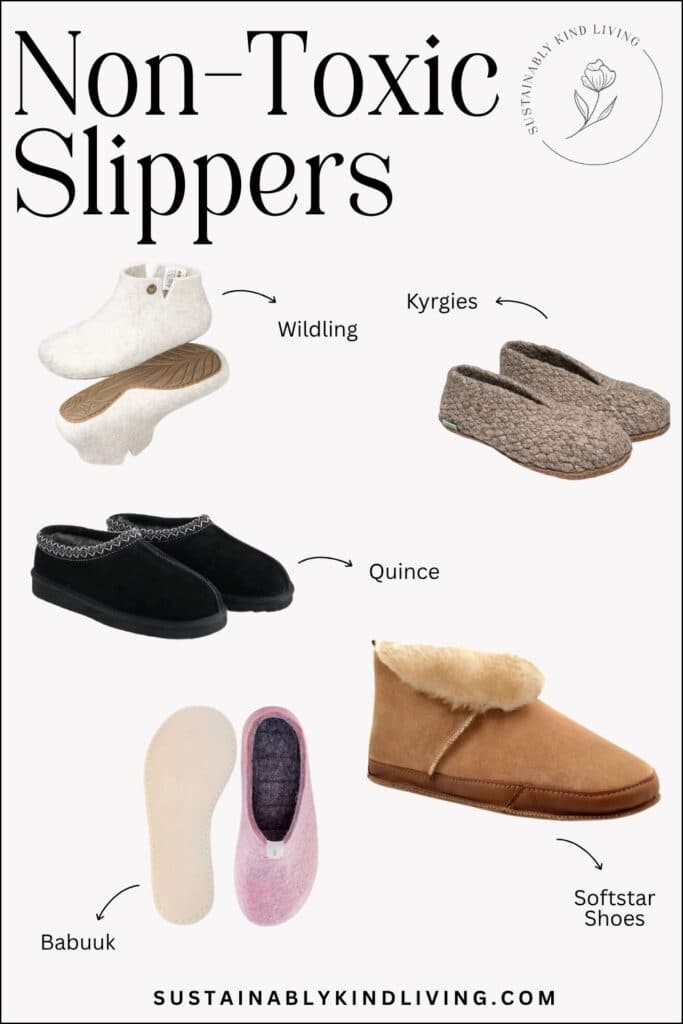
These are the seven that made the cut. They’re comfortable, they held up, and they’re made from materials I feel good about. The ones that didn’t make it are further down, along with why.
If I Could Only Pick 5…
- Best Overall Non-Toxic Slippers: Softstar Fireside
- Best Year-Round Wool Slippers: Wildling Slinka
- Best Affordable Shearling Slippers: Quince Australian Shearling Clog
- Best Colorful Felted Wool Slippers: Baabuk Mel
- Best All-Natural Wool Slippers: Kyrgies Wovens
Before the reviews, here’s what I actually check when I call a slipper non-toxic. I look at the whole thing: what it’s made of, how it’s finished, and how much the brand is willing to tell me.
Safe vs. Not
Materials & Finishes I Avoid in Slippers
- Polyester faux fur and fleece linings → Plastic fiber held against your skin for hours. It traps heat and sweat, and synthetic textiles shed microfibers in the wash.
- Unnamed foam footbeds → “Memory foam” and “cushioned” usually mean polyurethane foam. Brands almost never say what additives went into it.
- PVC soles → PVC needs plasticizers to stay flexible, and phthalates are a common choice. Several phthalates are restricted in consumer articles in the EU because of reproductive toxicity.
- “Vegan leather” uppers → Usually polyurethane or PVC. That’s plastic against the foot, with the same additive questions.
- Stain- and water-repellent finishes → PFAS have been used to make textiles repel water and stains. They persist in the body and the environment, and indoor slippers don’t need them.
- Antimicrobial or odor-control treatments → These are biocides added to the fabric. Biocide finishes are a documented cause of textile contact dermatitis, and wool already handles odor on its own.
- Linings dyed with no dye standard → Some azo dyes break down into carcinogenic aromatic amines. They’re banned in EU skin-contact textiles, but only a certification tells you a brand checked.
Want the deeper version? After the reviews, I break down slipper soles, padding, PFAS, and certifications in detail.
Safer Materials I Look For in Slippers
- Wool and wool felt → Warm, breathable, and naturally good at handling moisture and odor.
- Sheepskin and shearling → Real sheepskin against the foot instead of polyester faux fur.
- Organic cotton and linen → Lighter options if you don’t wear wool or run warm.
- Leather or natural latex soles → Clearly named sole materials instead of a vague “rubber” label.
- Component-by-component disclosure → Upper, lining, footbed, padding, and sole listed separately.
- OEKO-TEX Standard 100 or GOTS on the actual product → Not just on the brand’s bedding or another line.
- Replaceable insoles → A practical way to make a good pair last longer.
Now that you know what I’m looking for, here are the seven pairs that made the cut. I wore all of them, paid attention to fit, warmth, comfort, and how they held up, and kept only the ones I’d recommend to a friend.
The 7 Best Non-Toxic Slippers I’d Buy Again
1. Softstar Fireside | Best Overall Non-Toxic Slippers
Best for anyone who wants warm, flexible sheepskin slippers with room for their toes, in regular or wide widths.
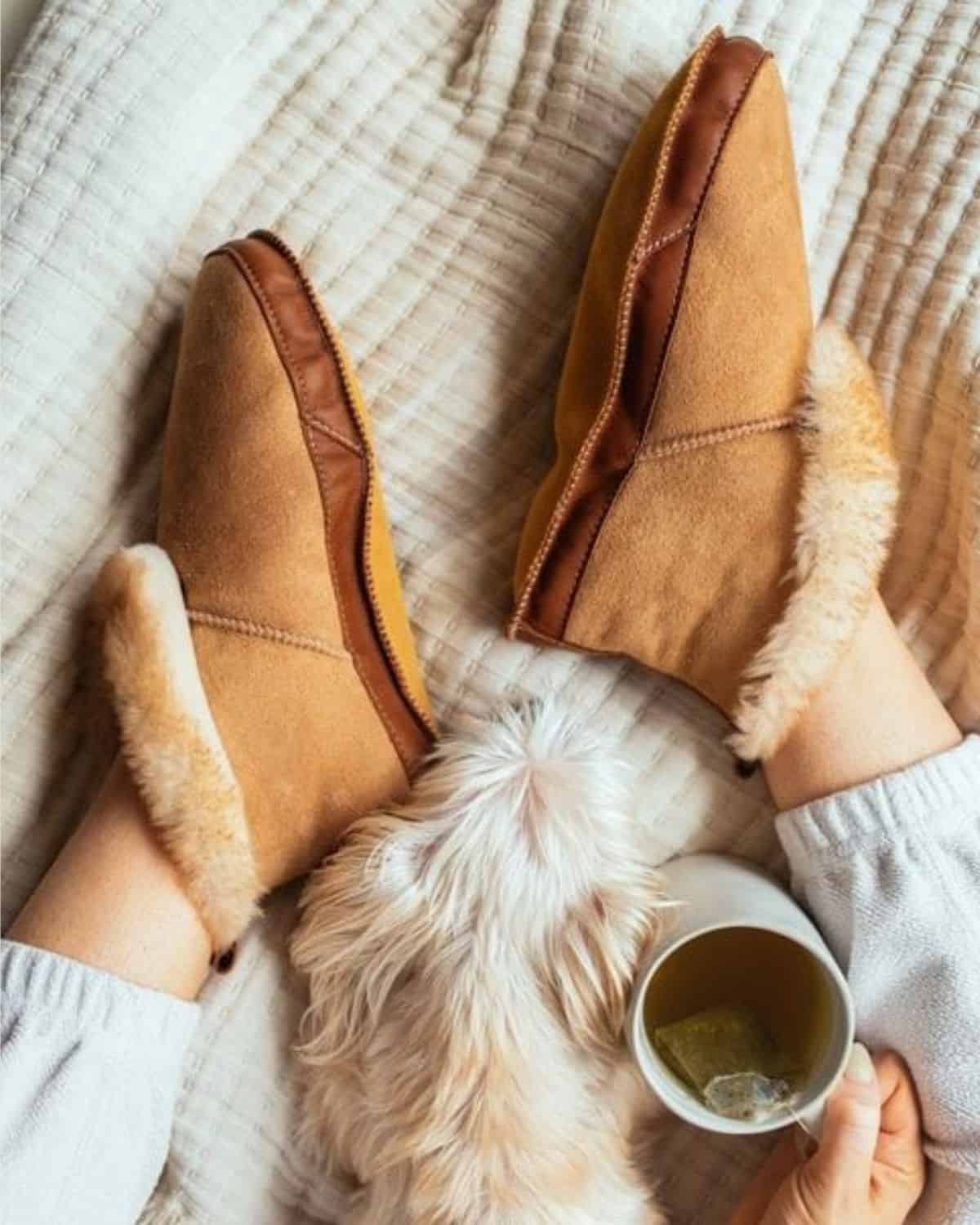
Softstar is the pair I recommend first. The Fireside feels like a cushion underfoot, but it stays flexible and zero-drop, so your feet still move the way they’re meant to.
It’s sheepskin inside and out, with a suede sole and a sheepskin insole you can replace when it eventually wears down. It also comes in wide widths, which is rare for slippers.
I’ve worn mine almost every day for 18 months, and they still look nearly new. I keep them strictly indoors, and that care shows. This is a pair that rewards you for treating it well.
They’re handmade in Oregon. My usual size fit perfectly. If you’re between sizes, Softstar recommends sizing down, since the sheepskin relaxes slightly with wear.
Price
From $160 | Unisex sizing 5-13, regular and wide widths
Materials
Sheepskin upper and lining | Replaceable sheepskin insole | Suede leather outsole
location/shipping
Philomath, Oregon, USA; ships internationally
why it made my list
- Sheepskin against the foot, with every main component named
- Zero-drop, flexible construction
- Regular and wide widths
- Replaceable insoles
my testing experience
- The fit hugs the whole foot without feeling stiff. They flex with every step.
- Seriously warm, but my feet never get sweaty. That’s the sheepskin doing its job.
- The first pair I reach for once it drops below about 70°F.
- 18 months of near-daily indoor wear, and they still look nearly new.
- True to size for me.
2. Wildling Slinka | Best Year-Round Wool Slippers
Best for anyone who wants one lightweight wool slipper they can wear year-round, from warm days to real winter.
Use discount code SKL10 to save $10!
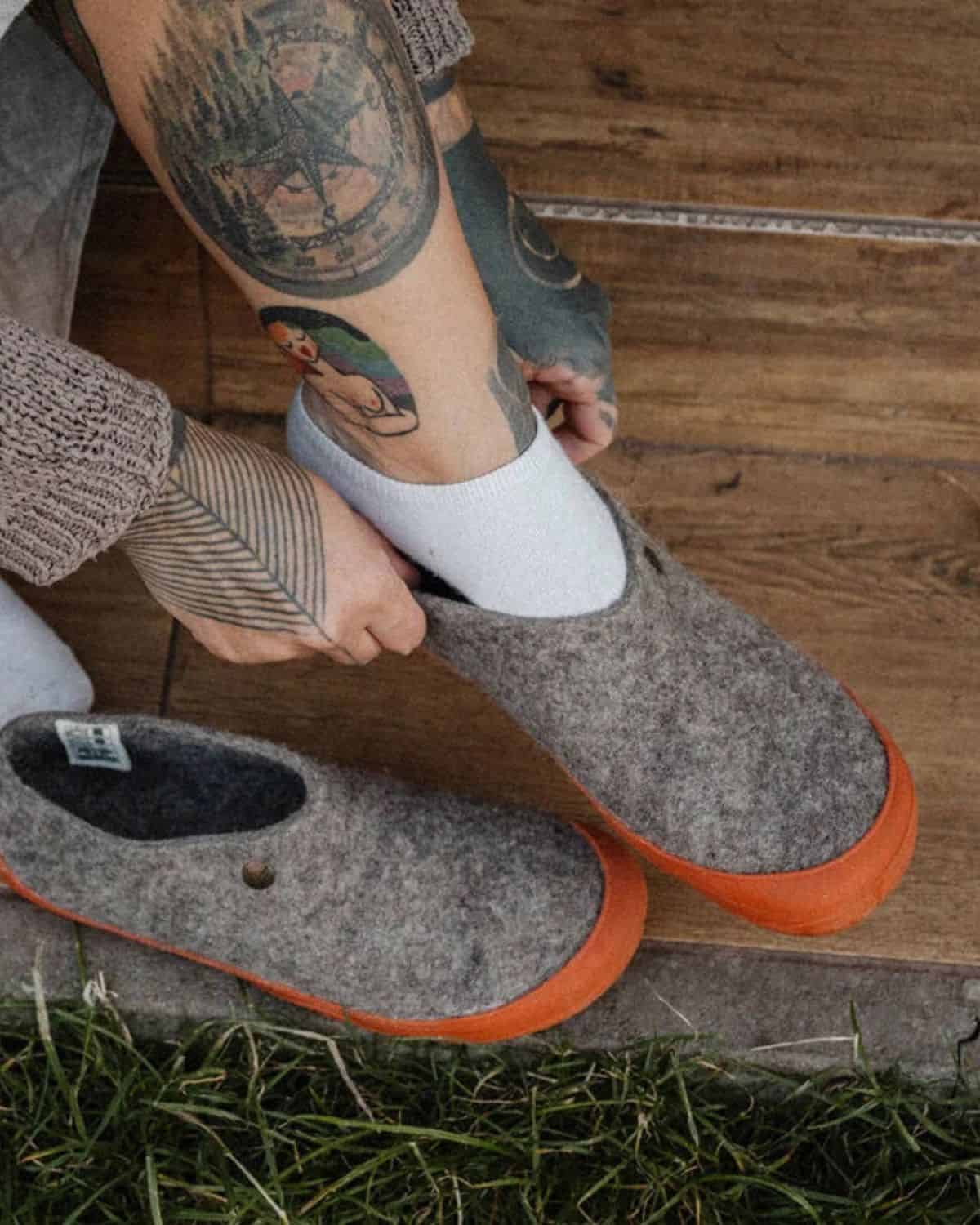
The Wildling Slinka is the most versatile pair on this list. It’s light and breathable, closer to a soft wool house shoe than a traditional slipper, so it works from the warm months straight through winter.
When it gets really cold, I pair it with thick wool socks and it holds its own. It’s also a true indoor-outdoor slipper. The shell sole protects against moisture from below, so it goes from the couch to the mailbox or a quick trip outside without a second thought.
The upper and midsole are undyed felt, 100% virgin wool from certified organic farming, felted by a family workshop in Finland. And since it’s undyed, there’s no dye question.
Wildling is also unusually open about the sole. It’s roughly 55% synthetic rubber, plus silica, recycled rubber and/or cork, natural rubber, processing aids, and pigments.
Your foot never touches it, though. The sole sits beneath the wool felt, so the only thing against your skin is wool.
Price
$99 | Women’s 5-14, men’s 4-13.5
Materials
Undyed wool felt upper and midsole (100% virgin wool from certified organic farming) | Outsole: ~55% synthetic rubber, ~15% silica, ~15% recycled rubber and/or cork, ~10% natural rubber, ~5% processing aids and pigments
Location/shipping
Germany; ships worldwide
why it made my list
- Undyed wool felt, so no dye question on the upper
- One of the most detailed sole disclosures I’ve seen
- Very minimal, flexible construction
my testing experience
- Light enough for warm weather. With thick wool socks, warm enough for real winter.
- One of my two top picks, alongside Softstar.
- I wore Wildling’s earlier wool slipper, the Lotus, for two years before switching to the Slinka, which I’ve now worn for three months.
3. Quince | Best Affordable Shearling Slippers
Best for anyone who wants real shearling slippers without paying $150+.
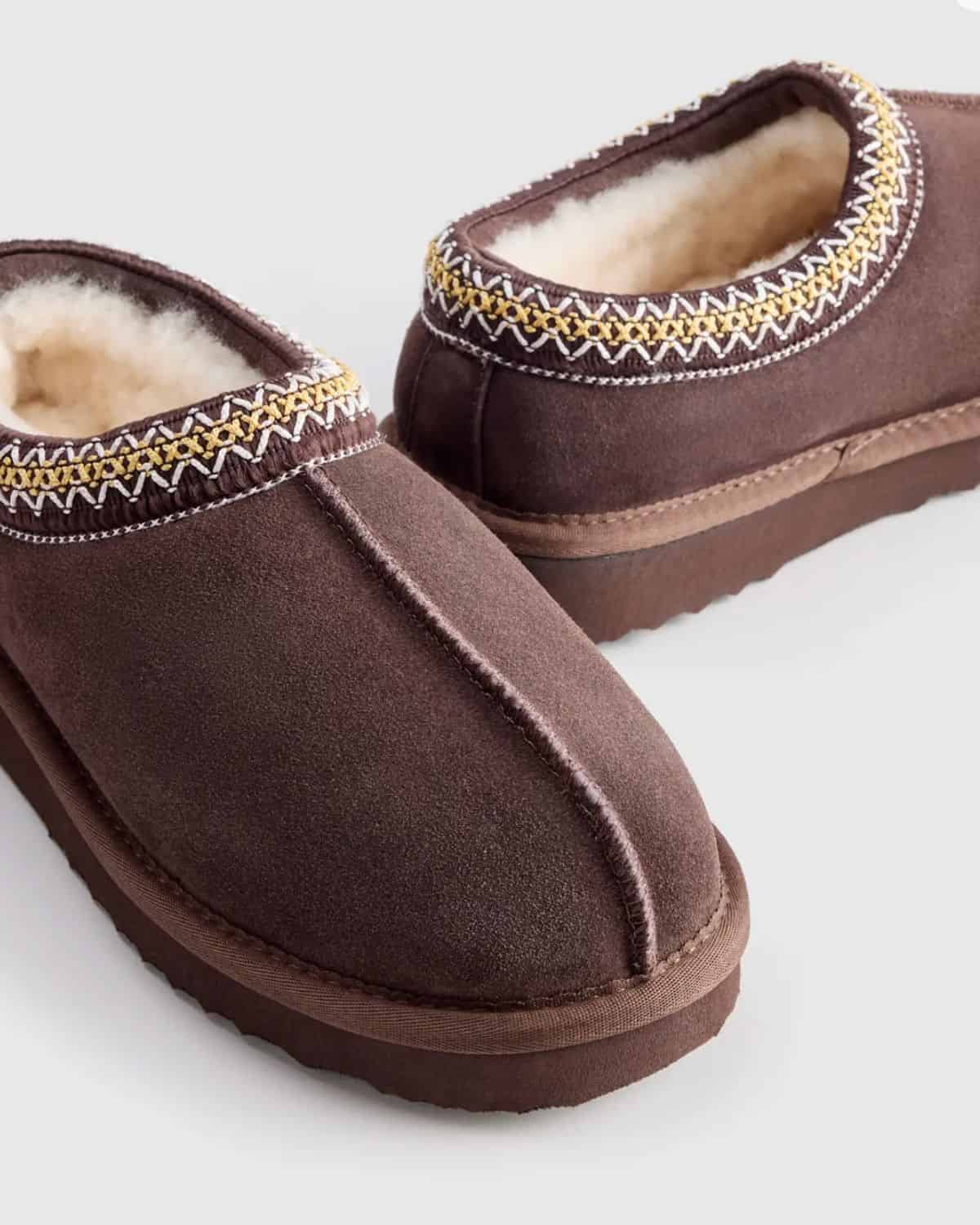
At $60, this is the most affordable real shearling on the list. The Quince clog has a suede upper, 100% Australian shearling lining and insole, and a rubber outsole. The open back makes them easy to slip on and off.
That lower price comes with two trade-offs.
The first is feel: mine have held up well, but they don’t feel as good underfoot as the pricier pairs here.
The second is transparency. Quince tells you what touches your foot, but not much else. The rubber compound, adhesives, and internal components aren’t disclosed, so I can’t tell you exactly what’s in the sole.
Also worth knowing: “Australian shearling” describes where the sheepskin comes from. The slippers are made in China.
Price
$60 | Women’s 5-11, men’s 7-13
Materials
Suede leather upper | 100% Australian shearling lining and insole | Rubber outsole (compound not disclosed)
location/shipping
San Francisco, California, USA; ships to the US and Canada
why it made my list
- Genuine shearling lining and insole
- Open-back clog shape
- Rubber sole for quick trips outside
my testing experience
- True to size. My usual size fit well.
- It’s held up well with regular wear.
- Comfortable, but it doesn’t feel as good underfoot as the pricier pairs on this list.
- My go-to recommendation when budget matters most.
4. Baabuk Mel | Best Colorful Felted Wool Slippers
Best for anyone who wants felted wool slippers with a little color and removable insoles.
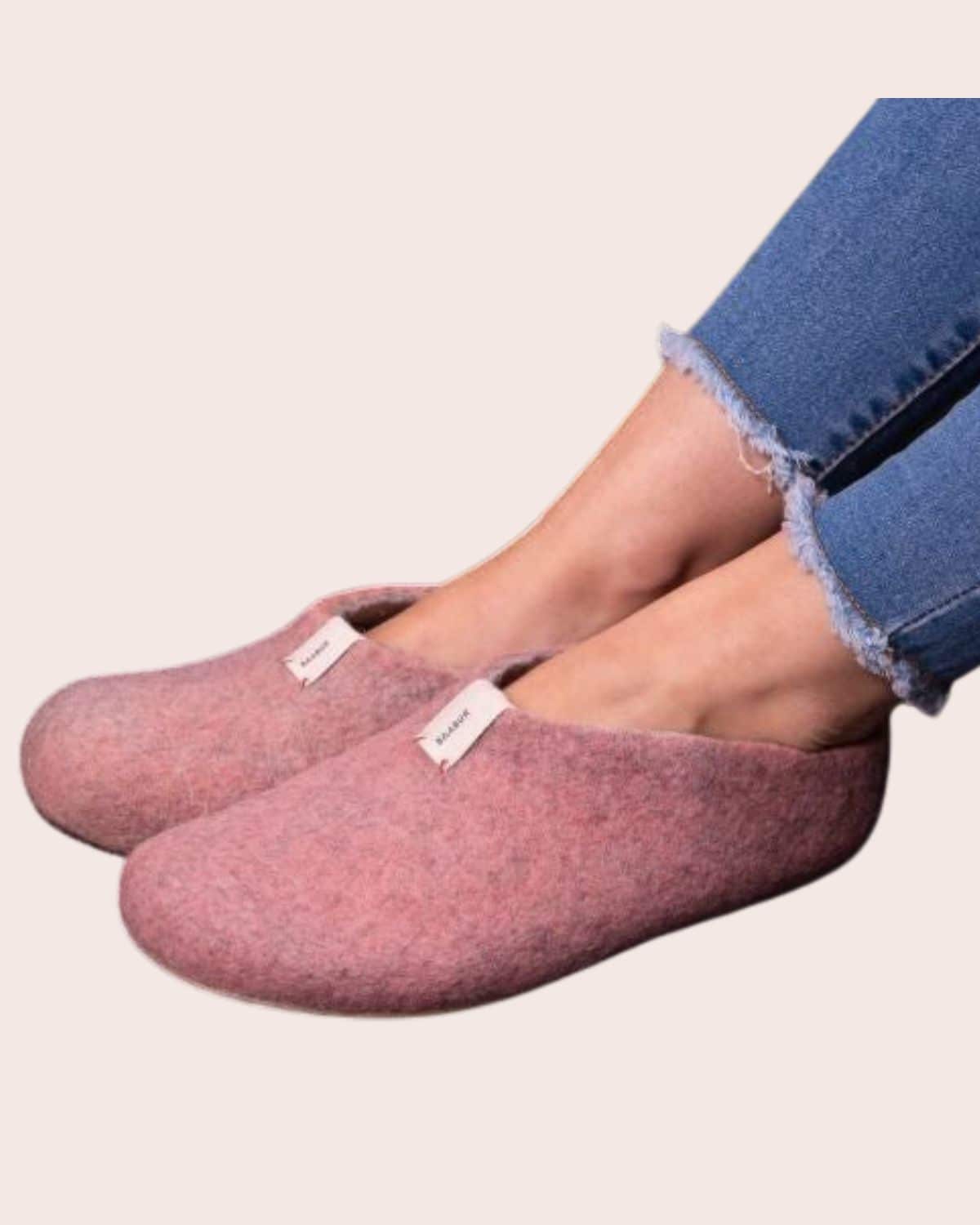
I tested Baabuk’s Mel in pink, and it’s cozy without ever feeling stuffy. It’s warm (not sheepskin warm, but plenty for most days), and socks cover the colder ones.
It’s also very breathable, and wool naturally resists odor!
It’s New Zealand wool, hand-felted in Nepal with soap and water, and very durable.
The wool felt insoles are removable and replaceable, and the sole and glue are natural latex, a far clearer answer than most brands give.
Two things to know: the felt starts stiff and takes a couple of weeks to soften, and there’s little arch support, which suits anyone who likes a flat, flexible feel. Latex allergy? Note the natural latex sole and glue.
Price
$99 | Women’s 5-11.5, men’s 7-13
Materials
New Zealand wool upper | Removable wool felt insole | Natural latex sole and adhesive
location/shipping
Switzerland; ships to USA & most countries
why it made my list
- Hand-felted wool
- Natural latex sole and glue, clearly named
- Removable, replaceable insoles
- Fun color options
my testing experience
- Warm enough for most days, and easy to layer with socks when it’s colder.
- Very breathable, and wool’s natural odor resistance keeps them fresh.
- Very durable – it’s been 3 years since I purchased and they look new.
✔️ Need something for outside too? My barefoot boots for fall and winter guide covers the pairs I actually wear outdoors.
5. Kyrgies Wovens | Best All-Natural Wool Slippers
Best for anyone who wants a slipper made entirely from natural materials: 100% wool on top, vegetable-tanned leather underneath. Bonus: they fold flat for travel.
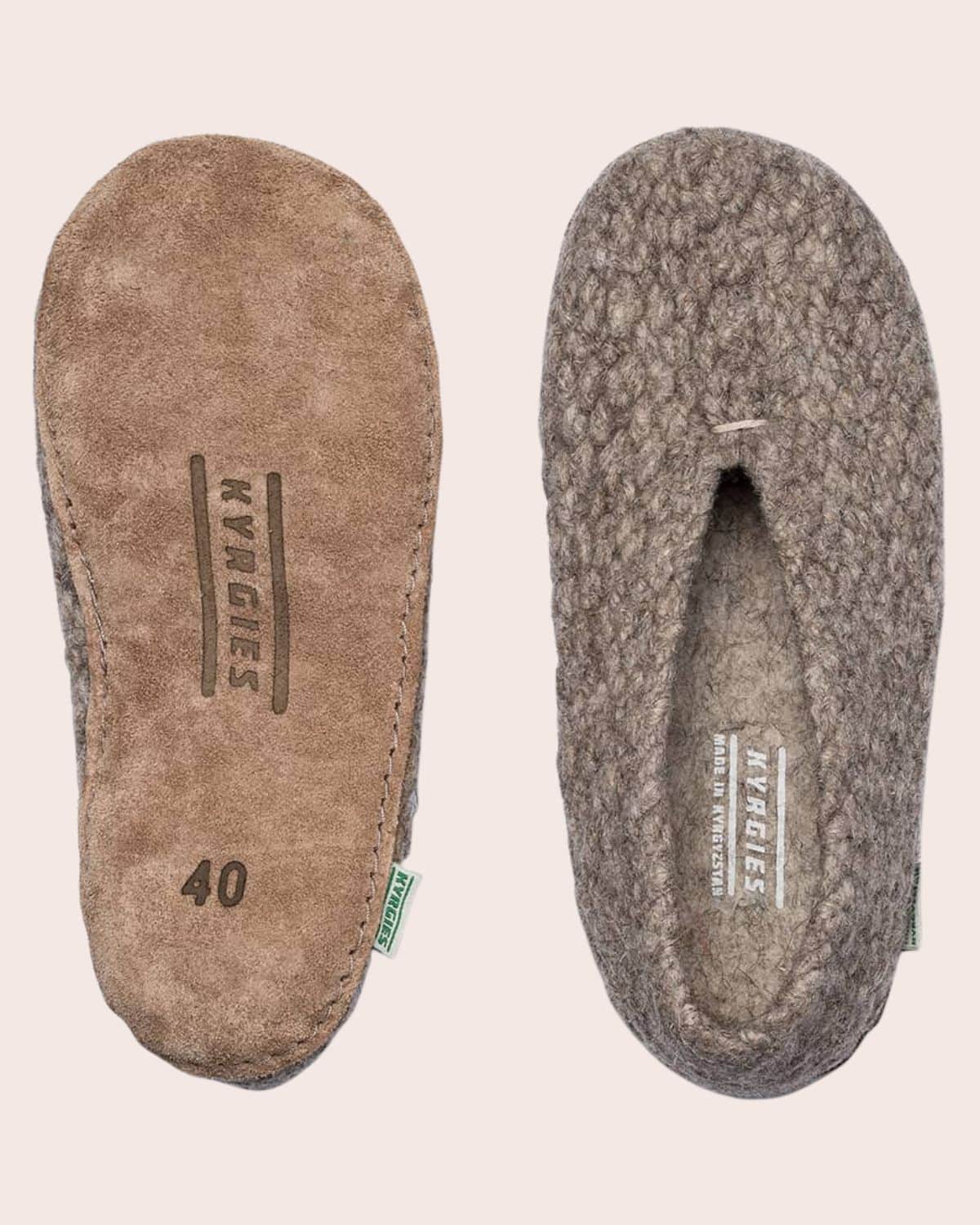
Kyrgies Wovens are made from thick, handspun wool yarn using traditional weaving, by a women’s cooperative in southern Kyrgyzstan. The construction uses woven felt and leather.
They’re light and flexible enough to fold into a purse, and they’ve come with me to more than eight countries. They’re my go-to on long-haul flights between Europe and Chicago, but they’re just as good for an ordinary day at home.
Kyrgies makes several constructions with different materials, so this review covers the Wovens only. The sole is vegetable-tanned leather instead of chrome-tanned, and the dyes are low-impact. Spot clean only, and keep them indoors.
Price
$109 | Women’s 5-14, men’s 7-15.5
Materials
100% wool yarn upper | Vegetable-tanned leather sole | Low-impact dyes
location/shipping
USA (handmade in Kyrgyzstan); ships worldwide
why it made my list
- Handspun wool, traditional weaving
- Flexible and packable
- Made by a women’s cooperative
my testing experience
- I tested and loved the Wovens specifically.
- Traveled with me to 8+ countries, tucked in my purse for long-haul flights.
- It fits almost like a thick sock. Just lovely.
6. Cozy Earth | Best Open-Toe Shearling Slides
Best for anyone who wants sheepskin underfoot but doesn’t like enclosed slippers.
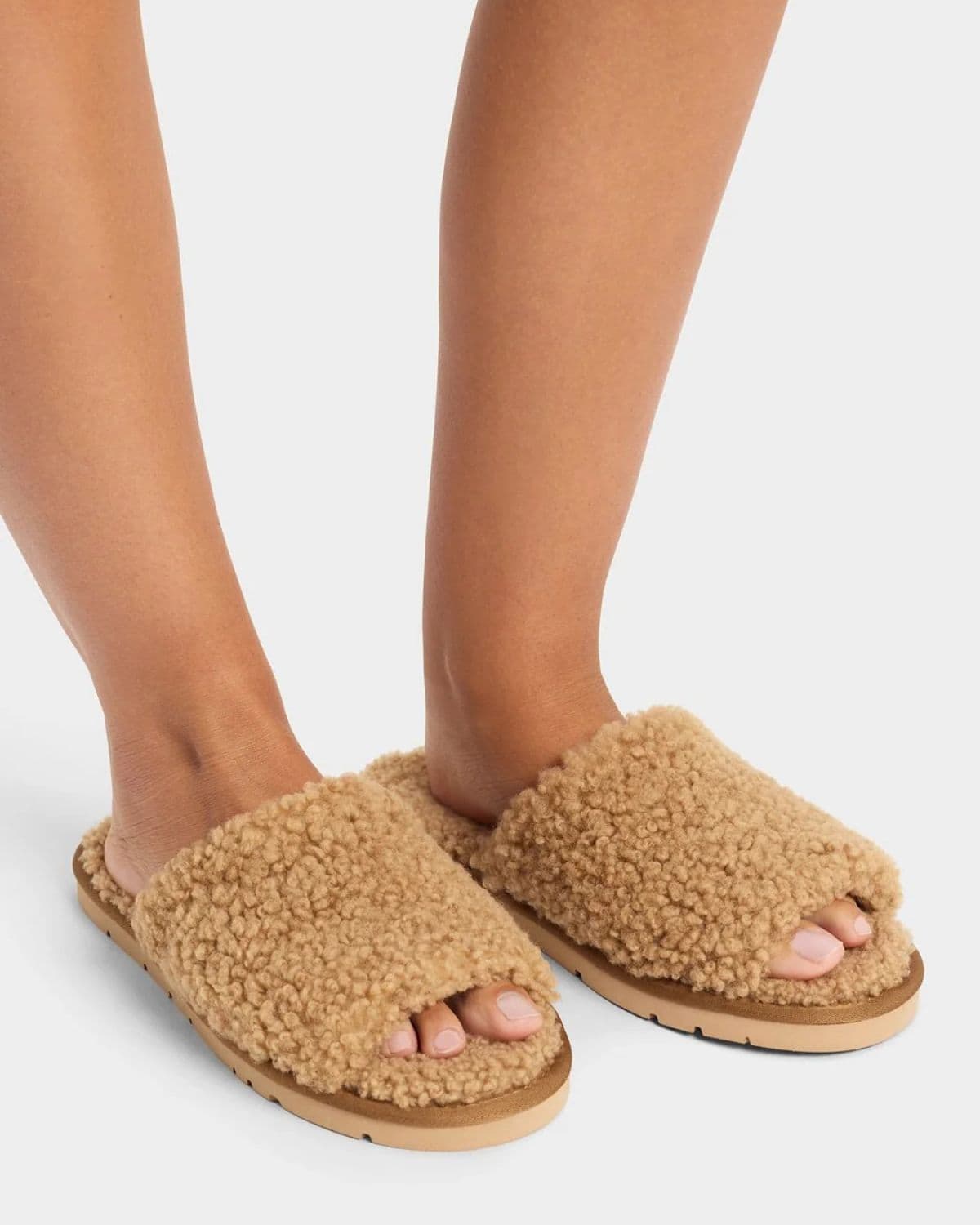
Open-toe non-toxic slippers are surprisingly hard to find, so I was thrilled to land on Cozy Earth’s Puffy Sheep Slides.
They’re my pick for spring, early fall, and even summer, when an enclosed slipper feels like too much and my toes want to breathe.
The upper, lining, and footbed are all 17 mm sheepskin on a lightweight rubber outsole, so you still get that soft, plush feel underfoot.
One gap: the padding inside the footbed isn’t identified, so I can’t call these plastic-free. Size up if you’re between sizes, and spot clean only.
Price
$88 | Women’s 5-11
Materials
17 mm sheepskin upper, lining, and footbed | Rubber outsole
location/shipping
Utah, USA; ships within the US and internationally
why it made my list
- Sheepskin on the upper, lining, and footbed
- Open-toe slide shape
- Rubber sole for indoor and light outdoor wear
my testing experience
- My go-to for spring, early fall, and summer.
- My toes get to breathe without giving up sheepskin softness.
- I’ve had mine for 18 months. True to size: my usual size fit great.
✔️ Cozying up for the colder months? Pair your slippers with my favorite non-toxic sweaters and cardigans: the 10 natural-fiber knits that made the cut after I tried more than 30.
7. Parachute | Best Washable Cotton Terry Slippers
Best for anyone who wants cotton slippers they can actually put in the washing machine.
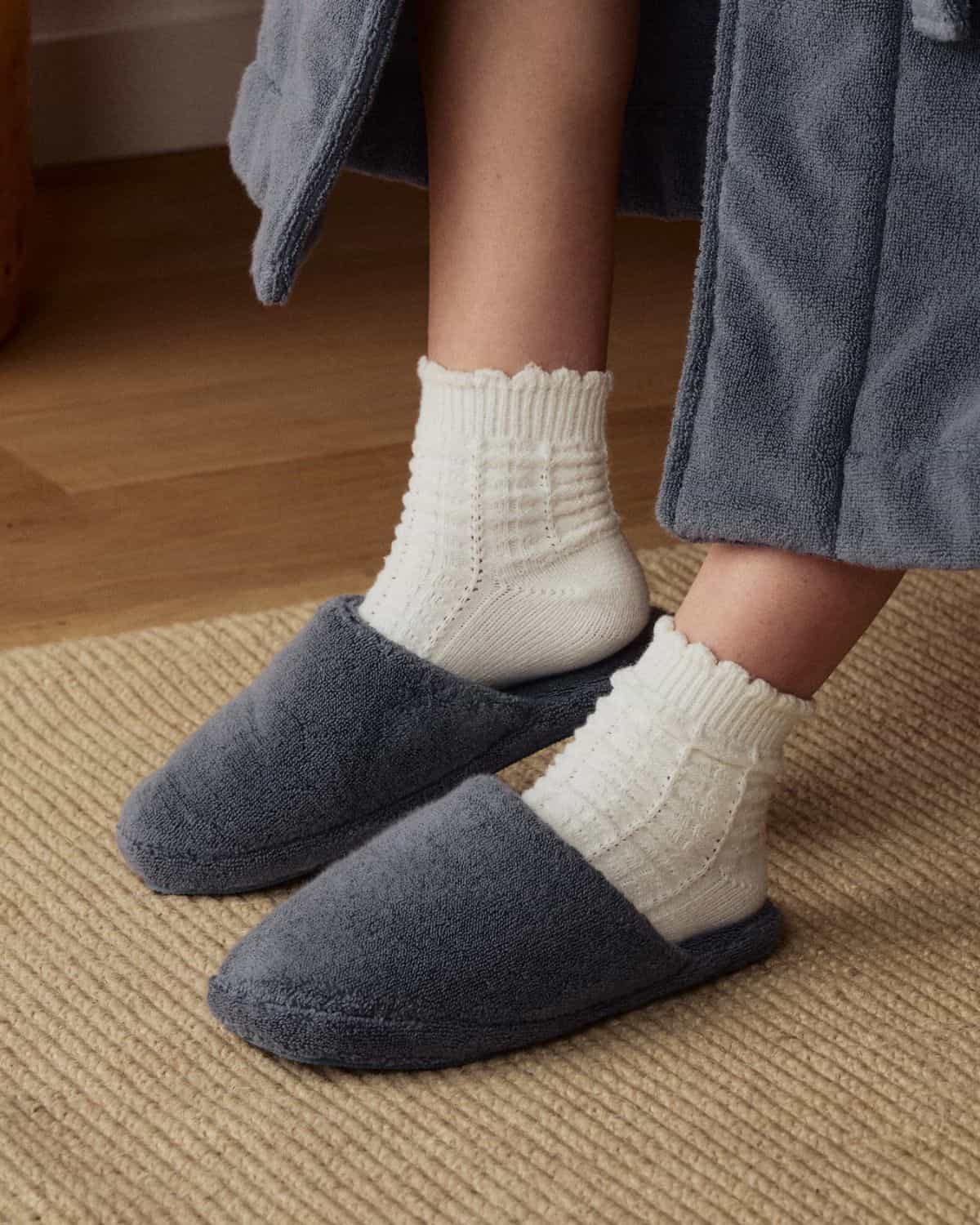
With three kids in the house, a slipper I can toss in the washing machine is a real win. That’s what makes Parachute’s Classic Plush Slippers stand out: nearly everything else on this list is spot clean only.
Soft cotton terry is exactly what I want after a shower, and these are my go-to on days when the house isn’t too cold. In the middle of winter they’re not warm enough for me, but for everything in between, they’re hard to beat.
They’re 100% cotton terry, a dense 450 GSM weave made in Turkey, and the product page lists OEKO-TEX Class 1 certification.
Wash cold and let them air dry instead of using the dryer.
Price
$59 | XS – XL (5-12)
Materials
100% cotton terry (450 GSM) | Cushioned sole (filling not specified) | OEKO-TEX Class 1
location/shipping
Los Angeles, California, USA (made in Turkey); ships within the US
why it made my list
- Machine washable
- OEKO-TEX Class 1 certification listed
- Cotton terry against the foot
my testing experience
- Machine washable, which matters with three kids at home.
- My favorite pair to step into after a shower.
- Great for milder days. Not warm enough for me in the dead of winter.
Slippers I Tested That Didn’t Make the Cut
I tested every pair below. All but one failed on materials. The other failed on fit.
Rothy’s Scuff Slipper
Why It Didn’t Qualify: The Scuff Slipper is sold on its RWS-certified merino, but the upper is knit from merino blended with Rothy’s signature thread, which is recycled plastic bottles. The lining and insoles are “vegan shearling,” which Rothy’s own designer describes as recycled faux shearling. So the part touching your foot is plastic, and no fiber percentages are given for the upper.
Best Alternative: Quince, for real shearling against your foot at a lower price.
Verloop Knit Slippers
Why It Didn’t Qualify: Verloop’s knit slippers are 100% acrylic with a polyester fleece lining and a foam-cushioned microfiber sole. That’s plastic from top to bottom. Using deadstock yarn keeps waste out of landfills, which is a real environmental win. It doesn’t change what’s against your skin.
Best Alternative: Baabuk Mel, for color and a cozy knit feel in actual wool.
Bombas Gripper Slippers
Why It Didn’t Qualify: The Gripper Slippers are marketed with merino, but the shell is 50% acrylic, 30% nylon, and only 20% merino wool. The lining is 71% viscose, 25% polyester, and 4% elastane, with silicone grippers on the bottom. That’s an 80% synthetic shell with wool as the garnish.
Best Alternative: Wildling, for undyed wool felt against your foot.
MagicLinen Waffle Slippers
Why It Didn’t Qualify: The linen-cotton waffle upper is lovely, and the product is listed as OEKO-TEX certified. But the padded footbed and anti-slip sole are never named. If I can’t find out what’s under your foot, it doesn’t make the list.
Best Alternative: Parachute, for a washable, 100% cotton terry slipper.
Bearaby Pillow Boots
Why It Didn’t Qualify: The outside is OEKO-TEX certified organic cotton. The inside is filled with “real pillow fibers,” and Bearaby never says what those fibers are. A whole boot of unnamed filling is too big a gap.
Best Alternative: Softstar, for a fully enclosed slipper where you know every layer.
Teva ReEmber
Why It Didn’t Qualify: Teva sells the ReEmber as an eco-friendly slipper made from recycled materials. That recycled material is polyester, inside and out, on a PU footbed and an EVA midsole. It also has a water-repellent coating that isn’t named, plus Aegis antimicrobial treatment. That’s two finishes from my avoid list on one pair of slippers.
Best Alternative: Kyrgies Wovens, for wool and vegetable-tanned leather with no added finishes.
UGG Tasman
Why It Didn’t Qualify: UGG markets these under “Responsible Materials,” and the UGGplush lining is mostly upcycled wool with TENCEL lyocell. The problem is everything else. The outsole is either sugarcane EVA or petroleum-based Treadlite EVA, and you can’t tell which pair you’ll get. The binding is recycled polyester. On some styles, UGG says the sheepskin was artificially dyed and treated, without saying how.
Best Alternative: Softstar, for sheepskin on a suede sole with nothing left unexplained.
Allbirds Wool Slipper
Why It Didn’t Qualify: The materials are listed as recycled wool, polyester, and “fluff,” on a sugarcane-based EVA midsole. “Fluff” isn’t a material, and the wool shares the upper with polyester.
Best Alternative: Wildling Slinka, for undyed wool felt with a fully disclosed sole.
TOMS Ezra
Why It Didn’t Qualify: Faux shearling, a TPR outsole, and memory foam insoles. The composition is listed only as “100% textile” with no fibers named. For a brand that markets an eco line, that’s very little to go on.
Best Alternative: Kyrgies Wovens, for 100% wool on vegetable-tanned leather.
Hush Puppies The Good Slipper
Why It Didn’t Qualify: The name is doing the marketing. The upper and lining are 90% recycled RPET polyester, and the footbed is 100% recycled foam with no foam type named. “Good” here means recycled plastic against your foot.
Best Alternative: Parachute, for a 100% cotton terry slipper you can machine wash.
Dearfoams Alpine
Why It Didn’t Qualify: Dearfoams sells the Alpine line as “Everyday Eco-Friendly”. The eco claim rests on BLOOM soles made with harvested algae. On their EcoCozy line, Dearfoams says that algae is infused into the EVA. That makes it a plastic foam sole with some algae added. The upper is “microwool” with a “furry lining,” and neither one gets a fiber breakdown.
Best Alternative: Baabuk Mel, for real wool on a natural latex sole.
Everlane ReNew Slipper
Why It Didn’t Qualify: The ReNew name points to recycled content, and that recycled content is plastic: a 100% recycled nylon upper with a recycled polyester lining. Recycling keeps bottles out of landfill. It doesn’t keep plastic off your feet. These are no longer available for sale.
Best Alternative: Kyrgies Wovens, for 100% wool on a vegetable-tanned leather sole.
Vivobarefoot Mim Felt Slipper II
Why It Didn’t Qualify: The materials are excellent: a 100% wool upper and a 100% leather outsole. The fit wasn’t. They ran far too tight on me, which makes no sense from a barefoot brand built on giving your toes room. Vivobarefoot says the wool loosens with wear, but a slipper shouldn’t need to be broken in just to stop squeezing.
Best Alternative: Wildling, for a minimal wool house shoe with actual room to move.
Slipper Materials, Explained
A slipper has more parts than people think: upper, lining, footbed, padding, sole, glue, thread, and whatever finish went on top. The product name usually describes one of them.
I’m not telling you to toss the slippers you own. I’m telling you where to look next time you buy.
Start With What Touches Your Foot
Wool, sheepskin, and cotton make up every pair on my list. But the fiber name is only the start. It doesn’t tell you about dyes, finishes, or what’s underneath.
I read the lining and footbed description, not just the upper. A wool slipper with a polyester fleece lining puts plastic against your foot, which is the part I care about most. Synthetic fabrics also shed plastic microfibers in the wash.
If you want the bigger picture on why I lean toward natural fibers, my natural vs. synthetic fibers guide goes deeper.
Sheepskin and Leather: Ask About Tanning
Sheepskin, suede, and leather all have to be tanned, and most leather worldwide is chrome tanned.
The concern is chromium VI, which can form in chrome-tanned leather and is a known skin sensitizer. The EU limits chromium VI in leather that touches the skin to 3 mg/kg for exactly that reason. Vegetable-tanned leather, like the Kyrgies Wovens sole, skips chromium entirely.
If a brand doesn’t say how its sheepskin was tanned, it’s a fair question to email them.
Soles Are Their Own Question
Leather, natural latex, synthetic rubber, mixed rubber, and EVA are all different materials. “Rubber sole” alone doesn’t tell you which one you’re getting.
EVA (ethylene-vinyl acetate) is a plastic. Synthetic rubber is petroleum-based. Wildling’s Slinka is a good example of what real disclosure looks like: it lists every part of its mixed sole, including the synthetic rubber.
I avoid PVC soles. PVC needs plasticizers to stay soft, and phthalates are one of the most common. The EU restricts four of them (DEHP, DBP, BBP, and DIBP) in plasticized materials because they’re classified as toxic to reproduction.
Padding Is Where Disclosure Disappears
“Cushioned,” “padded,” and “pillow-filled” with no material named means the material is unknown. I’d rather flag that than guess. Cozy Earth’s footbed padding, for example, isn’t named.
Memory foam footbeds are almost always polyurethane foam. If a brand doesn’t name the foam or what was added to it, I treat it as a gap.
PFAS Is a Separate Question
PFAS have been used to make textiles water- and stain-repellent. EPA guidance even warns that treated clothing can be a source of PFAS contamination. My full PFAS guide covers why that matters.
I haven’t seen a finished-product PFAS test for every pair here. A wool upper or organic cotton fabric doesn’t prove the whole slipper is PFAS-free. If that’s your deciding factor, ask the brand two things: was any water- or stain-repellent finish added, and can they share a current test report with the method and detection limits?
Indoor slippers don’t need a repellent finish. I wouldn’t spray one on either.
What a Certification Actually Covers
OEKO-TEX Standard 100 tests certified textiles for a long list of harmful substances. It does not mean organic or plastic-free. Look up the certificate number to see exactly which article it covers.
GOTS covers organic fiber plus how it was processed, including restrictions on dyes and finishes. It’s the certification I trust most for cotton.
One trap: a brand can certify its bedding or towels and not its slippers. A certification on another product line tells you nothing about the pair in your cart.
Dyes
Some azo dyes can break down into carcinogenic aromatic amines. The EU restricts them in textiles and leather that touch the skin. Undyed wool, like the Wildling slippers, skips the question.
For dyed pairs, OEKO-TEX or GOTS is how you know someone checked.
Greenwashing in Slippers (yep, it’s a thing)
Slippers are a sneaky category. The upper does all the marketing, and everything underneath gets one vague word or nothing at all. Here’s what I look at more closely.
“Wool Slippers” Can Have a Polyester Lining
A wool upper with a polyester fleece or faux fur lining is still a wool slipper on the product page. It’s also plastic against your foot. Read the lining line, not the headline.
“Organic Cotton” May Only Describe the Outside
A slipper can have an organic cotton shell and a filling or footbed made of something else entirely. “Organic cotton slippers” may only describe the outside. Check what’s inside.
“Australian Shearling” Is Not Where It Was Made
On the Quince clog, “Australian” describes the sheepskin. The slippers are made in China. Neither is a problem. They’re just two different facts.
“Rubber Sole” Doesn’t Mean Natural Rubber
Rubber can be natural latex, synthetic rubber, recycled rubber, or a blend. If a brand means natural rubber, it will usually say so. Baabuk does. Wildling tells you exactly how much is synthetic.
“Vegan” and “Eco” Aren’t Material Specs
“Vegan” usually means polyurethane, PVC, or polyester instead of wool and leather. “Recycled polyester” is still polyester. The FTC’s Green Guides warn that broad claims like “eco-friendly” are close to impossible to back up without saying what they’re based on.
A Brand’s Certification Isn’t Your Slipper’s Certification
A brand can hold OEKO-TEX or GOTS on its sheets and not on its footwear. Look for the certificate on the slipper’s own product page, then look up the number.
The material tag wins over the marketing copy. Every time.
How to Care for Natural Slippers
Follow the instructions for your exact model. Cotton terry and sheepskin don’t want the same treatment.
- Wool and felt: Brush gently and spot clean where the brand allows it. Don’t assume felted wool can go in the machine.
- Sheepskin and suede: Follow the maker’s directions. Skip soaking and high heat unless they say otherwise.
- Washable fabric slippers: Use the listed settings. Parachute is cold wash and air dry.
- Replaceable insoles: Softstar and Baabuk sell replacements. A new insole can buy a good pair a lot more time.
Let slippers dry fully before you put them away. And skip the waterproofing spray on indoor slippers.
How I Researched, Tested & Updated This Guide
1. I Tested More Than I Featured
I’ve tested more than 20 pairs of slippers over the years. Seven made it here. The rest didn’t meet my standards for materials, comfort, or quality.
2. I Wore Them in Real Life
These aren’t try-on impressions. I work from home with three kids, so slippers get worn all day. Every pair here has at least one full year of wear, and some much more. I wore them until they were beaten down, because that’s the only way to know what holds up.
3. I Checked the Materials Separately From How They Felt
For this update, I went through the current product information for every pair: upper, lining, footbed, padding, and sole. Where a brand only discloses part of the construction, I flagged the gap instead of assuming the rest is natural.
My wear-testing tells you about comfort and durability. It doesn’t replace a lab test. I keep those two things separate in every review.
4. I Named the Exact Model
Brands use very different materials across their lines. Every recommendation here is for the specific style I tested. Check the exact model before you order.
5. I’m Still Testing
Prices, sizes, and materials change. I revisit this guide and swap in better pairs when I find them. If a brand changes its materials, I’ll update the review.
Most Common Questions on Non-Toxic Slippers
The best non-toxic slippers are made from natural materials with soles the brand actually names. My top pick is the Softstar Fireside, which is sheepskin inside and out on a suede sole. For a lighter wool option, try the Wildling Slinka. For a budget pick, try the Quince Australian Shearling Clog.
A non-toxic slipper uses natural materials against the foot, like wool, sheepskin, or cotton, and has a sole and padding the brand clearly names. It also skips water-repellent, stain-resistant, and antimicrobial finishes. If a brand won’t tell you what’s in its slippers, treat that as a red flag.
Wool slippers can be non-toxic, but only if they’re actually mostly wool. Some “merino” slippers are made mostly of acrylic and nylon. Look for 100% wool on every surface that touches your foot, and check the lining and sole too.
Sheepskin slippers are generally a safe, breathable choice. The main thing to check is tanning. Most leather is chrome tanned, and the EU limits chromium VI in leather that touches the skin because it can trigger skin allergies. Vegetable-tanned leather avoids the issue.
The warmest non-toxic slippers are made from real sheepskin, which holds heat without making your feet sweat. Softstar’s Fireside is my pick for cold weather. Wool felt slippers like Wildling and Baabuk run lighter but work in winter with thick socks.
Most non-toxic wool and sheepskin slippers are spot clean only. If you want machine-washable non-toxic slippers, go with cotton. Classic Plush Slippers are 100% cotton and can go in a cold wash.
The best non-toxic slippers for wide feet have a roomy toe box or come in wide sizes. Softstar offers the Fireside in wide widths, and Kyrgies Wovens and Wildling Slinka are flexible and roomy enough for wider feet.
Sustainable slippers aren’t always non-toxic. Many are made from recycled polyester, which is still plastic, or sugarcane- or algae-based EVA foam. A slipper can have a smaller environmental footprint and still put synthetics against your skin, so check the full materials list.
The best affordable non-toxic slippers on my list are Quince’s Australian Shearling Clogs, at around $60. You get a real shearling lining and insole, but less disclosure about the sole and adhesives than with pricier brands.
The best non-toxic slippers for travel are lightweight, flexible, and packable. Kyrgies Wovens fold flat enough to fit in a purse and are made from 100% wool on a vegetable-tanned leather sole.
A good pair of non-toxic slippers should last several years with proper care. Keep them indoors, spot clean them, and look for replaceable insoles, like Softstar’s and Baabuk’s, to extend their life.
Still Deciding?
- Choose Softstar Fireside if you want one great pair of sheepskin slippers, need a wide width, or want a flexible, zero-drop sole.
- Choose Wildling Slinka if you want one wool slipper for every season, indoors and out.
- Choose Quince Shearlings if budget matters most and you still want real shearling.
- Choose Baabuk Mel if you want felted wool with some color and replaceable insoles.
- Choose Kyrgies Wovens if you want a light wool slipper that folds flat for travel.
- Choose Cozy Earth if your feet run warm and you prefer an open-toe slide.
- Choose Parachute if machine washing is non-negotiable.
My Final Thoughts On Non-Toxic Slippers
Slippers are the shoes I wear most, which is exactly why I take them so seriously. Eight years after my first pair of non-toxic slippers, I’ve never looked back.
You don’t need a closet full of them. Pick the material that fits your life: sheepskin if you’re always cold, wool if you want one pair for every season, cotton if you need to toss them in the wash. Then look at the whole slipper, not just the pretty part on top.
And once you find a pair you love, take good care of it. Keep them indoors, spot clean when they need it, and swap the insoles if you can. Take care of a good pair, and it’ll take care of you for years.
Is There a Pair You Want Me to Try?
Leave the exact brand and style in the comments. I’m always testing, and I want to know what you’re curious about!
Continue Your Non-Toxic Fashion Journey
If you’re exploring safer fashion swaps, these guides break it down step-by-step:
- Barefoot Boots for Fall & Winter: The barefoot boots my family actually wears outside once it gets cold.
- Barefoot Sandals: My favorites after trying 20 different pairs.
- Non-Toxic Sweaters & Cardigans: The 10 natural-fiber knits that made the cut after trying 30+.
- Best Organic Cotton Underwear: The 6 brands I keep coming back to.
- Non-Toxic Fashion Brands: Brands I actually wear, vetted for natural fibers and no PFAS.
📌 Save This Guide For Later
Save this guide for the next time you’re shopping for slippers and want a quick check on which materials, soles, and brands are worth it.
Sources & Further Reading
- Commission Regulation (EU) No 301/2014: The EU limit on chromium VI in leather that touches the skin, set because it causes skin sensitization.
- Commission Regulation (EU) 2018/2005: The EU restriction on DEHP, DBP, BBP, and DIBP in plasticized materials, classified as toxic to reproduction.
- Journal of the American Leather Chemists Association, Eco-friendly Chrome Tanning of Leather: Peer-reviewed study noting that most leather is chrome tanned.
- Quantifying Shedding of Synthetic Fibers From Textiles, PMC: Peer-reviewed research measuring microfiber shedding from acrylic, nylon, and polyester textiles.
- U.S. EPA, PFAS Field Sampling Guidance: Notes that water- and stain-resistant treated clothing can be a PFAS source.
- ECHA, REACH Annex XVII Entry 43 (Azo Dyes): EU restriction on azo dyes that release carcinogenic aromatic amines in skin-contact textiles and leather.
- Textile contact dermatitis review, Current Treatment Options in Allergy: Peer-reviewed review covering biocide finishes as a cause of textile contact dermatitis.
- OEKO-TEX Standard 100: What the certification tests for in finished textiles.
- Global Organic Textile Standard (GOTS): Official documentation on organic fiber and processing requirements.
- FTC Green Guides: Why broad terms like “eco-friendly” are hard to substantiate.

Steal My Non-Toxic Cleaning Checklist!
Believe us, it’s the BEST…. and it’s free. Does it really get any better than that?! Sign up for our newsletter and get this free checklist to clean your home without any harmful chemicals!