 Shop My Favorite Non-Toxic Gifts Of 2026!

SKL is reader supported. When you buy through links on our site, we may earn affiliate commission. Learn more here.
Non-toxic nursing bras are harder to find than they should be, and I’ve been looking since I had my twins 9 years ago.
Plenty of nursing bras call themselves organic or non-toxic. Far fewer hold up once you look past the main fabric to the padding, elastic, thread and clips (same issue I ran into with our search for the best organic bras).
The organic nursing bras that pass that test still have to survive 3 a.m. feeds, leaks, and a trip through the wash almost every day.
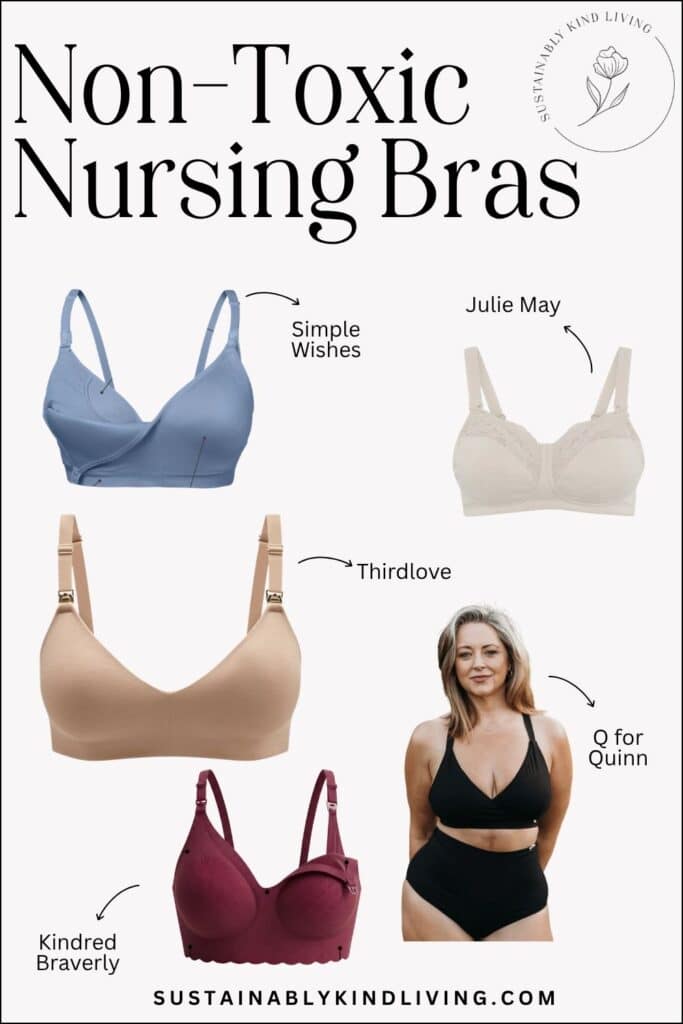
Between the twins and my youngest, I’ve owned more nursing bras than most. Plenty of the “organic” ones turned out to be mostly synthetic once I read past the front of the label. Others were soft and sweet but gave up the minute my milk came in.
And then there were the handful I kept reaching for, baby after baby.
My Quick Picks For The Best Non-Toxic Nursing Bras…
- Most Supportive Wireless Nursing Bra: JulieMay
- Best Organic Cotton Crossover Nursing Bra: Q For Quinn
- Best Plastic-Free Nursing Bra: The Very Good Bra
- Best Nursing Bra For Larger Bands & Fuller Cups: Elila
- Best Hands-Free Bra For Traditional Pumping: Simple Wishes
Few things you wear sit as close to your baby as your nursing bra. It’s where their cheek rests at every feed. It soaks up the milk you leak. You sleep in it, and you probably wash it more than anything else you own.
Safe vs. Not
Materials & Finishes I Avoid in Nursing Bras
- Untested synthetic blends → Polyester, nylon or spandex with no OEKO-TEX or similar certification. That’s plastic fiber against damp skin, with no testing behind it.
- Sewn-in foam cups → Usually polyurethane foam you can’t take out, with additives almost never disclosed.
- Water-repellent finishes → PFAS have been used to make textiles repel water and stains. They persist in the body and the environment.
- Antimicrobial or odor-control treatments → Biocides added to the fabric, and a documented cause of textile contact dermatitis.
- “Easy-care” or wrinkle-free finishes → Often formaldehyde-based resins, a known contact allergen that never shows up on the tag.
What I Look For in Nursing Bras
- GOTS-certified organic cotton → Restricts chemical inputs during processing, not just how the cotton was grown.
- Silk or TENCEL™ Lyocell → Breathable fibers for linings and sensitive postpartum skin.
- Natural rubber elastic and cellulose thread → The details most brands skip. Skip natural rubber if you have a latex allergy.
- No padding, or natural-fiber padding → Unpadded cups or light cotton padding instead of foam.
- Fewer clips and hardware → Pull-down and crossover styles skip nursing clips entirely, so there’s less metal and plastic against your skin.
- Undyed fabric or certified dyes → Some azo dyes break down into carcinogenic aromatic amines. Undyed fabric or a certification is how you know.
- OEKO-TEX Standard 100 on the actual product → Especially when a bra uses cotton blends or synthetics.
Want the deeper version? After the reviews, I break down padding, linings, elastic, PFAS and certifications in detail.
As with my non-toxic bras guide, the details matter. “Organic cotton” on a label usually describes the main fabric. The thread, elastic, padding and clips are a separate question.
So I looked at every part of each organic nursing bra: the fabric, lining, elastic, thread, padding, clips and certifications. Then I wore them the way you will, through night feeds, long days at home, sleep, and a postpartum body that seems to change size by the afternoon.
These are the non-toxic nursing bras that earned a permanent spot in my drawer. Further down, I’ve also included a few low-tox options for pumping, larger band and cup sizes, and molded cups.
The Best Non-Toxic Nursing Bras, Reviewed
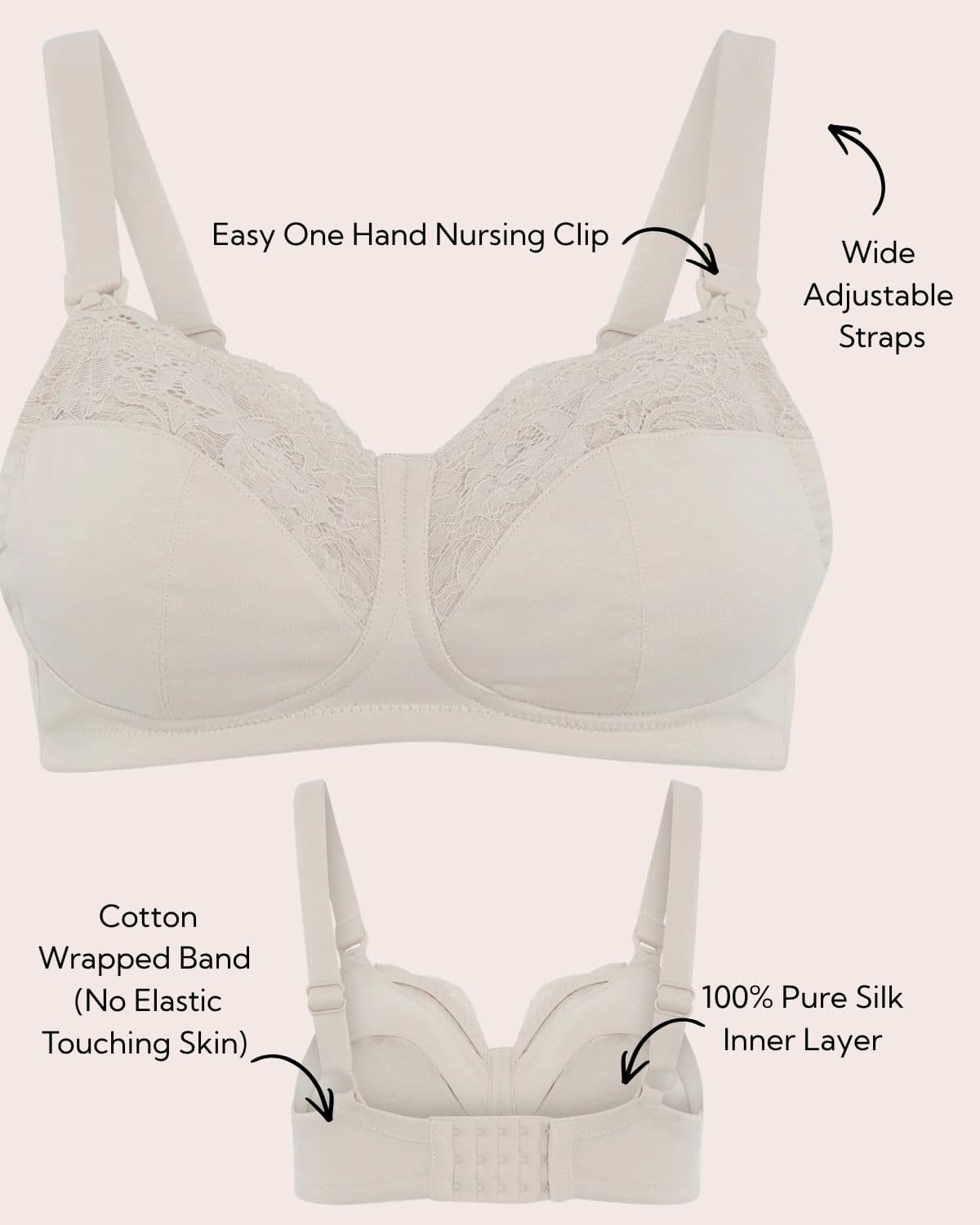
1. JulieMay | Most Supportive Wireless Nursing Bra
Best For: Anyone who wants the shape and support of a regular bra with drop-down cups for nursing.
Use discount code SKL15 to save 15%!
If you’ve tried on nursing bralettes and wished one of them had actual cups and a little shape, look at the Glacie.
JulieMay makes it in individual band and cup sizes, which gives you more to work with when a medium fits your rib cage but you need more room in the cup.
There’s a clip at each strap so the cup drops down for a feed, and an inner sling stays in place while the cup is open.
The cups are lined in mulberry silk, and JulieMay uses light cotton padding to give them shape.
I like this as a step up in structure for someone who’s happy to wear a soft bra at home but wants more coverage and support under clothes.
Price & size
$99 with code SKL15 | 30B–40G
Materials & features
78% organic Pima cotton and 22% silk body fabric | Mulberry silk cup lining | Light cotton padding | Plastic strap sliders
Location/shipping
United Kingdom | Ships worldwide, including the U.S. and Canada
why it made my list
- Individual band and cup sizes in a wireless nursing bra.
- Silk against the breast and light cotton padding for shape.
- Drop-down cups with an inner support sling.
my testing experience
- The most supportive nursing bra I tried.
- This was the one that felt like a “bra bra” to me. It had the structure of a regular bra, and I could nurse in it.
- I honestly thought it was fantastic.
👉 Pro Tip: If you’re building a non-toxic nursing setup, don’t stop at the bra. Your nursing pillow is the other thing pressed against you and your baby at every feed. See my guide to the best non-toxic organic nursing pillows to find one that’s safe and comfortable.
2. Q for Quinn | Best Organic Cotton Crossover Nursing Bra
Best For: Anyone who wants a clip-free organic cotton nursing bra with wide straps and enough support to wear beyond bedtime.
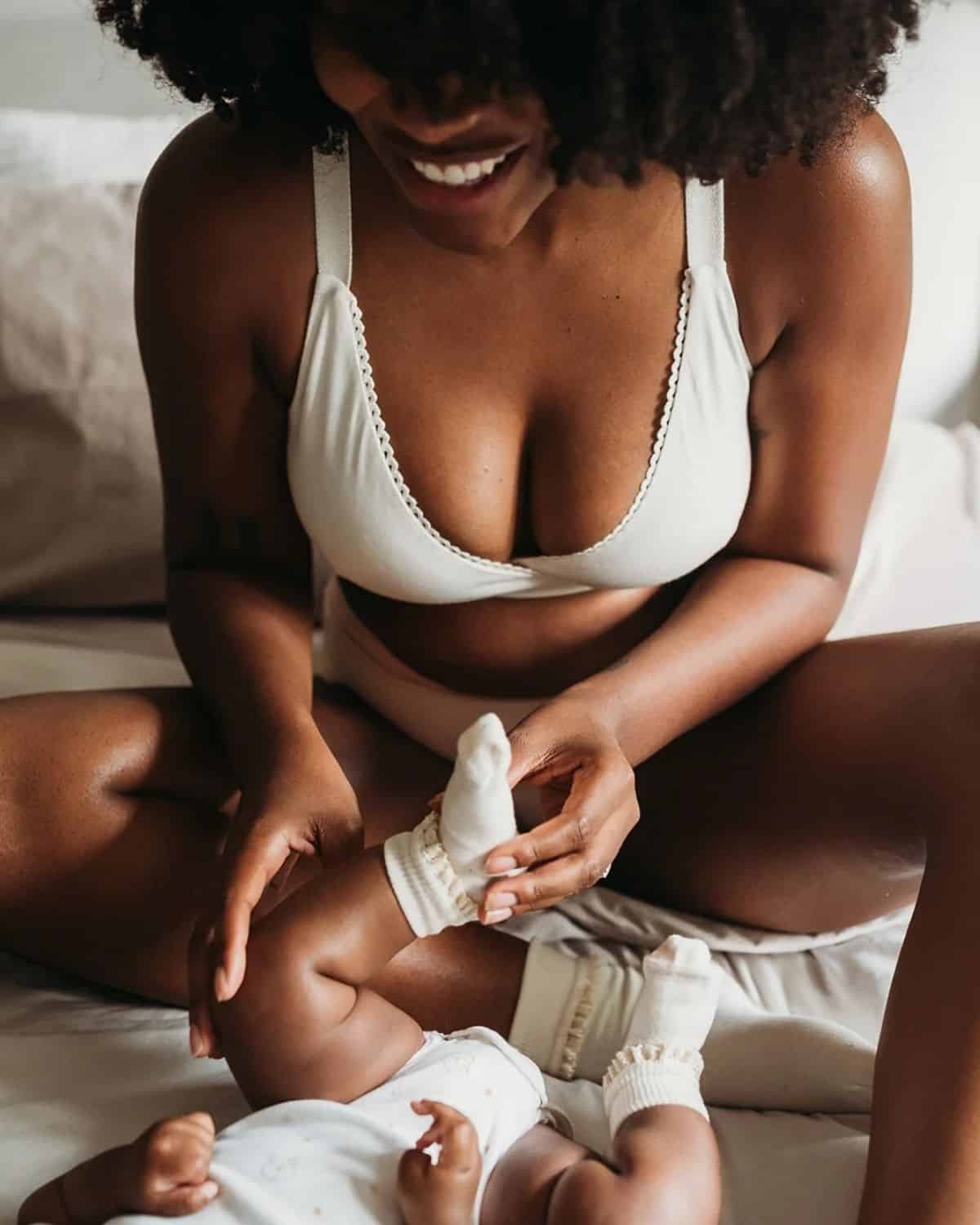
This one from Q for Quinn blew me away. I loved the crossover front for nursing, but it was the thick straps and how supported I felt that made me want to keep wearing it.
It’s beautiful, too. I’d happily wear it during the day and still be comfortable enough to sleep in it.
The wrap front pulls aside for feeds, and you can wear the straps straight or cross them in the back. The back closure also adjusts, which I appreciate on a bra this soft.
The brand spells out what it uses for the parts I usually have to go looking for, right down to the seam thread and the hook-and-eye piece. If you want the undyed version, choose Natural.
Price & size
$68 | XS–3XL
Materials & features
100% GOTS-certified organic cotton fabric | Organic cotton seam thread and hook-and-eye piece | Straps and underband elastic made with 50% organic cotton and 50% natural rubber | Contains natural rubber latex
location/shipping
Canada | Ships to the U.S. and Canada
why it made my list
- Pull-aside nursing access with an adjustable back.
- Wide straps can be worn straight or crossed.
- The brand discloses the fabric, thread, closure, and elastic.
my testing experience
- I loved how supported I felt in it. Those thick straps were one of the first things I noticed.
- The crossover worked beautifully for nursing.
- I thought it was gorgeous, and I was comfortable enough to sleep in it.
3. The Very Good Bra | Best Plastic-Free Nursing Bra
Best For: Anyone who wants a plastic-free nursing bra with pull-down access for everyday wear and sleep.
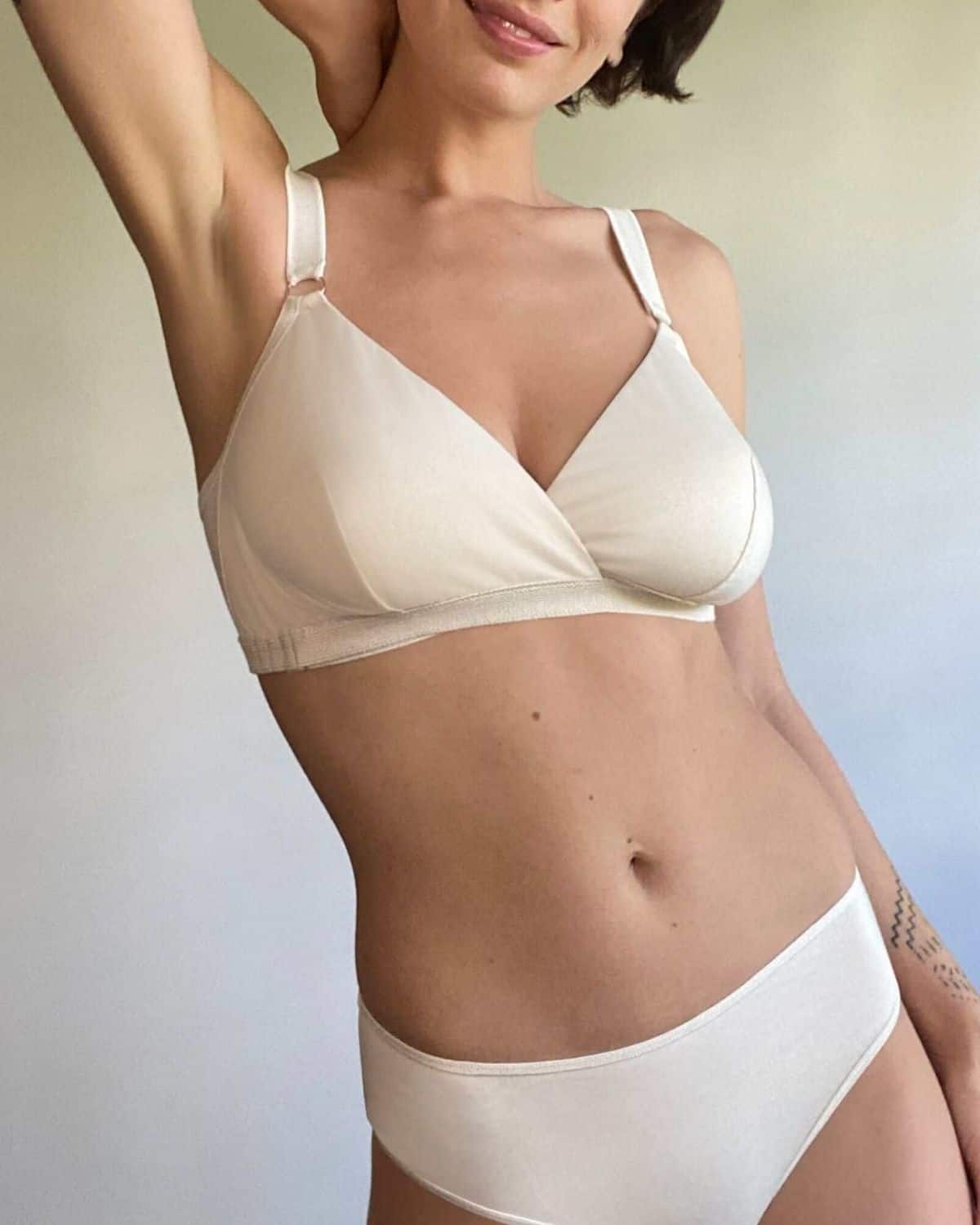
The first thing I’d tell you about this bra is to pay attention to the color. I’m featuring Ecru, which has an unbleached, undyed organic cotton body.
The black one uses TENCEL for the body, so picking a different color actually changes the fabric you’re getting (the TENCEL is great too, just different!).
I love that The Very Good Bra tells you what it uses for parts most brands skip over. The thread is cellulose, and the elastic is natural rubber knitted into organic cotton.
There’s a front closure with several positions, so you have room to adjust the fit. When it’s time to nurse, you pull the cup down. It’s the kind of setup I’d want if I’m feeding on the couch or half asleep in bed.
Price & size
$99
Materials & features
Unbleached, undyed organic cotton body in Ecru | Cellulose thread | Natural rubber elastic knitted into organic cotton | Adjustable front closure
location/shipping
Australia | Ships internationally, including to the U.S. and Canada | U.S. shipping was $22 USD at checkout at the time of this update. The brand covers U.S. tariffs.
why it made my list
- One of the few options I found that discloses the thread and elastic as well as the main fabric.
- The front closure gives you room to adjust the band, and there are no nursing clips to undo.
my testing experience
- I loved this for normal days around the house. I wore it to lounge, relax, and sleep.
- If I was already in it at bedtime, I was perfectly happy to leave it on.
✔️ A nursing bra is one small piece of what touches your baby every day. If you’re working through the rest, start with my guide to non-toxic nursery essentials. It covers the swaps worth making first.
Shopping For Organic Cotton Nursing Bras Specifically?
All three of my main picks use organic cotton. Q for Quinn is 100% GOTS-certified organic cotton, down to the seam thread. The Very Good Bra in Ecru is undyed organic cotton with cellulose thread. JulieMay pairs organic Pima cotton with silk. ThirdLove’s Organic Cloud is 93% organic cotton too, though its foam cups aren’t disclosed.
Low-Tox Nursing & Pumping Bras To Consider
These four didn’t meet my full standard, but each one solves a specific problem the main picks don’t. Pumping bras, extended sizes and molded cups are where organic options thin out, so I chose options with a clearly disclosed fabric blend and listed exactly what’s in each one.
4. Elila | Best Nursing Bra for Larger Bands and Fuller Cups
Best For: Anyone who needs a larger band and fuller cup in the same bra, with wireless support and built-in nursing access.
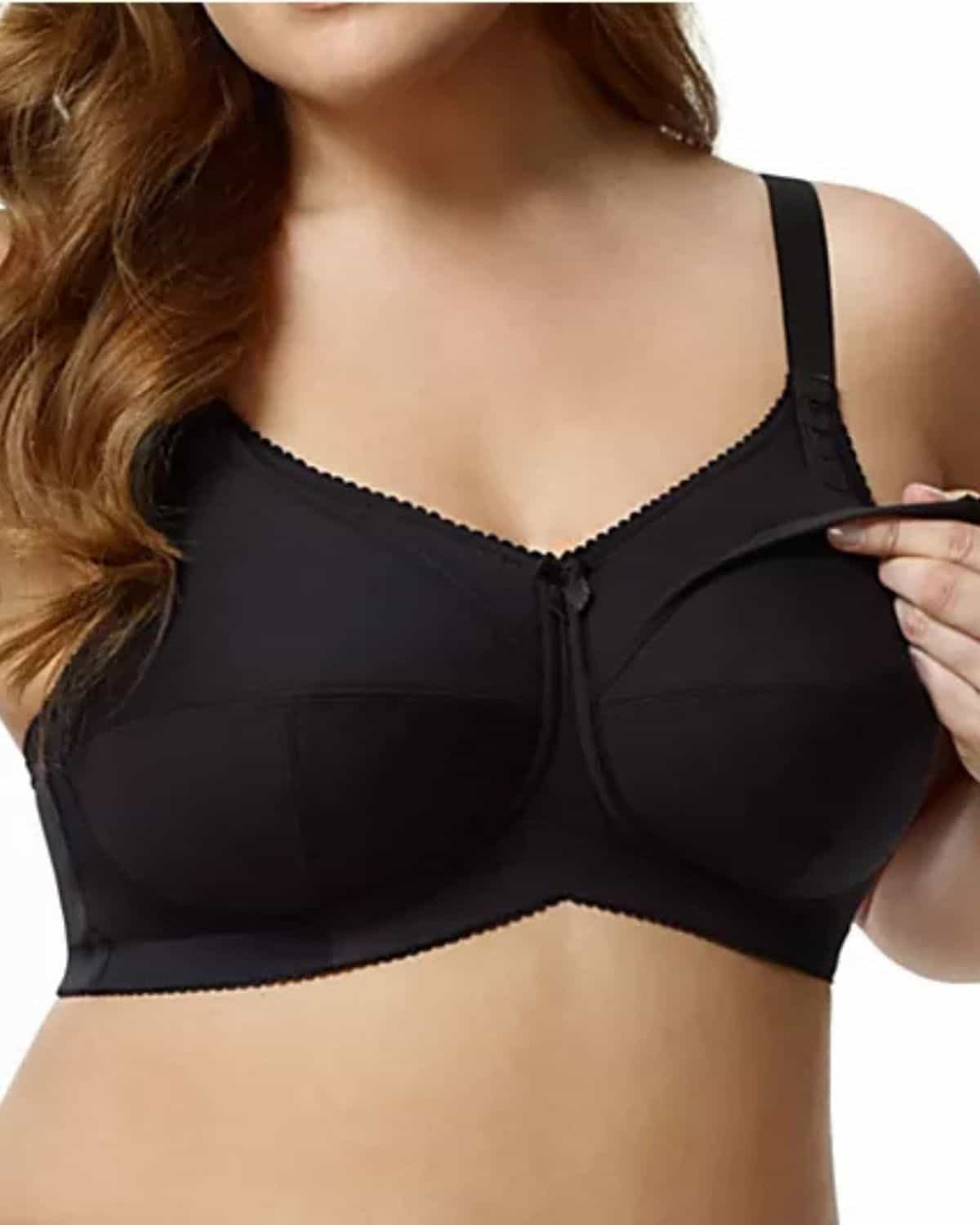
I asked Mandy, one of our internal reviewers, to try the Elila after she had her daughter. She needs a larger band and a fuller cup, so she could speak to how it fit and supported her in a way I couldn’t.
She found it comfortable and supportive, and told me it made nursing super enjoyable.
The Elila 1613 has multi-piece cotton cups and a padded support sling that stays in place when you open the cup to feed.
The nursing hooks have three positions, and the straps are wide and adjustable.
It’s in the low-tox section because the cotton isn’t organic, the back and band are nylon and spandex, and the support sling uses foam. But the cups and lining are cotton, and Elila tells you what’s in each part.
Price & size
$55 | Larger-band, fuller-cup combinations include 44L and 46L
Materials & features
100% cotton cups and cup lining | Cotton-lined foam support sling | Back and band are 75% nylon and 25% spandex | Three-position hook-and-eye nursing closures
location/shipping
United States
why it made my list
- Offers larger bands and fuller cups in the same bra.
- The support sling stays in place while the cup is open.
- The cotton cups and lining are clearly disclosed.
my testing experience
- Mandy tested it after having her daughter and found it comfortable in the larger-band, fuller-cup fit she needed.
- She felt supported in it and said it made nursing super enjoyable.
5. Kindred Bravely | Best Nursing Bra for Wearable Pumps
Best For: Anyone who wants clip-down nursing access and room for a wearable breast pump in the same bra.
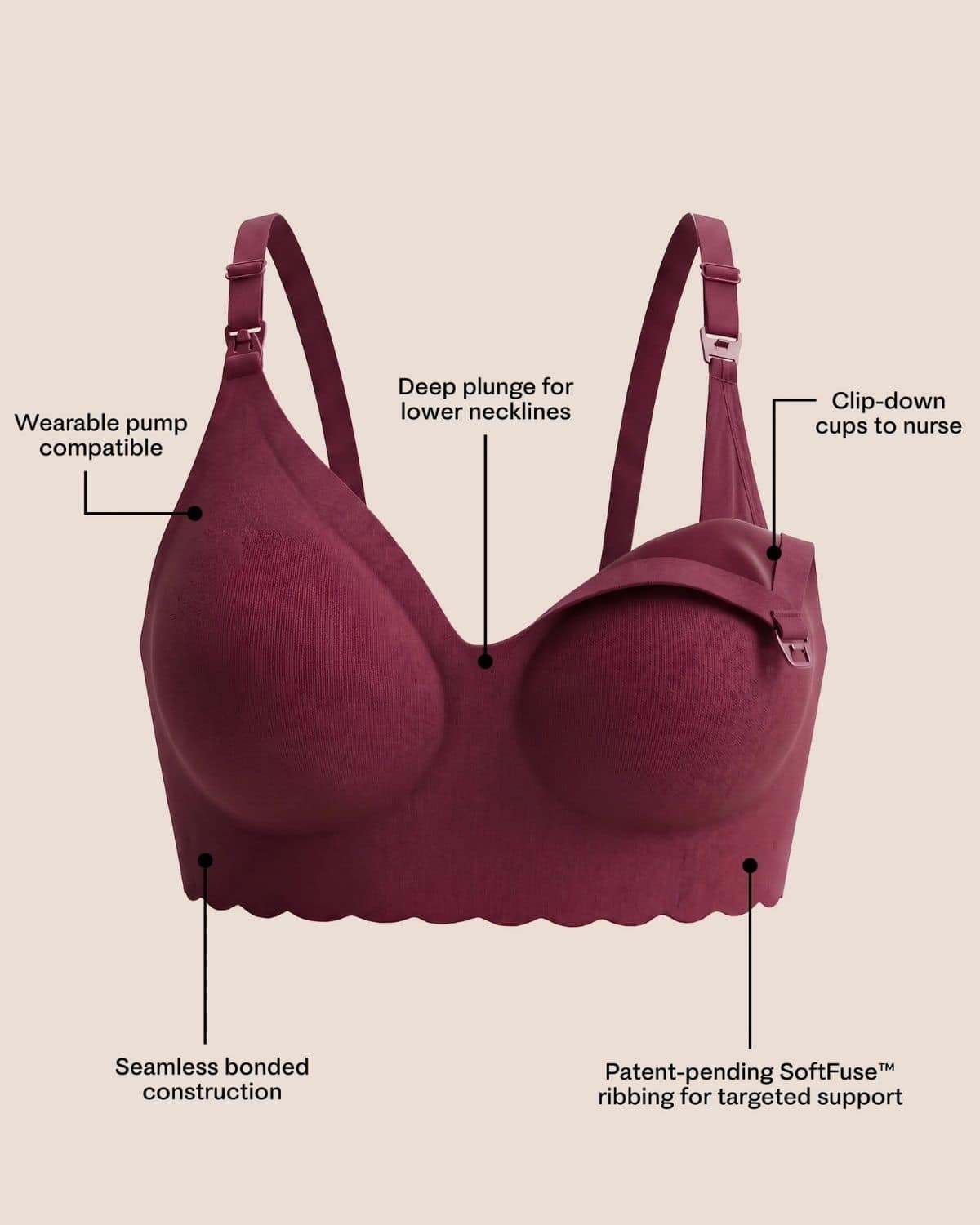
Kindred Bravely has been in my drawer since I had the twins. For this guide, I chose the BareBond Plunge because it solves so many nursing/pumping issues.
If you nurse and use a wearable pump, you can drop the cup for a feed or slip the pump inside the bra. The pads are removable if you want the extra room.
I like seeing a cotton-rich fabric in a bra designed for wearable pumps. The listed blend is 92% conventional cotton and 8% spandex, so it’s not organic, but it’s far more cotton than most pumping-friendly bras.
I’d love Kindred to be as specific about the removable pads and the materials it uses to bond the fabric but it’s a good low-toxic find.
Price & size
$64.90 | Regular B–D
Materials & features
92% cotton and 8% spandex | Bonded construction | Clip-down cups | Removable pads | Wearable-pump compatible
location/shipping
United States
why it made my list
- One bra can cover clip-down nursing and in-bra wearable pumping.
- Cotton makes up most of the disclosed fabric, and the pads are removable.
my testing experience
- Kindred Bravely was one of my most-worn brands when I was nursing and pumping for the twins.
- Seven years later, I pulled out my Everyday Cotton Bra and nursing tanks and wore them again for my next postpartum without a problem. I especially loved those tanks.
6. ThirdLove | Best Wireless Nursing Bra With Molded Cups
Best For: Anyone who wants a wireless nursing bra with clip-down access and a smooth, shaped cup under clothes.
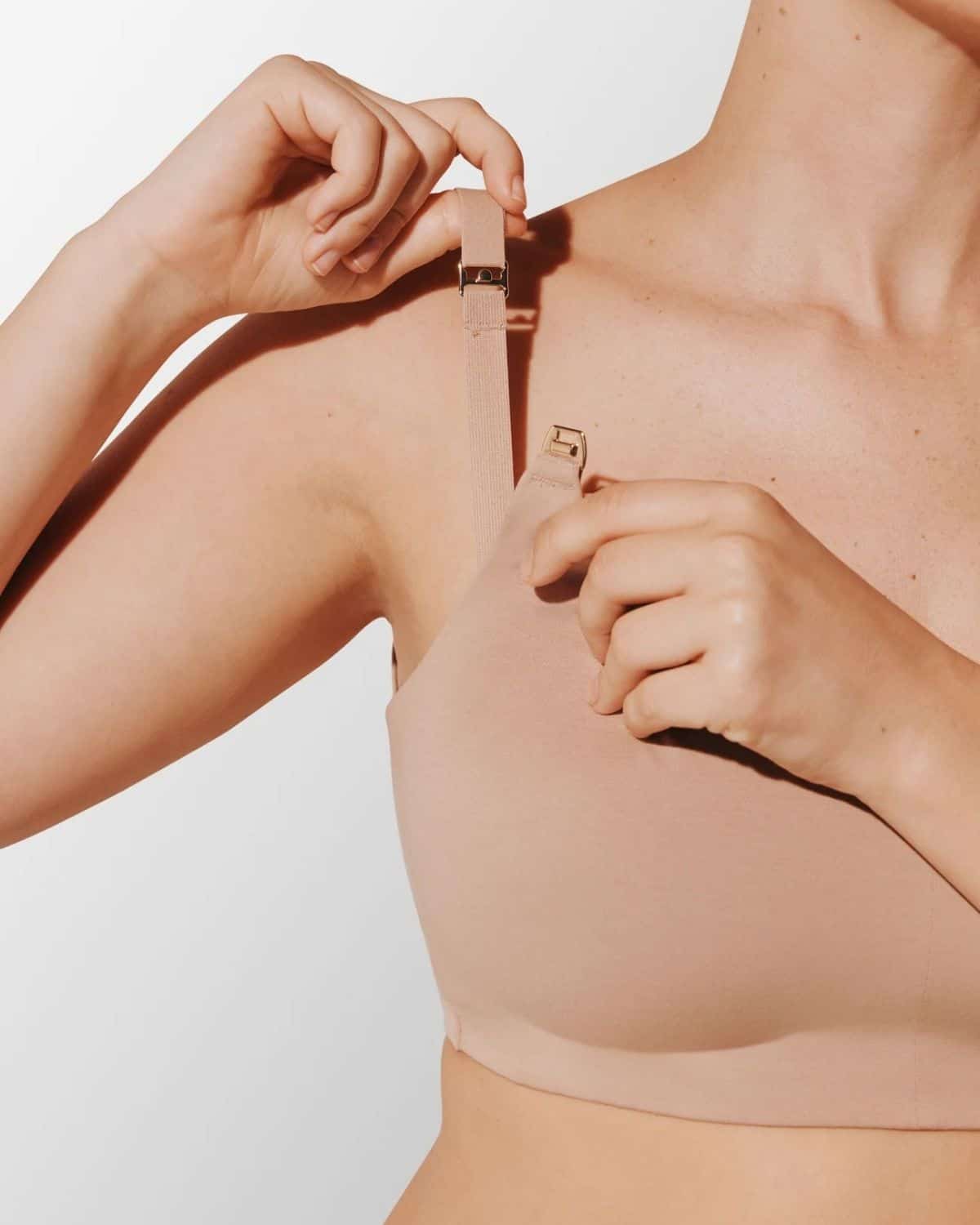
A few readers recommended the organic cloud by ThirdLove, so I finally gave it a try. It worked out great for me.
It was super comfortable, and I can see why readers who want a little more shape under their clothes kept pointing me to it.
The cups clip down for feeds, and there’s an extra row of hooks at the back to give you room as your fit changes. I also like that ThirdLove offers fuller-cup options within its letter sizing.
The thing I’m still curious about is the padding. ThirdLove tells us the cups are built-in foam, but it doesn’t say what that foam is made of. That’s worth knowing if you’re specifically looking for an unpadded organic cotton nursing bra.
Price & size
$68 (2 for $109) | XS–3X up to C½ | XS+–XL+ for D–E½ | XS++–XL++ for F–G
Materials & features
Cotton fabric is 93% organic cotton and 7% spandex | Mesh is 93% nylon and 7% spandex | Built-in foam cups with composition undisclosed | Clip-down access
location/shipping
United States
why it made my list
- Built-in cups give it a smooth shape without an underwire.
- Expanded cup options give you more ways to match your band and cup fit.
- An extra row of hooks lets you adjust the band as your fit changes.
my testing experience
- A few readers put this one on my radar, and I’m glad I listened. It worked out great for me.
- What stood out most was how comfortable it was.
7. Simple Wishes | Best Hands-Free Bra for Traditional Pumping
Best For: Anyone who uses traditional pump flanges and wants a hands-free layer that goes over their usual nursing bra.
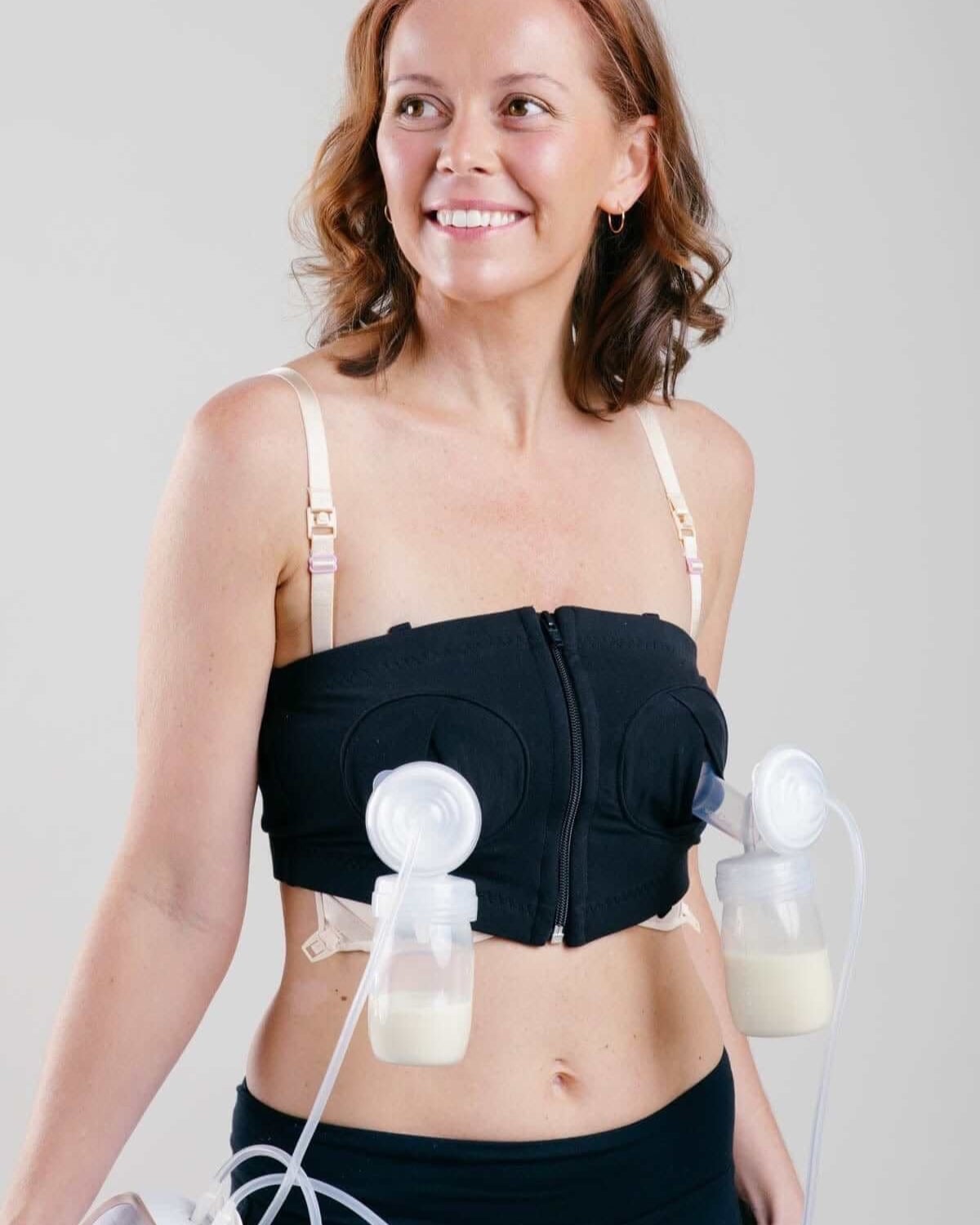
If you’ve ever sat there holding both flanges and wishing you had one free hand, this is the one I’d show you.
The Simple Wishes bra zips on over your nursing bra. You slide the flanges through the front openings, and the back panel lets you adjust how snugly it holds them.
The straps are removable, so you can decide whether you want them for your setup.
I was also happy to see that the main fabric is 83% cotton (OEKO-TEX Standard 100), with spandex for stretch. I’d choose this if you already have a nursing bra you love and want to keep wearing it between pumping sessions.
Price & size
$28.90 | XS–L and L–Plus
Materials & features
83% cotton and 17% spandex, excluding trims | OEKO-TEX Standard 100 certified fabric | Front zipper | Adjustable back panel | Removable straps
location/shipping
United States
why it made my list
- The flange openings and adjustable back give you a way to dial in the hold for pumping.
- You can add it to the nursing bras you already own.
my testing experience
- This one blew me away. I tried it for pumping and ended up just adoring it.
Toxic Materials & Finishes Hiding In Nursing Bras, Explained
A nursing bra can contain a lot more than the fabric on the label.
Synthetic fibers, foam, adhesives, dyes, finishes and metal hardware all end up against your skin, often for most of the day and night. In a nursing bra, they also sit right where your milk leaks and your baby’s cheek rests.
Here’s what I look for when I vet one.
Polyester, Nylon & Spandex
Polyester and nylon are petroleum-based plastics. Spandex, also sold as elastane, is a polyurethane-based synthetic.
I don’t assume every synthetic bra is toxic. My concern is that these fibers often come with dyes and finishes brands rarely disclose. They also put more plastic against skin that’s already damp from leaks.
Polyurethane Foam Cups & Pads
Molded and padded nursing bras usually hide polyurethane foam inside the cup.
Brands almost never say what went into it. In a nursing bra, that foam sits right where milk soaks in, and it gets washed constantly.
Removable pads are better than sewn-in foam because you can take them out. But removable doesn’t tell you what they’re made of.
Adhesives & Bonded Construction
Bonded and seamless bras can use adhesives instead of stitching to hold layers and edges together.
The formulations are rarely disclosed. Unless the brand tells you, there’s no way to know what’s in a bonded seam.
PFAS
PFAS are a large class of persistent chemicals sometimes used to make textiles repel water and stains. You may see that kind of finish marketed as “leakproof” or “stain-resistant.”
The EPA notes that exposure to certain PFAS may be linked to harmful health effects, including reproductive effects. Some PFAS also build up in the body and the environment.
If you’re worried about PFAS reaching your baby through breast milk, the same EPA page says the benefits of breastfeeding appear to outweigh the risks based on current science. Choosing a cleaner bra is about reducing what you can control. It’s not a reason to stop nursing.
Formaldehyde Finishes
Formaldehyde-based resins are used to make fabric wrinkle-resistant or “easy care.” The National Cancer Institute lists permanent-press fabrics among its uses and notes that IARC classifies formaldehyde as a human carcinogen.
On skin, these resins are a known cause of textile contact dermatitis. They never show up on a bra tag.
Azo Dyes
Azo dyes are some of the most widely used textile dyes. Most are fine. But some can break down into aromatic amines, and certain of those amines are carcinogenic.
The EU restricts those azo dyes in clothing and other textiles that stay in prolonged contact with skin. The U.S. has no equivalent rule.
Disperse Dyes
Disperse dyes color synthetic fabrics like polyester and nylon. They bind loosely to the fiber, and they’re among the most common causes of allergic reactions to clothing.
If a nursing bra leaves you itchy or red under the band, the dye is worth suspecting before the fabric itself.
Antimicrobial & Odor-Control Finishes
“Antibacterial,” “odor-resistant” and “fresh” claims usually mean a biocide was added to the fabric, often a silver-based treatment.
Brands sell the benefit and rarely name the chemical. For a garment you leak milk into all day, I want to know exactly what was used.
Nickel In Clips & Hardware
Nursing clips, hooks, sliders and underwire can all contain nickel. It’s the most common contact allergen in the general population, and it causes rashes exactly where the metal touches skin.
“Nickel-free” has to be stated outright. No certification implies it.
Plastic-Lined Nursing Pads
This one isn’t the bra itself, but it sits inside it all day.
Many disposable nursing pads have a plastic backing to stop leaks reaching your clothes. The Arizona Department of Health Services advises nursing moms to avoid pads with a plastic lining and change them often to help protect sore nipples.
Hidden Synthetic Trims
This is where “organic cotton nursing bra” marketing gets slippery.
A bra can be made from organic cotton fabric and still have polyester thread, spandex elastic, nylon lace, foam pads and plastic clips. That’s why I never stop at the fabric percentage. I want to know what’s in the lining, elastic, thread, padding and hardware too.
Safest Materials To Look For In Nursing Bras, Explained
For a nursing bra, I look for natural fibers against the skin, as few synthetic parts as possible, disclosed padding and elastic, and a fit that doesn’t press on your breasts.
GOTS-Certified Organic Cotton
Organic cotton is my first choice for everyday nursing bras. It’s soft, breathable and handles washing well.
I look for GOTS certification on the finished garment. GOTS restricts the chemicals used during processing, not just how the cotton was grown.
GOTS also explains why so many good nursing bras are 95% organic cotton with 5% elastane. A product needs at least 95% certified organic fiber to carry the “organic” label grade.
Silk
Silk is a lovely option for cup linings, especially when your skin is sensitive postpartum.
A peer-reviewed review of fabric choices for atopic dermatitis notes that cotton and silk have traditionally been recommended for irritation-prone skin. It also found both to be generally safe.
TENCEL™ Lyocell
TENCEL Lyocell starts as wood pulp and is semi-synthetic. It gets grouped with the safer options because of its closed-loop process, which recovers more than 99.8% of the solvent.
One distinction to know: TENCEL Lyocell and TENCEL Modal aren’t the same thing. Modal is made in a modified viscose process. And neither name covers dyeing or finishing, so the dye questions above still apply.
Undyed Or Certified-Dye Fabric
The cleanest option is undyed fabric, because there’s no dye process to vet.
If color matters to you, look for a certification that covers the dyed product, not just the raw fiber.
Natural Rubber Elastic
Natural rubber wrapped in organic cotton is my favorite alternative to synthetic elastic. It gives stretch without petroleum-based fibers.
The important exception is latex allergy. Natural rubber latex contains the proteins that cause the reaction, and allergy specialists list clothing elastic as a common source. If you’re allergic, choose a bra with elastane instead.
Cotton Or Cellulose Thread
Most bras use polyester thread, even when the fabric is cotton. A brand that uses cellulose or organic cotton thread has thought about the whole bra, not just the part on the label.
No Padding, Or Natural-Fiber Padding
If a nursing bra is padded, I want to know what’s inside. I prefer unpadded cups, double-layered fabric, or light cotton or silk padding over hidden foam.
Wire-Free Styles With Room To Adjust
This one is about fit, not chemicals, but it matters just as much.
The Academy of Breastfeeding Medicine lists pressure on the breast, including a tight bra, as a predisposing factor for mastitis. Its current guidance recommends a comfortable, supportive bra.
Wireless styles, adjustable bands and stretchy cups give you room as your size changes through the day.
Fewer Clips & Less Hardware
Pull-down and crossover nursing bras skip clips entirely. That means less metal and plastic against your skin, and nothing to undo one-handed at 3 a.m.
Reusable Natural-Fiber Nursing Pads
Washable organic cotton or wool pads let your skin breathe in a way plastic-backed disposables can’t.
Greenwashing In Nursing Bras, Explained
Nursing bra marketing leans hard on soft, reassuring words. Here’s what I watch for.
- “Organic” usually means the main fabric only. The thread, elastic, padding and clips are a separate question, and brands rarely answer it.
- “Made with organic cotton” can mean less than you think. Under GOTS, the “made with organic” grade covers products with 70% to 94% organic fiber. Without certification, the phrase has no floor at all.
- OEKO-TEX isn’t organic. OEKO-TEX tests the finished product for harmful substances. It says nothing about how the fiber was grown. I’ve seen guides and product pages list it under “organic materials,” and that’s simply wrong.
- “Silky” doesn’t mean silk. Silky, buttery and luxe-feel almost always describe polyester, nylon or modal blends.
- “Leakproof” doesn’t tell you how. It could mean a layer of cotton, a polyurethane laminate, or a water-repellent finish. Ask which.
- “Antibacterial” is a chemical claim, not a softness claim. If a fabric is marketed as antibacterial, something usually made it that way. That applies to bamboo blends too.
- “Recycled” is an environmental claim, not a safety one. Recycled nylon is still nylon against your skin.
- “Non-toxic” and “clean” aren’t regulated. Anyone can print them. I want a certification or full material disclosure behind the word.
What About A Little Spandex?
I don’t rule out a nursing bra because it has a little spandex.
Q for Quinn and The Very Good Bra get their stretch from natural rubber instead. In the low-tox section, ThirdLove (7% spandex) and Kindred Bravely (8%) are mostly cotton with a small amount of stretch. That’s very different from a bra made mostly from nylon and foam.
That’s why this guide has two sections. The main picks are organic cotton, silk or natural-fiber bras with disclosed materials. The low-tox picks solve specific problems, like pumping, extended sizing or molded cups, where the organic options run out. For those, I chose options with a clearly disclosed fabric blend and told you exactly what’s in each one.
Certifications To Look For In Nursing Bras
No certification covers everything. Here’s what each one checks, and what it doesn’t.
GOTS (Global Organic Textile Standard)
GOTS covers organic fiber content and the processing behind it, including restrictions on dyes and chemical inputs. The “organic” grade requires at least 95% certified organic fiber.
What it doesn’t automatically cover: elastic, hardware and trims that aren’t part of the certified fiber content.
OEKO-TEX Standard 100
OEKO-TEX tests the finished product for harmful substances. When it applies to the whole garment, every thread, button and accessory is tested, and the limits get stricter the more intensive the skin contact.
What it doesn’t do: require organic fiber, or say anything about microplastic shedding or breathability.
What Neither One Guarantees
Neither certification requires a brand to say its hardware is nickel-free. And a certification on one component, like the main fabric, doesn’t mean the rest of the bra met the same standard.
I check what’s actually certified, not whether a logo appears somewhere on the page.
How I Researched, Tested & Chose These Nursing Bras
It can be hard to tell whether a “best non-toxic nursing bras” list was actually worn or just pulled from bestseller pages.
That’s not how I build guides at Sustainably Kind Living.
1. Nursing Through Two Very Different Seasons
I nursed twins, then did it all again seven years later with my youngest. I’ve been breastfeeding for the last two years, so these bras were tested through engorgement, night feeds, leaks, and a bust that changed size more than once. Over that time, I’ve tested 15 nursing bras marketed as organic, natural, or non-toxic.
2. Reviewing The Whole Bra
For every bra, I looked past the fabric percentage to the lining, elastic, thread, padding, clips, hardware and certifications. Where a brand doesn’t disclose something, I say so in the review.
3. Wearing Them In Real Life
Every bra in the main section has been worn by me: under T-shirts, around the house, overnight and through feeds. I paid attention to access, support, softness, how the fabric felt after a long day, and how it held up in the wash.
4. Choosing The Low-Tox Picks
The low-tox picks needed a clear job, like hands-free pumping, wearable pumps, extended sizing or molded cups. They also needed a clearly disclosed fabric blend, and where a brand left gaps, I named them in the review. Mandy, one of our internal reviewers, tested Elila in a larger-band, fuller-cup size I couldn’t.
5. Listening To Readers
Some of the best leads come from you. ThirdLove, for instance, made this guide because several readers told me to try it, and the fit backed them up.
6. Keeping This Guide Updated
If a brand changes its materials, a favorite disappears, or I find something better, I update the list.
Most Common Questions On Non-Toxic Nursing Bras
It’s a nursing bra made mostly from natural fibers like GOTS-certified organic cotton or silk, with disclosed elastic, thread and padding. It also avoids foam, water-repellent finishes, antimicrobial treatments and undisclosed dyes. “Non-toxic” isn’t a regulated term, so look at what’s disclosed, not the word.
GOTS-certified organic cotton is my first choice, ideally undyed, with cellulose thread and natural rubber elastic. Silk is a great lining for sensitive skin. If you have a latex allergy, choose organic cotton with a small amount of elastane instead.
Pressure on the breast is a recognized risk factor. The Academy of Breastfeeding Medicine lists a tight bra among the predisposing factors for mastitis. If a bra digs in or leaves marks, it’s too tight.
Some people do without problems. The issue is pressure. A wire that presses into breast tissue can restrict milk flow. A well-fitted wireless bra removes the question, which is why every bra in this guide is wire-free.
You can nurse in any soft bra you can comfortably move out of the way. As a B cup, I’ve done it hundreds of times in a simple organic Pact bralette. Nursing bras just make access faster and give you more room as your size changes.
I’d start with three: one to wear, one in the wash, and one for the nights you leak through. Add a sleep bra if you want something softer overnight.
Late in pregnancy is a good time for your first one or two, in a stretchy or adjustable style. Your size can change again once your milk comes in, so wait to buy more structured bras until things settle.
Yes. Soft, wireless, clip-free styles are the most comfortable overnight. Avoid anything tight or structured for sleep.
Many disposable pads have a plastic backing, and health departments advise avoiding plastic-lined pads when your nipples are sore. Washable organic cotton or wool pads are a breathable alternative. Change them when they’re damp.
No. Natural rubber is latex, and clothing elastic is a known source of reactions. Choose organic cotton with elastane instead.
A nursing bra gives your baby access to the breast. A pumping bra holds flanges so your hands are free. Some do both, like Kindred Bravely’s BareBond for wearable pumps. Others, like Simple Wishes, go over your nursing bra.
No. OEKO-TEX tests the finished product for harmful substances. GOTS certifies organic fiber and processing. A bra can have one, both or neither.
Still Deciding?
If you’re torn on which non-toxic nursing bra to pick, here’s how I’d narrow it down.
- JulieMay if you want the support and shape of a regular bra with drop-down cups for nursing. This was the most supportive wireless nursing bra I tried.
- Q for Quinn if you want an organic cotton crossover with wide straps. I felt supported during the day and comfortable enough to sleep in it.
- The Very Good Bra if you want a plastic-free nursing bra for lounging or overnight feeds. Choose Ecru for undyed organic cotton.
- Elila if you need a larger band and a fuller cup in the same bra. Mandy found it comfortable and supportive while nursing her daughter.
- Simple Wishes if you pump with traditional flanges and want both hands free.
- Kindred Bravely if you use a wearable pump and want a bra with clip-down cups for nursing, too.
- ThirdLove if you want a comfortable wireless nursing bra with molded cups for a smooth shape under clothes. The built-in cups are foam, and ThirdLove doesn’t specify the foam type.
Final Thoughts On Non-Toxic Nursing Bras
Nursing bras don’t get the attention they deserve. You live in them for months, sometimes years, and most of us grab whatever’s on the shelf at the baby store.
These are the bras I actually reached for: nursing my youngest at 2 a.m., lounging on the couch between feeds, and the one I didn’t want to take off at bedtime.
You don’t need to replace everything this week. Start with the bra you wear most, probably the one you sleep in, and go from there.
I’ll keep testing new nursing bras and updating this guide as materials, certifications and my own family’s needs change. If something on this list stops holding up, you’ll hear about it here first.
Continue Your Non-Toxic Intimates Drawer
- Non-Toxic Bras: Once you’re done nursing, see my favorite organic cotton, silk and plastic-free bras for everyday wear.
- Non-Toxic Sports Bras: Supportive options made with organic cotton, TENCEL and other carefully vetted materials.
- Organic Cotton Underwear: The best organic cotton underwear I’ve tested for breathable, everyday comfort.
- Sustainable Lingerie: Organic, natural and lower-impact bras, bralettes and underwear for when you want something pretty.
📌 Save This Guide To Non-Toxic Nursing Bras For Later
Save this guide for the next time you’re shopping for nursing bras and want to quickly check which materials, certifications and brands are worth it.
Sources & Further Reading
- U.S. EPA, Our Current Understanding of the Human Health and Environmental Risks of PFAS: PFAS health effects, and EPA’s note on breastfeeding and PFAS.
- National Cancer Institute, Formaldehyde and Cancer Risk: Formaldehyde’s use in permanent-press fabrics and its carcinogen classification.
- DermNet, Textile Contact Dermatitis: Dyes, finishing resins and metal fasteners as causes of clothing-related rashes.
- European Chemicals Agency, REACH Annex XVII Entry 43: The EU restriction on azo dyes that release carcinogenic aromatic amines.
- StatPearls (NIH), Nickel Allergy: Clinical overview of nickel as the most common contact allergen.
- Academy of Breastfeeding Medicine, Clinical Protocol #4: Mastitis: Pressure on the breast, including a tight bra, as a predisposing factor for mastitis.
- Minnesota Department of Health WIC, Mastitis: Updated Guidance: Summary of ABM Protocol #36, including wearing a comfortable, supportive bra.
- Arizona Department of Health Services, Sore Nipples: Guidance on avoiding plastic-lined nursing pads.
- ASCIA, Latex Allergy: Clinical allergy guidance listing clothing elastic as a source of natural rubber latex.
- Fabric Selection in Atopic Dermatitis: An Evidence-Based Review, American Journal of Clinical Dermatology: Peer-reviewed review of cotton, silk and other fabrics for sensitive skin.
- GOTS, Label Grades: Official definitions of the “organic” and “made with organic” grades.
- OEKO-TEX, Standard 100: Official documentation on what Standard 100 tests.
- Lenzing, TENCEL™ Lyocell & Modal: Lenzing’s explanation of the closed-loop lyocell process and how modal differs.

Steal My Non-Toxic Cleaning Checklist!
Believe us, it’s the BEST…. and it’s free. Does it really get any better than that?! Sign up for our newsletter and get this free checklist to clean your home without any harmful chemicals!