 Shop My Favorite Non-Toxic Gifts Of 2026!
SKL is reader supported. When you buy through links on our site, we may earn affiliate commission. Learn more here.
Shopping for the best non-toxic gifts for kids can get overwhelming fast. There are thousands of toys calling themselves “safe,” “natural,” or “eco-friendly,” but those words do not tell you much about the wood finish, plastic, paint, fabric, glue, or other materials your child is actually touching.
I’ve spent nearly 10 years researching and testing non-toxic and sustainable products, but some of my best research happens right in our own house. I have three kids, and over the years we have tested a LOT of toys, art supplies, clothes, games, bikes, building sets, and playroom gear. I also buy constantly for my nieces, nephews, goddaughter, and friends’ kids.
That means every gift on this list has to pass two tests: do I feel good about the materials, and will a real kid actually play with it?
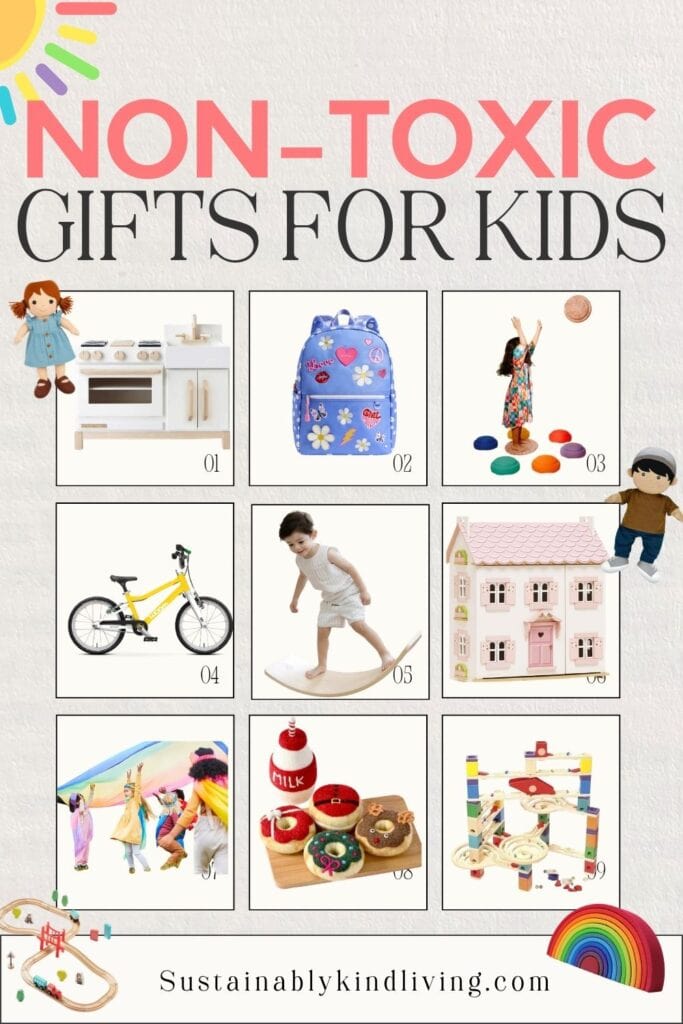
Some of these are non-toxic gifts for kids I chose because the materials and finishes are simply better. Others are sustainable gifts for kids because they are built to last, encourage years of play, create less waste, or can eventually be passed down to another child. The best ones do both.
You’ll find wooden toys, open-ended play, non-toxic art supplies, STEM gifts, organic clothing, everyday essentials, and a few truly big Christmas gifts, all filtered through nearly a decade of clean-living research and years of watching my own kids put toys through real-life abuse.
If I Could Only Pick 5 Gifts For Kids…
- Best Open-Ended Gift: Sarah’s Silks Playsilk
- Best Building Gift: Mideer Magnetic Tiles
- Best Active Gift: PlanToys Balance Board
- Best Creative Gift: Honeysticks Beeswax Crayons
- Best Big Gift: Figgy Play Couch
✔️ Prefer to shop our Amazon Storefront? SKL Approved Gifts For Kids On Amazon
What I Look for in a Non-Toxic Gift for Kids
With kids, I pay especially close attention to materials because toys are not exactly handled delicately. They get chewed, slept with, thrown across the room, dragged outside, covered in snacks, and handed down to siblings.
Here is what I look at first:
- For wooden toys, I check more than the wood. Solid or responsibly sourced wood is a great start, but I also want to know about the paint, stain, sealant, and glue holding everything together. FSC certification can tell me more about responsible wood sourcing, while clear disclosure around water-based paints and finishes helps me evaluate the actual toy.
- For plastic and silicone toys, I want the material clearly identified. I am particularly cautious with PVC and poorly disclosed soft plastics, especially for younger kids who still put toys in their mouths. For silicone, I look for brands that clearly identify food-grade or platinum silicone and provide meaningful safety information rather than simply calling the product “non-toxic.”
- For crayons, paints, dough, and kids’ makeup, ingredients matter. These products end up all over hands, faces, furniture, and occasionally mouths. I look for straightforward ingredient disclosure, safer pigments and dyes, and brands that tell me what is actually creating the color, scent, or texture.
- For dolls, stuffed animals, pajamas, and other soft goods, I check the fabric and filling. Organic cotton, wool, silk, and other well-disclosed materials are usually where I start. Certifications like GOTS and OEKO-TEX can be useful when they actually apply to the finished product.
- For play couches, climbing toys, and bigger playroom pieces, I look underneath the cute exterior. Foam, waterproof treatments, adhesives, composite wood, paints, and flame-retardant chemistry can all matter. Certifications like GREENGUARD Gold or CertiPUR-US can add useful information depending on the product, but I still look at the entire material story.
And then I ask the question years of parenting have taught me matters just as much: will my kids actually keep playing with it?
Some of the most sustainable toys in our house are not complicated at all. They are playsilks that became capes, forts, and doll blankets; wooden toys that survived multiple kids; building sets that get used differently every year; and art supplies that actually get finished.
A toy does not become sustainable just because it is wooden or comes in recyclable packaging. If it breaks quickly or gets abandoned after Christmas morning, it still becomes clutter.
That is why this guide is intentionally curated. I would rather recommend fewer non-toxic, eco-friendly, and sustainable gifts for kids that I have a real reason to trust than fill the page with another 50 toys just because they look “green.”
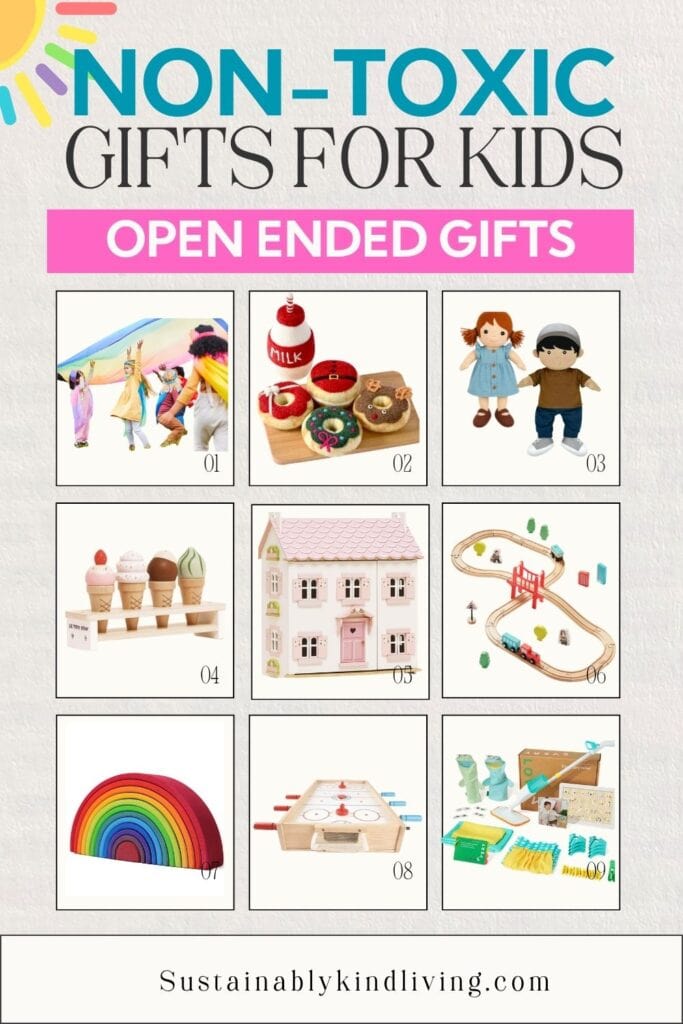
Imaginative & Open-Ended Gifts for Kids
The toys that last longest in our house are almost always the simplest ones. My kids have turned playsilks into forts, wooden toys into entire little worlds, and train tracks into setups that take over the living room for days.
For these non-toxic gifts for kids, I focused on better materials, safer finishes, and open-ended toys that leave the actual playing up to the child. These are the kinds of sustainable toys I love because they can change as kids grow instead of being exciting for one week and forgotten the next.
- Sarah’s Silks Giant Rainbow Playsilk | $48 | Best For: Ages 3-10+ | My twins have used playsilks for years, and they still find completely different things to do with them. A cape becomes a fort roof, then an ocean, then a blanket for stuffed animals. Sarah’s Silks uses 100% silk with non-toxic dyes, and this is one of the best examples I know of a simple toy growing with a child instead of getting outgrown.
- Tara Treasures Felt Toys | $8-$156 | Best For: Ages 3-8 | I’ve gifted these to my nieces, and the beauty is that there is no single way to play with them. The felt food, animals, landscapes, and little-world pieces can become whatever a child decides that day, and the wool construction gives me a much nicer material option than another bin of molded plastic toys.
- Apple Park Dolls | $50-$55 | 10SKL for 10% off | Best For: Ages 1-5 | I gave one of these dolls to my daughter, and I especially like them for younger kids who carry their favorite doll everywhere and inevitably sleep with it too. Apple Park uses organic cotton and better-disclosed materials, so this is one of those soft toys I feel genuinely good putting right into a child’s arms.
- Le Toy Van Wooden Pretend Play Sets | From $39.95 | Best For: Ages 3-8 | My kids and nieces have both had Le Toy Van pretend-play toys, and they are exactly the kind of gift that keeps resurfacing. A wooden ice cream shop or food set can become a café, store, restaurant, or whatever story is happening that afternoon, which gives it far more staying power than a toy with one built-in function.
- TinyLand Wooden Dollhouse & Furniture | From $113 | Best For: Ages 3-8 | Dollhouses are one of those bigger gifts that can stick around for years because the stories keep changing as kids grow. TinyLand uses a mix of plywood, MDF, and solid woods with water-based, child-safe paint, and its dollhouses are tested to standards including ASTM F963 and EN71. I like that the brand is actually transparent about the construction instead of just calling it a “wooden dollhouse” and leaving it there.
- TinyLand Wooden Train Set | $24.99+ | Best For: Ages 3-8 | My sons received a Tiny Land train set from their grandparents, and it has had real staying power. They have rebuilt those tracks more ways than I could count, adding cars, animals, blocks, and whatever else happens to be nearby. This is exactly what I want from a bigger kids’ gift: something that keeps changing instead of being “finished” after one play session.
- Grimm’s Rainbow Stacking Tunnel | $115 | Best For: Ages 1-8+ | The Grimm’s rainbow is one of those toys that looks almost too simple until you watch children play with it. It can become a bridge, tunnel, fence, tower, animal home, or part of a much bigger setup. Grimm’s uses sustainably sourced wood and water-based color stains, and the open-ended design is why these pieces tend to stay relevant across such a wide age range.
- Hape Wooden Toys | From $10 | Best For: Ages 1-8+ | Hape has been one of my go-to brands when I want classic wooden toys without losing the fun factor. Their range is huge, from puzzles and vehicles to pretend-play sets, and many use FSC-certified wood and water-based finishes. I especially like Hape for gifts because you can match the toy to the child instead of buying the same “eco toy” for everyone.
- Lovevery Play Kits | From $80 | Best For: Babies-Age 5 | Lovevery is one of the few toy subscriptions I have repeatedly bought for my own kids. I gift my daughter a kit every Christmas, and I love that the toys are chosen around what children are actually learning and doing at that stage instead of simply giving them more stuff. The kits use materials like FSC-certified wood and organic textiles, and the toys tend to keep getting reused long after the box arrives.
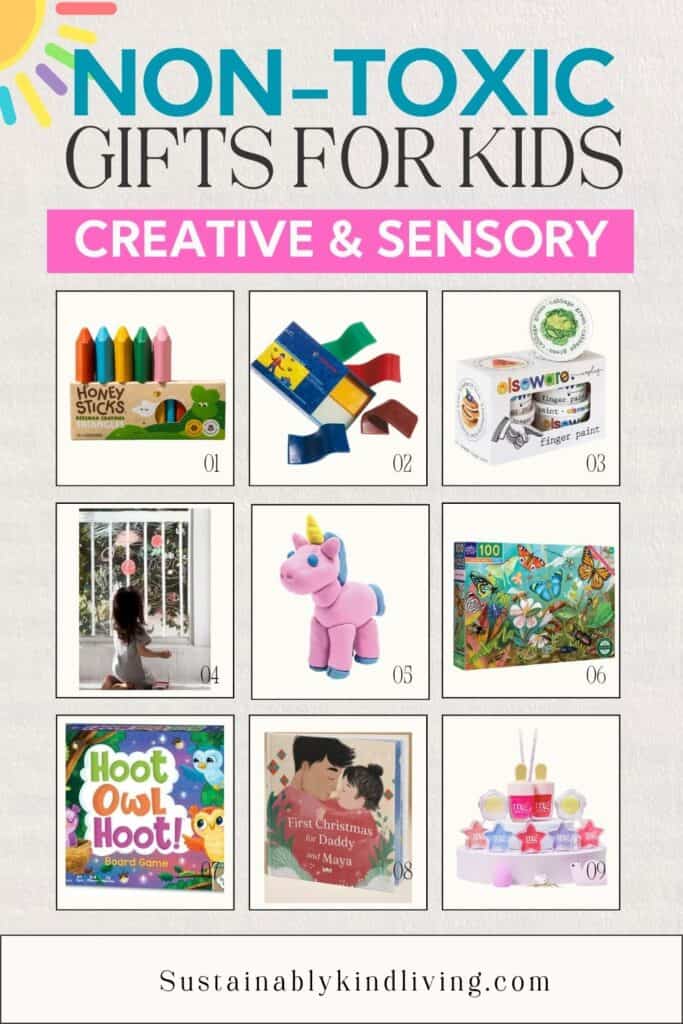
Creative, Sensory & Screen-Free Gifts for Kids
Some of the gifts my kids use most are the ones that give them something to actually do. Drawing, painting, building little scenes, working through a puzzle, or sitting with a sensory activity tends to hold their attention far longer than another toy that lights up and does the entertaining for them.
For these non-toxic gifts for kids, I focused on art supplies, sensory materials, games, and creative gifts with better ingredient transparency, safer materials, and enough replay value that they do not get used once and forgotten.
- Honeysticks Beeswax Crayons | $24.95 for the Original 12-Pack | Best For: Ages 1-5 | My daughter has gone through multiple packs of these, which tells me more than any product page ever could. They are made from pure beeswax in a chunky shape that is easy for little hands to grip, and they are one of those art supplies that actually get finished instead of drying out in the back of a drawer.
- Stockmar Modeling Beeswax | $21.99 for the 6-Color Set | Best For: Ages 3-8 | I like this for kids who love working with their hands but are ready for something different from standard modeling dough. The beeswax softens with the warmth of their hands, can be shaped over and over, and firms back up when it cools, so it does not dry out after one afternoon of play.
- Elseware Unplug Finger Paint Set | $19.99 | Best For: Ages 2-6 | Finger paint is exactly the kind of product where I want to know what is actually in it, because it ends up everywhere. Elseware uses food-safe, plant-based ingredients and natural pigments, which makes this a much easier yes for messy little artists who are going to wear half the project by the time they are done.
- Kitpas Window Art Crayons | $23 | Best For: Ages 3-8 | My favorite creative gifts are the ones that make kids feel like they are getting away with something. Kitpas crayons can be used on windows and glass, then wiped away, so kids get that giant-canvas feeling without permanently redecorating the house. They are washable, easy to grip, and much more exciting than another basic box of crayons.
- Elseware Unplug Therapy Dough | $14.99 | Best For: Ages 3-8 | This is one of those quieter gifts I like having in the mix for kids who enjoy squeezing, rolling, and shaping while they sit. Elseware uses vegetable pigments and essential oils and packages the dough with less waste, so it gives me a more transparent alternative to brightly colored mystery dough with an ingredient list I cannot find.
- eeBoo Children’s Puzzles | $13.99-$25.99 | Best For: Ages 3-10+ | I have gifted eeBoo puzzles to my own kids and friends’ kids because there is always an age and design that fits. They use recycled board, FSC-certified paper, and vegetable-based inks, and the artwork is beautiful enough that these feel like an actual gift rather than another generic puzzle grabbed at the last minute.
- Peaceable Kingdom Cooperative Games | $10.99-$49.90 | Best For: Ages 3-10 | My twins have grown up with cooperative games in rotation, and they are still some of my favorite family gifts. Everyone works toward the same goal instead of one child winning while another melts down, which makes them especially good for siblings and family game nights. Many of the games also use FSC-certified paper and cardboard with very little plastic.
- Wonderbly Personalized Books | $24.99-$99.99 | Best For: Ages 1-10+ | I have gifted personalized books for birthdays and Christmas because kids seeing their own name woven into a story still feels genuinely magical. They also have far more staying power than most personalized gifts; a good one becomes part of the bookshelf and eventually a keepsake instead of another novelty item.
- MG Naturals Kids Makeup Set | $42.95 | Best For: Ages 5-10+ | If a child is already asking to play with makeup, I would much rather give them something made specifically with younger users in mind than hand over conventional adult products. MG Naturals uses plant-based, organic-leaning formulas without titanium dioxide, and it gives kids the fun dress-up part while giving me much more ingredient information to work with.
✔️ Planning Christmas beyond the big gifts? My Non-Toxic Stocking Stuffers Guide has smaller kid-friendly picks, while my Non-Toxic Christmas Guide covers the rest of the holiday, from decor and cookware to safer seasonal swaps.
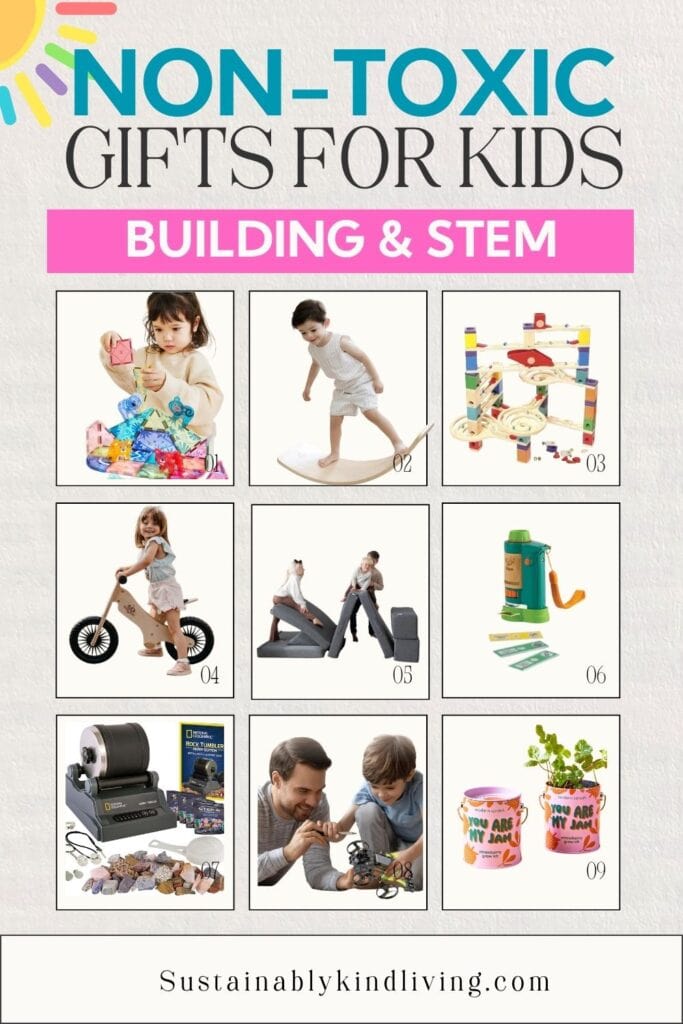
Active, Building & STEM Gifts for Kids
Some kids are happiest when they are building something, climbing something, taking something apart, or figuring out how it works. These are the gifts I reach for when I want to give them something that feels exciting but still encourages movement, problem-solving, and hands-on play.
For these non-toxic gifts for kids, I focused on durable building toys, active play equipment, and STEM gifts with better material transparency and enough challenge to keep kids coming back to them.
- Mideer Colorful Magnetic Tiles | $84.99 | Best For: Ages 3-10 | Magnetic tiles are one of those toys kids can use completely differently depending on their age. One day they are building a basic tower, the next they are making houses, roads, garages, and entire little worlds. I like Mideer because the tiles feel sturdy and give kids that open-ended building experience without needing instructions every time they sit down to play.
- PlanToys Wooden Balance Board | $89.99 | Best For: Ages 3-8 | My sons received a wooden balance board from their godfather, and it quickly became far more than something to stand on. It has been a bridge, rocker, ramp, seat, and obstacle-course piece over the years. This is exactly the kind of active toy I love because the child decides what it becomes.
- Hape Quadrilla Marble Run | From about $60 | Best For: Ages 4-10+ | This is exactly the kind of building toy I like for kids who want to figure out why something works, not just put pieces together. They can redesign the track, change the path of the marbles, experiment with speed and direction, and start over when their first idea does not work. Hape makes the Quadrilla system from birch and rubberwood with non-toxic child-safe finishes, and the sets can be expanded as kids get more ambitious with their builds.
- Kinderfeets Balance Bike | $139.99 | Best For: Ages 2-5 | A balance bike is one of those gifts that gives kids something genuinely useful to master. Kinderfeets uses wood and water-based finishes, and I like that this gets children outside, moving, and working on balance without adding another battery-powered toy to the house.
- Figgy Play Couch | $448-$584 | Best For: Ages 2-10+ | A play couch is expensive, but it is one of the rare big gifts that can be used every single day. Kids turn the cushions into forts, slides, obstacle courses, reading spots, and whatever else they invent. Figgy uses CertiPUR-US certified foam and GREENGUARD Gold certified materials, so this is also a category where the safety certifications matter to me just as much as the play value.
- Hape Field Microscope | $29.99 | Best For: Ages 4-8 | My own kids have this microscope, and it is one of those gifts that immediately gives them a reason to start investigating everything around them. Leaves, rocks, bugs, fabric, food, suddenly all of it becomes interesting. I like that it turns curiosity into something hands-on instead of pushing them toward another screen.
- National Geographic Rock Tumbler Kit | $64.99 | Best For: Ages 8-12+ | This is such a satisfying gift for the kid who loves collecting rocks or wants a project that unfolds over time. Watching rough stones slowly turn into polished gems gives them a real process to follow, and I like that it builds patience in a way instant-gratification toys simply do not.
- Thames & Kosmos STEM Kit | From $21.99 | Best For: Ages 6-12+ | Thames & Kosmos is where I would look for an older child who actually wants to build, experiment, and understand how something works. The brand has kits covering everything from solar power to engineering, so you can match the difficulty to the child instead of buying a science kit they will either breeze through or find impossibly frustrating.
- Modern Sprout Grow Kit | $10-$40 | Best For: Ages 5-10+ | A grow kit is one of my favorite STEM-adjacent gifts because the project keeps going after the box is opened. Kids plant the seeds, water them, watch for changes, and eventually get something living out of the process. Modern Sprout uses non-GMO seeds and offers compact kits that make this easy even if you do not have a garden.
Everyday Gifts Kids Actually Use
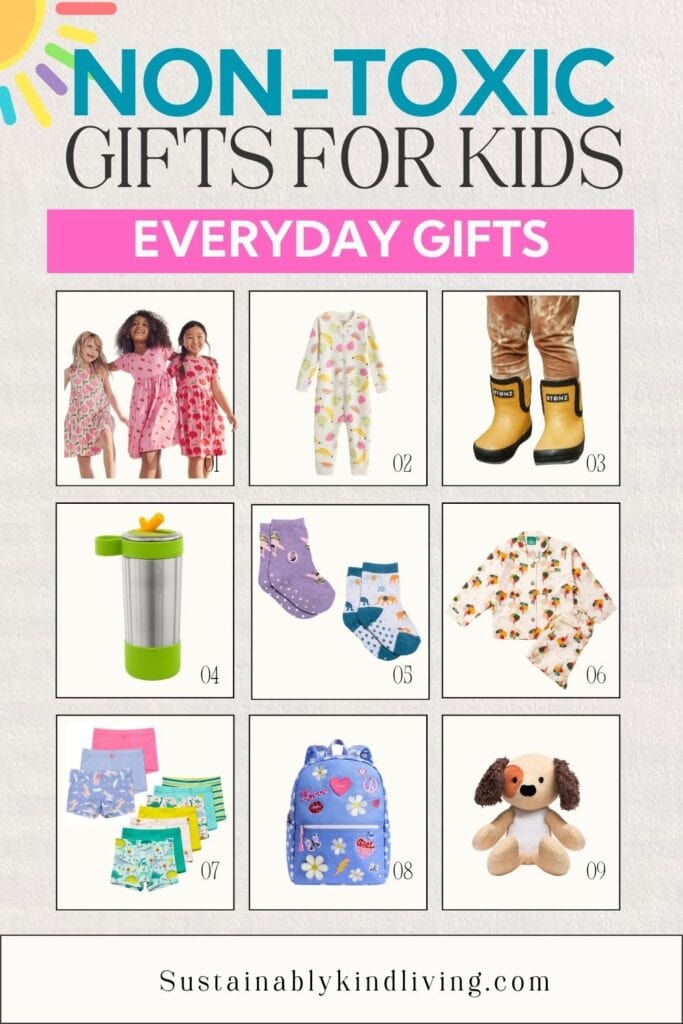
Some of the best gifts for kids are the things they end up reaching for every single day. Clothes, pajamas, water bottles, backpacks, and rain gear may sound practical, but when you choose the right colors, prints, and styles, they can still feel genuinely exciting to open.
For these non-toxic and sustainable gifts for kids, I looked for better materials, useful certifications, less plastic where practical, and products sturdy enough to survive real kid life instead of needing to be replaced a few months later.
- Hanna Andersson Organic Kids Clothing | From $12 | Best For: Ages 0-14 | Hanna Andersson is one of those brands I keep coming back to because the clothes are actually made to survive childhood. Their organic cotton pieces are available in genuinely fun prints and colors, and many are GOTS certified and OEKO-TEX STANDARD 100 certified. This is the kind of clothing gift that can become a favorite now and still have enough life left to pass down later.
- Quince Organic Kids Clothing | From $16.90 | Best For: Babies-Age 12 | My daughter lives in Quince organic cotton dresses, and my son is just as attached to their sweaters and jeans, so this one has plenty of real-life testing behind it in our house. I like Quince for gifting because you can find organic cotton dresses, tees, denim, sweaters, and other everyday pieces without the price jumping into special-occasion territory.
- Stonz Rain Gear | From $44.99 | Best For: Ages 2-6+ | My daughter lives in Stonz during our rainy spring and fall weather, so I know this is the kind of practical gift that actually gets used. Their rain collection includes boots, jackets, pants, and full rain suits designed for outdoor play, and I especially like giving gear that helps kids stay outside instead of treating bad weather as a reason to stay in.
- PlanetBox Stainless Steel Water Bottle | From $25.95 | Best For: Ages 3+ | A water bottle sounds boring until it becomes the one your kid insists on taking everywhere. PlanetBox uses stainless steel for the bottle, with food-grade silicone in the drinking components, and its 12-ounce kids bottle is insulated, leak-resistant, and designed for smaller hands. It is exactly the kind of everyday plastic swap that makes sense to me because it gets used constantly.
- Conscious Step Kids Socks | $10.95 | Best For: Toddler-Youth | Socks absolutely count as a gift when there are dinosaurs, foxes, soccer balls, elephants, and whatever else your child is currently obsessed with all over them. Conscious Step uses a high percentage of organic cotton, and many of the kids’ styles are GOTS and Fairtrade certified while also supporting a specific cause. It makes a practical little gift feel much more fun.
- Little Green Radicals Organic Pajamas | From $28 | Best For: Babies-Age 9+ | Pajamas are one of my favorite useful Christmas gifts because kids actually get excited about them when the print is right. Little Green Radicals has a huge range of organic cotton pajamas in playful designs, so this is one of those gifts that parents appreciate but still feels like it belongs under the tree.
- Lucky & Me Organic Underwear | From $38 | Best For: Ages 2-14 | Underwear is never going to be the loudest gift under the tree, but it is something kids wear directly against their skin all day, which makes the material matter to me. Lucky & Me offers organic cotton briefs and boxer briefs for younger kids plus extended tween sizing, making this an easy everyday upgrade that will actually get worn.
- STATE Backpacks | From $80 | Best For: Ages 2-12+ | This one earns its place more for durability and sustainability than for being a non-toxic material pick. STATE uses recycled polyester across many of its kids’ backpacks, and the bags are designed to handle school, travel, and everyday wear without needing to be replaced constantly. I like it here because not every gift has to check the exact same box, and a sturdy backpack a child actually uses for years can still be a much more sustainable choice than a cheaper one that falls apart after a season.
- Bears for Humanity Organic Plushie | From $35 | Best For: Ages 1-8+ | My daughter absolutely loves her plushies. She sleeps with them, has tea parties with them, takes them to the park, talks to them, and pulls them into whatever game she is playing that day. That is why I wanted a better-material plushie in this guide. Bears for Humanity uses organic cotton and thoughtfully chosen fillings, making it a much nicer option for a toy that can spend hours pressed against a child’s face, carried around the house, and loved hard every single day.
✔️ Looking for More Non-Toxic Fashion For Kids? My Organic Kids Clothing Guide covers the brands I trust most for organic cotton basics, while my Kids’ Barefoot Shoes Guide has my favorite picks for running, play, summer, and winter.
Splurge-Worthy Gifts for Kids
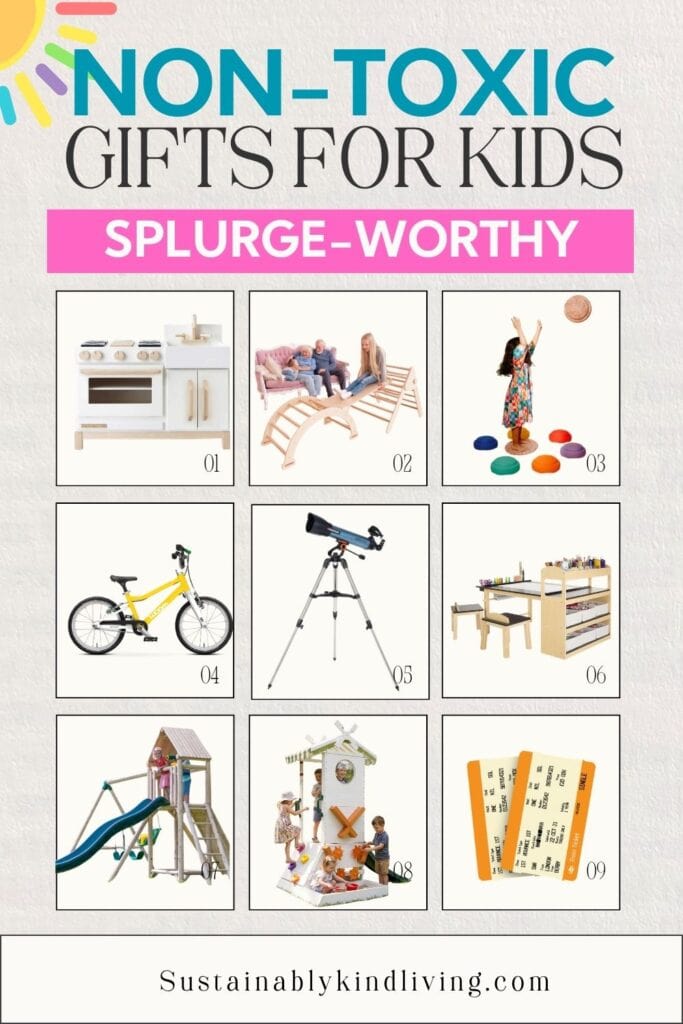
If you are looking for one big Christmas gift instead of ten smaller ones, this is where I would spend the money. These are the gifts that can completely change a playroom, backyard, or hobby and still be relevant long after the wrapping paper is gone.
For these splurge-worthy non-toxic and sustainable gifts for kids, I looked for better materials, serious durability, and enough play value to justify the price. I also wanted this section to feel genuinely exciting, not like I was calling a $100 everyday toy a “splurge.”
- Milton & Goose Wooden Play Kitchen | From $649 | Best For: Ages 2-7 | A play kitchen is one of those gifts that can become part of everyday childhood for years, especially for kids who are constantly pretending to cook, run a café, or serve dinner to their stuffed animals. Milton & Goose uses Baltic birch and solid North American maple with low-VOC, non-toxic finishes, so this is the kind of big-ticket pretend-play piece I would feel good building an entire Christmas morning around.
- Woodandhearts Montessori Climbing Set | From $218 | Best For: Ages 1-6 | For the kid who climbs absolutely everything, this gives that energy somewhere productive to go. The sets use birch plywood and solid beech and can include climbing triangles, arches, ramps, and slides that get rearranged as kids grow. I like this much more than another giant electronic toy because it actually gets their whole body involved in play.
- Stapelstein Rainbow Set | Around $299 | Best For: Ages 1-10+ | Stapelstein is one of those products that looks simple until you realize how many different ways kids use it. The pieces become stepping stones, stools, balancing challenges, obstacle courses, towers, and parts of completely unrelated games. I love that it works for toddlers but still gives older kids something physical and creative to do.
- woom Kids Bike | From about $459 | Best For: Ages 3-12+, depending on size | A really good bike is one of the most memorable big gifts you can give a kid, and woom makes bikes specifically around children’s proportions rather than simply shrinking an adult frame. I would choose the model based on the child’s height and riding level, from first pedal bikes through larger bikes for confident older riders. This is the kind of gift they can use for years of actual adventures, not just inside the house.
- Celestron Inspire 100AZ Telescope | About $380 | Best For: Ages 8+ | For the kid who asks a million questions about space, I would skip the plastic “kids telescope” and give them something they can actually grow into. The Celestron Inspire 100AZ is a real beginner telescope, so they can look at the moon, planets, and brighter deep-sky objects without immediately outgrowing the equipment. This feels like such a special Christmas gift for an older curious kid.
- Guidecraft Deluxe Art Center | About $350 | Best For: Ages 3-10+ | If art supplies are constantly taking over your kitchen table, giving a creative kid their own art station can feel enormous. The Guidecraft Deluxe Art Center gives them a proper workspace with storage, seating, shelving, and space for paper, paints, crayons, and all the projects that usually end up scattered across the house. I love this for the kid who does not just “like art” but is always making something.
- CedarWorks Outdoor Playset | From the thousands | Best For: Ages 2-12+ | This is the truly massive splurge on the list. CedarWorks makes outdoor playsets from Northern White Cedar, which is naturally resistant to rot and does not require the same chemical wood treatments used on many outdoor structures. If you have the yard, the budget, and multiple kids who will use it, this is the kind of gift that can become the center of childhood summers for years.
- Avenlur Outdoor Playhouse or Jungle Gym | From about $359 | Best For: Ages 2-8+ | I wanted one backyard option that sits between a small indoor climber and a full custom playset. Avenlur makes larger wooden playhouses and climbing structures with slides, climbing features, and imaginative-play spaces, so this can become the big shared gift for siblings without going all the way into several-thousand-dollar territory.
- Experience Gift or Family Membership (my full guide) | Price Varies | Best For: Every Age | Some kids genuinely do not need another thing in the house. A museum membership, ski pass, concert, weekend trip, riding lessons, sports tickets, art classes, or another experience built around what they already love can feel every bit as exciting as a huge toy. I especially love this for kids who already have plenty because you are giving them something to look forward to and memories they will actually keep.
✔️ Want to keep going beyond gifts? My Non-Toxic Swaps for Kids Guide walks through the everyday products I pay the most attention to for kids, from toys and clothing to lunch gear, bedding, and more.
How I Choose Non-Toxic Gifts for Kids
I look at the whole product, not just whatever material or certification gets the biggest font on the product page. A wooden toy can still have a questionable finish. A “phthalate-free” toy can still be a mystery plastic. So here’s what I actually check.
1. The Main Material Comes First
I want to know exactly what a toy is made of.
For wooden toys, I look for:
- Solid wood, or engineered wood the brand actually names
- FSC-certified wood when possible
- Water-based paints, stains, and finishes
- Disclosure about glues and adhesives
Vague “eco wood” or “natural wood” claims with nothing behind them don’t count. And FSC is great, but it only tells half the story. FSC chain of custody certification tracks responsibly sourced wood from the forest to the finished product. It says nothing about the paint or glue on that toy.
For plastic toys, I look for:
- The actual type of plastic
- BPA and phthalate information
- PVC-free options when practical
- Real safety testing from a manufacturer I can trace
U.S. law already limits eight phthalates to 0.1% in accessible parts of children’s toys and child care articles. But brands can swap in other plasticizers, and the CPSC puts the responsibility on manufacturers to make sure those alternatives are adequately tested. So “phthalate-free” is useful. It’s not the end of my research.
2. Paints, Glues, and Finishes Matter Just as Much
This is where a lot of non-toxic toy roundups stop too early. The base material can look perfect, but I also want to know:
- What paint creates the color?
- What seals the wood?
- What glue holds it together?
- Is there a waterproof or stain-resistant coating?
- What’s inside the foam or stuffing?
- Was the finished product tested, or just one component?
Federal rules cap lead at 100 ppm in accessible parts of children’s products and 90 ppm in paint and surface coatings. Those rules only help if the product was made to meet them. That’s why I steer clear of untraceable marketplace toys, old painted toys, and kids’ jewelry from sellers I can’t identify. The CDC specifically warns that some imported toys, antique toys, and toy jewelry may contain lead.
3. Anything That Goes in a Mouth Gets Extra Scrutiny
Babies and toddlers don’t politely hold their toys. They chew them, suck on them, rub them on their faces, drop them in their food, and pick them back up. The CDC notes that young children frequently put their hands and objects in their mouths, which is one reason they are particularly vulnerable to lead exposure.
So I’m pickiest about teethers, bath toys, sensory toys, crayons, finger paints, play dough, kids’ makeup and lip products, cups and bottles, and anything made for babies. For these, “non-toxic” printed on the box isn’t enough. I want ingredient or material disclosure and real testing.
4. For Art Supplies, I Want to Know What Makes the Color
Paints, crayons, dough, slime, and kids’ makeup end up directly on hands and skin. I look at pigments and dyes, fragrance, preservatives, glitter and plastic add-ins, age recommendations, and whether there’s independent testing.
I trust a brand that tells me exactly what its crayons are made of. I don’t trust one that just says “natural,” “green,” or “kid-safe.”
5. I Know What Each Certification Actually Covers
Certifications are useful, but each one measures something specific. Brands love to slap a logo on a product and let parents assume the rest.
Here’s how I read them:
| Certification | What it tells me | What it doesn’t |
|---|---|---|
| GOTS | Organic fiber content plus rules for how the textile is processed. “Organic” means at least 95% certified organic fiber. “Made with organic” means at least 70%. | That every non-textile part was tested for harmful substances |
| OEKO-TEX STANDARD 100 | Every thread, button, and accessory was tested against a list of harmful substances, with stricter limits for baby items and things worn close to the skin | That the fiber is organic or sustainably grown |
| CertiPUR-US | The polyurethane foam was made without formaldehyde, CPSC-regulated phthalates, mercury, and lead, and has low VOC emissions | Anything about the cover, liner, glue, or the rest of the product |
| GREENGUARD Gold | Low chemical emissions into indoor air, with stricter limits meant for spaces like schools and nurseries | That the product is organic, plastic-free, or sustainable |
| FSC | Responsibly sourced wood and paper, tracked through the supply chain | Anything about paint, glue, or finish safety |
GOTS and OEKO-TEX get used interchangeably all the time. They shouldn’t. One is about organic fiber and processing. The other is about testing for harmful substances. And even CertiPUR-US calls “chemical-free” claims unsupportable. If a certification body won’t make that claim, a brand shouldn’t either.
6. Age Ranges Aren’t Just About Fun
Age recommendations are also about safety. The CPSC bans small parts in toys for children under 3, and the federal toy safety standard, ASTM F963, is mandatory for children’s toys.
That’s why every gift in this guide has a Best For age range. It’ll point you toward something developmentally right, but always check the manufacturer’s official minimum age and warnings before you buy.
7. “Eco-Friendly” Has to Mean More Than the Packaging
The sustainability side of my vetting is practical. I ask:
- Will a child still use this next year?
- Can siblings share it or hand it down?
- Can it be repaired?
- Does it invite more than one kind of play?
- Is it replacing something the family actually needs?
- Is the brand giving me real information, or just green marketing?
A durable plastic toy that survives three kids can be a better choice than a flimsy wooden one that breaks in six months. An FSC logo, a recycled box, or a beige color palette doesn’t make something sustainable on its own.
My Final Test Is Still the Kid
After all that research, one question decides it: would a child actually want this?
I pay attention to what my own kids go back to again and again, what survives cousins and siblings, what grows with them, and what’s forgotten by February. That’s why so many favorites here are open-ended: playsilks, trains, magnetic tiles, balance toys, dolls, art supplies, and building sets. They don’t dictate one way to play. They give kids the materials and let them take it from there.
If I haven’t personally tested a product, I’ll never pretend I have. In those cases, my recommendation is based on materials, testing, certifications, construction, and brand transparency, and whether the product genuinely earns its spot.
Frequently Asked Questions On Non-Toxic Gifts For Kids
There really is not one universally “safest” toy. The right choice depends on the child’s age, how they play, the toy’s construction, small parts, materials, and condition. Even an otherwise excellent toy can be inappropriate for a younger sibling if it contains pieces they could swallow.
For younger children, chemical exposure is only one part of toy safety. I also check the manufacturer’s age recommendation, small parts, detachable pieces, accessible batteries or magnets, sharp edges, and how sturdy the toy is.
No. Wood can be a great material, but I still check the paint, stain, sealant, glue, and whether the toy is made from solid or engineered wood. A well-made plastic toy from a transparent manufacturer can be a better choice than a poorly made wooden toy with mystery finishes.
No. I would not panic and throw out every plastic toy in the house. I pay more attention to what type of plastic it is, whether the brand identifies the material, whether the toy is damaged, and how my child uses it. I am particularly cautious with poorly disclosed soft vinyl/PVC products.
It means the product is being marketed as not containing bisphenol A, but BPA-free does not mean plastic-free or automatically non-toxic. It also does not tell you whether the product contains PVC, phthalates, other bisphenols, or alternative plasticizers. I look at the complete material disclosure rather than treating BPA-free as a blanket safety claim.
No. “Montessori” tells me very little about the actual material or finish. It has also become a huge marketing term. I still want to know what the toy is made from, what paint or finish was used, whether there are small parts, and who manufactured it.
I look for clear ingredient information and recognized safety labeling rather than relying only on a big “non-toxic” claim on the front. For art supplies sold in the U.S., the ACMI AP seal is one useful certification to look for because it identifies art materials evaluated for acute and chronic health hazards.
The magnets need to stay securely enclosed inside the toy. High-powered magnets can cause severe internal injuries if more than one is swallowed, so this is one category where I pay close attention to age guidance, construction quality, and damaged pieces.
It depends. I care less about whether a brand uses the word “recycled” and more about whether it identifies the plastic, controls its manufacturing process, complies with children’s product standards, and discloses relevant testing. “Made from recycled plastic” is a sustainability claim, not automatically a chemical-safety claim.
They absolutely can be, and secondhand is often one of the most sustainable ways to gift. I am more cautious with very old painted toys, damaged plastic, recalled toys, toys with deteriorating surfaces, and older products where I cannot identify the manufacturer or materials.
Definitely not. Price is not a safety certification. Some of the gifts my kids have used the longest are incredibly simple. I would rather see clear material disclosure, appropriate safety testing, sturdy construction, and real play value than a premium price tag and beautiful branding.
This is where I usually stop looking for another toy. I would choose something they will use up, wear, experience, or use for years instead: art supplies, organic pajamas, a bike, outdoor gear, a museum membership, lessons, tickets, or another experience based on what they genuinely love.
Final Thoughts on Choosing Non-Toxic Gifts for Kids
The longer I shop for kids, the less interested I am in finding the toy with the biggest reaction for five minutes.
I would rather give something that becomes part of their childhood.
The playsilk that turns into a cape for three years. The bike they finally learn to ride without help. The stuffed animal that goes to bed, the park, and tea parties. The art supplies that actually get used up. The train set that keeps getting rebuilt differently as they grow.
That is what makes a gift feel worth bringing into our home.
And I think that is where non-toxic gifts for kids and sustainable gifts for kids really overlap. Better materials matter, but so does choosing things children form a relationship with, use hard, and keep using.
If one of these gifts ends up becoming that toy in your house, the one you still remember years later because your child dragged it everywhere, I’d say it was a pretty good choice.
I’d love to hear what your kids are actually loving right now. If you’ve found a non-toxic, eco-friendly, or sustainable gift that has become a real favori
Sources
- Centers for Disease Control and Prevention. Lead Hazards in Toys.
- CertiPUR-US. The Truth About Chemical-Free Mattress Claims.
- Forest Stewardship Council. Chain of Custody Certification.
- Global Organic Textile Standard. Label Grades.
- OEKO-TEX. OEKO-TEX STANDARD 100.
- UL Solutions. UL GREENGUARD Certification.
- U.S. Consumer Product Safety Commission. Phthalates Business Guidance.
- U.S. Consumer Product Safety Commission. Phthalates FAQ.
- U.S. Consumer Product Safety Commission. Total Lead Content FAQ.
- U.S. Consumer Product Safety Commission. Lead in Paint FAQ.
- U.S. Consumer Product Safety Commission. Small Parts FAQ.
- U.S. Consumer Product Safety Commission. Toy Safety Business Guidance.

Steal My Non-Toxic Cleaning Checklist!
Believe us, it’s the BEST…. and it’s free. Does it really get any better than that?! Sign up for our newsletter and get this free checklist to clean your home without any harmful chemicals!