 Shop My Favorite Non-Toxic Gifts Of 2026!
SKL is reader supported. When you buy through links on our site, we may earn affiliate commission. Learn more here.
A non-toxic Christmas does not mean tossing everything you own and rebuying your entire holiday in beige wool felt. It means getting more intentional about what you bring into your home, what you keep using, and what is actually worth replacing.
I have spent more than a decade researching safer products and materials for my own home and family, and Christmas is one of the easiest times of year to get swept up in buying more than we need. Artificial trees, string lights, ornaments, candles, wrapping paper, cards, garlands, and all the festive extras can add up quickly.
So before I recommend anything, I look at Christmas products the same way I look at everything else we use at home: What is this made from? What is it treated with? Is the brand actually transparent about that? Will we use it for years? And do we need to buy it at all?
That is the standard behind this guide. I am not interested in replacing perfectly good decorations just because a newer version is marketed as “clean,” “natural,” or “eco-friendly.”
I am interested in understanding the materials, questioning vague marketing claims, and making better choices when something genuinely needs replacing.
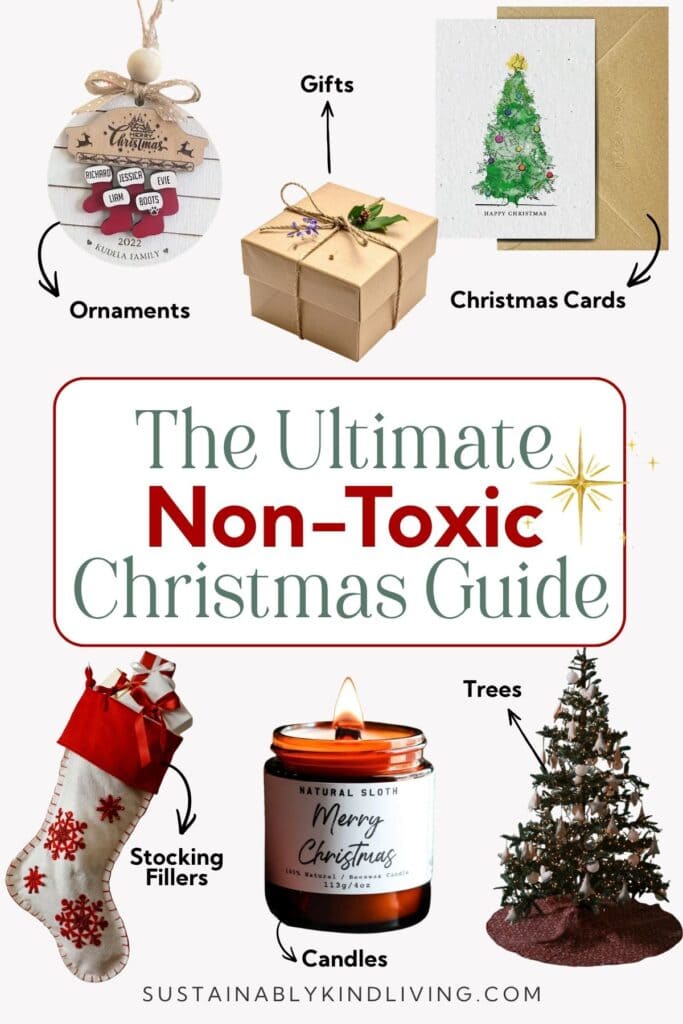
This is how I approach a non-toxic Christmas in my own home year after year, and it is the same lens I use throughout this guide. That’s what this guide walks through: trees, lights, decorations, candles, cards, wrapping, and gifts.
A Non-Toxic Christmas In 7 Steps…
You don’t need to overhaul your whole holiday in one December. If I were starting from scratch, this is where I’d put my energy first:
- If you’re buying a new artificial tree, look past how real it looks. I want to know what the branches are made from, how much PVC is in it, and whether the manufacturer will actually tell me about flame-retardant treatments.
- Pay attention to the light cord, not just the bulb. LEDs save electricity. That has nothing to do with what’s in the plastic insulation wrapped around the wire.
- Use the decorations you already own, and pick materials you can name when you do buy new ones. Wood, wool, paper, glass, ceramic, cotton, and natural greenery are things I can actually evaluate. A mystery plastic ornament covered in glitter and coating is not.
- Go easy on artificial holiday fragrance. Candles, sprays, plug-ins, wax melts, and scented pinecones all add to your indoor air during the exact season your windows are shut.
- Keep cards and wrap simple. Reused materials, recycled paper, fabric wrap, and anything without glitter or plastic lamination are easier to recycle, reuse, or compost.
- Buy fewer gifts, and mean them. I’d rather give one thing someone actually wants than five cheap “eco” fillers headed for a donation bin by February.
- Save the fussing for what’s actually touching food. Use the dishes you already own for everything else, but reach for glass, stainless steel, or ceramic over a festive plastic bowl when something is hot.
That’s the whole philosophy: keep what works, cut what you don’t need, and get pickier about what comes into the house next.
What a “Non-Toxic Christmas” Actually Means
I use the phrase non-toxic Christmas because it’s how people search for this, but it deserves an explanation. There’s no clean line sorting every Christmas product into toxic and non-toxic.
Materials matter, dose matters, and how something is actually used matters, and brands don’t always give us enough information to work with.
The FTC’s Green Guides set a real bar for the word “non-toxic”: a marketer making that claim needs competent and reliable scientific evidence that the product is safe for both people and the environment.
Most Christmas products making this claim don’t come close to that, and the FTC itself has never defined a testing standard brands have to hit, which is exactly why the word gets printed on so much.
That’s a much higher bar than slapping the word on a product page, which is why you’ll see me use language like lower-tox, safer material choice, or one of the better options I found, instead of handing something a health halo it hasn’t earned.
Non-Toxic and Sustainable Aren’t the Same Thing
These two get bundled together constantly, but they’re answering different questions.
Non-Toxic is about the material itself: what it’s made from, whether it contains flame retardants, what kind of plastic it is, whether fragrance ingredients are disclosed.
Sustainability is about its footprint: how long it lasts, whether it’s made from recycled content, whether it can be reused, repaired, recycled, or composted.
Sometimes one product checks both boxes. Sometimes it doesn’t.
A real Christmas tree skips the PVC used in a lot of artificial trees, but where it was grown, pesticide use, mold, and what happens to it after December 26th all matter too. I don’t want to trade one oversimplified rule (fake tree bad, real tree good) for another one.
“Natural” Doesn’t Automatically Mean Safer
A natural wreath is a simple, easy decoration to evaluate. A “natural fragrance” claim tells me almost nothing, because fragrance formulas are proprietary and rarely disclosed down to the ingredient.
An ornament made from wood can still be finished with paints, adhesives, or coatings that never make it onto the label. Natural is a description. It’s not a safety certification, and I want the actual materials.
Why “Eco-Friendly” Doesn’t Tell Me Enough
You’ll still see eco-friendly and sustainable Christmas throughout this guide, because environmental impact genuinely matters to me. But I don’t treat “eco-friendly” as proof something is healthier or chemically safer, because it isn’t one.
The FTC specifically warns businesses against broad, unqualified claims like “green” or “eco-friendly” because consumer research shows those terms imply far-reaching environmental benefits that are almost impossible to substantiate.
A specific claim, like the actual percentage of recycled content, tells you something. A vague one doesn’t.
So instead of “eco-friendly ornament,” I want: made from FSC-certified wood, finished with water-based paint. Instead of “sustainable Christmas card,” I want: printed on 100% post-consumer recycled paper, no glitter or plastic lamination. Instead of “non-toxic artificial tree,” I want to know the branches are polyethylene, and whether PVC or added flame retardants are in the build.
Specifics beat marketing language every time.
My Non-Toxic Christmas Shopping Cheat Sheet
| Christmas Item | I Look For | I think twice about |
|---|---|---|
| Christmas Trees | PE over PVC when possible, manufacturer transparency, flame-retardant disclosure, durable construction | Unknown plastics, vague “non-toxic” claims, no information about materials |
| Christmas Lights | LED bulbs, RoHS compliance, UL or ETL certification, well-made cords | Damaged wiring, vague material claims, unexplained Prop 65 warnings |
| Ornaments & Decor | Wood, wool, paper, glass, ceramic, cotton, linen, natural greenery | PVC, soft vinyl, loose glitter, heavily fragranced decor, mystery plastics |
| Holiday Candles | Beeswax, coconut wax, disclosed fragrance ingredients, cotton or wood wicks | “Premium wax blends,” undisclosed fragrance, unnecessary dyes |
| Christmas Cards | Recycled or FSC-certified paper, simple inks, minimal packaging | Glitter, foil, plastic coatings, plastic embellishments |
| Gift Wrap | Recycled or FSC paper, reusable fabric, twine, paper tape | Plastic lamination, foil, glitter, disposable bows |
| Christmas Gifts | Quality items people will actually use, durable materials, thoughtful purchases | Impulse buys, trend-driven gifts, excessive packaging |
| Table & Entertaining | Glass, ceramic, stainless steel, reusable linens, natural centerpieces | Disposable tableware, hot food served in plastic, unknown vintage glazes |
You’ll notice a pattern. I’m not chasing products labeled non-toxic. I’m looking for brands that clearly tell me what something is made from, how it’s finished, and whether it’s built to last. Transparency beats marketing every time.
What a Non-Toxic Christmas Means to Me
When I first started learning about healthier materials, I thought a non-toxic Christmas meant finding the “right” products.
Now I think it’s much simpler than that.
A non-toxic Christmas isn’t built from perfect decorations, expensive swaps, or a house full of products labeled “eco-friendly.” It’s built from understanding what comes into your home and feeling confident enough to ignore the marketing when it doesn’t hold up.
Some years we’ll buy something new because we genuinely need it. Other years we’ll decorate with the same ornaments, ribbons, and stockings we’ve unpacked for as long as I can remember. Both can fit into a healthier Christmas.
The traditions my family talks about aren’t the things I ordered online. They’re the dried orange slices hanging on the tree, the rosemary plant we decorate every December, and the homemade decorations that somehow survive another year in the storage box.
That’s why I wrote this guide.
Not to convince you that every Christmas product is a problem, or that you need to replace everything you already own. I wanted one place where you could cut through the greenwashing, understand the materials, and make informed choices when you do decide to buy something new.
If this guide helps you choose a better Christmas tree, find a cleaner-burning candle, skip unnecessary plastic, or simply feel less overwhelmed by all the holiday marketing, then it’s done its job.
Because at the end of the day, I don’t think a non-toxic Christmas is about having the perfect home.
I think it’s about creating a holiday that feels healthy, intentional, and full of the traditions that matter most to the people living in it.
Christmas Greenwashing Is Everywhere
Christmas is an easy season to greenwash, because we want our purchases to feel good. Add kraft paper, a sprig of greenery, and the word “natural,” and almost anything can look sustainable.
The front of the package rarely tells you the real story. Here’s what I actually watch for.
“Eco-friendly.”
Eco-friendly how? Recycled material, less packaging, responsibly sourced wood, renewable energy, reusability? Or is the box sustainable while what’s inside it is regular plastic?
The FTC tells companies to qualify broad environmental claims with a specific, provable benefit rather than leaning on general “green” language. I expect the same thing as a shopper.
“Non-toxic.”
This gets the most scrutiny from me, not the least. A product doesn’t earn a pass just because the word is printed in big green letters.
What was actually tested? Was it independent testing? Does the claim cover the finished product, or one component the brand happened not to use? If a company can’t answer those questions, it doesn’t make my list.
“Natural.”
Natural wood, finished with what? Natural wax, which wax, with what added to it? Natural fragrance, made from which ingredients? The material tells me more than the adjective ever will.
“Recycled.”
I want the number. “Made with recycled materials” can mean a token amount. The FTC’s own guidance says marketers should qualify recycled content claims and specify what percentage is actually recycled when it isn’t 100%.
And recycled doesn’t automatically mean lower-tox. For some purchases I’d rather have a well-disclosed virgin material than recycled content with an unknown chemical history.
“Organic.”
This one is real when it’s tied to an actual standard and a specific material. Organic cotton certified through GOTS is specific. A Christmas collection described as “organic-inspired” is marketing with no certification behind it.
Look for what’s actually certified, who certified it, and what portion of the product that certification covers, because a brand can hold one certification and let it imply the whole product was vetted the same way.
That extra digging is annoying, I know. It’s also how we stop rewarding brands for vague green language and start rewarding the ones actually willing to tell us what’s in their products.
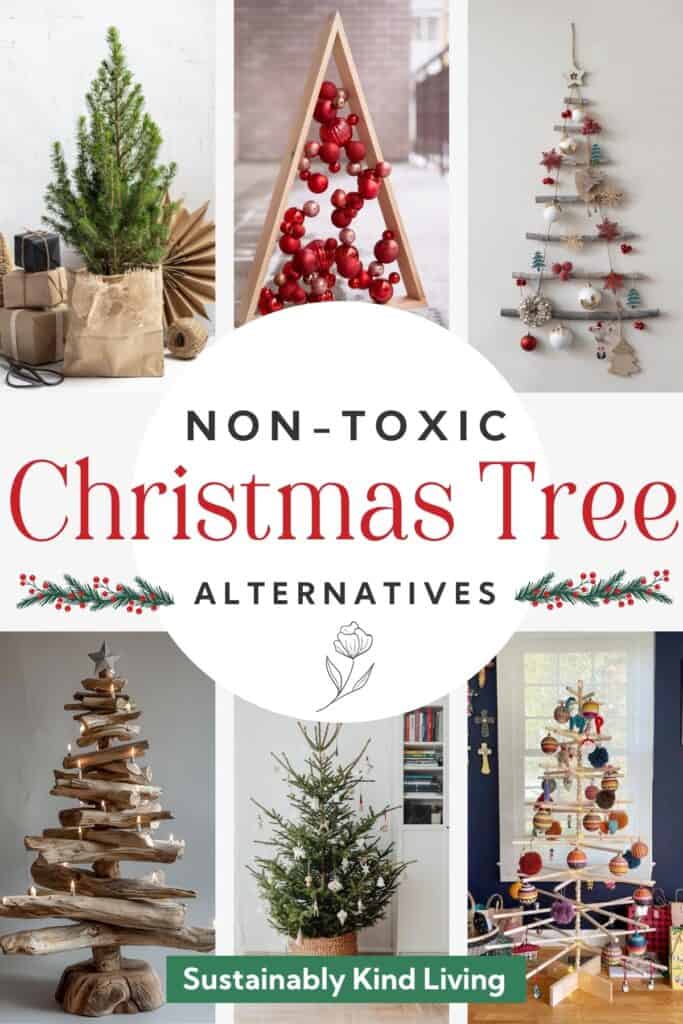
Non-Toxic Christmas Trees + Natural Tree Alternatives
Christmas trees are one of those holiday purchases where non-toxic and sustainable do not always mean the same thing.
Most artificial Christmas trees are made with PVC, PE, or a combination of plastics, while real trees come with a different set of considerations, including how they were grown, transported, and eventually disposed of.
If you already own an artificial tree you love, I would not replace it simply because you discover it contains PVC. Using what you already have is still an important part of reducing holiday waste.
But when your tree eventually needs replacing, that is a good time to be more selective.
What I Look for in an Artificial Christmas Tree
When shopping for a new artificial tree, I prefer PE-heavy or PVC-free options when possible, from brands that are actually willing to talk about materials. Specifically, I ask about:
- PVC versus PE content. PVC is made from vinyl chloride, which the EPA classifies as a known human carcinogen and is currently running through a formal risk evaluation. That hazard applies to the raw chemical, not proof that sitting next to a finished PVC tree is the same exposure, but it’s why I’d rather minimize PVC when a well-disclosed alternative exists.
- Added flame retardants. A “fire resistant” label, which the CPSC recommends looking for, tells you the tree resists ignition. It doesn’t tell you what chemical treatment, if any, got it there.
- Current heavy-metal testing. A 2004 study found measurable lead in two of eight tested PVC trees, mostly a concern in older trees handled directly by young children. The CDC has never identified a safe blood lead level for children, so I’d rather ask than assume.
- Electrical safety certification, if it’s pre-lit.
- How long the tree is realistically built to last.
I’m cautious with a bare “non-toxic Christmas tree” claim when a company can’t explain what that actually means. PE beats PVC on my list, but PE is still plastic. It’s a preference, not a certification.
Are Real Christmas Trees Better?
A real tree skips most of the plastic, but real doesn’t mean organic or chemical-free. Christmas trees are a farmed crop, and growers use pesticides depending on region and pest pressure. North Carolina’s Christmas tree industry, for one, has cut pesticide and fertilizer use significantly through integrated pest management, scouting for pests before spraying instead of spraying on a schedule. That’s worth asking your local farm about directly.
Real trees can also bring in pollen, natural plant compounds, mold, and the occasional overwintering insect, which may matter more than PVC if allergies or asthma are already a concern in your house.
There is no universally perfect Christmas tree, real or artificial, and either one is a completely reasonable choice depending on what matters most to your household.
If you want something different this year, whether that’s less plastic, less space, or just something a little more fun, here are 12 alternatives worth considering too.
7 Christmas Tree Alternatives Worth Trying
Some of my favorite Christmas trees are not technically Christmas trees, and I like them for this guide specifically because most of them sidestep the PVC, flame retardant, and lead questions above entirely.
A branch, a houseplant, or a stack of books was never going to have vinyl chloride or heavy metals in it. These aren’t just low-waste ideas. They’re a genuinely easier way to opt out of the whole materials question.
1. Potted Evergreen Christmas Tree

A small potted evergreen gives you the look and smell of a traditional tree without it automatically becoming a single-season purchase. The important part is choosing a species suited to your climate and actually caring for it so it survives past Christmas.
2. Rosemary Christmas Tree
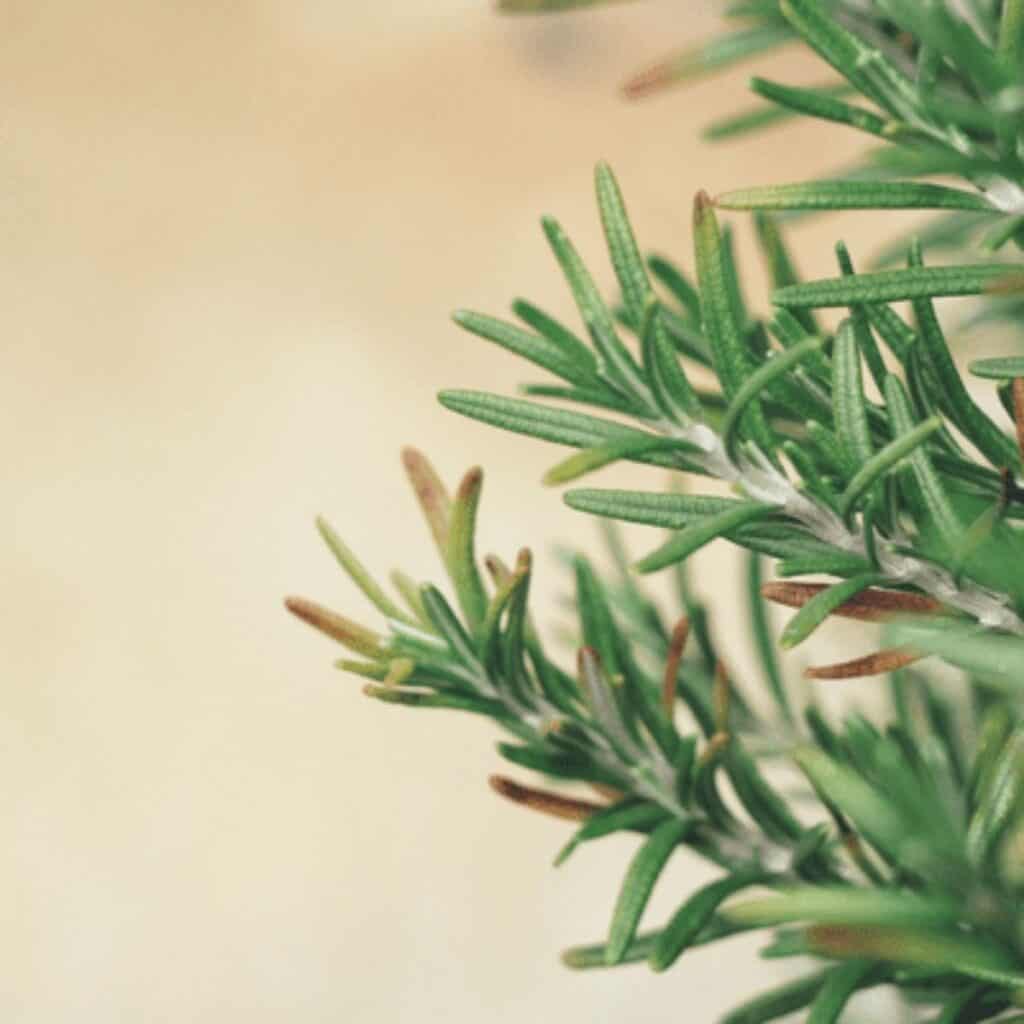
This one’s personal. I decorate our little rosemary tree on the balcony every year, and I still love it. Rosemary already has that evergreen look, smells wonderful, and can be gently shaped into a miniature tree. Once Christmas is over, it goes back to being an herb we cook with.
3. Rent a Christmas Tree

Tree rental services are becoming available in some areas (California option | Philadelphia option): you rent a living potted tree for the season and return it to the grower afterward. This is very location-dependent, so I’d look for something nearby rather than driving a long way just to rent a tree.
4. Ladder Christmas Tree
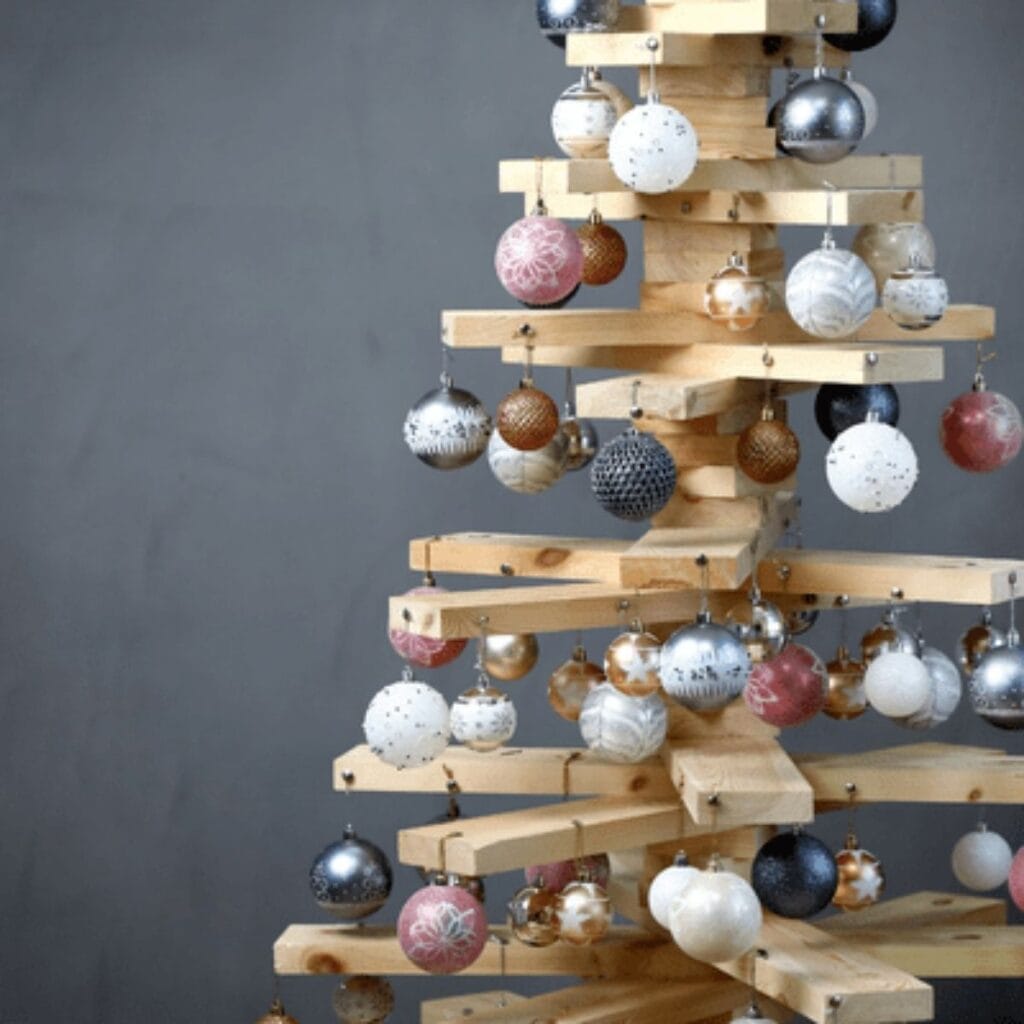
Have an old wooden ladder? Open it up and use the rungs to display greenery, ornaments, lights, or gifts. This is the kind of holiday DIY I love, because the best version uses something already sitting in your garage. One thing worth a quick check: if it’s an older painted ladder, chipping or peeling paint on anything made before 1978 can be lead-based, so give it a wipe-down or a light sand before it’s covered in decorations kids will be handling.
5. Driftwood Christmas Tree

Branches or driftwood arranged largest to smallest make a simple tree shape. Leave it natural for a minimalist look, or decorate it with the ornaments you already use every year.
6. Book Christmas Tree
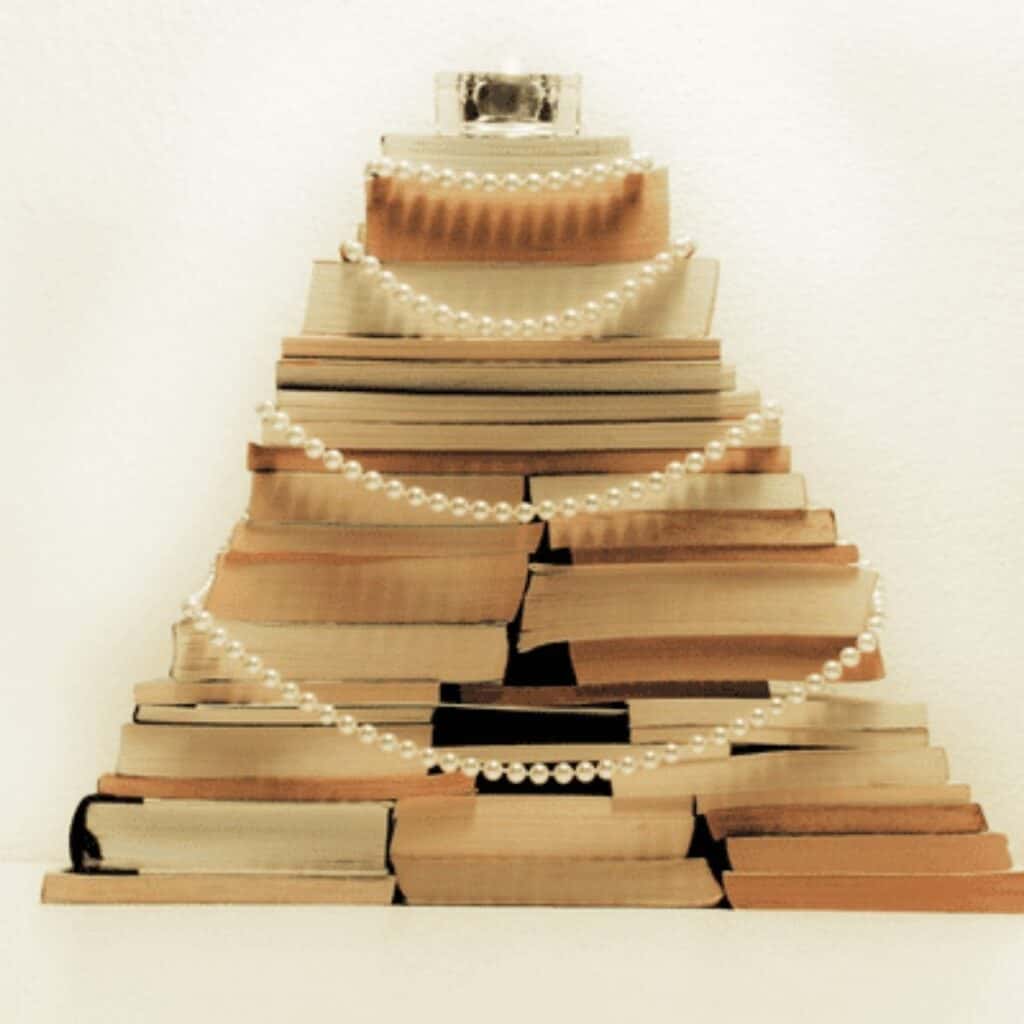
Stack books into a loose tree shape and add a few decorations around the outside. Works especially well in an office, reading nook, classroom, or small apartment.
7. Wall Art Christmas Tree
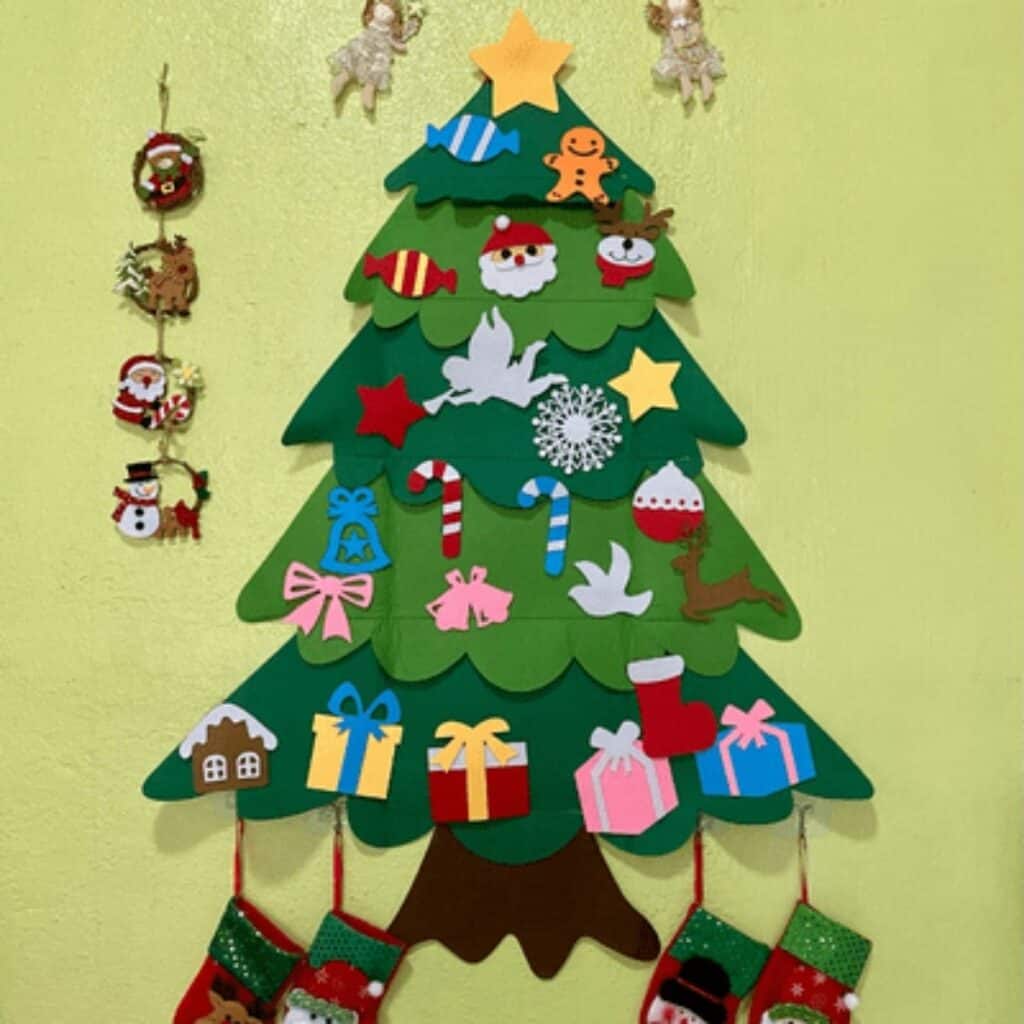
A fun one if you have kids. Use recycled cardboard, an old sheet, or kraft paper to make a tree shape for the wall. Kids can paint it, draw ornaments, or attach paper decorations from whatever’s already in the craft drawer.
Since it’s kids doing the painting and gluing, I’d apply the same standard here as anything else in the house: look for an AP-certified non-toxic label on paint and glue rather than assuming craft supplies are automatically fine. It hangs flat, which also makes it a good fit for small homes.
The Most Sustainable Christmas Tree Might Be the One You Already Have
I don’t think anyone needs to chase the perfect Christmas tree. If you already own an artificial one, use it. If you love your local tree farm tradition, ask how the trees are grown and keep doing it. If you’ve got a rosemary plant on the balcony, decorate that. And if your kids decide a pile of books covered in ornaments is obviously the best Christmas tree ever, I’m not going to argue with them.
A non-toxic Christmas isn’t about replacing everything with products carrying the right label. It’s about using what you have, understanding materials when you actually need something new, and building traditions that work for your family.
Non-Toxic Christmas Lights: What to Look for Before You Buy
Christmas lights are one of those products that can look wonderfully simple while hiding a surprisingly complicated materials list.
The first thing most of us look for is LED lighting, and I still think that makes sense. LED light strings use significantly less electricity than incandescent strings and run cooler, which also cuts down on fire risk.
But LED does not automatically mean non-toxic Christmas lights. The wire coating matters too.
Many Christmas light cords are insulated with PVC, and depending on how that PVC is formulated, it can contain plasticizers, stabilizers, pigments, and other additives. Lead and other heavy metals have also historically been a concern in electrical cord insulation, which is why I look beyond the bulb type when shopping for new lights.
Are There Lead-Free Christmas Lights?
I’d be cautious of any brand promising completely lead-free Christmas lights without testing to back it up.
A better thing to look for is RoHS compliance. RoHS, the EU’s Restriction of Hazardous Substances Directive, currently restricts ten substances in covered electrical and electronic products: lead, cadmium, mercury, hexavalent chromium, two brominated flame retardants, and four phthalates.
The important word there is restricts, not eliminates. RoHS compliance doesn’t mean a string of lights contains zero lead or zero phthalates. It means those substances have to stay under the limit the standard sets. That’s still far more useful than a vague “non-toxic” claim with nothing behind it.
What I Look for in Lower-Tox Christmas Lights
If I’m buying new lights, I look for:
- LED bulbs
- RoHS compliance
- clear material information when the brand provides it
- a recognized electrical safety certification
- cords and plugs that feel well made and are free of visible damage
I also pay attention to Prop 65 warnings when shopping in the U.S. A warning doesn’t automatically mean a product is unsafe. It means the product may expose you to a chemical on California’s Prop 65 list at a level the state requires disclosure for, and it’s worth looking into which chemical triggered it.
I also wouldn’t assume a green or clear wire is PVC-free just because it looks different from the usual white cord. If the cord material actually matters to you, check the product specs or ask the manufacturer directly.
RoHS and UL Are Not the Same Thing
RoHS is about restricting certain hazardous substances. A certification like UL is about electrical and fire safety, evaluated under a dedicated standard for seasonal lighting, UL 588, which the CPSC has specifically credited with reducing shock and fire injuries tied to wire gauge, strain relief, and overcurrent protection in holiday lighting.
Ideally I want to see attention to both. A light string can use lower levels of restricted chemicals and still be poorly built. A string can also meet every electrical safety requirement without being the lowest-tox material option out there.
Don’t Keep Damaged Christmas Lights Just to Be “Sustainable”
This is one place where use what you have has a limit.
If your old lights have frayed wires, cracked sockets, exposed wiring, loose connections, or damaged plugs, replace them. I’d much rather responsibly replace a damaged string than keep using an electrical hazard to avoid waste.
Also make sure outdoor lights are actually rated for outdoor use, avoid overloading outlets, and turn powered decorations off when you leave home or go to sleep, which the CPSC calls out as one of the more preventable causes of holiday decorating fires.
Practical Buying Checklist for Christmas Lights
When you’re comparing two sets of lights online, or standing in the holiday aisle trying to make sense of the packaging, this is the checklist I’d use:
- Choose LED lights for lower energy use and cooler operation.
- Look for RoHS compliance rather than relying on vague “lead-free” or “non-toxic” marketing.
- Check for UL, ETL, or another recognized electrical safety certification.
- Read the cord material details if the brand provides them. Don’t assume a clear or green cord is PVC-free.
- Check whether the lights are rated for indoor or outdoor use, based on where you plan to hang them.
- Look at Prop 65 warnings and find out what chemical triggered one if it’s present.
- Skip products with almost no technical information if a more transparent option exists.
- Inspect plugs, sockets, and wire thickness. Avoid anything that feels flimsy.
- Choose a set you can realistically reuse for years instead of chasing a disposable seasonal trend.
- Replace damaged cords immediately. Electrical safety matters more than squeezing one more Christmas out of a failing string.
My shortcut: if I can find LED, RoHS compliance, a recognized electrical safety certification, and decent manufacturer transparency, that’s the combination I feel best about.
So, What Are the Safest Christmas Lights?
I haven’t found a string of Christmas lights I’d confidently call 100% non-toxic, and I don’t think we need to pretend one exists.
For new lights, my preference is a well-made LED set that’s RoHS compliant and carries a recognized electrical safety certification, with as much material transparency as the manufacturer is willing to give. Then I use them for years, keep cords away from babies and toddlers who might handle or mouth them, and replace the set once the wiring starts to deteriorate.
Not perfectly toxin-free. Just a more informed choice.
Non-Toxic Christmas Decorations: Materials I Feel Better Bringing Home
When I shop for non-toxic Christmas decorations, I care much more about what something is actually made from than whether the tag says natural, eco-friendly, or sustainable.
Christmas decor is full of mystery materials: soft vinyl, plastic glitter, synthetic felt, painted ceramics, coated fabrics, artificial greenery, adhesives, finishes, and fragrance.
That does not mean your Christmas bins are suddenly toxic waste. If you already own decorations you love, keep using them. The better time to be picky is when something breaks, wears out, or you genuinely want to add something new.
Christmas Decoration Materials I Prefer
For new decorations, I tend to gravitate toward simple materials I can actually identify:
- Wood. Especially unfinished or clearly finished solid wood.
- Wool felt. A lovely alternative to polyester felt for ornaments, garlands, and small decorative figures.
- Paper and cardboard. Great for ornaments, stars, chains, Advent calendars, and decorations you can recycle or store flat.
- Glass. Beautiful and reusable for years, although obviously not my first choice around toddlers.
- Ceramic and terracotta. Durable options when the manufacturer is transparent about glazes and finishes.
- Cotton and linen. Useful for stockings, tree skirts, table linens, reusable crackers, and Advent calendars.
- Natural greenery. Evergreen branches, eucalyptus, pinecones, dried citrus, rosemary, and other natural materials can create a huge amount of Christmas atmosphere without another tub of plastic decorations.
For textiles, certifications can give us additional information. OEKO-TEX Standard 100, for example, tests every component of a finished textile item, down to the thread and buttons, against a list of over 1,000 substances, with stricter limits the more skin contact the item involves.
That does not make every OEKO-TEX product organic or sustainable, but it is far more meaningful than a vague “non-toxic fabric” claim.
Christmas Decorations I Am More Selective About
I do not have a Christmas-decoration blacklist, but there are a few things I generally buy less of.
- PVC and soft vinyl. I prefer simpler materials when I have the choice, particularly for items kids will frequently handle.
- Loose plastic glitter. It sheds everywhere, is difficult to clean up, and turns an otherwise recyclable paper decoration into something much harder to deal with at the end of its life.
- Strongly fragranced decorations. Scented pinecones, artificial wreaths, ornaments, and decorative objects do not need fragrance to look festive.
- Mystery plastics. If a company cannot tell me what an ornament is made from beyond “plastic,” I would rather choose something with better disclosure.
- Flaking or chipping painted decorations, especially older pieces that children may handle. The CPSC has recalled holiday ornaments and figurines for excessive lead in surface paint more than once, so a damaged painted decoration deserves a little more caution around young kids.
Again, context matters. An ornament that hangs high on the tree for three weeks is a very different exposure from a toy your toddler puts in their mouth every day. That is why I do not think we need to panic over every vintage Santa in Grandma’s Christmas box.
Natural Christmas Decoration Ideas You Can Make Yourself
Some of the prettiest Christmas decorations require almost no shopping at all. These are the projects I come back to because they actually feel like Christmas: dried oranges hanging in the window, greenery across the mantel, paper ornaments the kids made years ago.
1. Dried Orange + Natural Ornaments
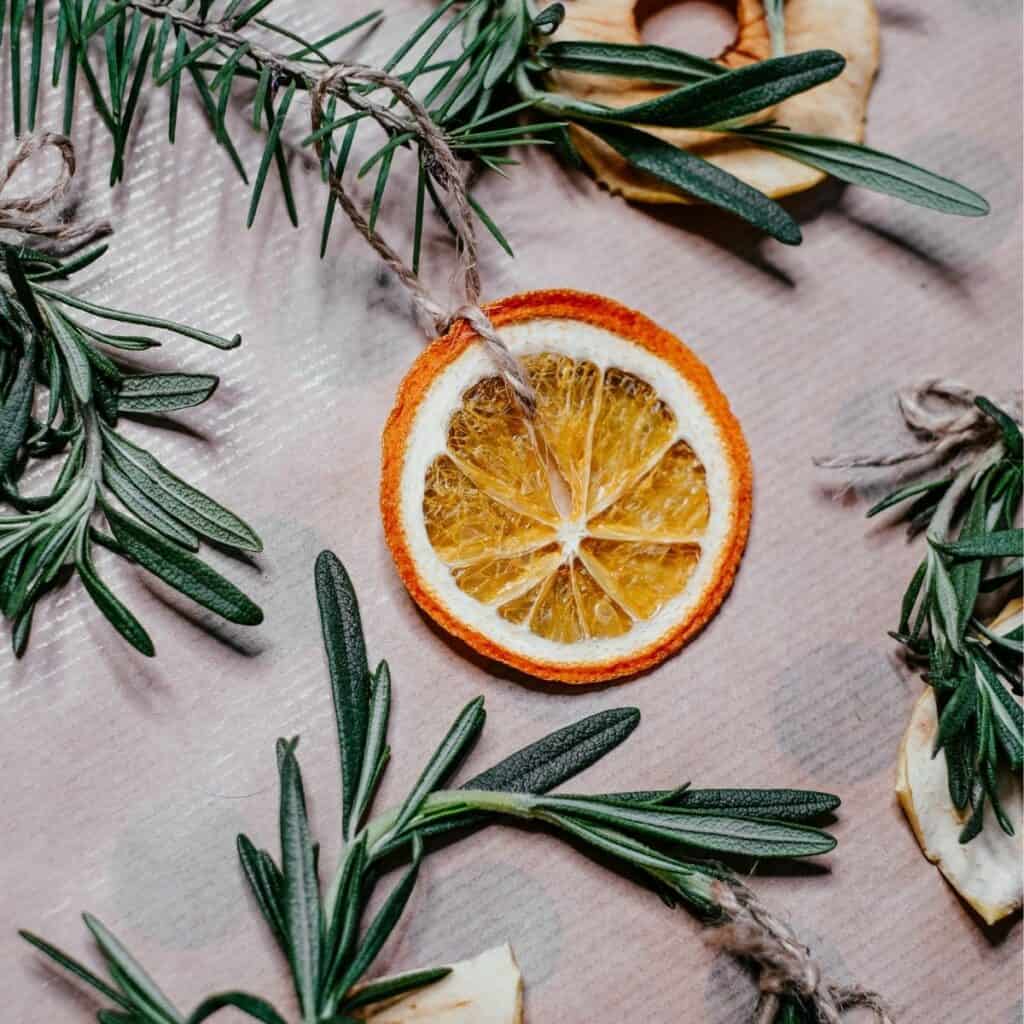
Dried orange slices are probably one of the easiest natural Christmas ornaments you can make. Add twine and hang them as-is, or combine them with cinnamon sticks, rosemary, pinecones, acorns, dried herbs, or wooden beads.
They work on the tree, tied onto gifts, or strung together into a garland. And unlike a box of glitter-covered plastic baubles, they look better when they are a little imperfect.
2. Natural Christmas Garlands

A garland does not have to be plastic greenery covered in fake snow. Try evergreen clippings, dried orange slices, cranberries, popcorn, pinecones, paper shapes, wool felt, or scraps of cotton or linen.
Drape them around the tree, across a mantel, along a staircase, or down the center of the Christmas table. If you use fresh greenery, keep it away from flames and replace it once it becomes very dry.
3. Homemade Christmas Wreaths
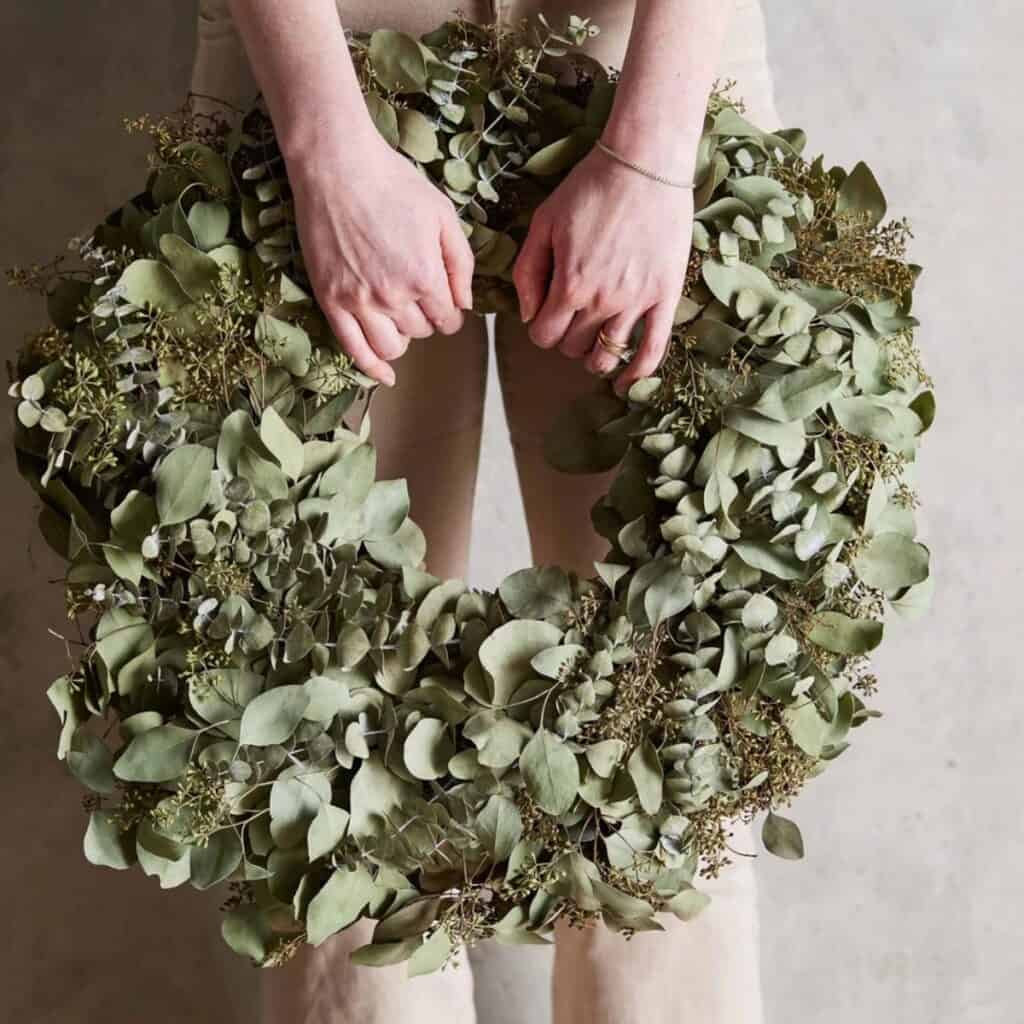
A wreath is another easy place to skip synthetic greenery. Evergreen branches, rosemary, eucalyptus, dried flowers, pinecones, berries, twigs, and dried citrus can all work beautifully.
You can also reuse the same metal or wooden wreath base each year and simply change what you attach to it, which gives you the fun of making something new without buying an entirely new wreath every December.
4. Paper Christmas Decorations
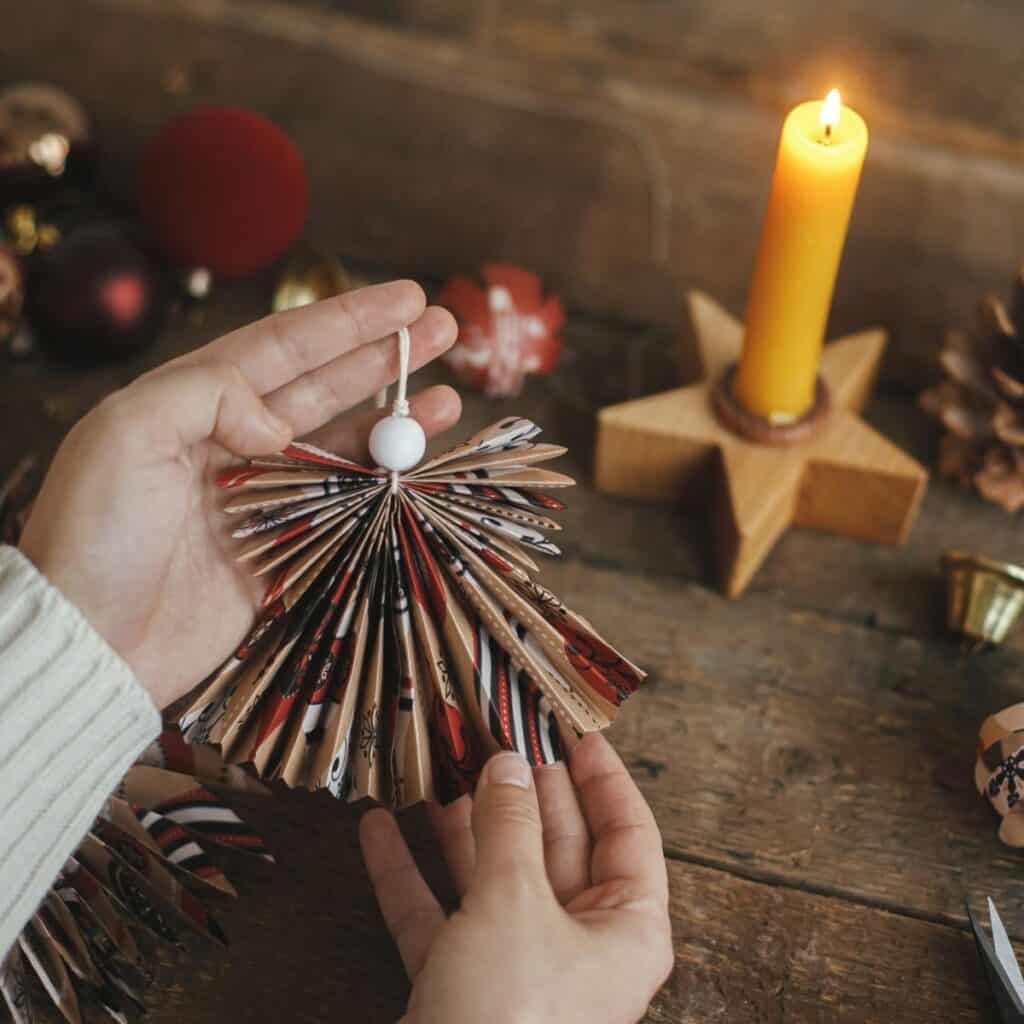
Paper decorations are especially good if you have kids who want to help. Paper stars, snowflakes, chains, folded trees, angels, honeycomb ornaments, and little houses can all be made from recycled paper, old cards, kraft paper, or whatever is already hiding in the craft drawer.
I actually prefer these to a lot of mass-produced ornaments, because the wonky ones usually end up being the decorations you remember.
5. Reusable Advent Calendars
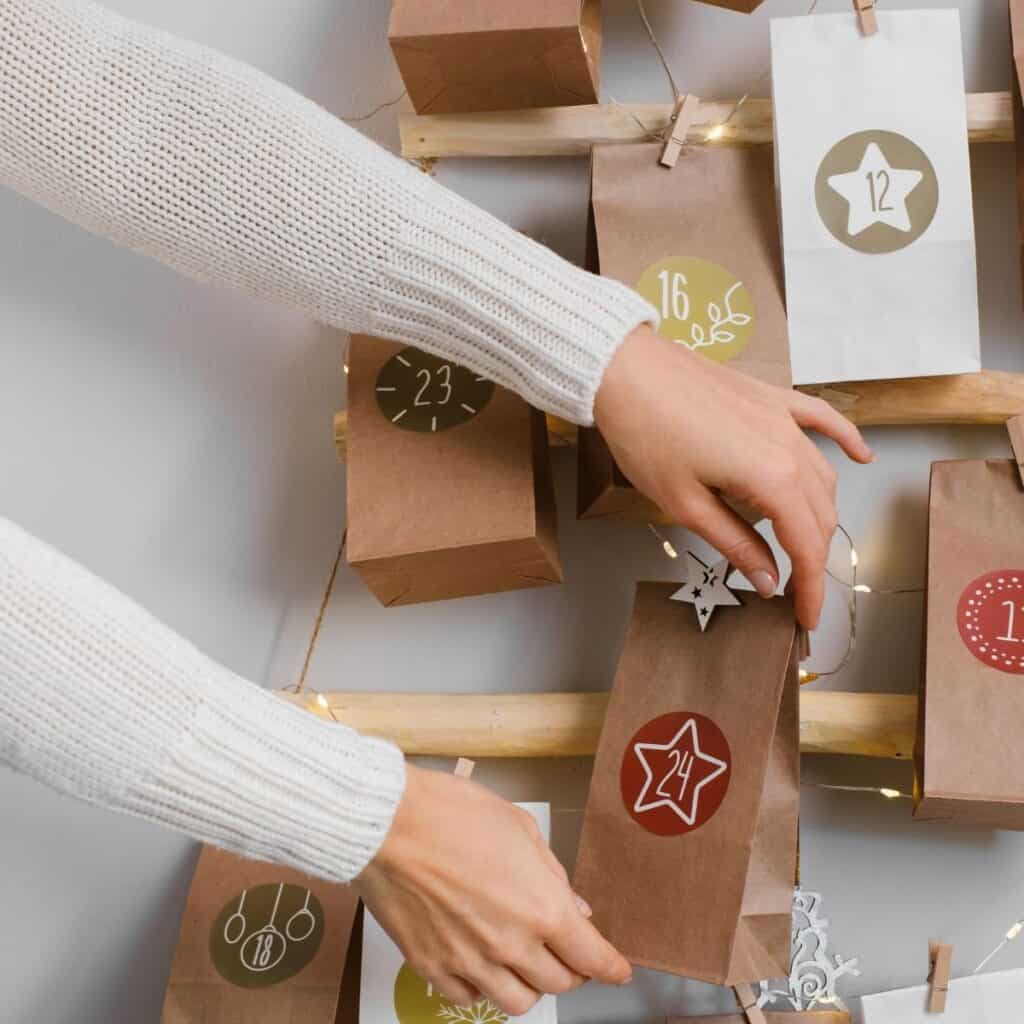
Instead of buying a disposable Advent calendar every year, use one that can come back out each December. Fabric pockets, little wooden drawers, envelopes, paper bags, or a homemade hanging calendar all work.
Fill it with chocolates, handwritten notes, tiny activities, jokes, clues, or whatever your family actually enjoys. For fabric versions, I like natural fibers such as linen or cotton, with certifications like OEKO-TEX or GOTS when available.
6. Reusable Christmas Crackers
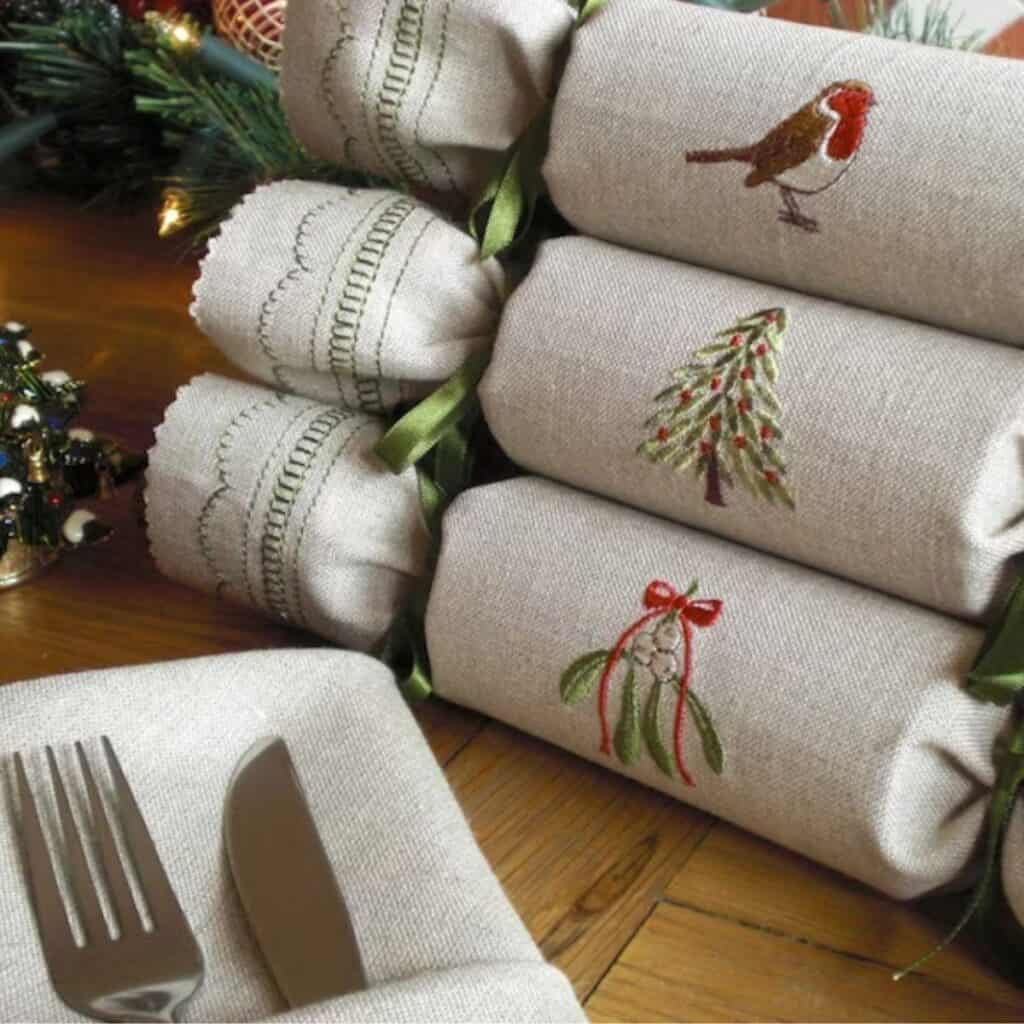
Christmas crackers are fun. The pile of glittery paper, plastic toys, ribbons, and tiny plastic hats left afterward is less charming. Reusable fabric crackers are an easy alternative, or you can make simple paper versions from materials already at home.
Fill them with something people will actually use: chocolates, jokes, handwritten notes, coins, small gifts, or clues for a family game. You can also use them as place cards at the Christmas table.
7. Natural Christmas Table Decorations
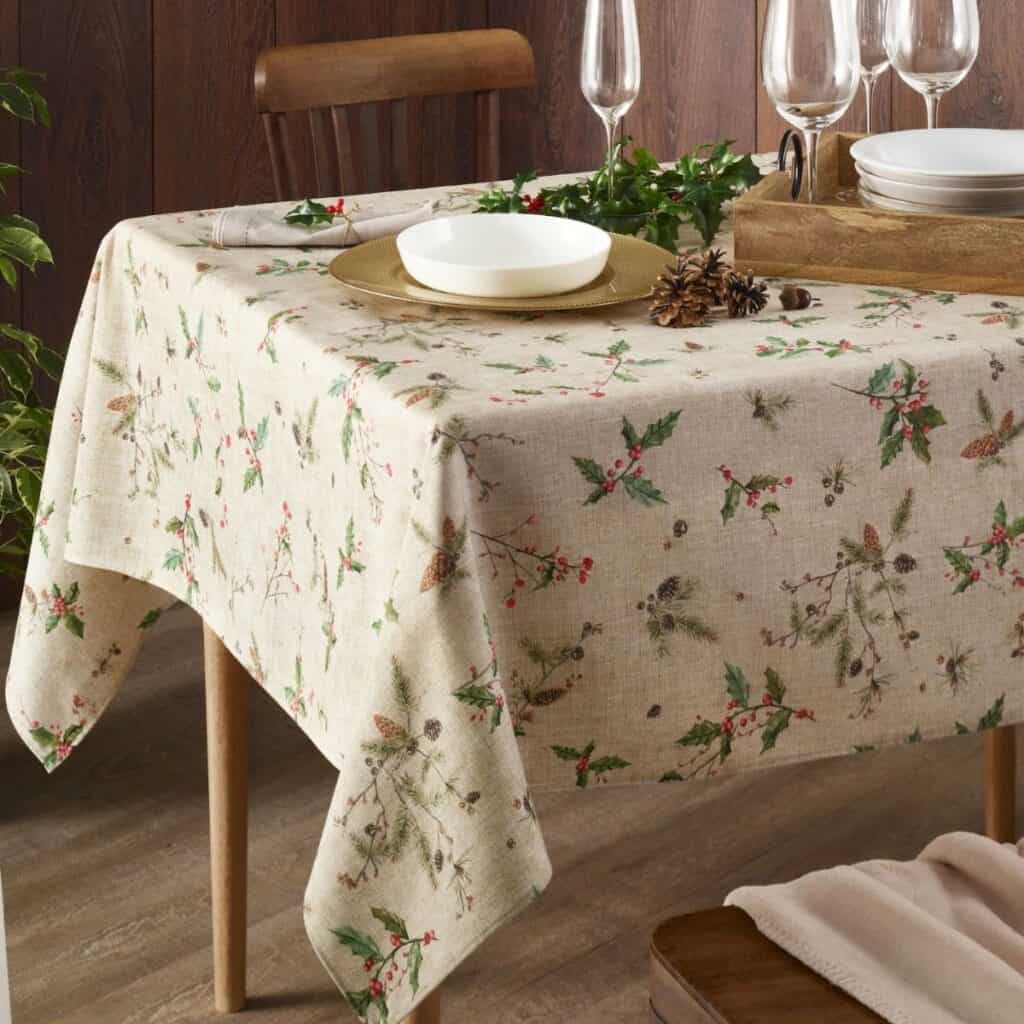
You do not need another box of decor just for Christmas dinner. A few evergreen branches, dried oranges, pinecones, rosemary, pomegranates, nuts in their shells, beeswax candles, or seasonal flowers can make a table feel incredibly festive.
Use your normal dishes, glasses, serving bowls, and cloth napkins rather than buying a Christmas-specific disposable set. The food is going to cover most of the table anyway.
8. Decorations Made From Things You Already Have
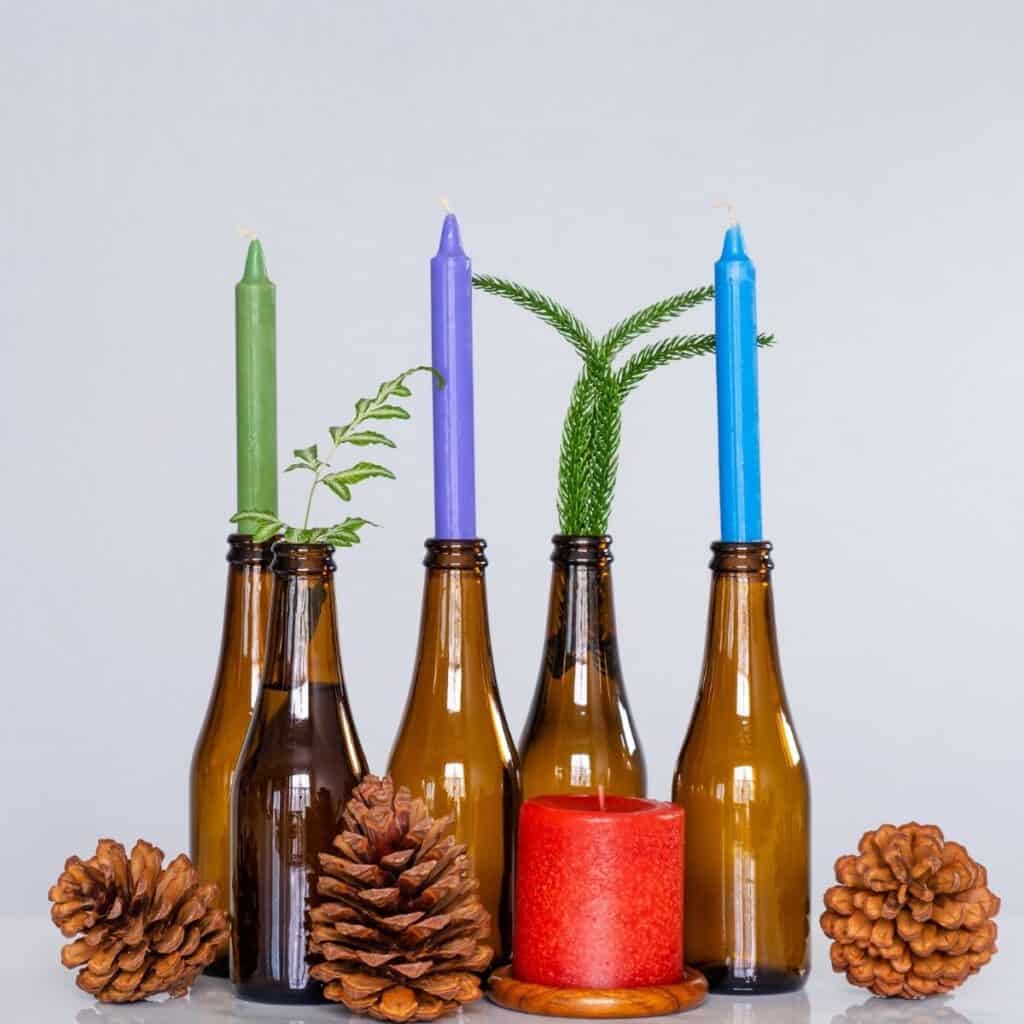
This may be the most sustainable category of all. Old ribbon. Fabric scraps. Wine corks. Glass jars. Last year’s Christmas cards. Children’s artwork. A basket filled with pinecones. A bowl of oranges and greenery.
Christmas decorating gets much easier once you stop assuming everything festive has to come from the Christmas aisle.
What I Look for When Buying New Christmas Decorations
Sometimes DIY is lovely. Sometimes I just want to buy the ornament. When I do, this is my quick checklist:
- Can I clearly identify the main materials?
- Is it mostly wood, wool, glass, ceramic, paper, cotton, linen, or another material I am comfortable with?
- Are paints, glazes, finishes, or coatings disclosed when they matter?
- Does it contain loose glitter or unnecessary plastic embellishments?
- Is it fragranced for no real reason?
- For textiles, is there GOTS, OEKO-TEX, or another meaningful certification?
- Does the product look durable enough to come out every Christmas for years?
- Would I still want this five Christmases from now?
That last question eliminates an impressive amount of holiday shopping.
A Note on “Natural” Christmas Decor
I also do not automatically give something a pass because it is made from a natural material.
A wooden ornament may still use paint, stain, glue, varnish, or an acrylic topcoat. A ceramic decoration still has a glaze. A cotton stocking may contain polyester batting, synthetic embroidery, or stain-resistant treatments.
That does not necessarily make any of those products a bad choice. It just means the whole product matters, not the prettiest material mentioned in the product title.
If I can choose between a brand that tells me exactly what something contains and one that simply calls its collection “eco-conscious,” transparency wins every time.
And once the house is decorated, there is another Christmas tradition that deserves the same closer look: what we use to make it smell festive.
The Best Non-Toxic Christmas Candles for a Cozy Holiday Home
Christmas is probably the season when I burn candles most often, so this is one area where I have become much pickier.
A candle can look incredibly simple while actually being a combination of wax, fragrance, dyes, wick materials, and other additives. And because we’re intentionally burning it inside the house, I want to know what those ingredients are.
That does not mean a candle needs to be completely unscented to make it into our home.
I still love pine, orange, cinnamon, clove, peppermint, and all the scents that make December feel like December. I just prefer getting there with brands that are transparent about what is creating that scent.
What I Look for in a Christmas Candle
For candles I burn at home, I generally look for:
- beeswax, coconut wax, or another clearly disclosed wax
- essential oils or a clearly disclosed fragrance system
- cotton, hemp, or untreated wooden wicks
- no unnecessary dyes
- a short, understandable ingredient list
- third-party screening or certification when available
What makes me pause is language like “premium wax blend,” “clean fragrance,” or “natural fragrance” without much explanation behind it. “Soy candle” does not tell me whether paraffin is also in the blend. “Essential-oil infused” does not tell me whether synthetic fragrance is also present. As usual, the details matter more than the marketing.
I tested more than 15 candles for my complete non-toxic candle guide, looking at wax, fragrance, wicks, certifications, soot, scent throw, ingredient transparency, and how they actually performed in our home.
A Few Non-Toxic Christmas Candles I Like
1. Fontana
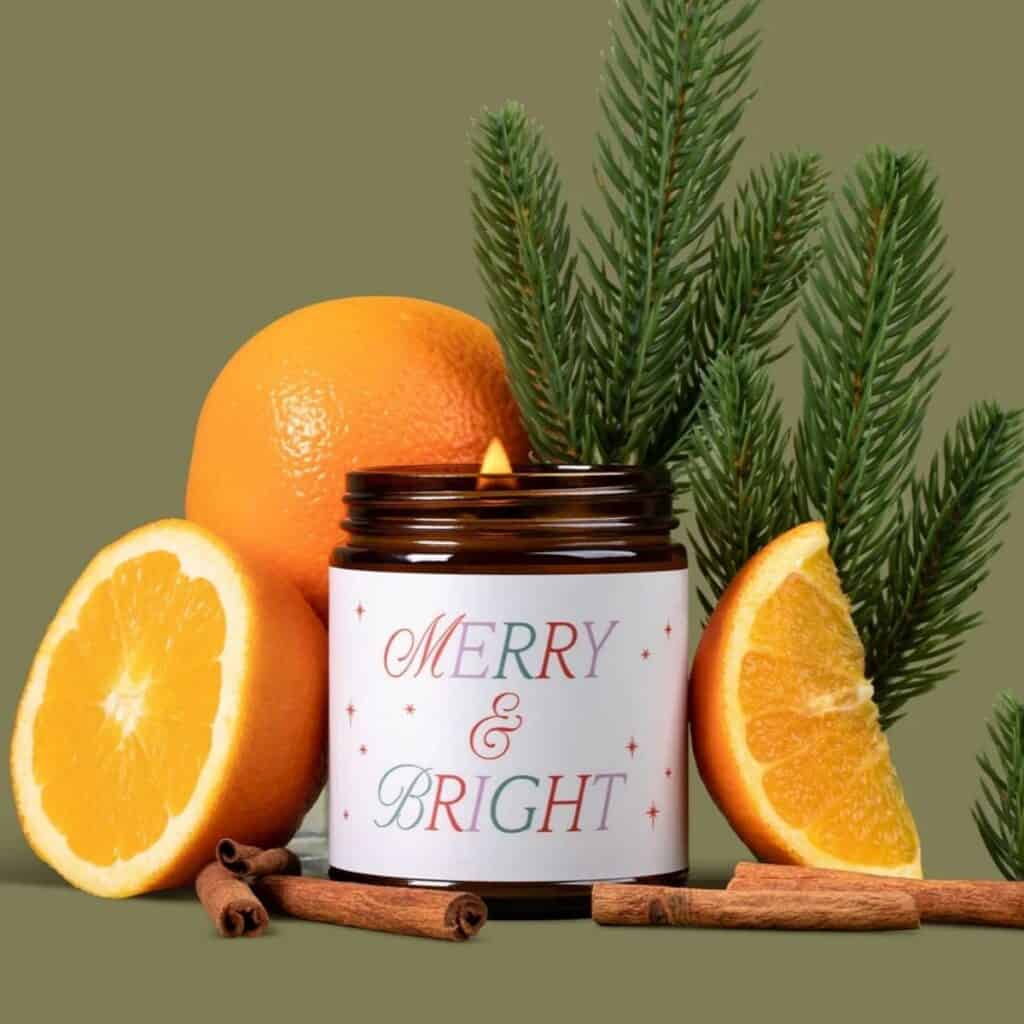
Their beeswax and coconut oil candles come in genuinely traditional holiday profiles: pine and orange, and warm spice blends like cinnamon, clove, and orange. Good pick if you want the shortest, simplest ingredient list.
2. Primally Pure
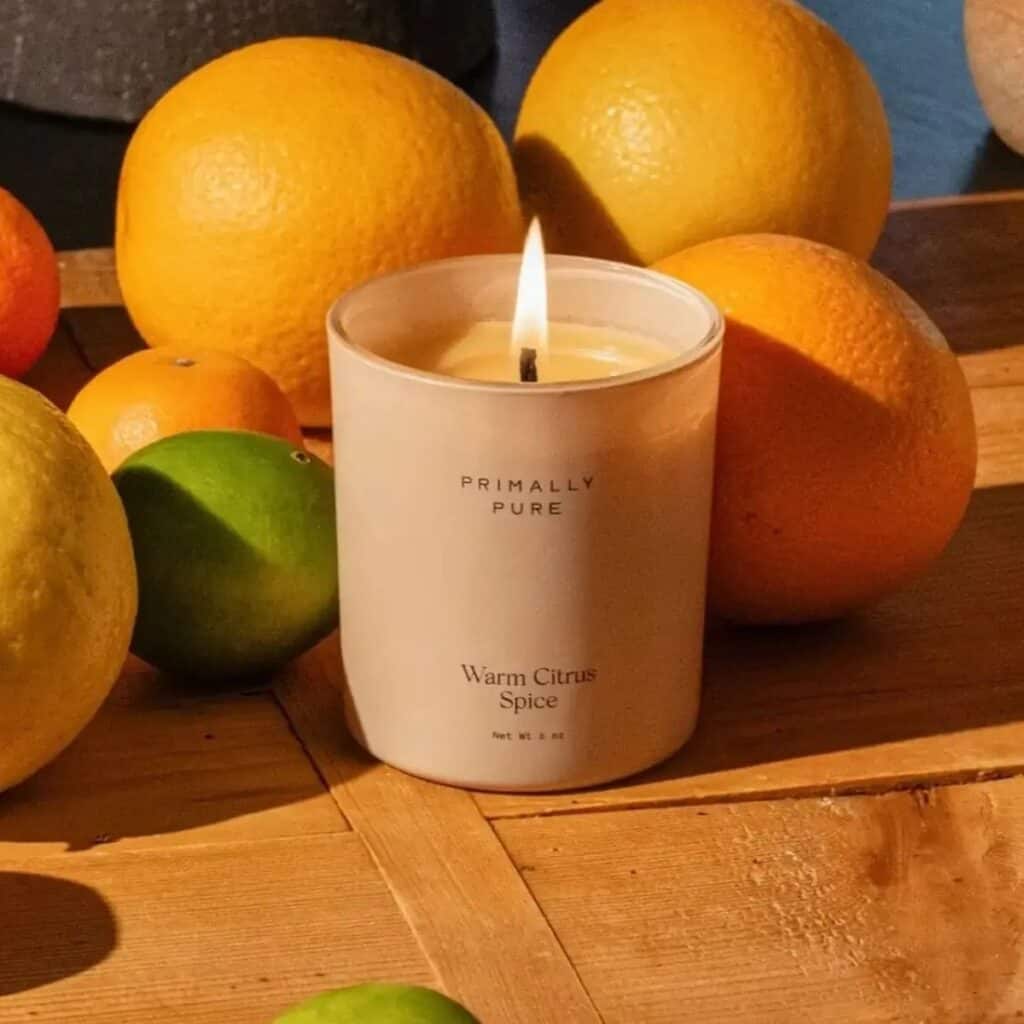
Their citrus-and-spice holiday scents lean richer, built around beeswax, coconut oil, and essential oils like cardamom, cinnamon, and cacao. This is the one I’d reach for on Christmas dinner or a gifting occasion.
3. Meaningful Mantras
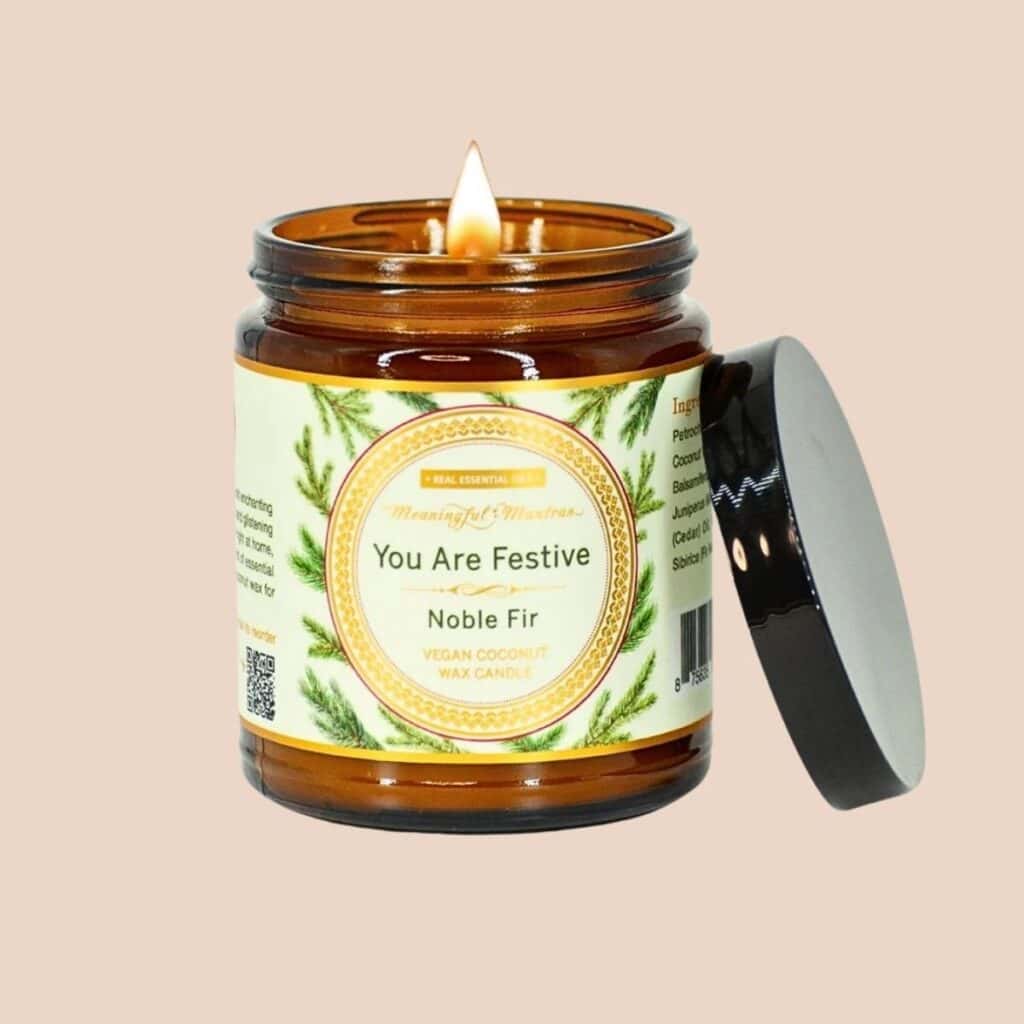
Their seasonal lineup covers a wide range: fir, classic orange-cinnamon-clove, gingerbread, peppermint, and eggnog, all in a coconut wax base with essential oils or plant extracts.
4. Grow Fragrance
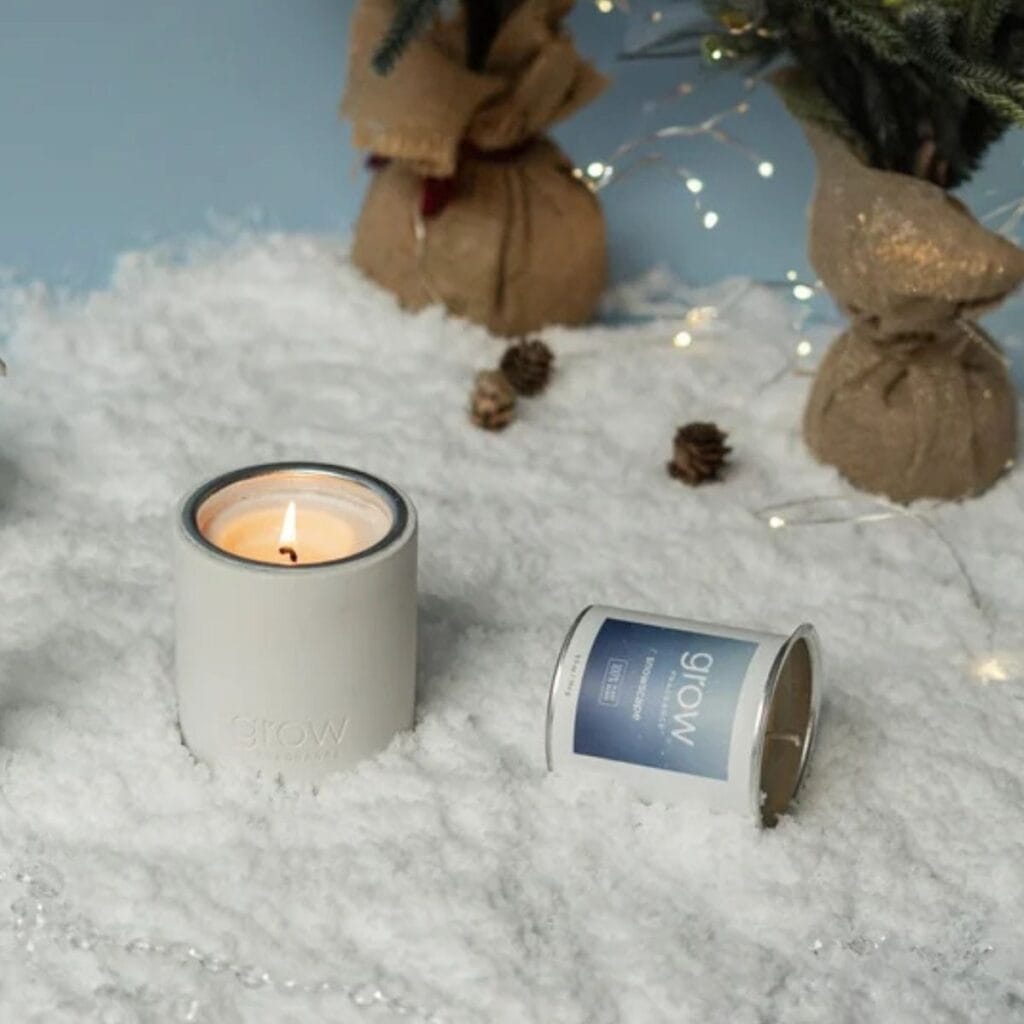
If you want a stronger scent throw than essential-oil-only candles typically give you, Grow’s holiday scents (pine, spice, and peppermint options) use a fully disclosed plant-based fragrance system instead of essential oils alone.
For the full breakdown of the candle brands I recommend, plus the popular ones that did not meet my standards, see the SKL Non-Toxic Candle Guide.
Remember: A Cleaner Candle Is Still a Burning Candle
I do not think any burning candle should be marketed as completely emission-free.
Combustion creates particles, whether the candle is made from paraffin, beeswax, coconut wax, or something else, and the EPA lists candle burning among the recognized sources of indoor particulate matter, the same category as cooking and fireplaces.
So alongside choosing a more transparent candle, I also:
- trim the wick
- avoid letting the flame get excessively large or smoky
- stop using candles that are producing visible soot
- give the room some ventilation
- never leave candles burning unattended
A better ingredient list matters, but how we burn the candle matters too.
Natural Ways to Make Your Home Smell Like Christmas
And honestly, some of the best Christmas scents do not come from candles at all.
Simmer Oranges + Spices
A simple pot of water with orange peels, cinnamon sticks, cloves, rosemary, cranberries, apple slices, or star anise can make the whole kitchen smell like Christmas. Just keep an eye on the water level and never leave a simmer pot unattended.
Bring in Fresh Greenery
Evergreen branches, rosemary, cedar, and other fresh greenery add a subtle natural scent while doubling as decoration. This is one reason I love decorating our little rosemary tree every year.
Use Dried Citrus + Cinnamon
The dried oranges from the decor section can do double duty. Pair them with cinnamon sticks, greenery, or cloves and use them in garlands, wreaths, ornaments, and gift wrapping. They are not going to fragrance the entire house like a synthetic plug-in, and that is completely fine.
Be Thoughtful With Essential Oils
I do not automatically consider essential oils harmless simply because they are natural. They are highly concentrated plant compounds, and the ASPCA notes they can be a genuine danger for pets, cats and birds especially, along with sensitive people in the house.
If you use an essential-oil diffuser during the holidays, use a small amount, follow the safety guidance for the specific oil, and make sure it is appropriate for everyone sharing the space.
Sometimes the simplest option really is enough: greenery on the mantel, oranges drying in the oven, something good cooking, and one candle burning on the table. Christmas does not need to smell like the fragrance aisle to feel like Christmas.
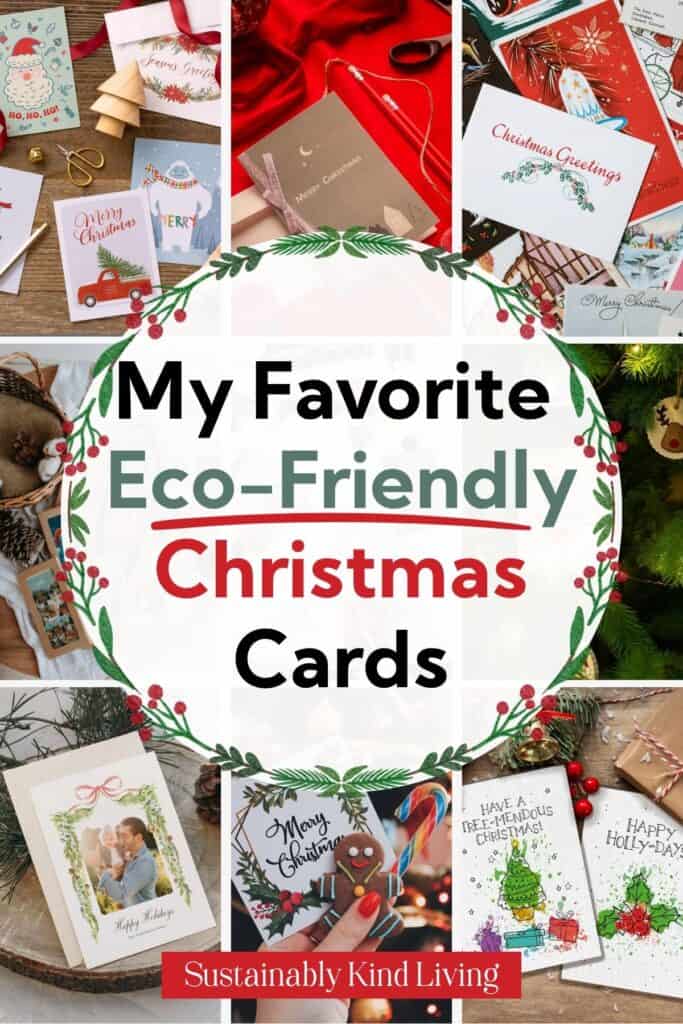
Eco-Friendly Christmas Cards: Recycled, Plantable + Lower-Waste Options
Christmas cards are one area where I care more about paper sourcing, unnecessary plastic, and what happens after the holidays than trying to force everything under a “non-toxic” label.
A plain paper card sitting on the mantel is not one of my biggest exposure concerns. What I do question are cards covered in plastic glitter, laminated coatings, foil, plastic gems, and other embellishments that make a simple piece of paper much harder to reuse or recycle.
So here, I keep things simple.
What I Look for in a Better Christmas Card
When I am buying new cards, I usually look for:
- 100% post-consumer recycled paper
- FSC-certified paper when recycled paper is not available
- simple printing without unnecessary coatings
- no loose plastic glitter
- little or no plastic packaging
- recycled-paper envelopes
- clear information about inks when the brand provides it
Recycled and FSC-certified do not mean the same thing, and it’s worth keeping that distinction straight.
Post-consumer recycled paper gives existing paper another life.
FSC certification tells us the virgin wood fiber comes through a more responsibly managed forest supply chain. Both can be useful.
What I do not love is a card described simply as “made with recycled materials” without telling me how much.
Glitter, Foil + Plastic Embellishments
The easiest Christmas-card improvement may be the least exciting one: skip all the stuff glued on top.
Plastic glitter sheds. Plastic gems and bows add more mixed materials. Heavy laminates and metallic finishes can make recycling less straightforward.
If a card is basically paper and ink, I know what I am dealing with. If it lights up, sings, sparkles, has a plastic window, and looks like someone emptied the craft drawer over it, I am not putting it straight into paper recycling.
That does not mean every tiny metallic detail makes a card automatically unrecyclable, since local recycling rules and card construction vary, but simple materials make the end-of-life decision much easier.
What About Plantable Christmas Cards?
Seed-paper cards are one of the more creative options out there, and I think they belong in this guide.
The paper contains seeds that can be planted after Christmas rather than tossed away. I like the concept, with one caveat: the seed mix needs to make sense where the card is actually being planted.
A plantable card is not automatically sustainable just because it contains seeds. If I am mailing one across the country or internationally, I want to know what those seeds are and whether the brand gives clear planting and shipping guidance.
And realistically, choose this option for someone who will actually plant it. Otherwise, recycled paper may be the simpler choice.
The Best Eco-Friendly Christmas Card Brands
You don’t need a dozen options to choose a good Christmas card. Here are a few brands worth naming that cover the main needs well.
Paper Culture | For Recycled Photo Christmas Cards
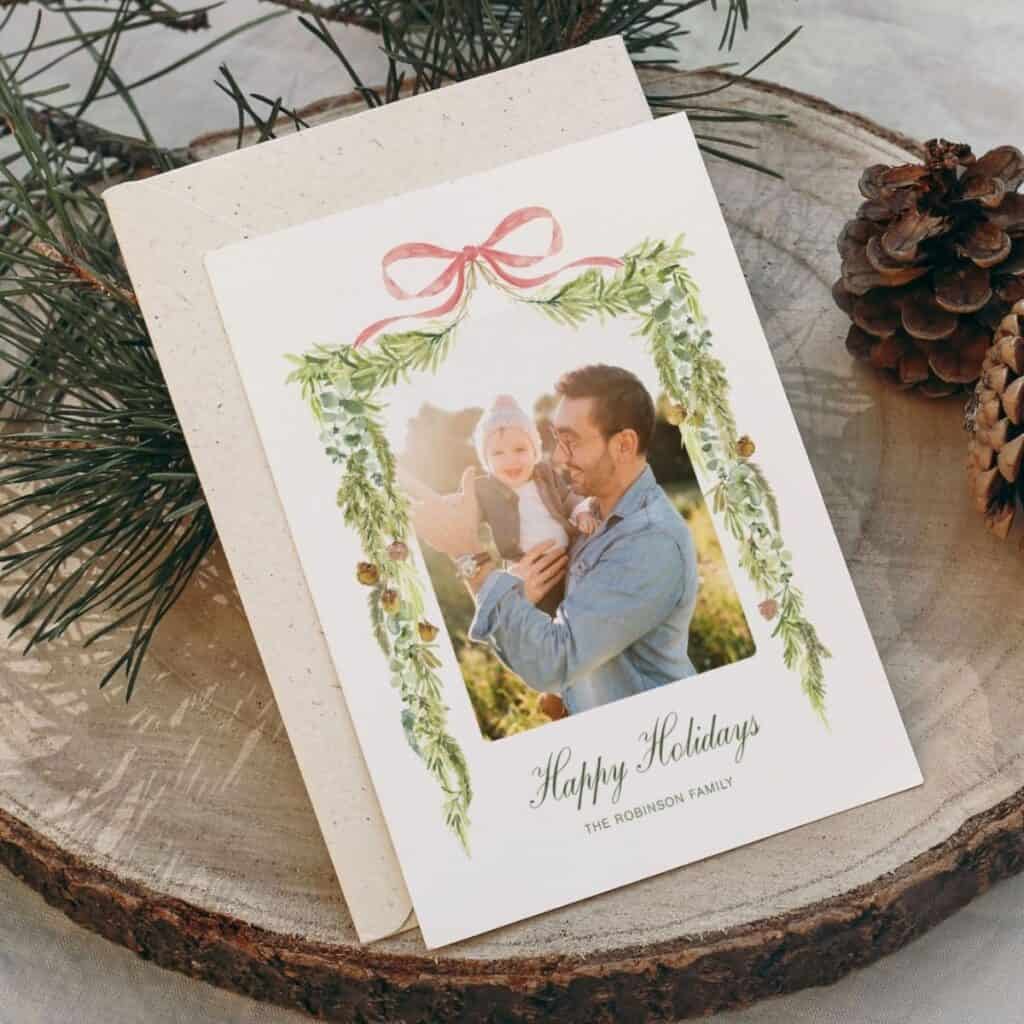
If you’re sending the classic family photo card, Paper Culture is the option I would look at first. Their Christmas cards are printed on 100% post-consumer recycled paper, making this an easy way to keep the photo-card tradition while choosing better paper. This is especially useful if you are ordering fifty or a hundred cards, where the paper choice starts adding up quickly.
Tree-Free Greetings | For Simple Recycled Christmas Cards
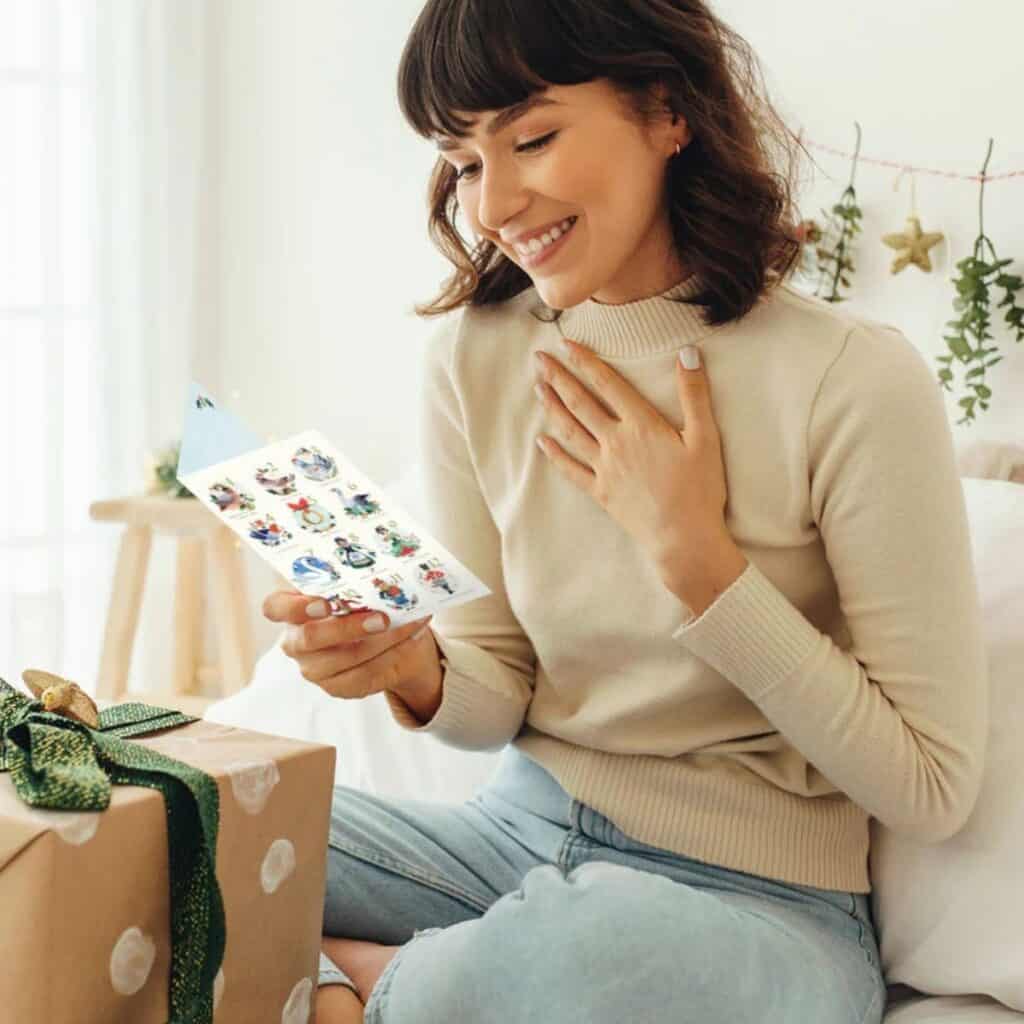
Tree-Free Greetings combines 100% post-consumer recycled paper with VOC-free inks. I like this one when you want a traditional illustrated Christmas card rather than designing a personalized photo card. Simple materials, recycled paper, no need to overcomplicate it.
Botanical PaperWorks | For Plantable Christmas Cards
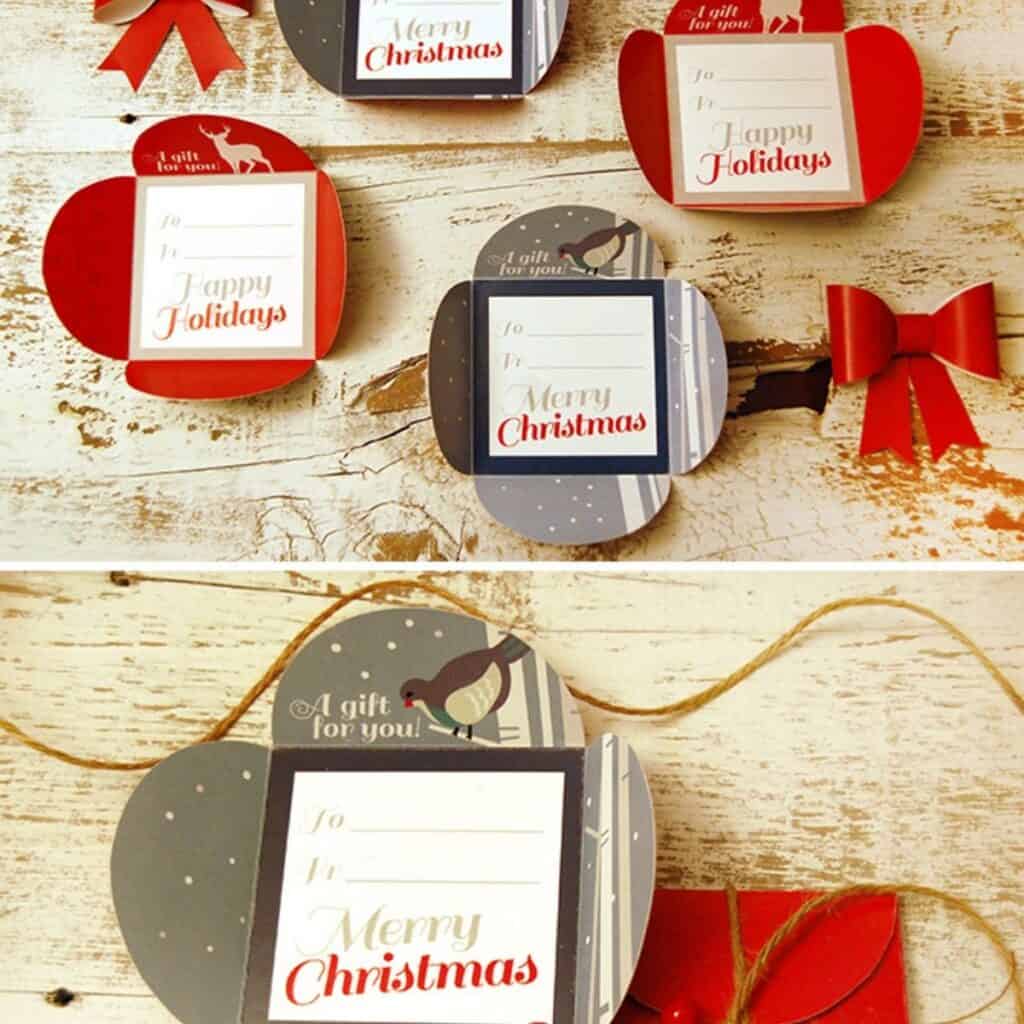
Botanical PaperWorks is the one I would choose if the whole point is sending a card that can be planted afterward. Their Christmas cards use seed paper made with recovered paper fibers, giving the recipient the option to grow flowers from the card rather than throwing it away. This is also one of those gifts where the novelty actually makes sense, especially for gardeners.
Little Difference | For Recycled Cards + Plastic-Free Packaging
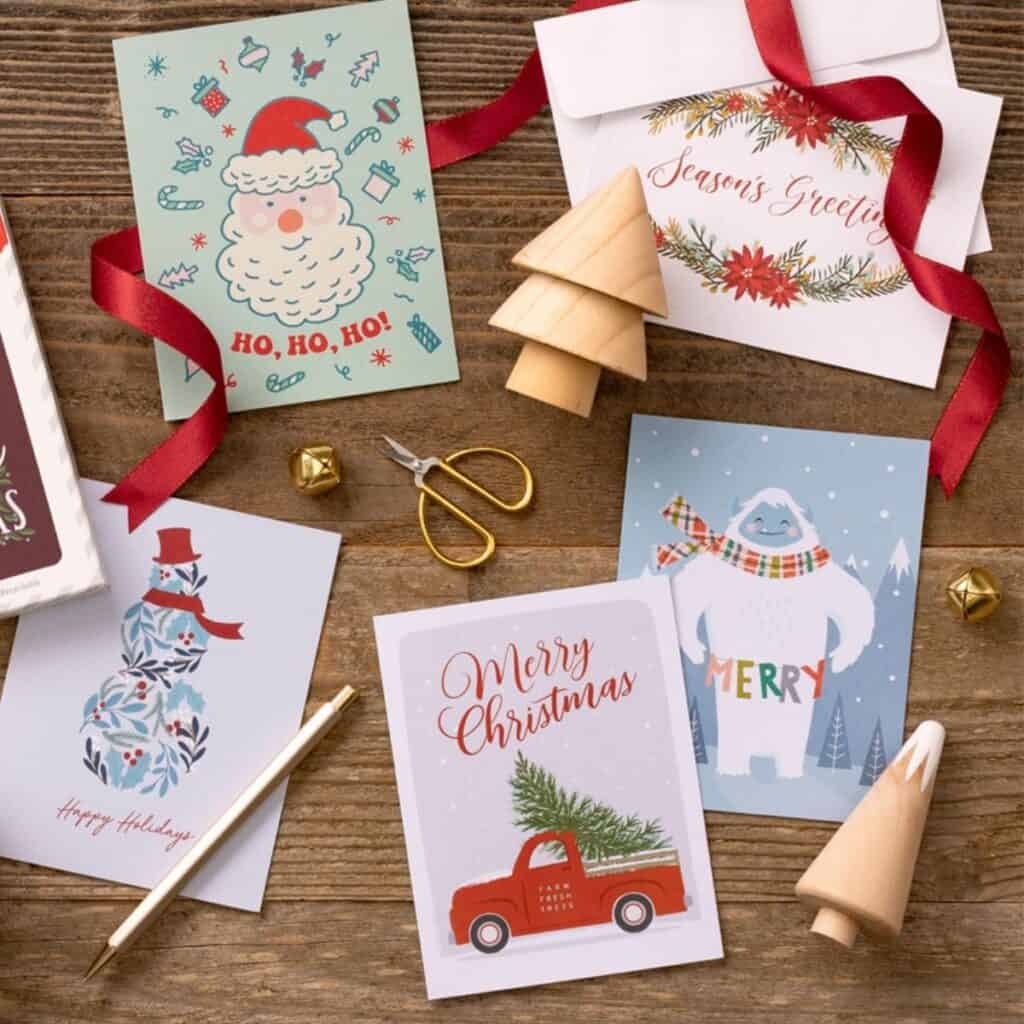
Little Difference combines 100% post-consumer recycled card stock with illustrated designs and minimal packaging. Their cards feel less polished-corporate than a typical photo-card company, which makes them a nice choice if you prefer something that looks more handmade.
Decomposition | For Recycled Artistic Christmas Cards
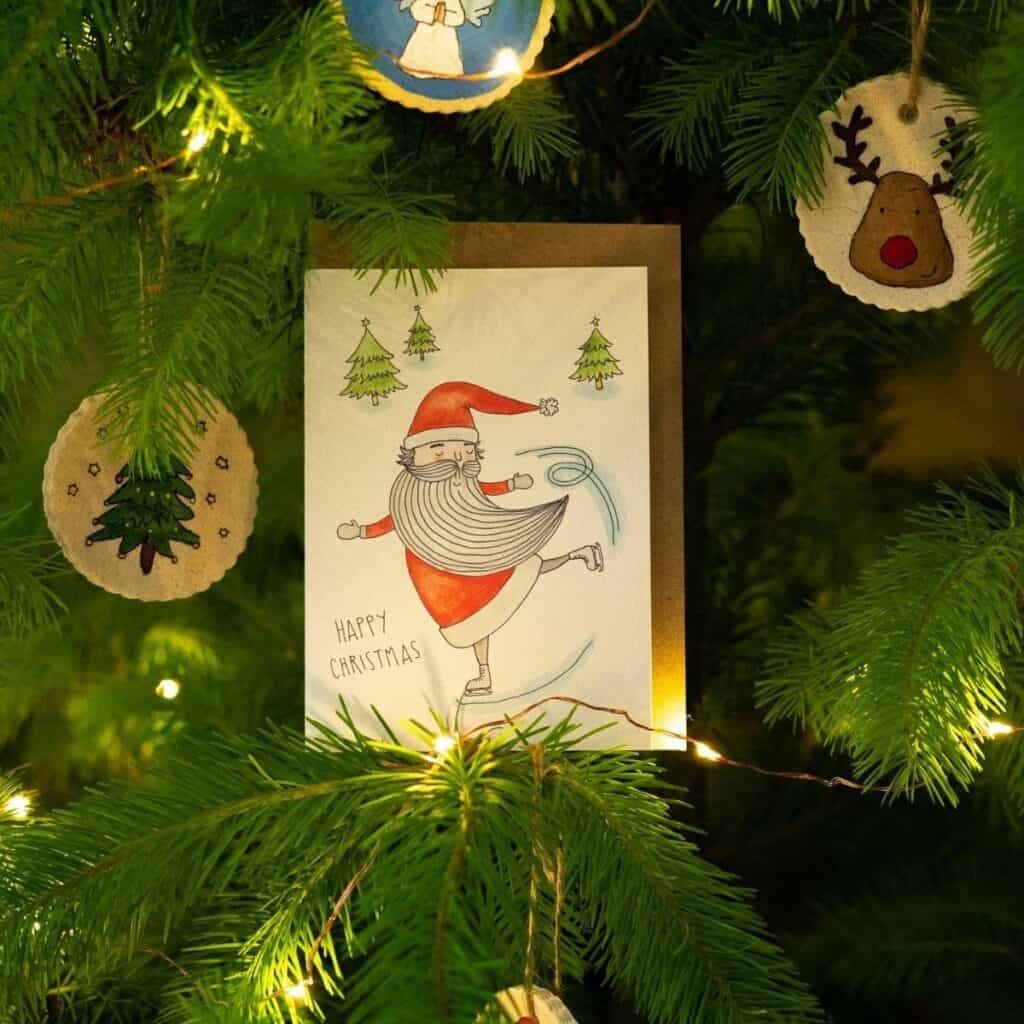
Decomposition’s holiday cards use 100% post-consumer recycled paper and soy-based inks, with playful artwork that feels a little different from the usual Christmas stationery. I would choose these if the paper credentials matter but you still want the card itself to be fun.
👉My Christmas Card Shortcut: If you’re staring at a wall of cards and do not want to research stationery for the next hour, this is my shortcut: recycled or FSC paper, simple ink, no glitter, no plastic embellishments, minimal packaging. Done.
You do not need the world’s most sustainable greeting card. You just need a card that says what you want it to say without becoming a tiny mixed-material waste project afterward.
And Reuse the Ones You Receive
Before recycling Christmas cards in January, I usually see what can get another life first. Old cards can become:
- gift tags
- paper ornaments
- bookmarks
- kids’ crafts
- place cards
- pieces for homemade cards next Christmas
Even the front of a beautiful card can be cut off and reused while the written half stays in the memory box. Sometimes the most sustainable Christmas stationery is simply the card that gets used twice.
Non-Toxic + Sustainable Christmas Gift Wrapping
I used to finish Christmas with bags full of shiny wrapping paper, plastic-coated bows, ribbons, and tissue that had been used for all of five minutes. Once I realized how much of it could not be recycled, the whole thing started feeling a little ridiculous.
Now our wrapping looks very different.
I save the good bags and boxes. My kids decorate kraft paper and old packing paper. We tie gifts with ribbon we’ve had for years and add dried oranges, rosemary, or greenery when we want them to look a little more special.
It is simpler, but honestly, I like it better.
And this is another area where lower-tox and sustainable overlap without being exactly the same thing. I’m not especially worried about touching wrapping paper for a few minutes.
I care much more about avoiding unnecessary plastic, glitter, mystery coatings, and materials that turn a simple paper product into something that cannot easily be reused or recycled.
Why Some Christmas Wrapping Paper Can’t Be Recycled
Unfortunately, having paper in the name does not mean gift wrap automatically belongs in the recycling bin.
Shiny or laminated coatings, plastic layers, glitter, foil, sticky tape, bows, and other non-paper additions can all make wrapping harder or impossible for paper recycling systems to process. EPA specifically recommends avoiding plastic-coated, ribbon-covered, and glittered wrapping and suggests recycled paper, newspaper, fabric, and reusable bags instead.
Local rules still matter. Recycle Now notes that wrapping paper is only recyclable if it passes the “scrunch test,” and that foil or glitter-decorated paper can’t be recycled even where a curbside program exists, so check your local program before assuming any of it can go in the bin.
For me, that is another reason to keep wrapping simple in the first place.
My Favorite Lower-Waste Christmas Gift Wrapping Ideas
1. Recycled Kraft Paper
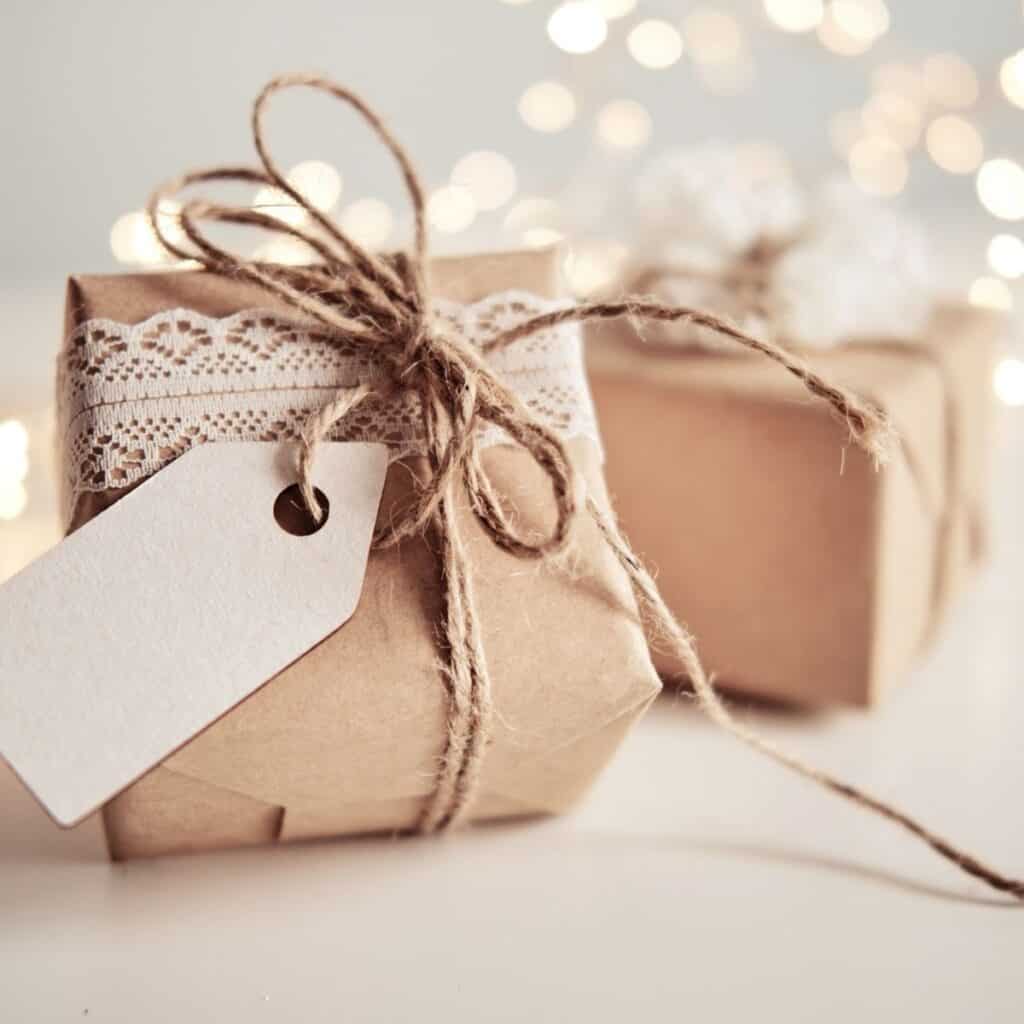
Plain kraft paper is probably my most-used traditional wrapping option.
It gives you the satisfying wrapped-present look without all the glitter and glossy coatings, and you can dress it up a hundred different ways.
We use:
- twine
- dried orange slices
- rosemary
- evergreen clippings
- cinnamon sticks
- stamps
- kids’ drawings
My children love stamping or drawing directly on the paper, which has somehow turned wrapping presents into an actual Christmas activity instead of one more thing I have to finish after they go to bed.
Even better, I often skip buying a new roll completely and use the brown packing paper or grocery bags we already have.
2. Furoshiki + Fabric Gift Wrap
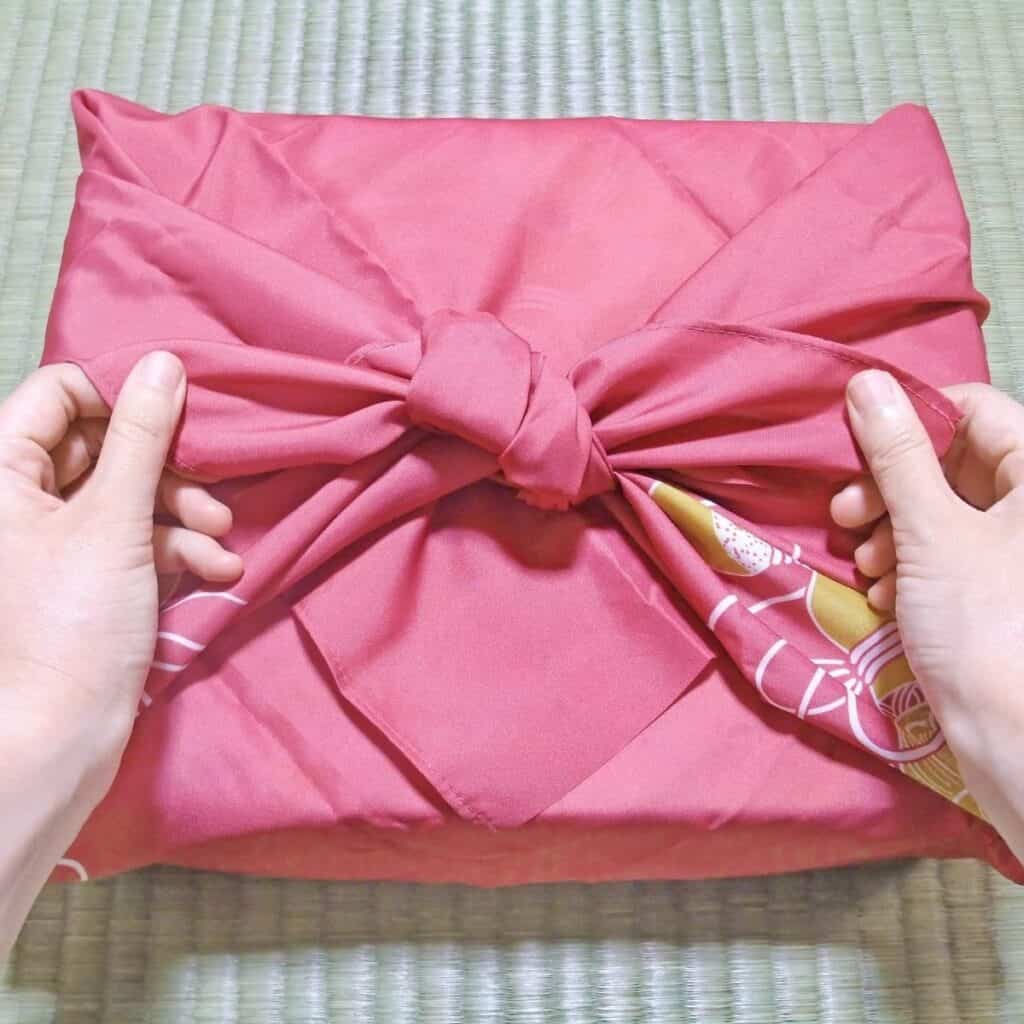
Fabric wrapping is probably my favorite option for a gift where the wrapping can become useful too.
The Japanese tradition of furoshiki uses a square of fabric that is folded and tied around the gift instead of using paper and tape.
You can use:
- scarves
- tea towels
- linen napkins
- bandanas
- fabric scraps
- cotton cloths
The first time I wrapped a present in one of my own scarves, the recipient liked the wrapping almost as much as the gift.
If you want a dedicated reusable version, I also like Wrappr’s reusable fabric wraps (use code SUSTAINABLYKINDLIVING for 20% off). They offer organic-cotton options designed specifically for furoshiki-style wrapping.
But you definitely do not need to buy special fabric to try this. Start with the linen napkin hiding in your drawer.
3. Reusable Gift Bags + Boxes
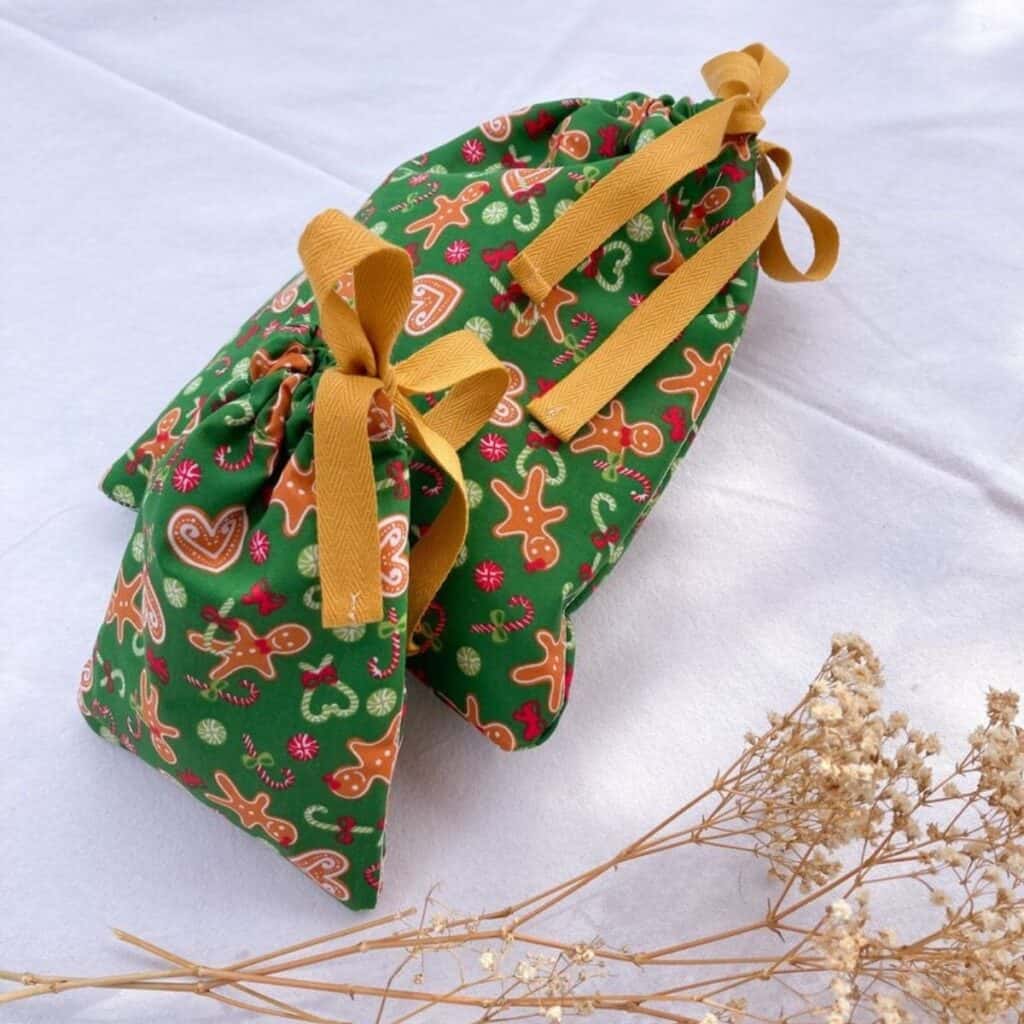
Our family has a stash of cloth bags, old gift bags, boxes, and drawstring pouches that comes out every Christmas.
They rotate from person to person every year. At this point, seeing the same bag again is almost part of the tradition.
This is also one of the easiest swaps if beautifully folding fabric around a strangely shaped children’s toy is not how you want to spend Christmas Eve. Put it in a bag. Tie it. Finished.
4. Use Newspaper, Packing Paper + Kids’ Artwork
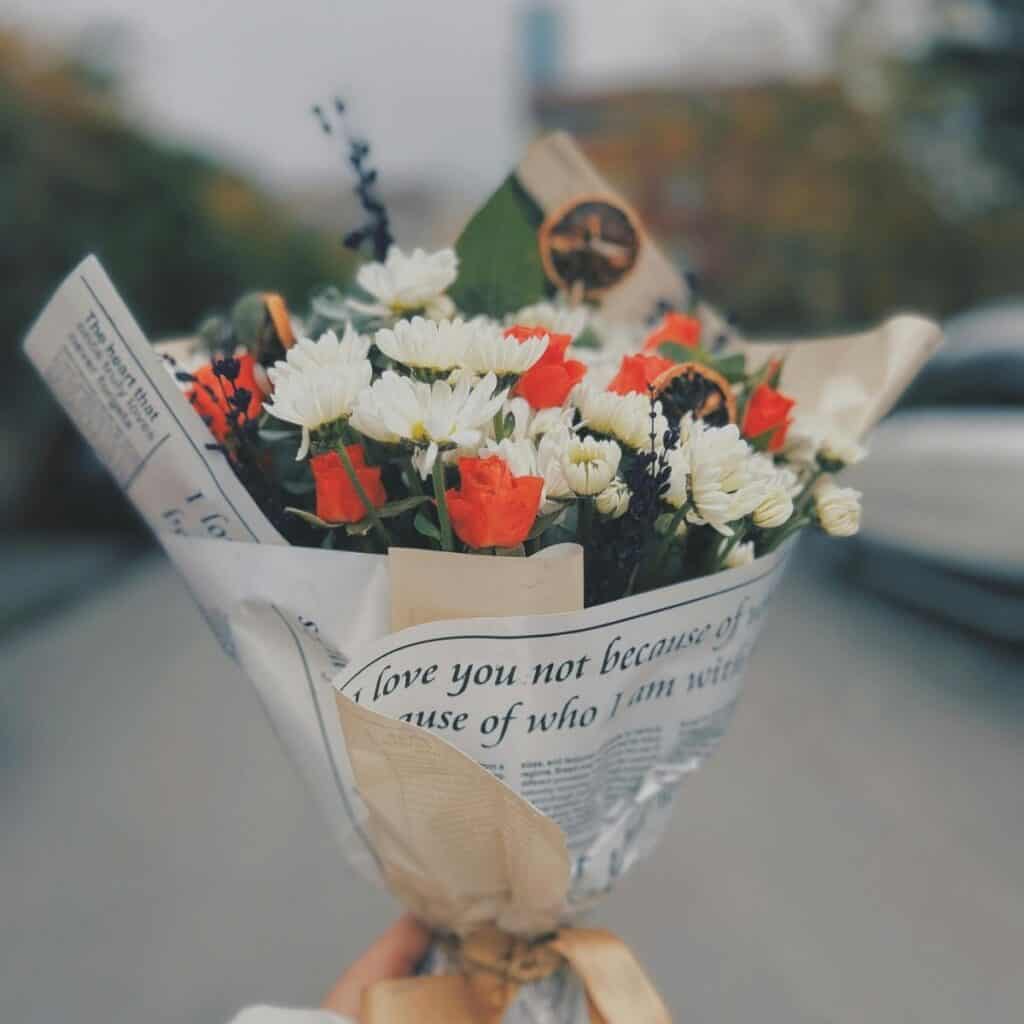
Some of the best wrapping paper is already sitting in your house.
Try:
- newspaper
- packing paper from deliveries
- brown grocery bags
- old maps
- unused calendar pages
- children’s artwork
That last one gets used frequently in our house. If your kids produce drawings at the rate mine do, Christmas can become a very effective gallery-clearance event. Grandparents usually love it too.
One small recycling note: heavily painted children’s artwork may not belong in ordinary paper recycling afterward, depending on the paint and your local rules, so reuse it because you like it, not because it automatically guarantees a recyclable package.
5. Wrap the Gift With Another Gift
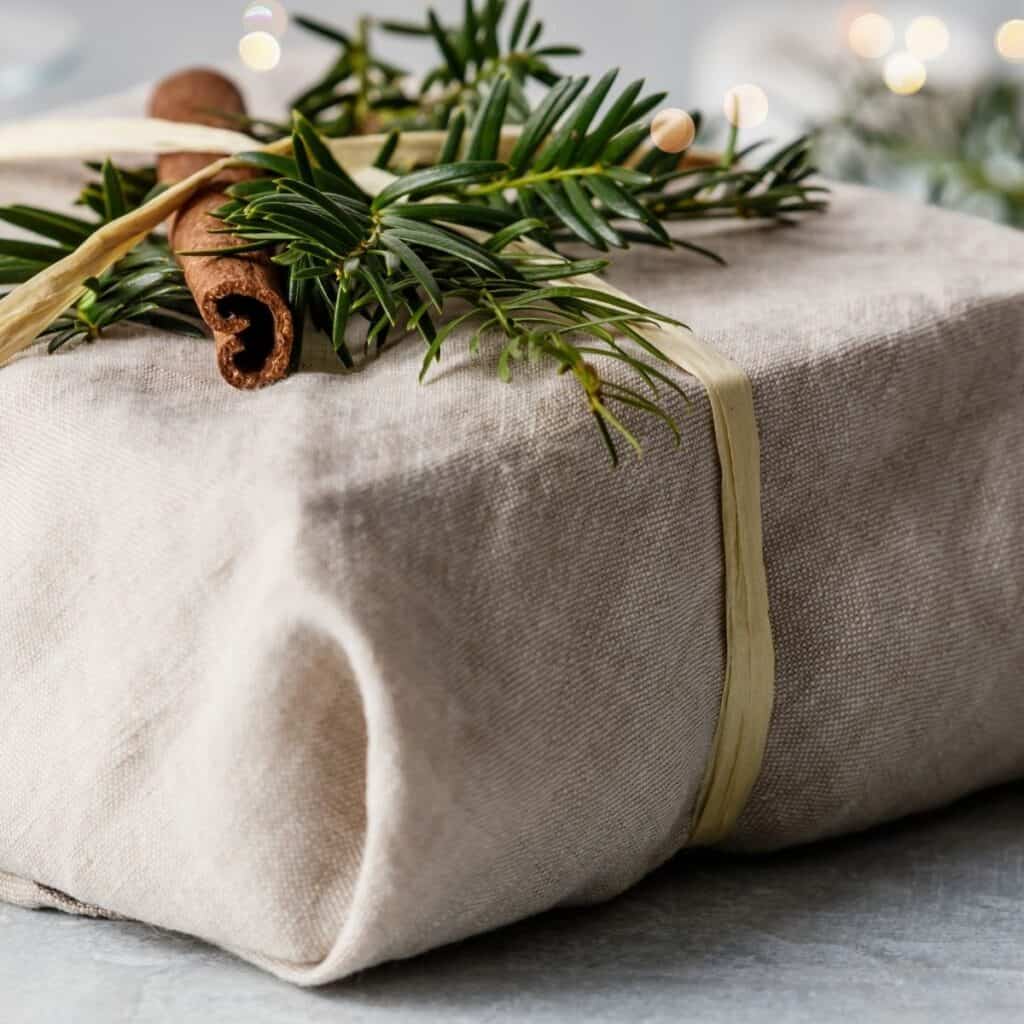
This is my favorite option when it actually makes sense.
A cookbook can be wrapped in a tea towel. A bottle can go inside a reusable market bag. Skincare can be tucked into a toiletry pouch. A cozy gift can be wrapped in a scarf.
The wrapping becomes part of the present instead of something the recipient has to deal with five minutes later.
Just make sure it is genuinely something the person will use. Giving somebody an unwanted tote bag in the name of zero waste is still giving them an unwanted thing.
6. Use Natural Finishing Touches
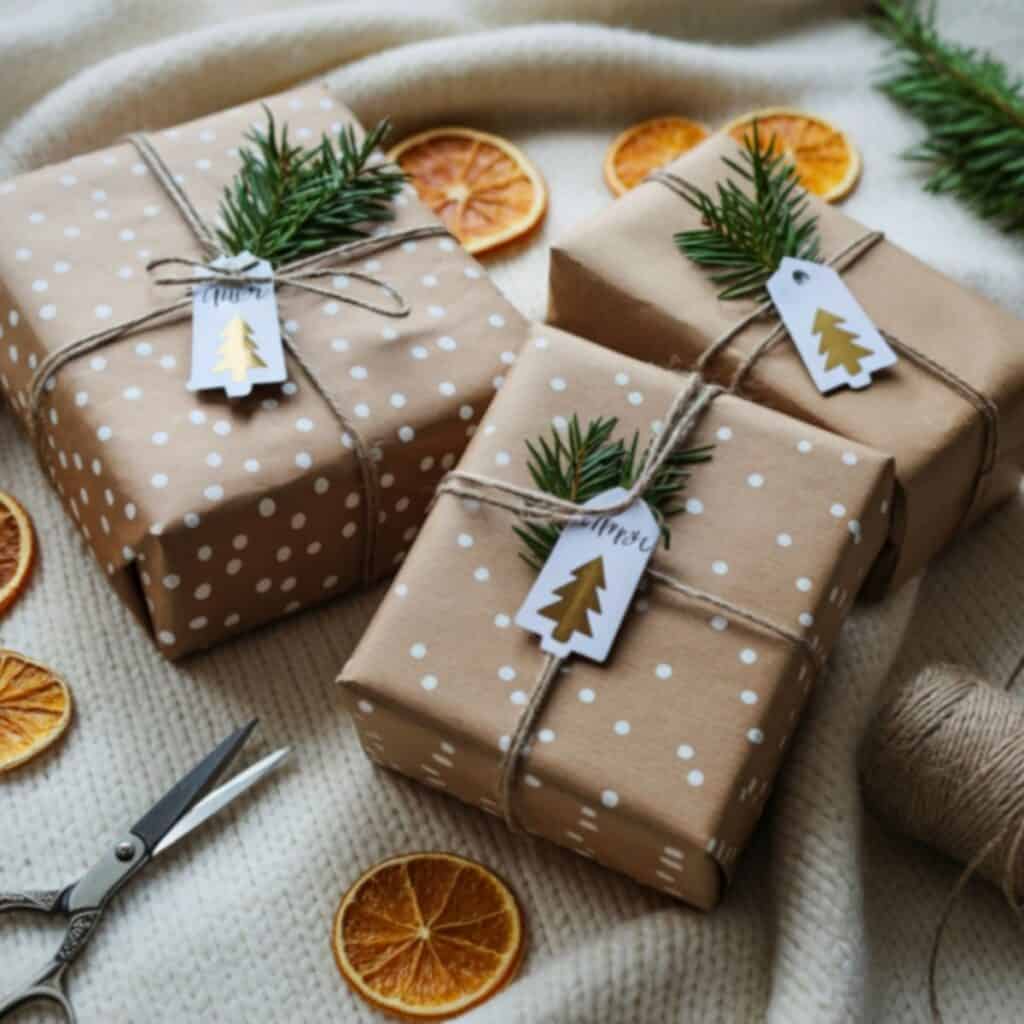
This is where the dried oranges and greenery from the decorating section come back again.
Instead of a plastic bow, try:
- rosemary
- evergreen
- pinecones
- cinnamon sticks
- dried orange slices
- bay leaves
- a tiny paper ornament
We collect pinecones and greenery ourselves when appropriate, and I love how good something as basic as brown paper can look with one little natural detail tied on top.
You do not need twelve pieces of decoration per gift. One sprig of rosemary is enough.
7. Reuse Ribbon Before Buying New Ribbon
I prefer cotton, linen, hemp, raffia, or other simple fibers when I am buying something new.
But I am absolutely not throwing away perfectly good polyester ribbon just because natural ribbon exists. Use it. Save it. Use it again next year.
I keep a little collection of ribbons and ties that come back into circulation every Christmas. The point is to reduce waste, not purge the wrapping drawer so we can restock it with more aesthetically sustainable things.
8. Turn Old Christmas Cards Into Gift Tags
Before the cards from this Christmas head toward recycling, save the ones with pretty fronts.
Cut them into rectangles, circles, or whatever shape you want, punch a hole, and add a piece of string. Instant gift tag.
Cardboard packaging, kraft-paper scraps, and leftover wrapping paper work too. It is one of those tiny habits that costs nothing and keeps materials circulating for another year.
9. Use Paper Tape When You Actually Need Tape
I try not to obsess over making every package completely tape-free.
Fabric wrap does not need it. Some boxes only need ribbon. But when I do need adhesive, I prefer simple paper-based tape or water-activated tape when it works for the package.
Just don’t assume paper tape guarantees the whole parcel belongs in recycling. Local systems vary, and sticky materials can still be an issue for some paper recyclers.
What I Skip When Buying New Gift Wrap
If I am standing in front of a rack of Christmas paper, these are the things most likely to stay there:
- Loose glitter. It adds plastic with no practical purpose and makes recycling harder.
- Plastic-laminated paper. If it feels more like plastic than paper, that is usually a sign the recycling situation is going to be complicated.
- Foil and heavily metallic wrap. These are commonly excluded from ordinary paper recycling streams.
- Plastic bows and single-use ribbon. Especially when I already have a box of ribbon at home.
- Vague “eco-friendly” paper. Tell me the recycled content or certification instead.
My Gift-Wrap Shortcut
If I need to buy new supplies, I look for:
Recycled or FSC-certified paper No glitter No plastic lamination Minimal coatings Reusable ribbon or twinePaper-based tape when needed Something sturdy enough to save and reuse
And before I buy any of it, I check the cupboard. That has probably made a bigger difference to our Christmas wrapping waste than any special “zero-waste” product I have ever purchased.
Non-Toxic Christmas Gifts: Buy Fewer, Better Things
Once the wrapping is sorted, we get to the part of Christmas where it is very easy to undo all that careful thinking: the gifts themselves.
I love giving gifts. I just don’t love buying things for the sake of having something to put under the tree.
For me, a non-toxic Christmas gift starts with one question: does this person actually want or need this? Because the safest, most sustainable product in the world is still wasteful if it spends six months in a closet before being donated.
After that, I start looking at materials.
Why Gift Materials Actually Matter
I don’t think every gift needs a background check. But there’s a real reason I don’t treat “it’s just a gift” as a pass on materials.
Children’s products in the U.S. do have real legal limits:
- The CPSIA caps lead at 100 ppm in the material itself and 90 ppm in surface coatings.
- The CPSC permanently bans eight specific phthalates above 0.1% in children’s toys and child care articles.
Those rules exist and they help. They also don’t catch everything, and enforcement happens after products are already in homes. As recently as January 2025, the CPSC recalled a children’s jewelry set sold on Amazon in a “Special Gift for the Charming You” box for lead and cadmium above the federal limit. Roughly 7,000 sets had already been sold.
Black plastic is its own thing to know about.
It’s hard for recycling facilities to sort, so some of it gets sourced from recycled electronics housings instead, which were often treated with flame retardants.
A 2018 peer-reviewed study out of the University of Plymouth tested more than 600 black plastic consumer products and found bromine and lead in items including children’s toys, jewelry, and Christmas decorations, at levels that would be restricted if the product were still classified as electronics.
That doesn’t mean every black plastic gift is contaminated. It means “black plastic, unknown origin” is a real category worth being a little more careful with, especially for toys and anything a kid will mouth.
This is the actual reason I do the brand outreach and material verification for my gift guides instead of just listing whatever is trending.
A retailer doesn’t have to tell you where its black plastic came from, and a “non-toxic” sticker on a gift box isn’t independently checked by anyone. Someone has to actually ask the material questions before the gift goes under the tree, not after a recall notice shows up in your inbox in March.
What I Look for in a Lower-Tox Gift
I do not expect every Christmas present to come with a stack of certifications. But I do look for a few things consistently:
- clear materials or ingredient disclosure
- fewer unnecessary coatings, finishes, and mystery treatments
- meaningful certifications where they actually apply
- durable construction
- products designed to be used rather than displayed and forgotten
- brands willing to answer basic material questions
- something that fits the recipient instead of the latest holiday trend
And I am immediately skeptical when a gift is marketed as clean, green, natural, or non-toxic without explaining why. We’ve already covered that game.
The Gifts I Prioritize
The older I get, the less impressed I am by gifts that are exciting for a week and forgotten by February.
The presents that have meant the most in our family are rarely the trendiest ones. They’re the things we reach for again and again, the experiences we still talk about months later, or the little luxuries we wouldn’t have bought for ourselves.
When I’m shopping for Christmas, I usually start with a few simple questions.
Will they actually use it?
A thoughtful gift that’s used every day is almost always a better choice than something bought just to fill space under the tree.
Is it made to last?
Whether it’s cookware, clothing, toys, or home goods, I look for quality over quantity. I’d rather give one well-made item than a handful of things that won’t survive the year.
Could it be an experience instead?
Museum memberships, cooking classes, concert tickets, a family outing, or even a gift card to a favorite local restaurant often create memories long after the wrapping paper is gone.
Would something handmade or secondhand be even more meaningful?
Some of my favorite gifts have come from antique shops, local makers, and small businesses. They usually have more character than something mass-produced, and they often become the gifts people remember (check out my full guide to secondhand gifts!).
Can I choose a consumable they’ll genuinely enjoy?
Good olive oil, specialty coffee, loose-leaf tea, locally made honey, handmade soap, or a favorite bottle of wine are all gifts that get used instead of collecting dust.
One of my favorite gifts to give is good olive oil with a handwritten recipe. It always gets used, and it feels much more personal than another novelty gift.
For me, a non-toxic Christmas gift isn’t defined by a label. It’s something chosen with care, made from materials I feel good about, and likely to become part of someone’s life instead of their next donation pile.
If you’re looking for specific recommendations, I’ve rounded up more than 180 non-toxic Christmas gift ideas for every age, budget, and interest in the guides below.
Need Gift Ideas? Start Here!
I have a much bigger Non-Toxic Gift Guide with 180+ ideas across ages, budgets, and categories, so I am not going to recreate that entire list here. If you already know who you’re shopping for, head straight to the guide that fits:
- For Her Non-Toxic Gifts for Her: safer beauty, home, wellness, clothing, and everyday gifts without the usual greenwashing.
- For Him Non-Toxic Gifts for Him: practical gifts with a stronger focus on safer materials, useful upgrades, and things he’ll actually use.
- For Kids Our Non-Toxic Gifts for Kids guide focuses on toys, playthings, clothing, and practical gifts made with materials I feel better about bringing into a child’s space.
- For Teens + Tweens The Non-Toxic Gifts for Teens + Tweens guide is for that slightly impossible age where they have very definite opinions and absolutely do not want a present that feels like it was chosen for a little kid.
- For Mom Our Gifts for Mom guide pulls together thoughtful home, beauty, comfort, wellness, and everyday-use gifts with the same materials-first approach.
- For Dad The Gifts for Dad guide focuses on useful, well-made gifts rather than another pile of novelty products he’ll never touch again.
- Stocking Stuffers And if you’re filling stockings, the Non-Toxic Stocking Stuffers guide is where I would start. Small should not automatically mean cheap plastic filler.
👉 If you only open one, make it the full Non-Toxic Gift Guide. It is the easiest place to browse everything before narrowing down by recipient!
Don’t Underestimate DIY Christmas Gifts
Some of my favorite gifts don’t come from a store at all.
Homemade food, infused oils, candles, knitted pieces, bath salts, ornaments, photo gifts, baked goods, and simple handmade projects can feel far more personal than another rushed online order.
And DIY does not have to mean spending three weeks learning pottery. A batch of someone’s favorite cookies wrapped in a reusable tin counts. So does a framed photo. So does the recipe your grandmother always made at Christmas.
If you want more ideas, I have a full DIY Christmas Gift Guide with 35 handmade gift ideas you can actually make.
Secondhand Gifts Can Be Really Good Gifts
I also wish we would stop treating secondhand gifts like the embarrassing backup plan.
Some things are genuinely better secondhand. Vintage cookware. Books. Collectibles. Jewelry. Designer clothing. Wooden toys. Records. Antiques. That impossible-to-find thing somebody has mentioned wanting for three years.
Secondhand shopping lets you find things with personality while keeping existing products in use, and it can be especially useful when you’re trying to avoid the endless stream of cheaply made holiday products.
The important part is still knowing your recipient. Your sister who loves vintage jewelry may be thrilled. Your coworker who asked for a specific coffee maker probably wants the coffee maker.
You can find plenty more ideas in my Secondhand Gift Guide.
Ask People What They Want!
This may be the least romantic Christmas advice I give, but it saves an incredible amount of waste.
Ask. Wish lists are useful. Specific requests are useful. Knowing someone’s favorite store is useful. There is nothing less thoughtful about giving someone exactly what they hoped for.
I’d rather lose a little bit of the surprise than give somebody a beautiful, sustainable, ethically produced object they quietly wonder how to return.
The goal is not to win Christmas with the most imaginative gift. It’s to give something that gets loved and used.
A Lower-Tox Christmas Table + Entertaining
By the time we get to Christmas dinner, I do not want to spend the day worrying about whether every napkin ring, serving spoon, and centerpiece is perfectly non-toxic.
This is another place where I keep things practical.
Use the dishes you already own. Use the tablecloth you already own. Pull out the cloth napkins if you have them. Bring in a few branches from outside. Light one good candle instead of filling the room with fragrance.
And focus most of your attention on the things actually touching hot food and drinks.
Start With the Tableware You Already Have
You do not need a brand-new set of “non-toxic Christmas dishes.”
If the plates, glasses, flatware, and serving pieces you already use every day are in good condition, use them. Buying a new holiday-only dinnerware set just because it is made from a supposedly better material does not make much sense to me.
When I am replacing something anyway, I tend to prefer simple materials I understand:
- stainless steel
- clear glass
- ceramic from reputable manufacturers
- solid wood for serving pieces
- cotton or linen textiles
The fewer mystery coatings and decorative finishes involved, the easier the product is for me to evaluate. If you actually do need a new set, I have a full non-toxic dinnerware guide that goes through materials, glazes, and specific brands.
Be More Selective With Vintage Ceramics
I love vintage dishes, especially at Christmas.
But I am more cautious about serving food or drinks in older ceramics when I do not know anything about the glaze. Some older or imported ceramic ware can contain lead or cadmium in decorative glazes, particularly brightly colored, hand-painted, worn, chipped, or cracked pieces.
That does not mean every inherited Christmas plate is dangerous. It means I would rather use an unknown decorative piece to hold ornaments, pinecones, or wrapped candy than pour hot soup into it every year.
Sentimental does not have to mean food-contact.
Skip Disposable Tableware When You Can
A big family gathering can make disposable plates and cutlery tempting. Sometimes convenience wins. I get it.
But if you already have enough real plates, glasses, and silverware, this is one of the simplest places to avoid a lot of single-use waste. And I would rather wash another load of dishes than buy a stack of “compostable” holiday plates without knowing whether my local composting system can actually process them.
If you do need disposables for a large gathering, keep them simple and check what your local waste system accepts before assuming anything labeled biodegradable or compostable belongs in a backyard compost pile.
Use Cloth Napkins + Table Linens
Cloth napkins make a Christmas table feel special without creating a pile of paper waste after dinner.
I like cotton or linen, especially if I am buying new. But again, I would not replace perfectly good polyester napkins just because natural fibers are available. Use what you have.
When textiles eventually need replacing, that is when I start looking for materials like organic cotton, linen, or products carrying certifications such as GOTS or OEKO-TEX. A holiday table does not become more sustainable because all the old linens were donated and replaced in one afternoon.
Keep the Centerpiece Simple
Some of the prettiest Christmas tables are made from things you already used elsewhere in the house.
Try:
- evergreen branches
- rosemary
- pinecones
- dried oranges
- apples or pears
- pomegranates
- cinnamon sticks
- beeswax candles
- glass jars
- ceramic bowls
- wooden boards
You do not need plastic glitter garlands running between every plate. A bowl of winter fruit with greenery around it can look just as festive and has a much better chance of being eaten, composted, or reused afterward.
Be Careful With Candles Around Food
If I am burning candles directly on the dinner table, I usually go lighter on scent. A strongly fragranced candle competing with dinner is not particularly pleasant anyway. This is where an unscented beeswax candle or one of the simpler options from the candle section makes sense.
And obviously, keep open flames away from dried greenery, napkins, paper decorations, children’s hands, and anything else that can catch fire.
Holiday atmosphere is lovely. Setting the centerpiece on fire is less charming.
Think About What Is Touching Hot Food
This is probably where I pay the most attention.
Heat can make certain materials more important to think about, so I prefer serving hot food in glass, stainless steel, ceramic, or other materials intended for high-temperature food contact. I also avoid putting piping-hot food directly into random plastic serving bowls just because they happen to be festive.
Same with reheating leftovers. The plastic Christmas container with the snowman lid may be cute, but glass is usually my first choice for hot food when I have it available.
Don’t Forget the Leftovers
Christmas leftovers are practically their own food group.
Instead of reaching automatically for disposable plastic wrap and bags, I use whatever reusable containers we already own first. Glass containers work especially well for things that are still warm or will be reheated later.
You can also use:
- stainless-steel containers
- jars
- bowls covered with a plate
- beeswax wraps for appropriate foods
- reusable silicone bags
If you’re actually shopping for new containers, I have guides on non-toxic food storage and non-toxic microwave containers specifically, since what’s safe to store food in and what’s safe to actually reheat food in aren’t always the same product.
And send food home with guests in containers you are completely prepared never to see again. This is not the night to hand someone your favorite glass storage container and spend January wondering where it went.
👉Planning Your Holiday Meals?
If you’re trying to create a more non-toxic Christmas, don’t forget the cookware you’re using. Many traditional nonstick pans and baking dishes can contain coatings or materials you’d rather avoid.
Before hosting Christmas dinner or baking holiday treats, check out these guides:
- Best Non-Toxic Bakeware (for cookies, casseroles, breads, and desserts)
- Best Non-Toxic Cookware (for everyday cooking and holiday meals)
- Best Non-Toxic Slow Cookers (for soups, holiday sides, mulled cider, and hands-off meals)
- Best Non-Toxic Air Fryers (for crispy appetizers, vegetables, and quick meals)
- Best Non-Toxic Cooking Utensils (for safer spatulas, spoons, tongs, and kitchen tools)
A Simple Christmas Table Is Enough
The theme running through this entire guide applies here too.
You do not need to buy a new tablecloth. You do not need matching Christmas plates. You do not need twelve tiny decorative objects around every place setting.
Use the good dishes. Bring out the napkins. Add greenery. Put something delicious on the table. The people sitting around it are doing most of the decorating anyway.
Christmas Materials + Certifications I Actually Pay Attention To
By this point, you have probably noticed that I keep coming back to the same handful of materials and certifications. That is intentional.
You do not need to memorize every chemical that might show up in a Christmas product. I certainly do not shop that way. I find it much more useful to recognize a few materials I generally prefer, understand where I am more cautious, and know which certifications actually tell me something useful.
Materials I Generally Prefer
When I am choosing something new, these are usually easier for me to evaluate:
- Solid wood Especially unfinished wood or products with clearly disclosed paints, stains, and finishes.
- Wool Useful for ornaments, garlands, stockings, and other soft decorations. I still check dyes and finishes when information is available.
- Cotton + linen My preferred fibers for table linens, fabric gift wrap, stockings, and other Christmas textiles.
- Paper + cardboard Especially recycled or responsibly sourced paper without plastic lamination, glitter, or lots of glued-on embellishments.
- Glass Great for ornaments, candle holders, storage, and serving pieces when breakage is not a concern.
- Ceramic A useful material for dishes and decor when it comes from a reputable manufacturer with appropriate glaze and food-contact standards.
- Stainless steel One of my favorite practical materials for serving pieces, food storage, and reusable household gifts.
- Natural greenery Evergreen branches, rosemary, pinecones, dried citrus, and similar decorations are simple materials that can often be reused, composted, or returned to nature afterward.
None of these materials automatically makes a product perfect. Wood can have questionable finishes. Cotton can be heavily processed. Ceramic can have problematic glazes. Paper can be plastic-coated.
The point is not that “natural” materials get an automatic pass. They are simply a much easier starting point than a product made from a mystery blend of plastics, coatings, fragrances, and adhesives.
Materials I Look at More Closely
These do not automatically mean I would never buy the product. They simply make me ask more questions.
PVC / vinyl Common in artificial Christmas trees, electrical cords, decorations, and other flexible plastic products. If I am replacing something, I generally prefer a well-disclosed alternative when one exists.
Soft or flexible plastics These can require plasticizers and other additives depending on the material and use, so I want more information than “plastic.”
Synthetic fragrance Especially in candles, room sprays, plug-ins, scented pinecones, wax melts, and heavily fragranced holiday decor. Disclosure matters much more to me than whether the front says “clean.” Fragrance is also one of the more common sources of indoor VOCs, and December tends to be exactly when that matters most: windows shut, candles lit, plug-ins running. If you want the full picture, I have a guide to what VOCs actually are and how to reduce them and a full guide to the fragrance loophole.
Loose glitter Mostly because it is an unnecessary plastic-heavy addition that sheds easily and complicates recycling.
Mystery coatings + finishes Water-resistant, stain-resistant, flame-resistant, glossy, metallic, soft-touch: whenever a finish is doing something special, I want to know what it actually is. This is also exactly the kind of finish where PFAS tends to show up. I have a dedicated guide on what PFAS is and how to avoid it if you want the deeper explanation.
Painted vintage items with unknown finishes Especially anything chipped, flaking, or intended for children to handle.
Again, context matters. A plastic ornament hanging high on a tree is not the same exposure as a toddler mouthing a soft plastic toy. How a product is used matters just as much as what it is made from.
Certifications Worth Knowing at Christmas
Certifications are helpful when they answer a specific question. They are not universal seals of purity.
GOTS
GOTS, the Global Organic Textile Standard, is one I look for on products like cotton stockings, table linens, pajamas, fabric gift bags, and other textiles. It covers organic fiber requirements along with processing criteria throughout the textile supply chain.
What it does not mean is that every non-textile part of a finished product has been evaluated in exactly the same way. A GOTS cotton stocking can still have a zipper, decoration, backing, or embellishment made from something else.
OEKO-TEX Standard 100
OEKO-TEX Standard 100 is useful when I want more information about harmful substances in a textile product. The certification involves testing textile components against a long list of regulated and potentially harmful substances.
You may see it on:
- bedding
- pajamas
- table linens
- fabric decorations
- stockings
- soft toys
It does not mean the textile is organic. That is an important distinction. GOTS tells me something about organic fiber and textile processing. OEKO-TEX Standard 100 tells me something about substance testing. Those are different questions.
GOTS and OEKO-TEX are the two I look for most, but they’re only two of dozens that show up across Christmas textiles. If you want the fuller list, I have a guide to 25 ethical fashion and textile certifications worth knowing, most of which apply well beyond clothing.
FSC
The Forest Stewardship Council is most relevant to the paper and wood products in this guide. You might see FSC certification on:
- Christmas cards
- wrapping paper
- gift boxes
- wooden decorations
- paper ornaments
- wooden toys
FSC certification relates to forest sourcing and chain of custody. It does not mean a finished product is automatically non-toxic. A wooden ornament can use FSC-certified wood and still be painted, glued, glittered, or coated with something I want to investigate separately.
A Quick Note on “Recycled” Claims
I mentioned this in the greenwashing section, but it’s worth repeating here since it applies to so much of what’s in this guide: recycled content isn’t one thing.
Post-consumer recycled material comes from products people actually used and threw away, like a card or a bottle that went through a recycling bin. Pre-consumer (sometimes called post-industrial) recycled material comes from manufacturing scraps that never reached a consumer at all, which is a much lower bar. A product can say “recycled” and mean either one, and most labels don’t tell you which. When a brand does specify post-consumer content and a percentage, that’s a more meaningful claim than “recycled” on its own.
Fair Trade
Fair Trade comes up most for handmade Christmas decor: wooden nativity sets, baskets, ornaments, and other artisan-made pieces.
It’s worth knowing there isn’t one single Fair Trade certifier. Fairtrade International is the most recognized label globally, but it’s built around commodities like coffee, cocoa, and cotton, and it doesn’t certify handicrafts. For handmade goods specifically, Fair Trade Federation membership or Fair Trade USA’s separate handicraft program are the more relevant options. If a Christmas decoration is labeled “fair trade,” it’s worth a quick check on which of these it’s actually referring to, since they’re not interchangeable.
MADE SAFE
MADE SAFE is one of the certifications I pay attention to for products where chemical formulation matters more, including some candles and personal-care gifts. The certification screens ingredients against its own criteria for human health and environmental concerns.
This is much more useful to me than a candle simply calling itself “clean” or “non-toxic.” It still does not mean I would burn a candle for eight hours in a sealed room. Certification does not replace common sense about how a product is used.
RoHS
We already talked about RoHS in the Christmas lights section. This one applies to electrical and electronic products and restricts specified hazardous substances such as lead, mercury, cadmium, certain flame retardants, and certain phthalates.
For Christmas lights, that gives me more information than a vague claim like “lead-free.” But remember: restricted does not necessarily mean zero.
UL + ETL
UL and ETL are different from the material certifications above. I look for these primarily as electrical safety signals. They are relevant to:
- Christmas lights
- light-up decorations
- powered garlands
- electrical candles
- other seasonal electrical products
These certifications help tell me that a product has been evaluated against applicable electrical safety requirements. They do not tell me that the cord is PVC-free, the plastic is phthalate-free, or the product meets my preferred chemical standard. That is why you will sometimes see me looking for both: electrical safety + better material disclosure.
Don’t Collect Certifications for the Sake of It
More logos on the package do not automatically make something safer.
I would rather buy a very simple product from a transparent company than something covered in green badges that do not actually apply to the part of the product I care about.
When I see a certification, I ask: what does this certification actually cover? The textile? The wood? The electrical construction? The ingredients? The entire finished product? That one question clears up a surprising amount of greenwashing.
My Simplest Rule
If all of this starts feeling like too much, come back to the basics: use what you already own.
And when something genuinely needs replacing, look for:
- simple materials
- clear ingredient or material disclosure
- relevant third-party certifications
- durable construction
- fewer unnecessary coatings, fragrances, and embellishments
You do not need to turn Christmas shopping into a chemistry degree. You just need enough information to make a better choice than the label alone gives you.
FAQs About Having a Non-Toxic Christmas
Start with what you already own.
You do not need to replace your tree, ornaments, lights, dishes, or wrapping supplies just because a lower-tox alternative exists. When something actually needs replacing, focus on simple materials, better ingredient or material disclosure, relevant certifications, and products you will use for years.
The biggest areas I pay attention to are artificial trees, Christmas lights, fragranced products, candles, decorations, wrapping materials, and the gifts coming into the house.
I would not describe every artificial Christmas tree as toxic.
Many artificial trees are made with PVC, PE, or a combination of the two, and some may include additional treatments or additives. If you already own an artificial tree in good condition, I would keep using it.
When replacing one, I prefer trees with more PE, less or no PVC when possible, clear material disclosure, information about flame-retardant treatments, and appropriate electrical safety certification if the tree is pre-lit.
Not automatically.
A real tree avoids the PVC and other plastics used in many artificial trees, but it comes with different considerations, including pesticide use, mold, pollen, natural plant compounds, transportation, and disposal.
If you prefer a real tree, I would look for a local grower, ask how the trees are managed, and dispose of it through a tree-recycling or composting program when one is available. The best choice depends on your household and what you already own.
There is no single safest ornament material, but I generally prefer simple materials I can identify.
That includes: solid wood, wool felt, paper, glass, ceramic, cotton or linen, natural materials such as dried citrus, pinecones, and greenery.
I look more closely at soft vinyl, mystery plastics, shedding glitter, heavily fragranced decorations, and painted or coated products with very little material information.
And with any ornament, placement matters. Fragile glass belongs somewhere different from something a toddler can reach and put in their mouth.
Christmas lights can contain materials I would not choose for other household products, particularly PVC cord insulation and restricted substances such as lead or certain phthalates.
That does not mean a string of lights is inherently unsafe to have in your home.
When buying new, I look for LED lights, RoHS compliance, recognized electrical safety certification such as UL or ETL, and as much cord-material transparency as I can find. I also replace lights with cracked, frayed, or damaged wiring rather than keeping them purely to avoid waste.
Used normally, yes, but the cord is the part I actually pay attention to around young kids, not the bulb.
I keep light strings away from babies and toddlers who are more likely to handle or mouth a cord, check for RoHS compliance on anything new, and treat a Prop 65 warning as a reason to look up what chemical triggered it rather than a reason to panic. Cracked, frayed, or damaged cords come out of rotation immediately, especially in a house with kids.
I prefer candles with a clearly disclosed wax, transparent fragrance ingredients, and cotton, hemp, or untreated wooden wicks.
Brands such as Fontana, Primally Pure, Meaningful Mantras, and Grow Fragrance have Christmas scents that give much more ingredient information than the typical vague “holiday fragrance.” For all of my tested brands and the ones I would skip, see my Non-Toxic Candle Guide.
And remember: even a better candle is still a burning candle, so wick care, ventilation, and avoiding visible soot still matter.
The simplest paper is usually the easiest to deal with.
I look for plain recycled or FSC-certified paper without glitter, plastic lamination, metallic film, plastic embellishments or heavy coatings. Local recycling rules vary, so I would still check what your local program accepts.
My regular rotation is kraft paper, newspaper, packing paper from deliveries, brown grocery bags, and fabric wrapping in the furoshiki style, a square of fabric folded and tied around the gift instead of using paper and tape at all.
Reusable gift bags and boxes work well too, especially for oddly shaped gifts. All of these skip the recyclability question entirely, since they were never disposable to begin with.
They can be. Seed-paper cards give the recipient the option to plant the card rather than throw it away, but I would still check what seeds are included and whether they are appropriate for the recipient’s location. They also only make sense if the person will actually plant them.
For many people, a simple Christmas card made from 100% post-consumer recycled paper may be the more practical option.
I look for gifts that combine safer materials with usefulness. That might mean organic textiles, solid wood, natural rubber, better cookware, lower-tox skincare, quality home products, or something consumable.
But the most important question is still: does this person actually want it?
You can browse more than 180 ideas in my Non-Toxic Gift Guide, along with separate guides for her, him, kids, teens and tweens, Mom, Dad, and stocking stuffers.
There is no single perfect version.
For me, it looks like using what we already own, buying fewer things, choosing better materials when something needs replacing, reusing wrapping, avoiding disposable decorations, giving gifts people actually want, eating the leftovers, and resisting the pressure to remake our entire Christmas every year.
You do not need a perfectly plastic-free tree, zero-waste dinner, handmade gifts, and matching linen everything. A more sustainable Christmas usually comes from doing less, keeping things longer, and being more intentional about what comes into the house in the first place.
A Safer, More Sustainable Christmas Without the Perfection
If there is one thing I hope you take away from this guide, it is that a non-toxic Christmas is not a shopping list.
You do not need a new tree because yours contains PVC.
You do not need to replace every plastic ornament with wood.
You do not need matching linen napkins, handmade wrapping paper, beeswax candles in every room, or a house that suddenly looks like a Scandinavian Christmas catalog.
Start with what you already have. Then, when something breaks, runs out, or genuinely needs replacing, make the better choice you can with the information available.
For me, that usually means asking:
- What is it made from?
- Does the brand actually tell me?
- Will we use it for years?
- Can I avoid unnecessary fragrance, coatings, glitter, or plastic?
- And do we even need to buy it in the first place?
Those questions have changed our Christmas much more than chasing the perfect “eco-friendly” product ever did.
There are still plastic ornaments in our house. There are reused gift bags that have been passed around the family more times than anyone remembers. There is a rosemary plant that gets decorated because I love it. There are gifts people specifically asked for. There are homemade things, secondhand things, and sometimes things that are simply practical and useful.
That is what a lower-tox, more sustainable Christmas looks like to me.
Not perfect. Just more intentional. And honestly, Christmas feels a lot better when you stop trying to buy your way into doing it right.
More Non-Toxic Christmas Guides to Explore
If you are working through your Christmas list, these guides can help you go deeper where you need it:
- Non-Toxic Gift Guide: 180+ safer and more sustainable gift ideas across ages, budgets, and categories.
- Non-Toxic Gifts for Her: beauty, wellness, home, clothing, and everyday gifts with better materials.
- Non-Toxic Gifts for Him: useful gifts without the pile of novelty junk.
- Non-Toxic + Eco-Friendly Gifts for Kids: toys and practical gifts made with materials I feel better about.
- DIY Christmas Gifts: handmade gifts for when you want something more personal.
- Secondhand Gift Ideas: vintage, thrifted, and pre-loved gifts worth giving.
- Non-Toxic Candles: the brands I tested, what I look for, and which popular candles I would skip.
You can also jump back to any section of this guide whenever you need help with Christmas trees, lights, decorations, candles, cards, gift wrapping, gifts, or your holiday table.
However you celebrate, I hope this helps you spend less time second-guessing every Christmas purchase and more time enjoying the people you bought all this stuff for in the first place.
Let’s Make This Guide Better Together!
Every year I update this guide as I discover new research, better products, and smarter ways to create a healthier holiday.
If you have a favorite non-toxic Christmas tradition, a product you’ve loved, or a question you’d like me to research, leave a comment below. I read every one and genuinely use your feedback to improve these guides.
And if you enjoy this kind of practical, research-backed advice, be sure to join my newsletter. I share new guides, product reviews, and simple ways to create a healthier home without the overwhelm.

Steal My Non-Toxic Cleaning Checklist!
Believe us, it’s the BEST…. and it’s free. Does it really get any better than that?! Sign up for our newsletter and get this free checklist to clean your home without any harmful chemicals!