 Shop My Favorite Non-Toxic Gifts Of 2026!
SKL is reader supported. When you buy through links on our site, we may earn affiliate commission. Learn more here.
Shopping for the best non-toxic baby gifts gets complicated surprisingly fast. When my twin boys were babies nine years ago, I bought what looked cute, what other moms recommended, and what showed up on all the baby “must-have” lists. I definitely was not turning stuffed animals over to check the filling or wondering what kind of finish was on a wooden rattle.
By the time I had my daughter, everything had changed.
I had spent years researching non-toxic and sustainable products through Sustainably Kind Living, and suddenly I knew to look at the organic cotton shell and the polyester stuffing. The wood and the glue. The silicone and the actual material disclosure behind it. I cared about what she was sleeping on, chewing on, eating from, wearing, and eventually crawling all over.
She is 2.5 now, my boys are 9, and between the three of them I have also learned something that research alone cannot teach you:
Babies do not need nearly as much stuff as we are told they do. They need the right stuff.
A really good baby gift should make sense for where that baby is developmentally, be made from materials I feel good about, and ideally have enough staying power that it does not become clutter three weeks later.
That is how I built this list of the best non-toxic baby gifts from newborn through the first birthday.
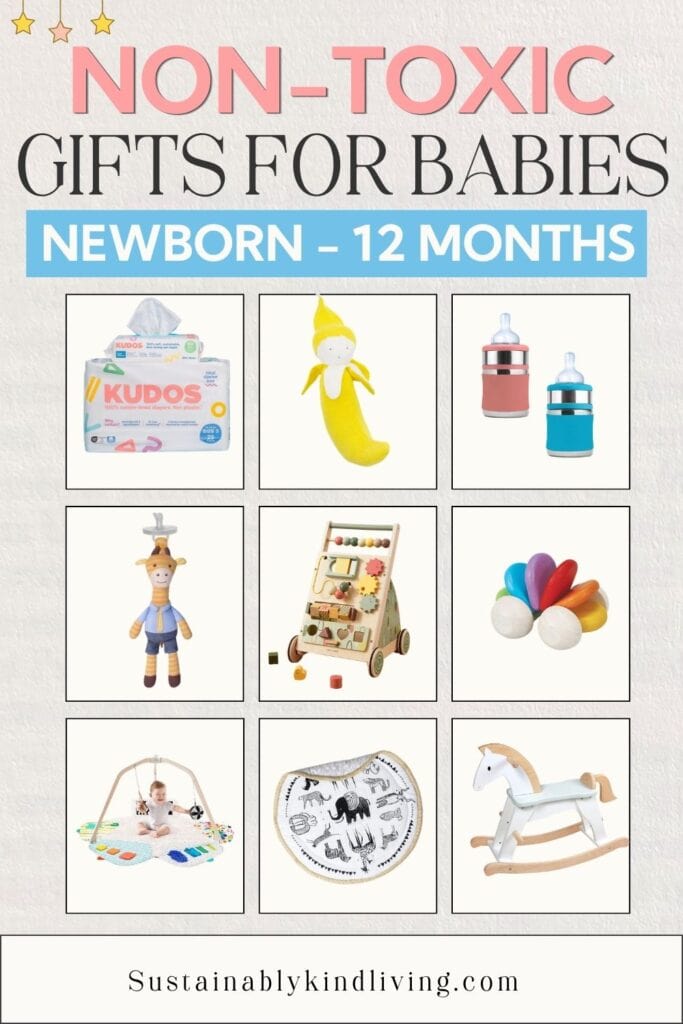
You will find practical newborn gifts, organic baby essentials, natural rubber teethers, wooden toys, feeding gear, developmental toys, first birthday gifts, and a few bigger splurges that babies can grow into.
I have organized everything by age because what makes an amazing gift for a 3-month-old is completely different from what I would buy for a baby turning one.
Some of these are products I used with my own daughter. Others are brands I have researched for years through SKL. And for every single one, I looked beyond the cute product photo and into the materials, age recommendations, certifications, construction, and whether I think a real family will actually use it.
If I Could Only Pick 5 Non-Toxic Baby Gifts…
If you do not want to scroll through all 45, these are the five I would start with.
- Best Everyday Essential: Kudos Diapers + Wipes
This is not the flashiest baby gift on the list, but it may be one of the most appreciated. Parents go through an unbelievable number of diapers and wipes, and I love that Kudos uses a cotton topsheet and TCF wood pulp while being unusually transparent about what is and is not plastic in the diaper. - Best Newborn Gift: Lovevery Play Gym
One of those rare baby products that gets used constantly instead of being interesting for two weeks. Babies can use it from the newborn stage for high-contrast visual play and tummy time, then keep discovering new parts of it as reaching, grasping, rolling, and sitting develop. - Best Gift That Grows With Baby: Woolino Ultimate 4-Season Sleep Bag
I love baby gifts that solve an everyday problem and last far longer than one size of pajamas. Woolino combines a merino wool lining with an organic cotton outer and is designed to fit from roughly 2 months through 2 years. - Best Feeding Gift: Ahimsa First Bites Bundle
Once solids start, feeding gear suddenly becomes part of everyday life. I love Ahimsa because stainless steel is durable, easy to clean, and can stay useful long after the baby phase instead of being another piece of short-lived baby gear. - Best First Birthday Splurge: Tiny Land PlayNest Climbing & Ball Pit Set
This is the kind of first birthday gift that actually matches what babies want to do at that age: crawl, climb, pull up, tumble, throw things, and test what their bodies can do. It works for early movement now and becomes even more fun as they get steadier and more adventurous.
✔️ Prefer to shop Amazon? Add your SKL Approved Baby Gifts Amazon Storefront here.
What I Look for in a Non-Toxic Baby Gift
Babies use things differently than anyone else. They chew their toys, suck on fabric, rub their faces on sleep products, and throw feeding gear on the floor before putting it right back in their mouths. In the first year, almost everything gets tasted.
So I look at the whole product, not just whatever material sounds nicest in the title.
- Wooden toys: Solid wood is a great start, but I want to know what’s on it. Paints, stains, sealants, and glues all matter. Water-based finishes, full disclosure, and responsibly sourced wood through FSC give me the full picture.
- Teethers, pacifiers, and feeding gear: The exact material matters. I lean toward natural rubber, stainless steel, glass, and well-disclosed silicone. I trust brands that say food-grade or platinum-cured silicone, not just “BPA-free.”
- Loveys, dolls, sleepwear, and crib sheets: I check the outside and the inside. An organic cotton shell is great, but I want to know if the stuffing is polyester. GOTS tells me far more than an “organic” product name, and OEKO-TEX STANDARD 100 means the textile was tested for a long list of harmful substances.
- Bigger nursery and play products: I look past the fabric cover to the foam, adhesives, plywood, waterproofing, and coatings underneath. GREENGUARD Gold adds useful information about chemical emissions.
- Age recommendations: This knocked several beautiful products out of this guide. I’d rather recommend something at 9 months than stretch it to fit the 6-month section.
- Will they actually use it? After three kids, this matters as much as materials. The most sustainable baby product in the world isn’t sustainable if it sits in a basket until the baby outgrows it.
Some of our best baby gifts were the simplest: a sleep sack that lasted forever, a wooden toy that carried from baby play into toddler play, feeding pieces we used every day, and toys that got more interesting as my daughter learned to sit, crawl, stand, and run. I’m not interested in filling a nursery anymore. I want fewer things, better materials, and gifts that earn their place.
Want the full breakdown of the standards, certifications, and safety rules behind every pick? Jump To How I Chose These Non-Toxic Baby Gifts.
Baby’s First Christmas Gifts
Baby’s first Christmas is one of those milestones you only get once, so I love gifts that actually feel special enough for it. Think tiny holiday pajamas, personalized keepsakes, beautiful first ornaments, and Christmas-themed gifts parents will still be pulling out years from now.
I still want the same things I look for throughout this guide: thoughtful materials, age-appropriate design, and gifts that are actually worth bringing into the house. But this section gets to be a little more sentimental too.
✔️ Planning the rest of your holiday shopping? Head to my complete non-toxic Christmas guide for safer holiday essentials, or browse my non-toxic Christmas gifts guide for gift ideas across the whole family.
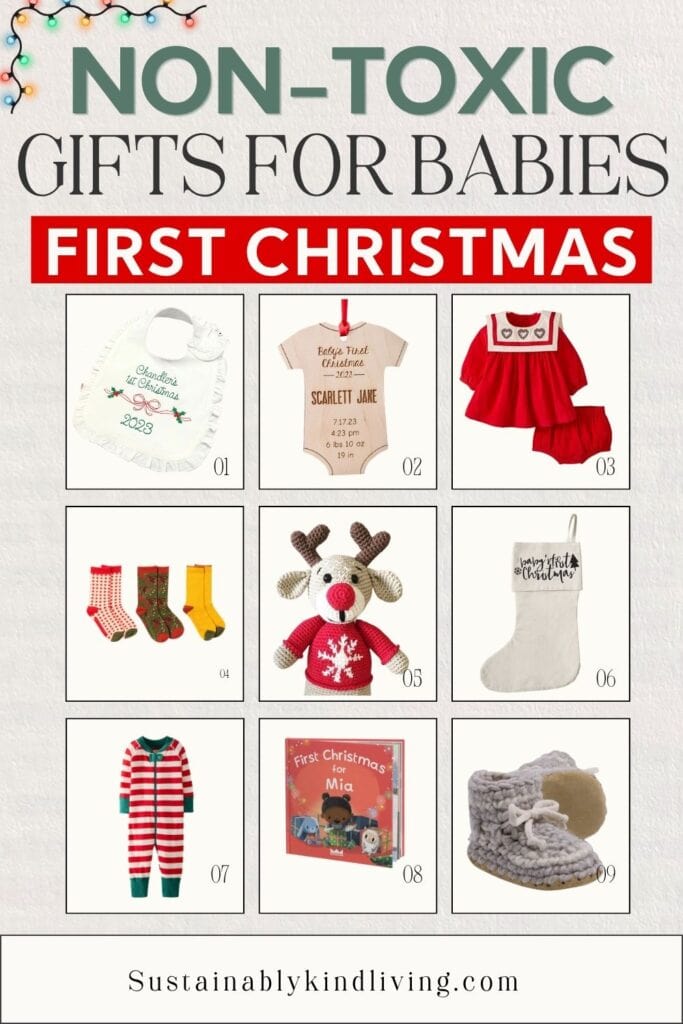
- HappyBabyandBeyond Personalized First Christmas Bib | $13.99 | Best For: Christmas dinner + holiday photos | 100% Cotton | This is exactly the kind of little gift that makes baby’s first Christmas feel special right away. A personalized holiday bib is cute, useful, and photo-ready, and I like that this one is embroidered and made from cotton rather than feeling like a cheap novelty item that gets tossed after one meal.
- Smiling Tree Toys Baby’s First Christmas Onesie Ornament | Price Varies | Best For: A keepsake parents will save forever | Handmade Wood | A first Christmas ornament is one of those gifts that truly lasts. I especially like this one because it feels simple and timeless, and it is the kind of keepsake parents will still be pulling out of the ornament box years from now.
- Hanna Andersson Holiday Baby Outfit | From $50 | Best For: Christmas Day + Holiday Photos | Organic Cotton | This is the kind of outfit that makes baby’s first Christmas feel extra special without being something I would only put on for five minutes for a photo. Hanna Andersson has some of the cutest holiday options for babies, and I love that we can still get that dressed-up Christmas look in soft organic cotton. It is festive enough for Christmas morning, family photos, or visiting grandparents, while still being comfortable enough for an actual baby to wear.
- Our Green House Organic Reindeer Stuffed Animal | Price Varies | Best For: A festive cuddle gift | Organic Cotton + Natural Filling | I wanted one Christmas stuffed animal in this section, but only if it actually had a good materials story. A little organic reindeer is perfect here because it feels holiday-specific, looks adorable in the collage, and still works as a sweet baby gift after Christmas is over.
- Cotton + Canvas Co. Baby’s First Christmas Stocking | $15.99 | Best For: A first stocking to use every year | Personalized Holiday Keepsake | I love the idea of giving baby their actual first Christmas stocking as part of the gift. It makes the holiday feel more complete in the moment, and then it becomes part of the family’s Christmas traditions year after year.
- Hanna Andersson Holiday Baby Pajamas | Price Varies | Best For: Christmas Eve + Christmas morning | Organic Cotton | Christmas pajamas are basically a first-holiday essential. Hanna Andersson is such a strong choice here because the prints are festive and fun, but the quality is also the kind parents genuinely want for sleepwear. This is one of those gifts that feels classic for a reason.
- Little Green Radicals Christmas Socks | Price Varies | Best For: Stockings, outfits, and little festive extras | Organic Cotton | Tiny holiday socks are one of those baby gifts that always look sweet and actually get used. I like adding these because they make the section feel even more Christmas-specific, and they are an easy way to add a festive little detail without buying another throwaway novelty item.
- Wonderbly First Christmas For You Book | From about $35 | Best For: Ages 0 to 3 | Personalized Christmas Story | This is exactly the kind of first-Christmas keepsake I love because it becomes part of the holiday itself. The story is personalized for the child, which makes it feel special now and gives families something they can pull back out and read again every Christmas.
- Softstar / Padraig Cottage Baby Wool Slippers | Price Varies | Best For: A cozy winter gift | Wool + Sheepskin + Suede | These are such a charming little Christmas gift. They feel cozy, wintery, and special in a way that fits the season perfectly, and I love that they give us something different from the outfits and keepsakes. They are the kind of gift that feels beautiful to open and genuinely useful during the colder months.
✔️ Need smaller Christmas ideas? My eco-friendly stocking stuffers guide is packed with affordable little gifts for babies, kids, teens, and adults, including plenty of ideas under $25.
Best Non-Toxic Gifts for Newborns, 0 to 3 Months
Those first few months are such a specific little window. Babies are mostly sleeping, feeding, staring at everything, starting tummy time, and slowly figuring out how their bodies work. For this age, I want gifts that are soft, useful, developmentally appropriate, and made from materials I feel good about having right up against baby.
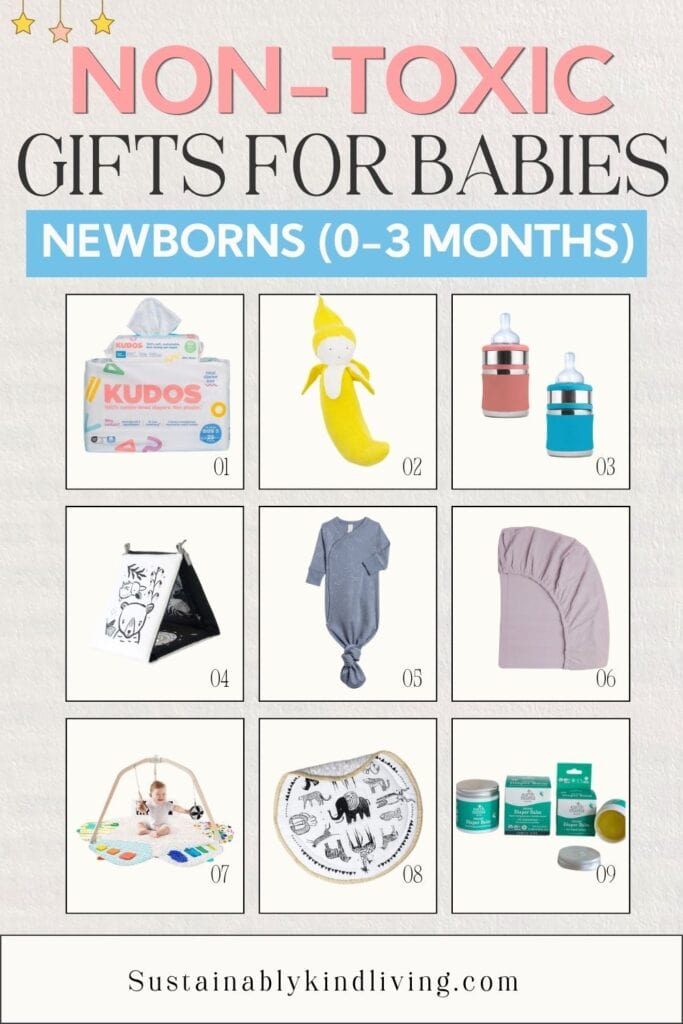
- Kudos Diapers + Wipes | From $24 (Use SKL15 For 15% off) | Best For: Newborn+ | Cotton Topsheet + TCF Wood Pulp | This is one of those gifts I am genuinely excited to recommend because parents will actually use it every single day. By the time I had my daughter, diapers were something I paid much closer attention to, and I love that Kudos uses a 100% cotton topsheet with TCF wood pulp and skips added fragrance, lotions, parabens, phthalates, and natural rubber latex.
- Under the Nile Organic Cotton Baby Buddy | From $14 | Best For: Newborn+ | GOTS Organic Cotton | This is exactly the kind of soft baby toy I wish I had known to look for when my boys were little. Under the Nile uses GOTS-certified organic cotton for both the outside and the stuffing, so you are not getting the polyester fill found inside so many plush toys.
- Pura Kiki 5 oz Infant Bottle | $21.99 | Best For: Newborn+ | Stainless Steel + Silicone | I love this bottle because it avoids the plastic-heavy construction found in so much baby feeding gear. It uses 18/8 stainless steel with a platinum-cured silicone nipple, and the interchangeable tops mean the bottle can keep being used as your baby grows.
- Wee Gallery Tummy Time Gallery | $63.95 | Best For: Newborn to 12 Months | Tummy Time + Visual Development | I absolutely love this for those early weeks when babies are just starting to really look at the world around them. The high-contrast artwork gives them something interesting to focus on during tummy time, and it keeps being useful well beyond the newborn stage.
- Colored Organics Indy Kimono Gown | $35 | Best For: Newborn to 3 Months | 100% Organic Cotton | Newborn gowns are one of those gifts that are actually adorable and useful. This one is made from organic cotton with water-based dyes and nickel-free snaps, and the open-bottom design makes those constant newborn diaper changes so much easier.
- Naturepedic Organic Muslin Crib Sheet | $39 | Best For: Newborn+ | GOTS + MADE SAFE Certified | A crib sheet might not sound exciting until you remember how many hours a newborn spends sleeping on one. I love this as a practical gift because the muslin is soft, breathable, and made from GOTS-certified organic cotton without adding another unnecessary baby gadget to the house.
- Lovevery Play Gym | About $150 | Best For: Newborn+ | Developmental Play | This is definitely one of the splurge gifts in this age group, but it is also one of the most useful. I love that it gives newborns a simple place for tummy time, reaching, looking, and eventually much more active play instead of relying on flashing lights and noisy plastic toys.
- Wee Gallery Organic Cotton Playmat | $144.95 | Best For: Newborn+ | Organic Cotton Play Surface | A good floor mat gets used constantly once you have a baby, and I love that this one is designed around the way newborns actually see and play. The organic cotton surface and high-contrast artwork make it such a beautiful spot for tummy time, rolling, and those first stretches of independent floor play.
- Earth Mama Baby Starter Kit | $35 | Best For: Newborn+ | Baby Bath + Body Essentials | If you want something practical that still feels like a real gift, I love a thoughtfully chosen baby care set. Earth Mama gives parents several everyday bath and body essentials in one place without filling the nursery with a bunch of random products they may never use.
✔️ Shopping for older kids too? I also rounded up my favorite eco-friendly gifts for kids and non-toxic gifts for teens, with the same focus on better materials, useful gifts, and things kids will actually want.
Best Non-Toxic Gifts for Babies 3 to 6 Months
This is such a fun stage because babies suddenly want to grab, shake, mouth, stare at, and inspect absolutely everything. For 3 to 6 months, I look for gifts that support those new skills without overwhelming them, with simple materials, age-appropriate designs, and plenty of opportunities for sensory play.
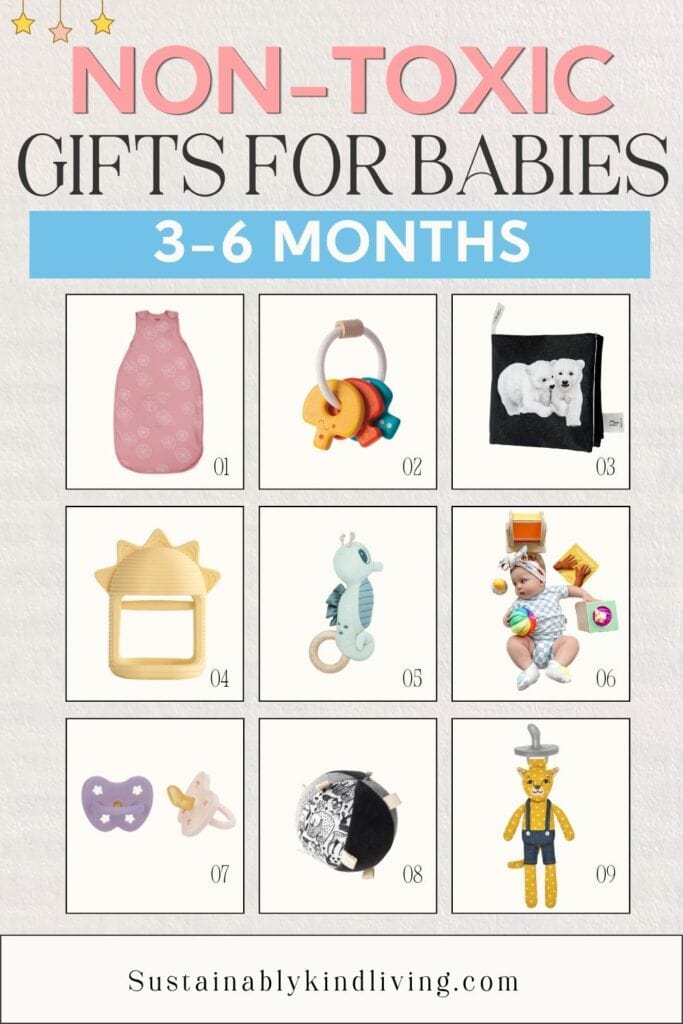
- Woolino Ultimate 4-Season Sleep Bag | $109 | Best For: 2 Months to 2 Years | Merino Wool + Organic Cotton| This is one of those baby gifts I would have been thrilled to receive because it actually gets used for years, not weeks. The inside is merino wool, the outer is organic cotton, and the universal sizing takes it from the baby stage well into toddlerhood, which makes this such a smart alternative to constantly buying different sleep sacks.
- PlanToys Baby Key Rattle | $17.99 | Best For: 0 to 6 Months | Rubberwood + Water-Based Dyes | I love a simple wooden rattle at this age because babies are just figuring out how to grab, shake, and move things from one hand to the other. PlanToys makes this one from rubberwood with formaldehyde-free glue, organic pigments, and water-based dyes, so it gives us both the developmental value I want and a material story I feel good about.
- Crinkle Book Made with ORGANIC Cotton by Tabitha Paige | $22.99 | Best For: Newborn to 6 Months | High-Contrast + Sensory Play | I was so happy to find a high-contrast baby book made with organic cotton instead of PVC fabric. The black-and-white animal illustrations are designed for early visual engagement, while the crinkly tactile pages give babies something to grab, listen to, and explore as their hands get busier.
- Mushie Sun Teether | $12.99 | Best For: 3 Months+ | Food-Grade Silicone | This is such a good little teether for the stage when everything is heading straight toward baby’s mouth. It is made from 100% food-grade silicone, and the ridged sun shape gives sore gums plenty of texture to explore while still being easy for little hands to hold.
- Apple Park Seahorse Teething Rattle | $26 | Best For: 3 Months+ | GOTS Organic Cotton + Natural Rubber Wood | I love that this combines a soft rattle and a teething ring instead of giving parents another single-purpose baby toy. It uses GOTS-certified organic cotton, corn-fiber filling, OEKO-TEX 100 dyes, and a smooth natural rubber wood ring, so babies get sound, texture, and something easy to grasp all in one.
- Lovevery Charmer or Senser Play Kit | $80 per kit | Best For: 3 to 6 Months | Stage-Based Developmental Play | Lovevery is one of my favorite picks when you want the toys to actually match what baby is working on right now. The Charmer is built for 3 to 4 months, while the Senser picks up at 5 to 6 months with the next stage of grasping, reaching, tummy-time strength, and early cause-and-effect play.
- HEVEA Natural Rubber Pacifier | $10.95 | Best For: 3 to 36 Months | 100% Natural Rubber | If you want a pacifier with an incredibly simple material list, this is one I really like. HEVEA makes it from one piece of 100% natural rubber with no plastic parts, and the seamless construction means there are no little joints where water can collect inside.
- Wee Gallery Taggy Ball with Rattle | From $36.95 | Best For: 3 Months+ | Sensory + Motor Play | This is such a good floor-play toy because there is something to explore from every angle. The high-contrast graphics, tags, textures, and internal rattle encourage grabbing, reaching, rolling, and listening, which is exactly the kind of play babies are starting to get really interested in at this stage.
- Apple Park Charlie Cheetah Pacifier Buddy | $18 | Best For: 3 Months+ | GOTS Organic Cotton + Crinkle + Rattle | I love this because it is more than just a pacifier holder. Charlie gives babies a soft little buddy they can grab, crinkle, shake, and cuddle, and Apple Park uses GOTS-certified organic cotton with corn-fiber filling and low-impact dyes, which makes this such a sweet little everyday gift.
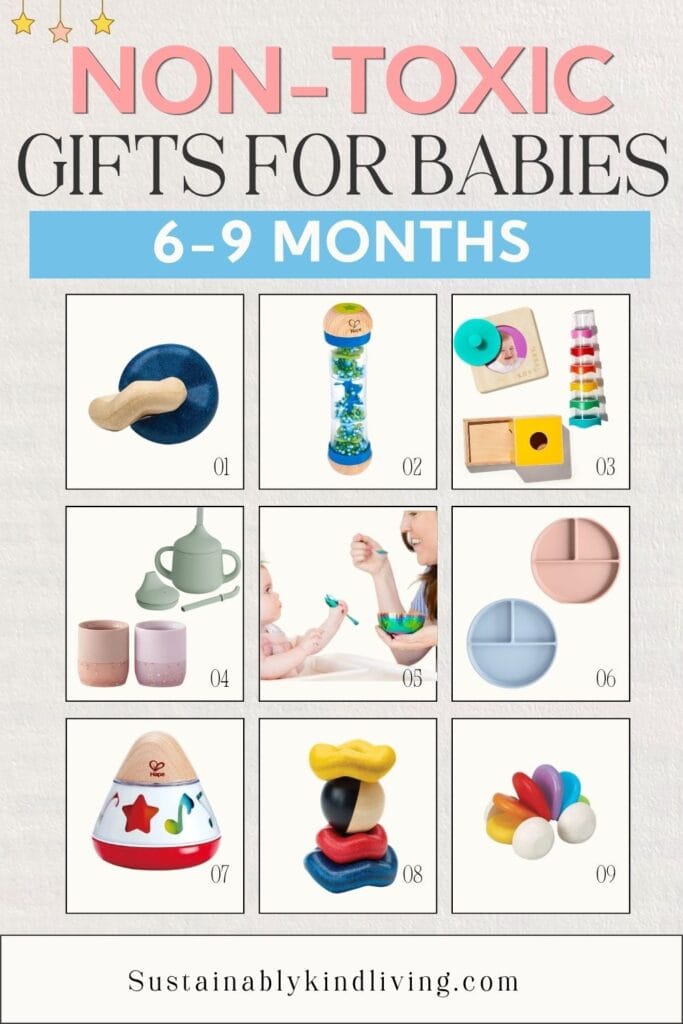
Best Non-Toxic Gifts for Babies 6 to 9 Months
This stage gets so much more interactive. Babies are sitting longer, reaching with purpose, starting solids, banging things together, passing toys between their hands, and getting completely fascinated by cause and effect. For 6 to 9 months, I want gifts that support all of that curiosity while still keeping the materials simple and the toys genuinely useful.
- PlanToys Interlocking Rings | $14.99 | Best For: 6 Months+ | Rubberwood + Fine Motor Play | I love how simple this one is. The connected rings encourage babies to grab, flip, twist, and transfer from one hand to the other, and PlanToys makes them from rubberwood with formaldehyde-free glue, organic pigments, and water-based dyes.
- Hape Beaded Raindrops | About $14 | Best For: 6 Months+ | Visual + Auditory Sensory Play | This is one of those toys that looks simple but keeps babies completely fascinated. They can watch the colorful beads fall, listen to the soft rain sound, and eventually start shaking and rolling it themselves as their coordination gets stronger.
- Lovevery Inspector Play Kit | About $80 | Best For: 7 to 8 Months | Cause-and-Effect + Object Permanence | I love Lovevery at this age because the toys actually line up with what babies are working on developmentally. The Inspector kit focuses on things like object permanence, nesting, texture, dropping, and early problem-solving, which makes it such a fun gift when baby is suddenly curious about how absolutely everything works.
- Moonkie Sippy Cup + First Open Cup | From about $12 | Best For: 6 Months+ | Platinum Silicone + Early Drinking Skills | Starting solids means cups suddenly become part of everyday life, and I love having both options. The sippy cup helps with the transition, while the tiny open cup lets babies start practicing independent drinking with something actually sized for their hands.
- Ahimsa First Bites Bundle | About $65 | Best For: 6 Months+ | Stainless Steel Feeding Set | This is such a beautiful feeding gift because it feels like something parents can use for years instead of a few months. Ahimsa uses stainless steel for its baby bowls, plates, and spoons, which makes this one of my favorite alternatives to plastic-heavy feeding sets.
- Mushie Silicone Suction Plate | $16.99 | Best For: 6 Months+ | Food-Grade Silicone | Once babies start solids, anything that helps keep dinner on the table instead of the floor is a win. I love the simple divided design, and the suction base gives babies room to explore food independently without sending the whole plate flying every five seconds.
- Hape Rotating Music Box | $22.99 | Best For: 6 Months+ | Music + Hand-Eye Coordination | This is such a sweet alternative to a battery-powered musical toy. It spins while playing a gentle melody, giving babies something to watch, reach for, and eventually figure out for themselves without lights flashing in every direction.
- PlanToys Ball & Wave Stacker | About $15 | Best For: 6 Months+ | Early Stacking + Coordination | I wanted one true stacking toy in this stage because babies are getting so much more interested in how objects fit, move, and relate to one another. This gives little hands an early way to practice grasping, coordination, and simple problem-solving without overcomplicating the play.
- Lalo Baby Car | $21.99 | Best For: 6 Months+ | Rubberwood + Water-Based Dyes | I love a first wooden car at this age because it feels like the beginning of real open-ended play. It is small enough for little hands to grab and push, and the simple rolling movement helps babies start connecting their own actions with what the toy does next.
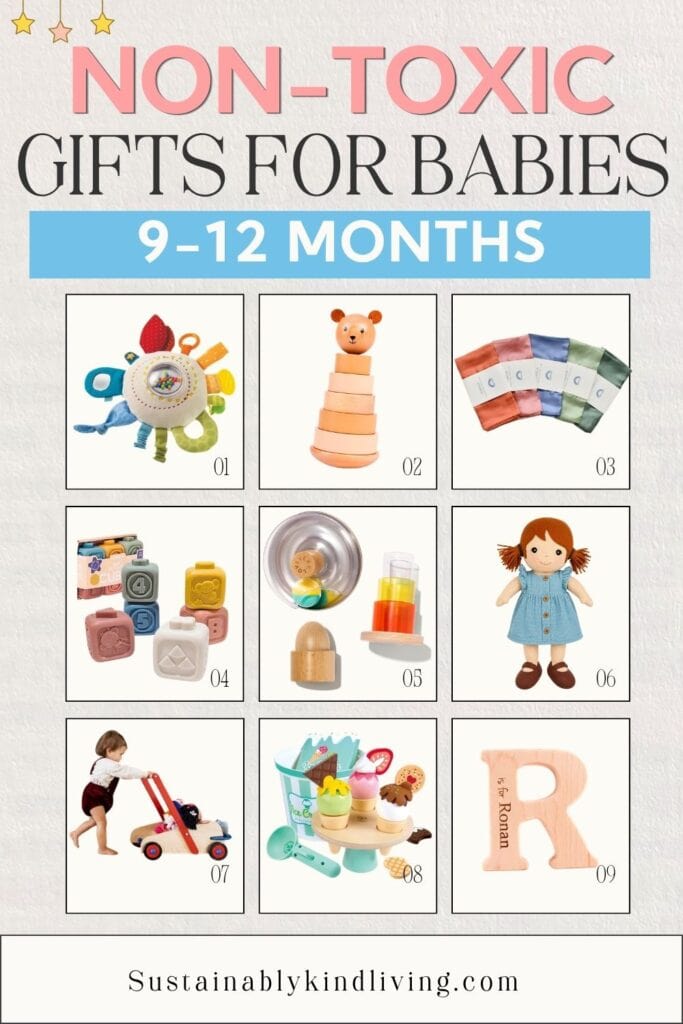
Best Non-Toxic Gifts for Babies 9 to 12 Months
This stage is so much fun because babies suddenly feel incredibly busy. They are crawling, pulling up, banging, dropping, stacking, opening, closing, and trying to figure out what happens when they do something over and over again. For 9 to 12 months, I want gifts that give them room to experiment, move, and problem-solve while still keeping the materials thoughtful and baby-appropriate.
- HABA Cuddly Rainbow Teether | $19.99 | Best For: 6 to 24 Months | Sensory + Teething Play | I love this one because there is so much for little hands to explore without it feeling overwhelming. It combines different textures, crinkle and rattle sounds, a mirror, and teething elements, which makes it such a fun sensory toy for babies who are getting busier by the day.
- Magnetic Wooden Bear Stacking Rings | Price Varies | Best For: 9 Months+ | Wood + Water-Based Finish | This is such a cute first stacking toy, and I love that the magnetic rings make early stacking a little less frustrating for babies who are just learning how pieces fit together. It is made from wood with non-toxic water-based finishes and helps build hand-eye coordination, fine motor skills, and early problem-solving.
- Sarah’s Silks Mini Playsilks | $12 | Best For: Babies + Toddlers | 100% Mulberry Silk | I absolutely love adding an open-ended toy here because babies do not need everything to have one specific purpose. These lightweight silk squares are wonderful for peek-a-boo, pulling, grabbing, hiding toys, and sensory play now, and they can turn into years of imaginative play later. Sarah’s Silks uses 100% pure mulberry silk with non-toxic, eco-friendly dyes and says the Playsilks are safety tested for children of all ages.
- Miniland Sensory Activity Rubber Cubes | Price Varies | Best For: 6 Months+ | Sensory + Stacking Play | These are such a fun change from a traditional block set. Each soft cube gives baby different textures, shapes, and sensory details to explore while they squeeze, stack, knock them over, and start experimenting with how objects fit together. Miniland recommends them from 6 months onward, so they fit this stage beautifully.
- Lovevery Explorer or Thinker Play Kit | $80 per Kit | Best For: 9 to 12 Months | Stage-Based Developmental Play | Lovevery really shines at this age because babies are suddenly working on so many specific skills at once. The Explorer is designed for 9 to 10 months and focuses on things like containment, bilateral coordination, pincer grasp, stacking, and cause and effect, while the Thinker continues that progression for 11 to 12 months.
- Apple Park First Baby Doll | $30 (Use 10SKL For 10% Off) | Best For: Baby’s First Doll | GOTS Organic Cotton + Corn Fiber Fill | This is such a sweet first doll because it is soft enough for a baby to cuddle but still gives them little sensory surprises to discover. It is made from 100% GOTS-certified organic cotton with corn-fiber filling and low-impact dyes, and it has both a gentle rattle and squeaker built in.
- HABA Walker Wagon | From $104+ | Best For: 10 Months+ | First Steps + Gross Motor Play | This is one of those bigger gifts that can become a real favorite right as baby starts pulling up and thinking seriously about walking. HABA makes it from beech and plywood with a non-toxic water-based stain, and I especially like the adjustable wheel resistance so parents can slow it down while those first steps are still wobbly.
- Hape Ice Cream Activity Cube | $24.99 | Best For: 9 Months+ | Fine Motor + Sensory Play | This one is just plain fun. Babies can grab, shake, drop the little ice creams into the openings, explore different textures, peek in the mirror, and discover all the little cause-and-effect surprises built into the cube. It gives them plenty to do with their hands without relying on flashing lights or electronics.
- Smiling Tree Toys Personalized Letter Wood Teether | From $15 | Best For: Baby Keepsake + Teething | Sustainable Hardwood + Organic Finish | I love ending this section with something personal. Smiling Tree handcrafts these wooden letters in Minnesota using sustainable hardwoods and its organic oil and beeswax finish, so baby can actually use it as a teether now and parents still get a little personalized keepsake to hold onto later.
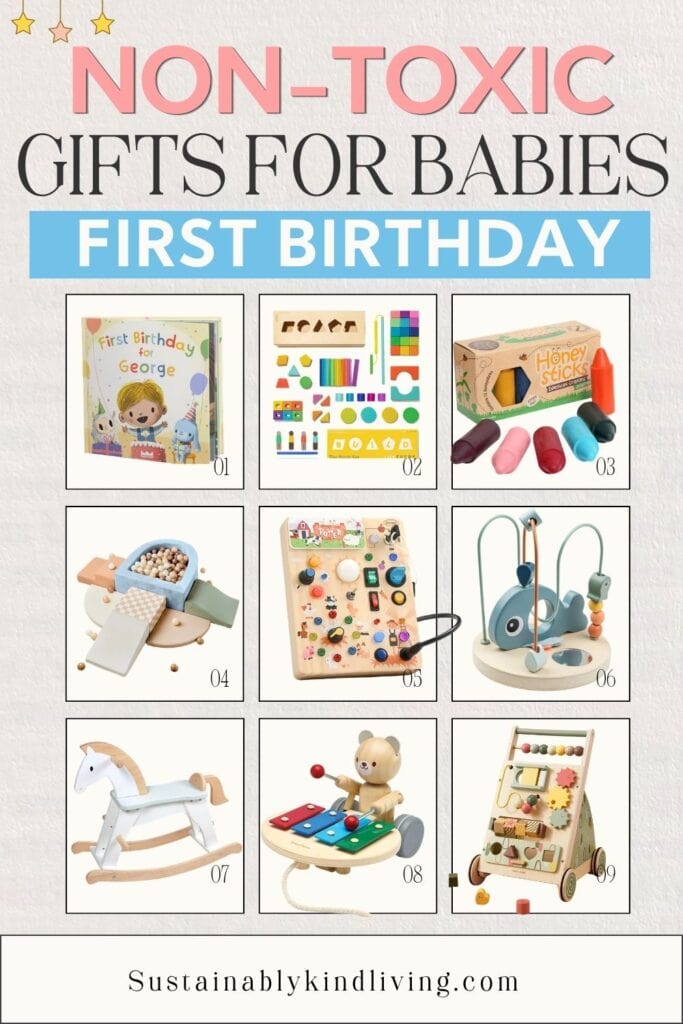
Best Non-Toxic First Birthday Gifts
A first birthday feels different. By one, babies are doing so much more with their hands and bodies, and the best gifts can finally lean into building, art, puzzles, movement, music, and early problem-solving. I still care just as much about materials, but I also want these gifts to feel exciting enough for a first birthday and useful well beyond the party.
- Wonderbly First Birthday For You Book | From $34.99 | Best For: First Birthday Keepsake | Personalized Story | I love a personalized book for a first birthday because it feels special without becoming another toy that gets forgotten in a few months. This one is made specifically around baby’s first year, can be personalized with their name and character, and becomes such a sweet little keepsake to read again later.
- Lovevery Block Set | $95 | Best For: 12 Months+ | Solid Wood + Open-Ended Play | This is exactly the kind of first birthday gift I love because it starts simple and keeps getting better as they grow. At one, babies can stack, roll, sort, and knock everything down, while the 70-piece solid wood set eventually turns into years of building and imaginative play.
- Honeysticks Originals Beeswax Crayons | $24.95 | Best For: Ages 1 to 3 | 100% Beeswax + Food-Grade Pigments | I get so excited about first art supplies because one is such a fun age to start letting kids make their own little marks. These chunky crayons are made specifically for small hands from pure beeswax and food-grade pigments, with no paraffin wax or cheap fillers, so they are such a good first set of crayons.
- Tiny Land PlayNest Climbing & Ball Pit Set | $199.99 | Best For: Crawlers + Early Walkers | Gross Motor + Sensory Play | This is such a fun first-birthday splurge because one is right around the age when babies want to crawl over everything, pull themselves up, and test what their bodies can do. The soft ramps, steps, climbing blocks, and ball pit give them somewhere safe to practice all of that now, then become even more fun as they get steadier on their feet.
- Joyreal Montessori Busy Board | $39 | Best For: 12 Months+ | Fine Motor + Practical-Life Play | A good busy board is basically made for this stage. One-year-olds want to press, flip, turn, pull, open, and repeat the same action twenty times, and Joyreal specifically designs its simpler boards around those early fine-motor skills rather than just piling on random activities.
- Done by Deer Wally Bead Maze | $48 | Best For: 12 Months+ | Responsibly Sourced Wood + Water-Based Paint | I love a bead maze for a first birthday because it gives busy little hands something to really concentrate on. Babies can move the fish and beads along the wire, explore the mirror, and practice pincer grip and hand-eye coordination, while the wooden pieces are made from responsibly sourced wood with water-based paint.
- Tender Leaf Lucky Rocking Horse | $139.99 | Best For: 12 Months+ | First Rocking Toy + Gross Motor Play | This is such a classic first birthday gift, and honestly, it is one of those bigger presents that actually feels worthy of the occasion. Tender Leaf rates it from 12 months, and I love that it gives newly mobile toddlers a playful way to work on balance and body awareness while still looking beautiful enough to keep out in the playroom.
- PlanToys Pull-Along Musical Bear | $69.99 | Best For: 12 Months+ | Music + Walking + Cause and Effect | This one is just ridiculously fun. As baby pulls the bear along, it taps the xylophone, and changing the direction of the pull changes the notes, so they are getting music, movement, cause and effect, and early walking practice all in one toy.
- Tiny Land Sage Green Wooden Baby Walker | $89.99 | Best For: Around 12 Months+ | Walking + Gross Motor Play | This is exactly the kind of first birthday gift I love because it meets babies right where they are. Around one, so many kids are pulling up, cruising along furniture, and starting to experiment with those first independent steps, and a sturdy wooden walker gives them something fun to push and grow into as their confidence builds. It feels substantial enough for a first birthday while still being genuinely useful during such a big developmental stage.
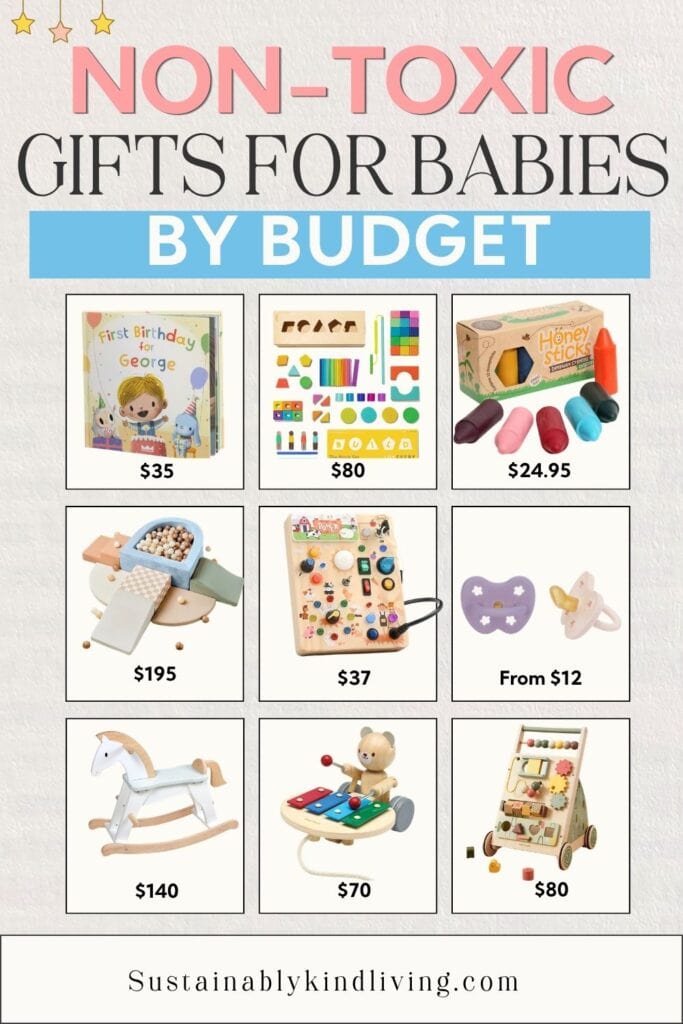
Non-Toxic Baby Gifts by Budget
If you already know how much you want to spend, this is the easiest way to narrow down the list. I pulled my favorite non-toxic baby gifts from every age group into quick budget categories, from little gifts under $25 to bigger first-birthday splurges.
Non-Toxic Baby Gifts Under $25
- Hape First Shapes Puzzle | $9.90
- HEVEA Natural Rubber Pacifier | about $12
- Mushie Sun Teether | $12.99
- PlanToys Interlocking Rings | $14.99
- PlanToys Ball & Wave Stacker | about $15
- Smiling Tree Toys Personalized Letter Wood Teether | from $15
- PlanToys Hexagon Baby Rattle | $20
- Apple Park Charlie Cheetah Pacifier Buddy | $18
- Sarah’s Silks Mini Playsilk | about $20
- Pura Kiki 5 oz Infant Bottle | $21.99
- Lalo Baby Car | $21.99
- Hape Rotating Music Box | $22.99
- Crinkle Book Made with Organic Cotton | $22.99
- Honeysticks Originals Beeswax Crayons | $24.95
- Hape Ice Cream Activity Cube | $24.99
Non-Toxic Baby Gifts From $25 to $50
- Apple Park Seahorse Teething Rattle | $26
- Finn + Emma Humphrey the Hippo Knit Buddy | $28
- Apple Park First Baby Doll | about $30
- Colored Organics Indy Kimono Gown | about $35
- Earth Mama Baby Starter Kit | about $40
- Done by Deer Wally Bead Maze | about $40
- Wonderbly First Birthday For You Book | from about $35
Non-Toxic Baby Gifts From $50 to $100
- Wee Gallery Tummy Time Gallery | about $64
- PlanToys Pull-Along Musical Bear | about $70
- Ahimsa First Bites Bundle | about $80
- Lovevery Play Kits | about $80
- Lovevery Block Set | $95
Non-Toxic Baby Gifts From $100 to $200
- Woolino Ultimate 4-Season Sleep Bag | about $109
- Tiny Land Sage Green Wooden Baby Walker | $89.99
- Tender Leaf Lucky Rocking Horse | about $140
- Wee Gallery Organic Cotton Playmat | about $145
- Lovevery Play Gym | about $150
- Tiny Land PlayNest Climbing & Ball Pit Set | $199.99
How I Choose These Non-Toxic Baby Gifts
When I was buying for my boys nine years ago, I didn’t know to ask half the questions I ask now.
Is this plush toy stuffed with polyester? What’s coating the wood? Is the silicone food-grade? Does “organic cotton” mean the whole product, or just the outer layer? Is that certification for the product, the fabric, or the company?
By the time my daughter arrived, I’d spent years researching safer materials through Sustainably Kind Living, and I made very different choices. Now she’s 2.5 and my boys are 9. That’s long enough to see which baby products were genuinely useful, which ones lasted, and which “must-haves” barely got touched.
That’s the lens for this whole guide.
The short version. Before anything makes this list, I check:
- What it’s made of, including what touches the baby directly
- What paints, dyes, glues, coatings, or finishes are used
- Whether a certification covers the actual product
- Whether the brand shares real testing or compliance information
- Whether it’s right for the age I’m recommending it for
- Whether a family will actually use it
Here’s how I think through each one.
1. “Non-Toxic” Is Not a Seal of Approval
I use the phrase “non-toxic baby gifts” because it’s what parents search for. But it isn’t a regulated label. The FTC says any brand calling a product non-toxic needs reliable scientific evidence that it’s safe for both people and the environment, and it warns against vague claims like “green” and “eco-friendly.”
So I ignore the front of the box. A green leaf on the packaging doesn’t tell me what the product is made of.
2. Babies Put Everything in Their Mouths
A baby toy doesn’t sit on the floor. It gets sucked, chewed, licked, dropped, picked back up, and chewed again.
Federal toy rules actually account for this. Under the mandatory U.S. toy safety standard, ASTM F963, coatings and accessible materials on toys that can be sucked, mouthed, or ingested have to meet limits for eight heavy elements. And toys for children under 3 can’t contain small parts that pose a choking hazard.
That’s why I look so closely at the surface of every teether, rattle, clutching toy, and feeding piece.
3. The Materials I Reach For
There’s no perfect baby material, but these are my go-tos:
- Solid wood, when the brand names the wood and discloses the glue, paint, stain, or oil finish
- Natural rubber, especially for teethers and simple sensory toys
- Organic cotton, for loveys, dolls, soft rattles, clothing, blankets, and anything a baby will cuddle or chew
- Stainless steel, for bottles, cups, and utensils that stay useful long after the baby years
- Glass, for feeding, when the design makes sense for the age
- Silicone, for teethers, plates, and feeding tools, when the brand identifies the material and shares testing
“Natural” on its own doesn’t earn a spot. I still want disclosure.
4. Wooden Doesn’t Mean Non-Toxic
“Wooden toy” sounds reassuring, but it tells you very little. Is it solid wood, plywood, or MDF? What glue holds it together? What paint, stain, or sealant is on it?
FSC certification helps on the sourcing side. The three FSC labels mean different things: FSC 100% is virgin material from certified forests, FSC Mix blends certified, recycled, and controlled sources, and FSC Recycled is 100% recycled fiber. But none of them tell me whether the paint or glue on the finished toy meets my standards. That’s a separate question.
On paint, federal law caps lead at 90 ppm in paint and surface coatings on children’s products, and 100 ppm in accessible components. That’s the legal floor. Between two similar toys, I’ll choose the brand that gets specific: water-based dyes or stains, organic pigments, plant-based oils, beeswax finishes, or testing to ASTM F963 or EN71. “Non-toxic paint” with no details doesn’t count.
5. Soft Plastics Get Extra Scrutiny
Phthalates are chemicals used to make plastic softer and more flexible. U.S. law restricts eight phthalates above 0.1% in children’s toys and child care articles, which covers products that help babies 3 and under with sleeping, feeding, sucking, or teething.
That doesn’t make every plastic baby product unsafe. It does mean I want clear material disclosure for soft plastics, bath toys, feeding gear, and teethers. And when there’s a well-made stainless steel, glass, natural rubber, organic cotton, or clearly identified silicone option, I usually choose it.
6. Organic Cotton Matters More for Babies
Babies spend most of their day against fabric. Sleep sacks, pajamas, crib sheets, blankets, loveys, bibs, and dolls touch their skin and end up in their mouths.
When I see GOTS, I pay attention. The GOTS “Organic” label grade requires at least 95% certified organic fiber, and the standard covers how the fabric is processed, not just how the cotton was grown. That means far more than a product title that just says “organic baby blanket.”
I always check the inside, too. A plush toy can have an organic cotton shell and a polyester filling. That doesn’t make it a bad toy. But you should know the difference before you buy it.
7. Certifications Answer Different Questions
I never lump certifications together:
| What you’ll see | What it tells you |
|---|---|
| GOTS | Organic fiber content and how the textile was processed |
| FSC | Responsible sourcing of wood and paper |
| ASTM F963 | The mandatory U.S. toy safety standard. Toys for kids 12 and under must be third-party tested and certified. |
| CPSIA | Broader U.S. children’s product rules, including lead, phthalates, testing, and certification |
One important point: legal compliance is the baseline. A toy can fully meet ASTM F963 and still use materials I wouldn’t choose over a better option.
8. The Toy Has to Fit the Baby
A beautiful wooden toy isn’t a good gift if the baby can’t safely or meaningfully use it yet. The American Academy of Pediatrics says the best toys match a child’s current skills and encourage new ones.
That’s why this guide is organized by age. Here’s roughly what I’ve seen with my own three:
- Newborn: They need very little. High contrast, tummy time, soft textures, and simple sensory play go a long way.
- 3 to 6 months: Grasping, reaching, mouthing, tracking, and early cause and effect.
- 6 to 9 months: Sitting, passing objects hand to hand, starting solids, banging, stacking, and discovering that hidden things still exist.
- 9 to 12 months: Crawling, pulling up, cruising, dropping, placing, pushing, and solving tiny problems over and over.
- First birthday and up: Art supplies, first puzzles, building toys, music, ride-ons, and big-body play.
9. Let the Baby Do the Work
The AAP warns parents not to assume flashy electronic toys are more educational, and says the best toys encourage play between the child and a caregiver.
That matches what I’ve seen at home. The toys that lasted were never the ones doing twenty things at once. They were blocks, balls, dolls, little cars, stacking toys, books, and climbing pieces. Things my kids had to move and figure out themselves.
When two products both meet my material standards, I pick the one that gives the child more of the play.
10. Feeding Gifts Need Their Own Standard
Once solids start, the gifts change: cups, plates, spoons, bowls, bottles. This is where I lean hardest on stainless steel and glass, with silicone where flexibility or suction makes the product genuinely better.
I look at the whole product, not one marketing claim. A stainless steel bottle with a plastic lid is different from one designed to minimize plastic throughout. And “BPA-free” alone doesn’t tell me what a plastic actually is. I want every component named.
11. I’m More Conservative With Baby Skincare
For baby bath and body products, I want a full ingredient list and a clear reason for every ingredient. I’m especially cautious about unnecessary fragrance and long, complicated formulas. And I don’t assume an essential oil is gentler just because it came from a plant.
One well-formulated wash or balm from a brand I trust beats a giant basket of scented baby products every time.
12. I Follow Age Labels and Check Recalls
Some beautiful products got cut from this guide because the manufacturer’s age rating didn’t match the section I wanted them in. I won’t tell you to ignore an age label because a toy “looks fine.” I’d rather move it to the next age bracket.
That’s also why some gifts here are described as something a baby can grow into. And before you buy, it’s worth a quick search of the CPSC recall database.
13. Sustainable Means It Gets Used
This might be my biggest lesson after three kids. The most sustainable baby gift isn’t automatically the wooden one, the organic one, or the one in brown cardboard. It’s the one the family actually uses.
A sleep sack that lasts from infancy into toddlerhood. A stainless steel bottle that converts to a straw bottle. Blocks a child plays with for five years. Even diapers, if diapers are what a new parent desperately needs.
That’s why this guide runs from a $13 teether to a $200 play set. They don’t need to look alike to meet the same standard.
The Question I Come Back To
For every product in this guide, I ask: would I buy this for my own baby today, knowing what I know now?
Nine years ago, my answer would have been very different. That’s the whole reason I made this guide.
Non-Toxic Baby Gifts FAQs
The best non-toxic baby gifts are the ones that combine safer materials, age-appropriate design, and actual usefulness. I look for things like organic cotton loveys and clothing, natural rubber teethers, stainless steel feeding gear, thoughtfully finished wooden toys, and developmental toys that match what the baby is actually learning to do.
If I am buying for someone else, I also think about whether the gift will genuinely get used. Sometimes the best gift is a beautiful wooden toy. Sometimes it is a sleep sack, a bottle, or a box of diapers.
My favorite materials for baby toys are solid wood, natural rubber, organic cotton, stainless steel, glass, and carefully selected silicone.
The material alone is not enough, though. With wooden toys, I also want to know what paints, glues, stains, and finishes were used. With soft toys, I check both the outer fabric and the stuffing. With silicone, I look for clear material disclosure and appropriate testing.
No. A toy being made from wood does not automatically make it non-toxic. Wooden toys can still contain plywood, MDF, adhesives, paints, stains, or surface coatings that I want more information about. I prefer brands that clearly disclose the wood type and the finishes they use, especially for toys babies are likely to chew or mouth.
Silicone can be a very useful material for baby products, especially for teethers, cups, plates, and feeding tools. I look for brands that clearly identify the material they use and provide meaningful testing or safety information.
I do not automatically assume that every product labeled “silicone” is equally well made, which is why brand transparency matters.
For products that spend a lot of time against a baby’s skin or in their mouth, I think organic cotton can be especially worthwhile.
I use it often for pajamas, sleep sacks, crib sheets, dolls, loveys, rattles, and blankets. When possible, I look for GOTS certification, because it gives me more information than a product simply being marketed as “organic cotton.”
It depends on the product. For textiles, I often look for GOTS and sometimes OEKO-TEX. For wood sourcing, FSC can be useful. For U.S. toys, I want products that meet applicable CPSIA and ASTM F963 requirements. Certifications like MADE SAFE and GREENGUARD Gold can also be helpful for certain product categories.
The important thing is to understand what each certification actually covers. One certification does not automatically tell you everything about the entire product.
For newborns, I usually keep it simple. Some of my favorite newborn gifts are organic cotton clothing, a soft lovey, a high-contrast tummy-time toy, a stainless steel bottle, an organic crib sheet, a play gym, or practical essentials like diapers and baby care products.
Newborns do not need complicated toys. Soft textures, high contrast, tummy time, sleep, feeding, and comfort are really the priorities at this stage.
Around 6 months, babies are usually becoming much more interested in grabbing, mouthing, banging, transferring objects, sitting, and starting solids.
I love simple rattles, stacking toys, natural rubber teethers, silicone or stainless steel feeding gear, activity toys, and developmentally appropriate play kits for this age.
A first birthday is where the gift options get really fun. I like first puzzles, blocks, beginner art supplies, push toys, musical toys, climbing or gross-motor play sets, bead mazes, and personalized keepsakes.
I especially love gifts that are useful at one but still have room to grow with the child over the next year or two.
I am cautious with baby toys that have poor material disclosure, soft PVC, unnecessary fragrance, mystery coatings, cheaply painted surfaces, or lots of tiny detachable parts.
I also pay close attention to the manufacturer’s age rating. A beautifully made toy is still not the right gift if it is designed for an older child.
No. “BPA-free” only tells you that the product does not contain BPA. It does not tell you what the rest of the product is made from or whether other materials may be a concern.
That is one reason I prefer brands that disclose the actual material composition rather than relying on a single “free from” claim.
Some of my favorite affordable baby gifts include natural rubber teethers, simple wooden rattles, organic cotton accessories, first puzzles, mini playsilks, baby cups, small stacking toys, and beeswax crayons for older babies approaching toddlerhood. You absolutely do not need to spend a lot to find a thoughtful baby gift.
Probably fewer than most gift guides make it seem. Babies tend to get a lot of mileage out of simple toys that support one or two developmental skills at a time. A good rattle, ball, stacking toy, soft book, play gym, or set of blocks can stay interesting much longer than a toy that does everything for them.
I would rather have a smaller number of well-chosen toys that get used constantly than a huge toy bin full of things that barely get touched.
Start with the manufacturer’s age recommendation. Then think about what the baby is developmentally ready to do. Newborn gifts should support things like visual tracking, tummy time, feeding, and comfort. Older babies may be ready for sitting toys, stacking, object permanence, early puzzles, push toys, and gross-motor play.
I never recommend ignoring an age rating just because a product looks simple.
I do not think sustainability comes down to one material. A sustainable baby gift is often one that is well made, useful, durable, repairable, washable, able to grow with the child, or easy to pass along to another family.
Something that gets used for two years can be a much better choice than an “eco-friendly” product that sits untouched in a closet.
Related Non-Toxic Baby Guides
If you’re trying to make more thoughtful choices beyond gifts, these are the baby guides I’d read next:
- Non-Toxic Swaps for Babies: A really helpful place to start if you are feeling overwhelmed and want to know which baby products are actually worth swapping first, instead of trying to replace everything at once.
- Best Non-Toxic Diapers: My favorite safer diaper options, plus what I look for in materials, absorbency, fragrance, and ingredient disclosure.
- Best Non-Toxic Baby Wipes: A deeper look at wipe ingredients, fabric materials, and the brands I’d actually feel good about using on sensitive baby skin.
- The Safest Non-Toxic Baby Bottles: A practical breakdown of glass, stainless steel, silicone, and other bottle options, including what matters most once bottles are being used every single day.
- Non-Toxic Nursery Essentials: Everything I prioritize when creating a lower-toxin nursery, from sleep surfaces and furniture to textiles and everyday baby gear.
Final Thoughts on Non-Toxic Baby Gifts
The biggest thing I have learned after three kids is that baby gifts do not need to be complicated to be really good.
A baby does not care whether something came in beautiful packaging or whether it was labeled the “must-have” toy of the year. They care that they can grab it, chew it, crawl over it, cuddle it, shake it, stack it, or somehow make it part of their little world.
That is why I keep coming back to the same standard: thoughtful materials, the right developmental fit, and a reason for the gift to actually be used.
Sometimes that means a beautiful wooden toy. Sometimes it means organic pajamas. Sometimes it means a really good feeding set, a sleep sack, or a box of diapers.
The best baby gifts are not always the fanciest ones. They are the ones that quietly become part of everyday life, get used over and over, and make things a little easier or a little more fun for both baby and parents.
And those are the gifts I would choose every single time.
📌 Save This Guide For Later
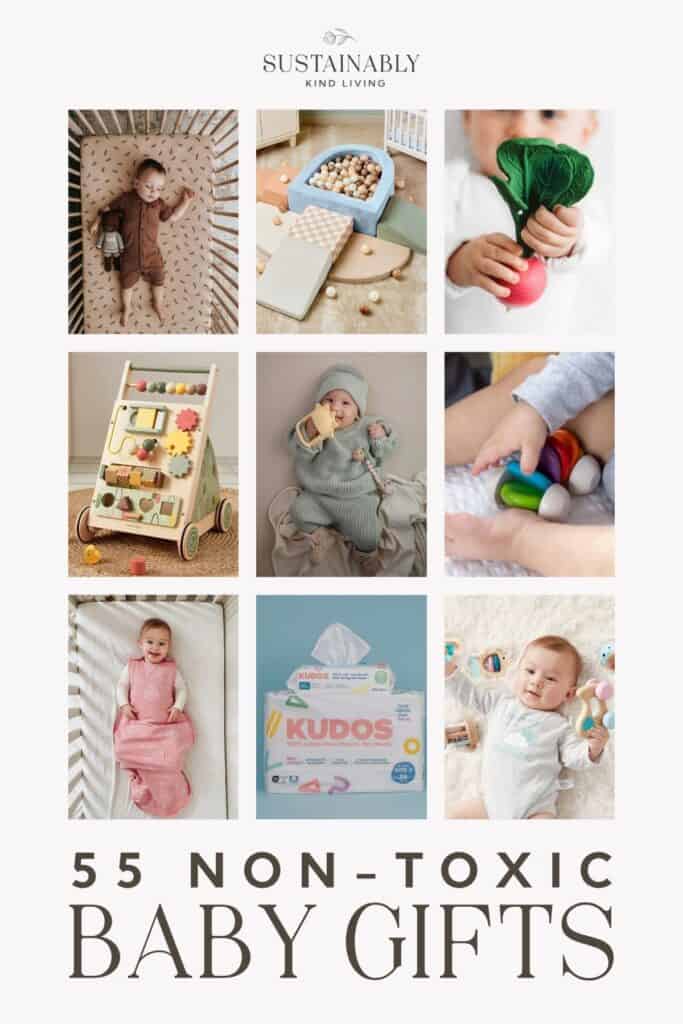
Saving this post to your Non-Toxic Baby or Baby Gift Ideas Pinterest board means you’ll always have these safer baby gift ideas for newborns through 12 months just a click away.
Sources
- American Academy of Pediatrics. The Best Toys Go Back to Basics. December 3, 2018.
- American Academy of Pediatrics, HealthyChildren.org. Toy Buying Tips for Babies & Young Children: AAP Report Explained.
- Federal Trade Commission. Environmental Claims: Summary of the Green Guides.
- Forest Stewardship Council US. What Do the FSC Labels Mean?
- Global Organic Textile Standard. Label Grades.
- U.S. Consumer Product Safety Commission. Toy Safety Business Guidance.
- U.S. Consumer Product Safety Commission. Small Parts FAQ.
- U.S. Consumer Product Safety Commission. Lead in Paint FAQ.
- U.S. Consumer Product Safety Commission. Total Lead Content FAQ.
- U.S. Consumer Product Safety Commission. Phthalates Business Guidance.
- U.S. Consumer Product Safety Commission. Recalls.

Steal My Non-Toxic Cleaning Checklist!
Believe us, it’s the BEST…. and it’s free. Does it really get any better than that?! Sign up for our newsletter and get this free checklist to clean your home without any harmful chemicals!